A Quick Overview of AI Agent Types and Projects Worth Watching
TechFlow Selected TechFlow Selected
A Quick Overview of AI Agent Types and Projects Worth Watching
The demand for creating AI agents is growing, as these intelligent assistants are designed to simplify the use of crypto applications.
 Navigating Web3 tides with focused insights
Author: Biconomy
Compiled by: TechFlow
When we hear about the convergence of AI and crypto markets, the main projects gaining attention are those addressing data collection, GPU computing, or data inference issues within the AI space. These protocols include Akash Network, Ritual net, and others. By leveraging the advantages offered by web3—such as decentralization, incentivization, censorship resistance, and privacy—they stand out in the broader AI industry.
While these projects create compelling applications, their impact on ordinary web3 users remains limited and has not effectively brought new users into the web3 ecosystem.
The Rise of AI Agents
With the rapid development of Web3, new crypto protocols, tokens, and applications emerge constantly. Even the most experienced users find it challenging to navigate this complexity. As a result, the need for AI agents is growing—intelligent assistants designed to simplify the use of crypto applications. AI agents sit at the intersection of cryptocurrency and artificial intelligence, aiming to solve complex user experience problems in crypto. Imagine a future where you simply tell an AI agent what task you want to accomplish on-chain, and it automatically writes and executes the necessary transactions for you.
AI agents will help us build an intelligent layer atop existing DeFi infrastructure—a layer that would serve in web3 what bankers, investors, traders, and fund managers do in traditional finance. They will leverage underlying technologies to conduct on-chain transactions.
The integration of DeFi and AI promises advanced applications such as AI-driven lending, smart liquidity mining strategies, automated market making, and AI-assisted portfolio management. The applications of AI agents extend beyond this; they can also be used in gaming, giving users assistants or pets to enhance their gameplay experience.
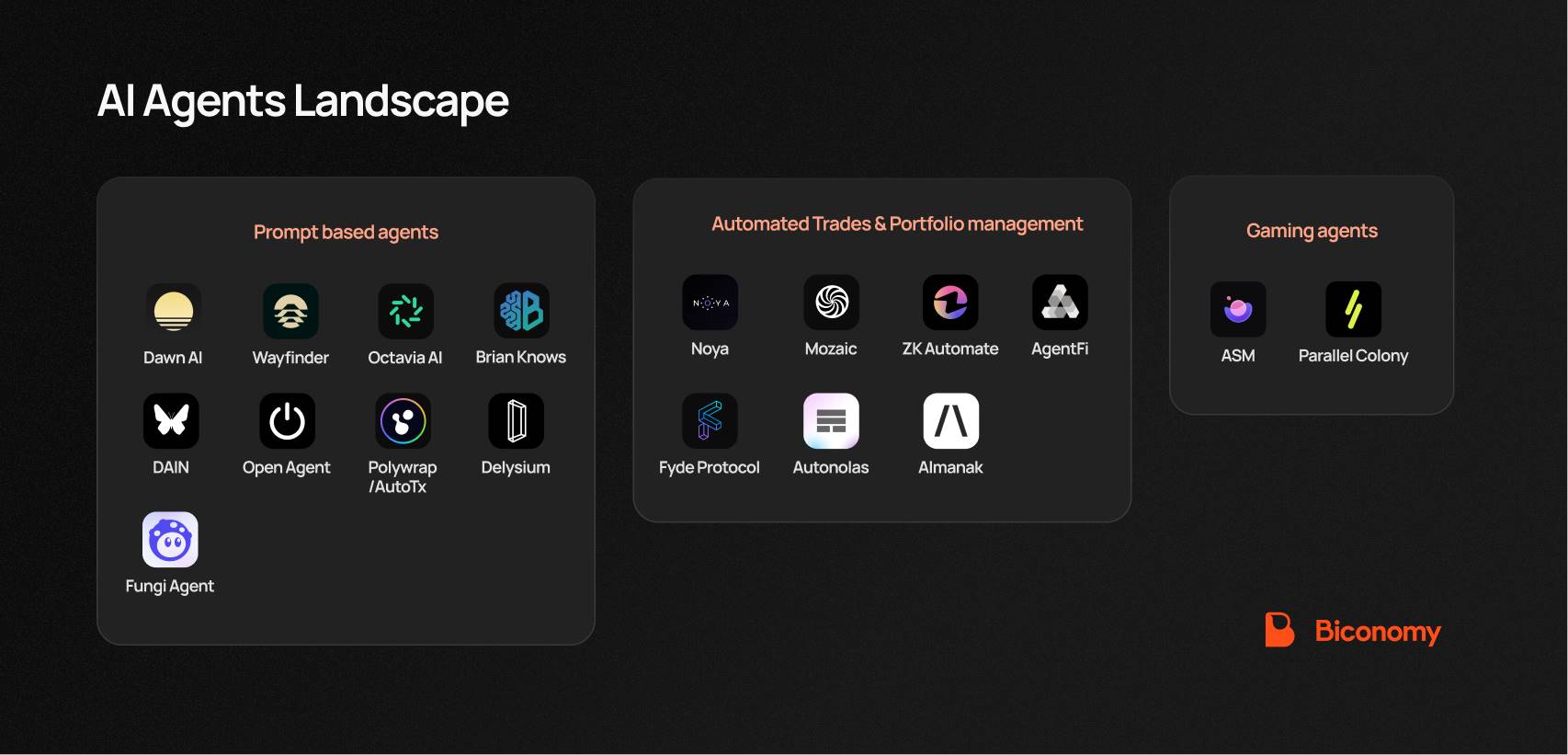
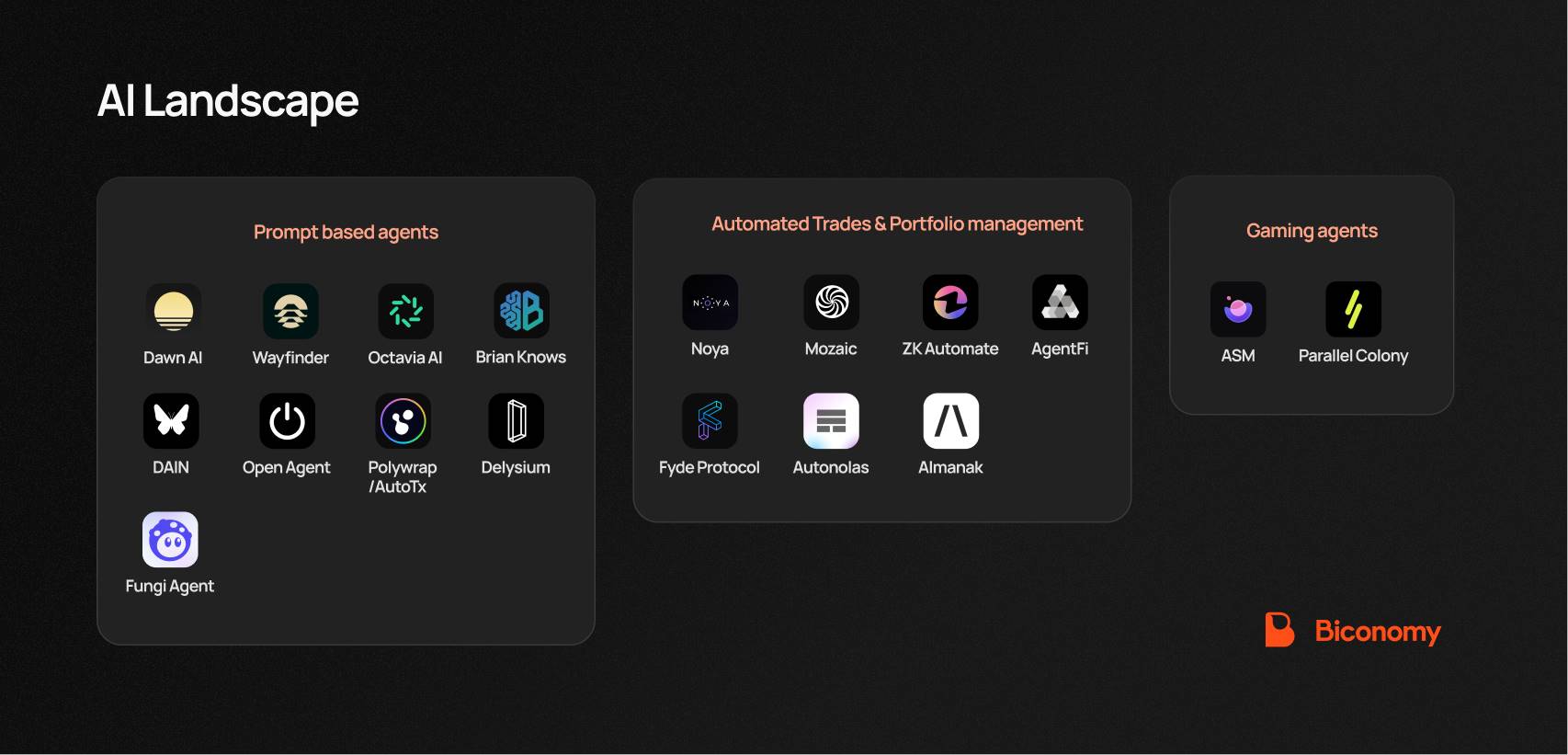
Based on the types of use cases and value propositions offered by different protocols, the evolving field of AI agents can be broadly categorized as follows:
Classification of AI Agents
Gaming AI Agents:
Teams like Parallel Colony are developing gaming AI agents to enhance user gameplay experiences. These AI agents operate within Web3 environments, interacting with players and game elements via on-chain smart contracts. AI agents can act on behalf of users or serve as pets/assistants in games. These agents can also interact with other agents and trade assets.
Some web2 and web3 games are actively using AI to design dynamic non-playable characters (NPCs). However, this article focuses only on AI agents capable of conducting transactions and taking actions on behalf of users.
Autonomous Portfolio Agents:
These AI agents can manage asset pools from multiple users. The goal of AI agents is to maximize returns by allocating assets across various DeFi strategies using off-chain AI data streams. This is essentially an investment portfolio management service powered by AI capabilities. To ensure minimal trust in the protocol, some projects also use zero-knowledge proofs (ZK) through protocols like Modulus to provide on-chain proof of AI reasoning.
Prompt-Based AI Agents:
Imagine a future where you simply tell an AI agent your goal on-chain, and it automatically writes and executes the required transactions for you.
This is the goal of most AI agent projects, and we can envision prompts becoming the preferred way for average users to interact with blockchains in the future.
Projects like Wayfinder, Brian Knows, and Aperture Finance are developing ChatGPT-like interfaces, allowing users to directly perform smart transactions on blockchains by chatting with AI agents. These protocols use large language models (LLMs) to convert user prompts and intentions into executable transactions.
Let’s take a closer look at some of these AI agent protocols:
Autonolas Agents
Autonolas is a platform enabling the creation and management of autonomous agent services. These services, known as agent services, run independently off-chain as multi-agent systems (MAS), collaborating to achieve common goals. Autonolas enables developers to build and deploy autonomous agents that seamlessly collaborate off-chain while leveraging blockchain technology to enhance on-chain functionality. BabyDegen is one such agent. (Directory of other agents built on Olas Network)
AutoTX developed by Polywrap
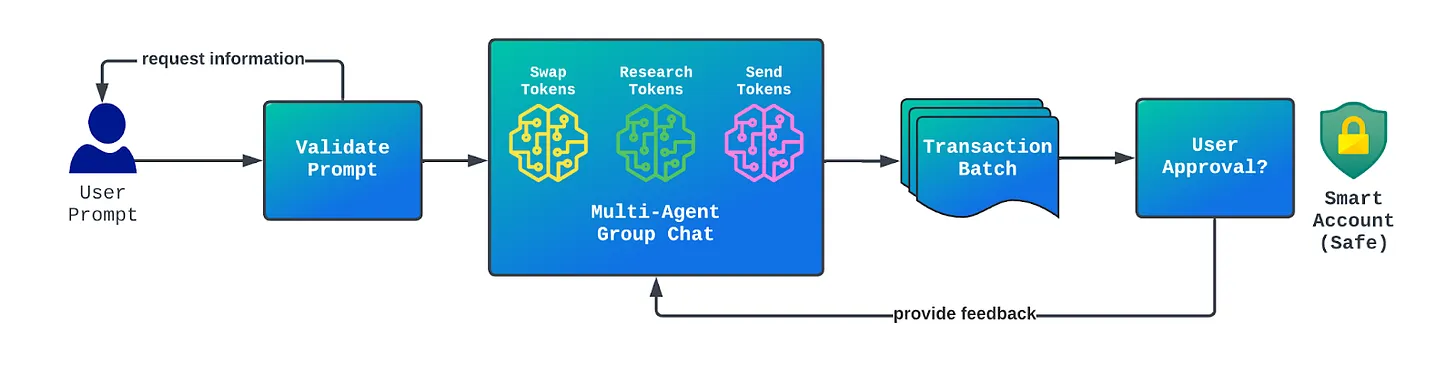
Polywrap is building a network of specialized AI agents to execute complex tasks for web3 users and protocols. These agents leverage crowdsourced insights, on-chain and off-chain data sources, task planning, and batch transactions to efficiently solve problems and make decisions. Current agents include those for payments, market research and trading, social content curation, prediction, and public goods funding. Polywrap’s future plans include expanding the range of specialized agents, decentralizing their execution, and evolving the system through community-driven governance. AutoTx is one such AI agent.
AutoTx can translate high-level user goals into a series of blockchain transactions. This means you no longer need to be an expert in every protocol or spend hours learning how to manually craft different types of transactions. Just tell AutoTx what you want to achieve, and let it handle the rest.
Parallel Colony
Parallel Studios takes a novel approach to AI agents through Colony, a new AI-powered Web3 survival game. In Colony, highly autonomous AI agents or "avatars" continuously learn from their environment. Players must guide and collaborate with these avatars—each possessing unique skills and abilities—to survive against competing colonies on a futuristic Earth.
Colony stands out by integrating continuous learning into its gameplay. AI avatars develop distinct personalities and worldviews, learning from their own experiences, identities, and objectives. Additionally, these avatars can autonomously manage digital assets through dedicated Web3 wallets, enabling them to trade with other in-game avatars. (Whitepaper reference)
Wayfinder
Wayfinder is creating a “map” for AI agents to handle tasks and streamline users’ on-chain activities. Through open-source development and incentivizing builders with the $PROMPT token, Wayfinder will expand its network of navigation instructions. Wayfinder’s pathways will progressively enhance AI agents’ capabilities, making them smarter over time. It aims to connect blockchains and off-chain data sources, allowing users to easily execute tasks via command prompts. Their innovation seeks to make blockchain interactions more efficient and accessible, improving users’ lives by reducing complexity and friction. You’ll enjoy this analogy and explanation by @tiggity_tc on Wayfinder. (Video reference of Wayfinder agent in action & whitepaper reference)
Noya
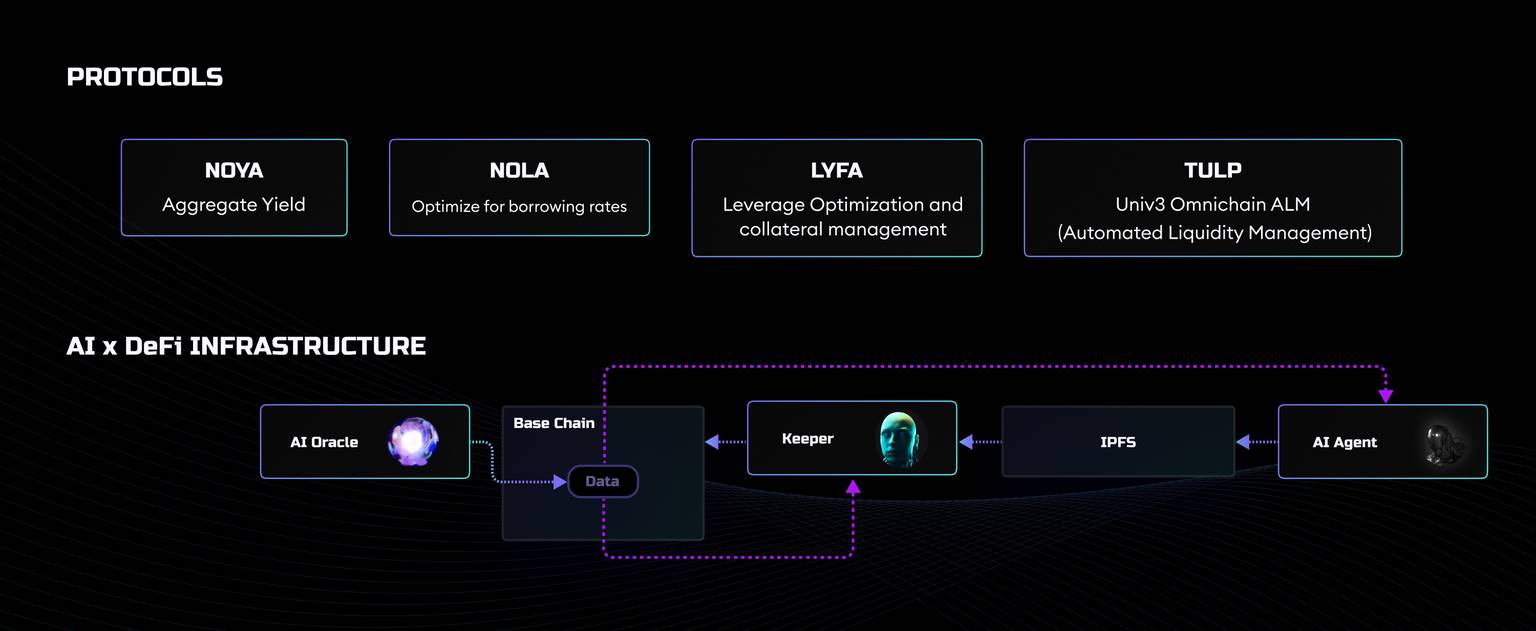
NOYA is a decentralized finance (DeFi) protocol enabling AI agents to securely and precisely manage liquidity across multiple blockchains. It uses a composable system built from the ground up, including a private guardian network, an AI-compatible oracle, and a competitive arena for AI and strategy managers. Noya operates multiple vaults, each configured for different user intent profiles. The protocol features its own custom-designed AI oracle that reads various DeFi markets and delivers information to AI agents.
NOYA’s infrastructure leverages advanced technologies such as zero-knowledge machine learning (ZKML) to support multiple functions, including liquidity allocation, leverage management, and borrowing rate optimization. It aims to set new standards for cross-chain liquidity management and financial strategies. The team is gradually rolling out access to the protocol.
Brian Knows
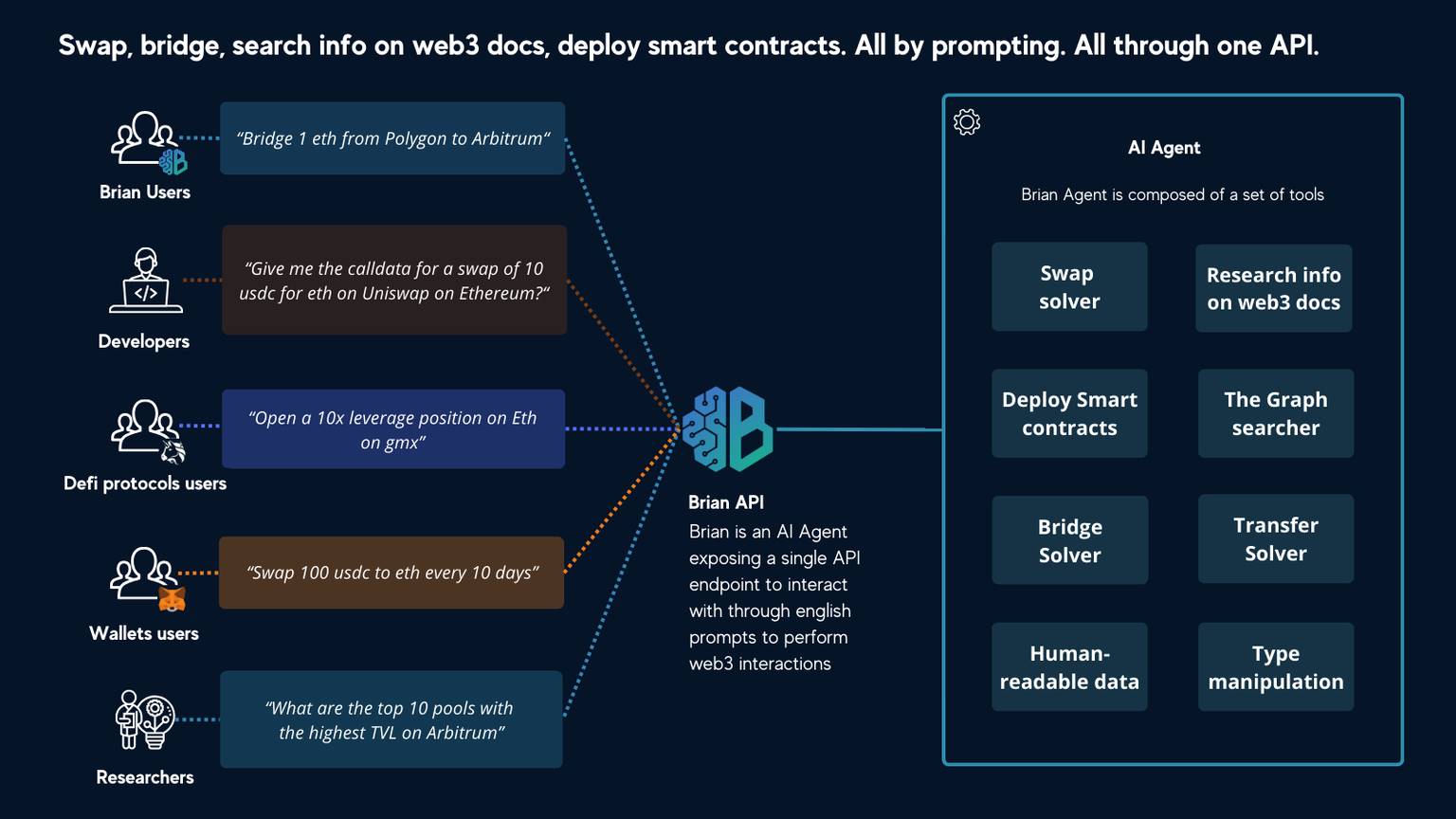
Brian provides APIs that developers can integrate into their applications, enabling users to generate web3 transactions via prompts—for example, “Can you swap 10 USDC for ETH on Uniswap on Ethereum mainnet?” They also offer smart contract deployment services through prompts. On the backend, the team uses LLMs to convert prompts into web3 transactions, which are then executed via their preferred protocols and solvers.
The team has also developed a Brian app where you can explore its feature set. They plan to expand their services by offering users functionalities such as setting up recurring and automated payments.
Aperture Finance
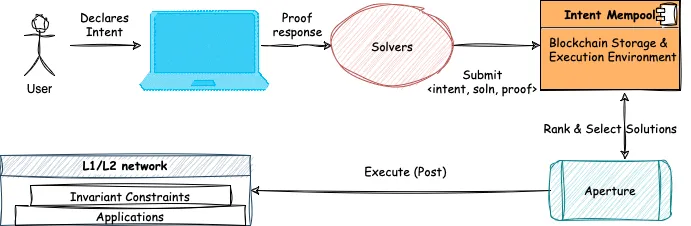
Aperture Finance is revolutionizing DeFi by offering liquidity management services through a user-friendly protocol. It aims to enhance the DeFi user experience with an intuitive chat-box interface inspired by GPT, allowing users to express their goals in natural language. Third-party participants (called solvers) process requests by optimizing workflows to ensure efficient and cost-effective execution.
Fungi Agent
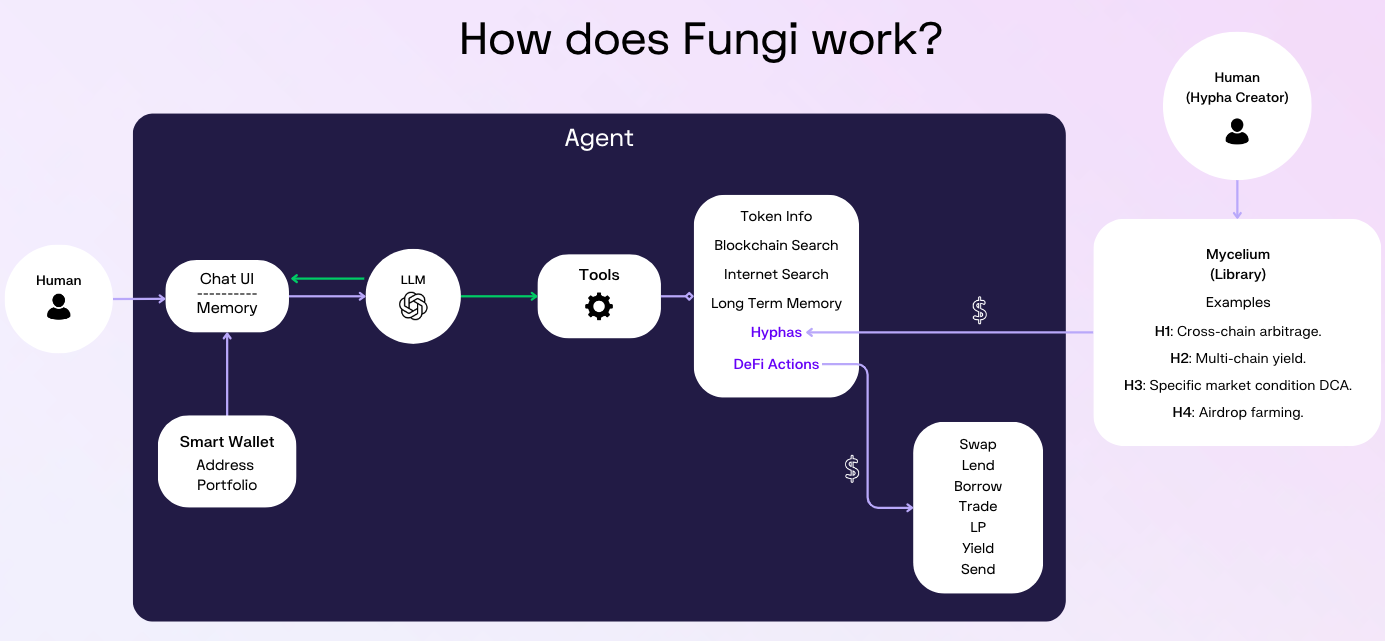
Fungi leverages the power of smart accounts and account abstraction to deliver a self-custodied AI agent experience. Fungi allows users to issue command prompts through its interface, which then processes real-time blockchain data and autonomously executes actions based on user instructions.
Users can chat with Fungi to deepen their understanding of crypto, receive personalized guidance, execute on-chain transactions, create custom DeFi strategies (Hyphas), and even monetize these Hyphas by sharing them with the community. Fungi is a network of agents that interact with each other and learn from past experiences—an accessible financial superintelligence for everyone. Here's how Fungi Agent works.
Fyde Protocol
Fyde enables users to grow their crypto holdings faster by depositing into diversified, AI-managed vaults that lock in gains and rebalance assets based on market performance and reduced volatility.
Users can deposit various tokens into these vaults and receive $TRSY, a token representing their share of the vault’s assets. Fyde aims to maintain $TRSY liquidity across various market conditions, allowing users to trade it easily.
The Need for an AI Authentication Layer in Smart Agents
Across all these emerging AI and intent-based projects, potential use cases range from handling simple tasks to empowering AI agents to execute complex DeFi strategies to find optimal yields. However, these AI agents face two major challenges:
-
They cannot achieve true autonomy: Currently, AI agents can recommend on-chain actions and prepare transactions for users, but still require user signature or approval.
-
If automation is chosen, they lose security: Protocols tend to explore alternative automation methods such as approvals, centralized vaults, shared private key pairs, etc., which make the protocol a custodian of your assets and introduce significant risks.
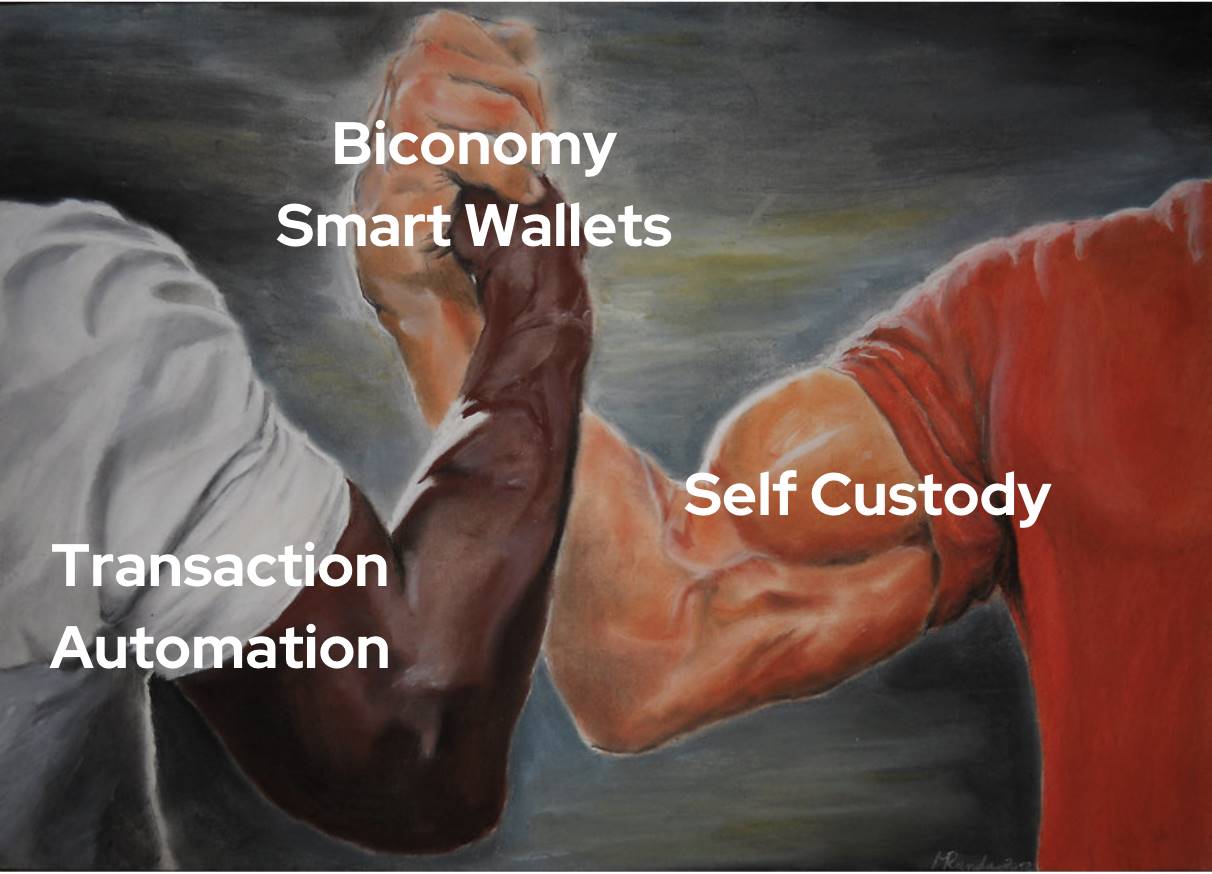
We need guardrails for AI in the form of user-defined permissions—strictly defining what operations AI is allowed to sign and what it isn't. Therefore, we need a solution that delegates transaction authorization to AI agents, but only within specific permissions and rules.
Join TechFlow official community to stay tuned
Telegram:https://t.me/TechFlowDaily
X (Twitter):https://x.com/TechFlowPost
X (Twitter) EN:https://x.com/BlockFlow_News
 @biconomy