
L2 Arrives, Is Solana Becoming What It Once Hated?
TechFlow Selected TechFlow Selected
L2 Arrives, Is Solana Becoming What It Once Hated?
Will Solana also get a Layer 2—is it just rehashing Ethereum's L2 story?
 Navigating Web3 tides with focused insights
By Alex Liu, Foresight News
The Solana community has long been a vocal critic of Layer 2 solutions. Yet now, some projects within the Solana ecosystem are building their own L2s—leading to jokes about whether Solana supporters face a dilemma: should they continue criticizing, or adjust their stance? Is Solana becoming what it once criticized?

Before passing judgment, it’s worth understanding whether Solana’s Layer 2 efforts are simply rehashing Ethereum’s L2 model—or if there are meaningful differences.
What Do They Think?
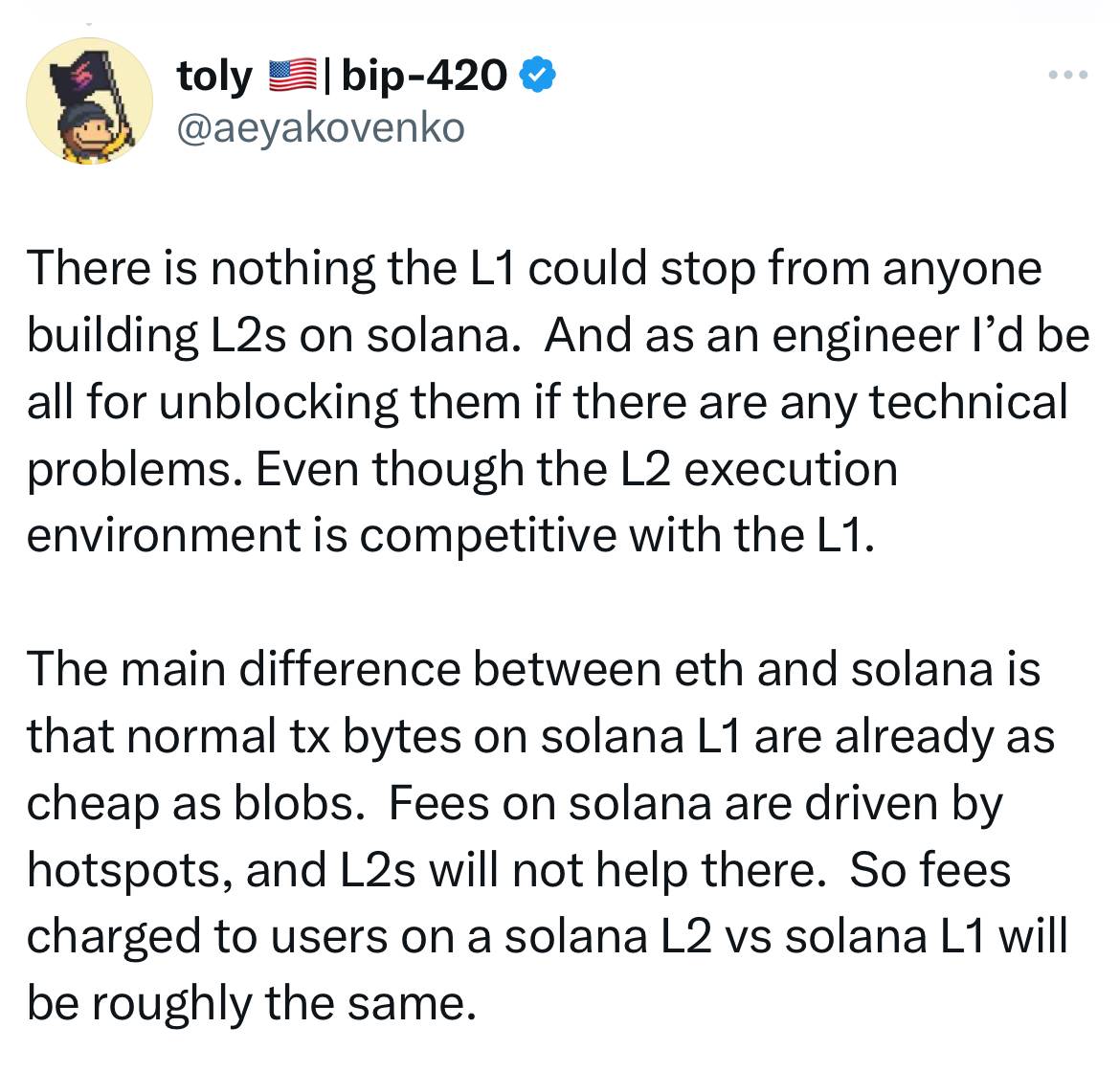
Regarding Solana's Layer 2, Solana co-founder Toly said: "L1 cannot stop anyone from building an L2 on Solana. As an engineer, I will fully support them if any technical issues arise—even though the L2 execution environment may compete with L1. The key difference between ETH and Solana is that regular transaction bytes on Solana L1 are already as cheap as blobs. Solana fees are driven by hotspots; L2s don't help much here. Therefore, the fees charged to users by Solana L2 and Solana L1 will be roughly the same."
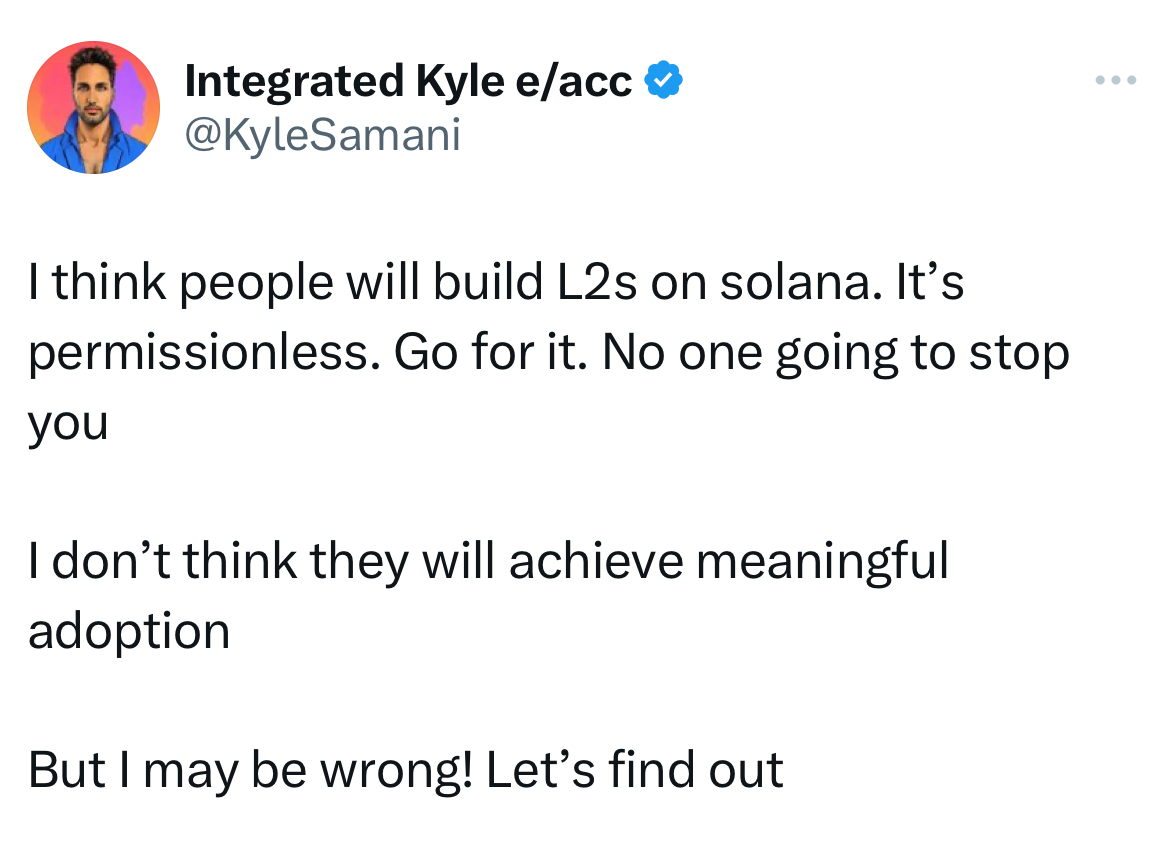
Multicoin partner Kyle, a major investor in Solana, expressed even stronger skepticism toward Solana L2s: "I think people will build L2s on Solana—it's permissionless. Go ahead, no one will stop you. But I don’t think they’ll achieve meaningful adoption. I could be wrong—we’ll see!"
Fees not significantly different from L1, unlikely to gain meaningful adoption... Are Solana’s Layer 2s even more redundant than Ethereum’s? Let’s take a closer look at what these projects are actually building.
Zeta Markets
Zeta Markets is developing a Layer 2 solution called ZX. ZX is an optimistic rollup built on Solana, aiming to enhance speed and scalability for decentralized trading by leveraging zero-knowledge proofs (zk-proofs) for trustless on-chain settlement.
Features of ZX
-
High throughput: Capable of processing up to 10,000 transactions per second (TPS), significantly boosting performance.
-
Low latency: Transaction confirmation under 10 milliseconds, approaching centralized exchange performance.
-
Seamless trading experience: One-click trading simplifies user operations.
-
High leverage options: Supports up to 50x leverage with multiple collateral choices.
-
Zero-knowledge proofs: Uses zk-proofs for trustless on-chain settlement, ensuring transparency and security.
-
$Z token: The native $Z token serves as gas for transactions and incentivizes participation.
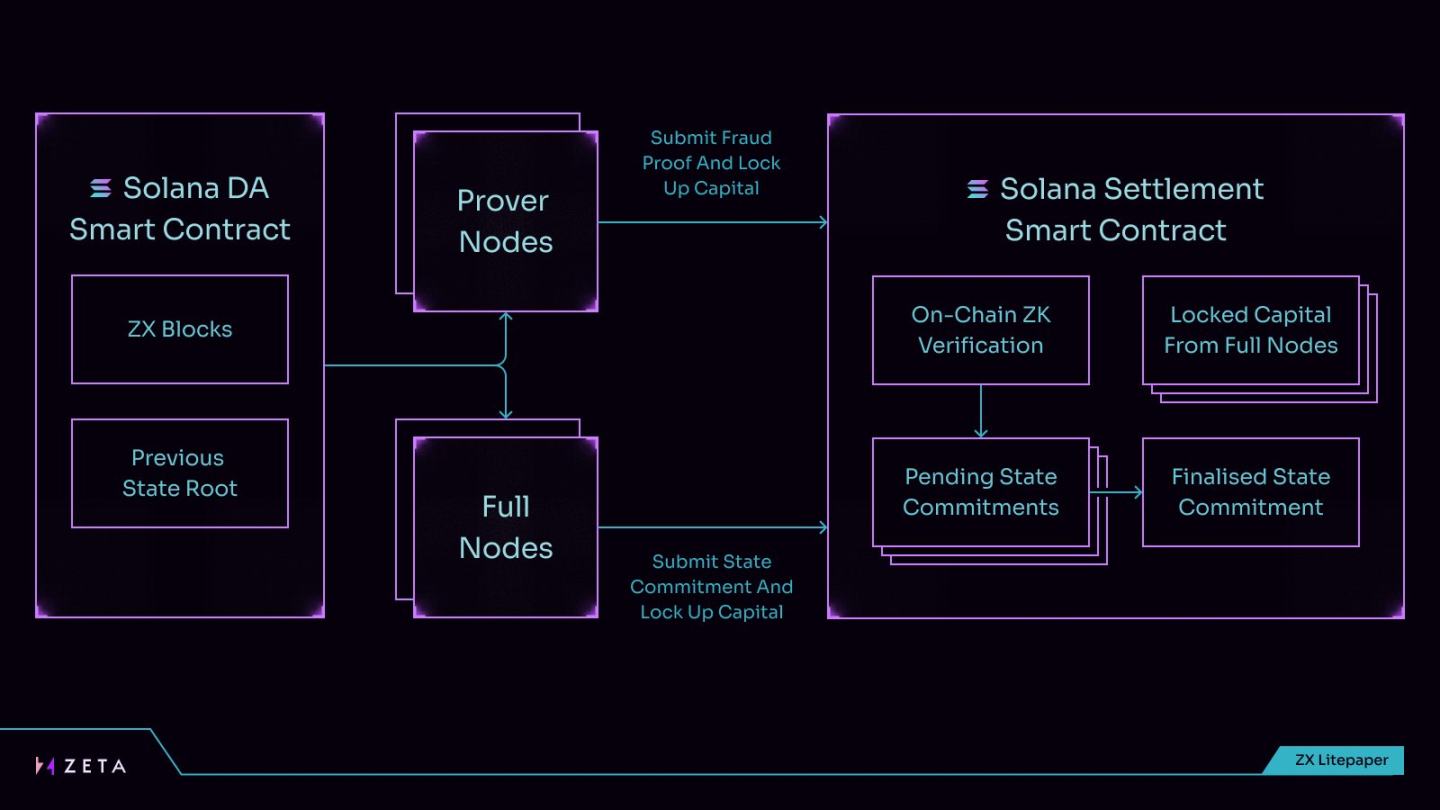
Architecture diagram of ZX
Why Build an L2 on Solana to Achieve These Features?
According to Zeta Markets’ litepaper, the main reasons for building a Solana Layer 2 include:
-
Improved transaction performance: While Solana’s Layer 1 already offers high throughput and low latency, ZX leverages optimistic rollups and zk-proofs to further boost performance for decentralized trading—achieving up to 10,000 TPS, compared to Solana L1’s real-world throughput of 1,000–2,000 TPS.
-
Mitigating congestion: Solana can experience network congestion during peak usage. By offloading some transaction processing to Layer 2, ZX reduces pressure on L1, improving overall efficiency and stability.
-
Lower transaction costs: Although Solana’s fees are already low, Layer 2 solutions like ZX can further reduce costs—especially beneficial for high-frequency and large-scale trading scenarios.
-
Enhanced user experience: ZX aims to deliver seamless trading experiences, including one-click trades and sub-10ms confirmation times—compared to Solana L1’s 400ms block intervals. These improvements bring UX closer to centralized exchanges while preserving decentralization benefits like self-custody and transparency.
-
Ecosystem integration: With Solana’s DeFi ecosystem rapidly growing, ZX will enhance liquidity and interoperability. ZX plans to leverage Solana’s low fees and fast block times to accelerate rollup finality and improve user experience.
In summary, Zeta’s development of the ZX Layer 2 solution on Solana aims to boost performance, lower fees, enhance user experience, and alleviate network congestion—improvements essential for meeting rising DeFi demand and strengthening Solana’s competitive edge.
marginfi
As the second-largest lending protocol by TVL on Solana, marginfi recently launched its “liquidity layer.” But is this what we typically consider an L2?
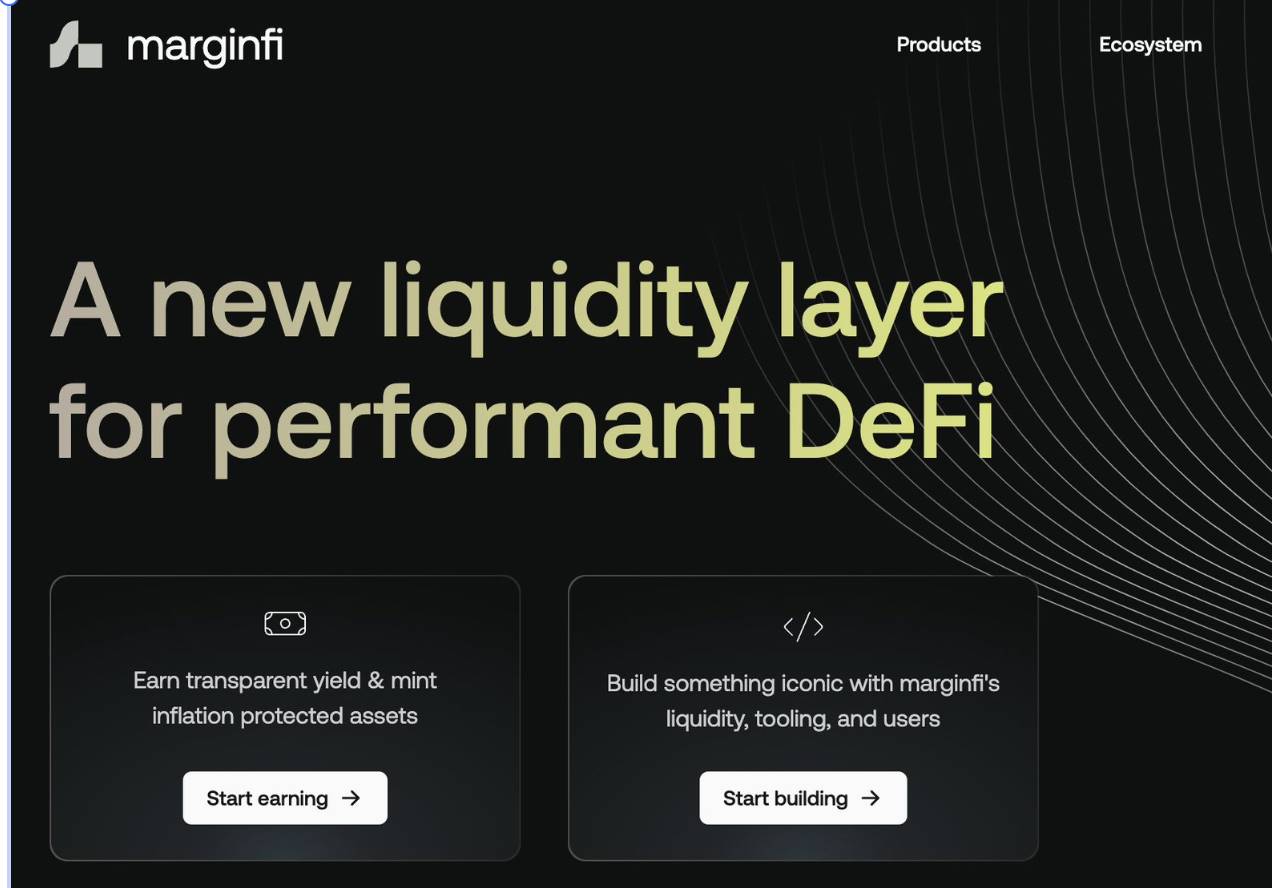
Actually, no. Despite the name, marginfi’s liquidity layer isn’t a conventional Layer 2—it’s an integrated “liquidity layer” protocol designed to provide liquidity support for DeFi applications on Solana.
Features of the Liquidity Layer
-
Integrated liquidity layer: As Solana’s first liquidity layer, marginfi allows traders to access liquidity without cross-chain bridging.
-
Risk management system: marginfi’s risk engine manages risks across the liquidity layer, with each bank able to define its own risk parameters.
-
Multi-asset support: Users can borrow and lend up to 16 assets simultaneously, offering greater flexibility in liquidity management.
-
High yield: Native staking and native token rewards enable users to earn integrated on-chain yields.
-
Support for dApps: Provides foundational infrastructure for decentralized applications involving trading, indexing, payments, etc.
As a specialized liquidity layer focused on supporting DeFi apps on Solana with liquidity provisioning and risk management, the liquidity layer is not a traditional Layer 2—it lacks its own execution environment, sequencers, or full nodes. Yet this unconventional, Solana-native approach might offer more value to the L1 network than standard L2 models.
Given the choice between a layer that enables direct liquidity access without bridges and Ethereum’s fragmented L2 liquidity landscape—which would you choose?
Key Differences from Ethereum L2s
Due to architectural and design differences, Solana L2s differ significantly from Ethereum L2s in several ways:
-
Transaction fee volatility:
Although Ethereum L2 fees are much lower than L1, they still fluctuate—especially under heavy network load. In contrast, Solana L2s maintain consistently low fees, typically under $0.01, with minimal variation regardless of network congestion.
-
Transaction speed:
While Ethereum L2s have improved transaction speeds, they still lag behind Solana’s native network. Solana confirms transactions in around 400ms, whereas Ethereum L2s typically require 5–10 seconds. Solana-based L2s like ZX achieve up to 10,000 TPS with sub-10ms confirmation, dramatically enhancing speed.
-
Interaction complexity:
Solutions like marginfi’s liquidity layer integrate seamlessly with the native network, enabling direct liquidity access without cross-chain bridges—greatly simplifying the user experience.
Conclusion
Solana’s Layer 2 initiatives were designed with common criticisms of Ethereum L2s in mind, delivering strong user experience, ultra-low fees, high security, and blazing-fast transaction speeds. Compared to Solana L1, they also add complementary functionality to meet broader demands. How Solana’s L2 landscape evolves remains to be seen—let’s wait and see, alongside Kyle.
Join TechFlow official community to stay tuned
Telegram:https://t.me/TechFlowDaily
X (Twitter):https://x.com/TechFlowPost
X (Twitter) EN:https://x.com/BlockFlow_News
 Foresight News