








Taiko: A seamless scaling and fully compatible Ethereum Layer 2 solution
TechFlow Selected TechFlow Selected
Taiko: A seamless scaling and fully compatible Ethereum Layer 2 solution
Taiko aims to scale Ethereum using zkEVM technology.
 Navigating Web3 tides with focused insights
Author: Teahouse Waiter
1. Project Overview
Taiko is a decentralized Ethereum-equivalent zkRollup project aiming to scale Ethereum through zkEVM technology.
Taiko strives to become a fully Ethereum-equivalent zkRollup, enabling Ethereum scaling without modifying existing decentralized applications (dApps). As a fully Ethereum-equivalent zkRollup, Taiko allows developers and users to leverage the powerful capabilities of Ethereum Layer 1 (L1) without altering current dApps.
Key Features:
-
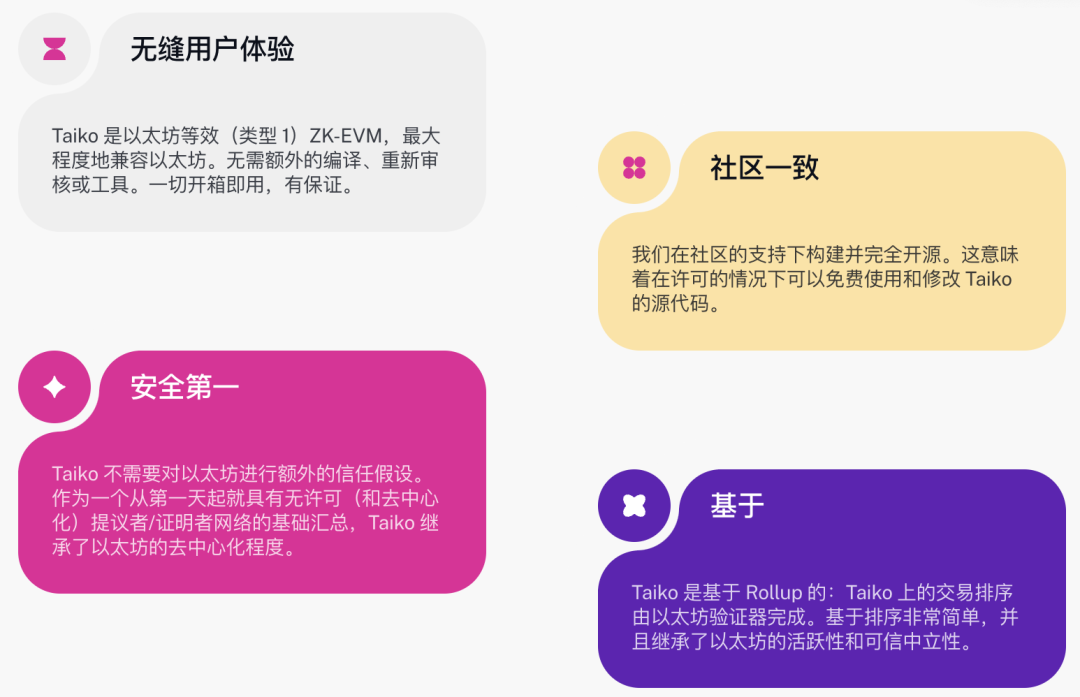
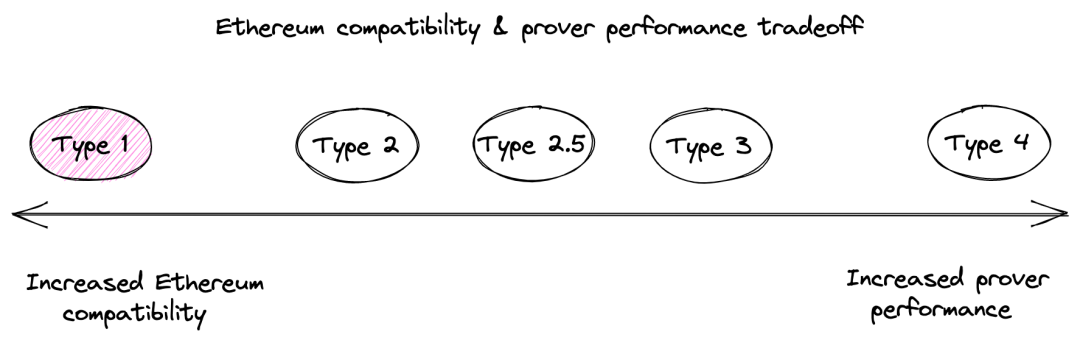
Type 1 zkEVM with full EVM compatibility: The Type 1 zkEVM adopted by Taiko is fully compatible with Ethereum, allowing developers to migrate dApps between Ethereum and Taiko without worrying about smart contract failures.
-
Open-source: All Taiko source code is available for viewing, building, or editing on GitHub, enabling blockchain development beyond a small team to include the global community and developers.
-
Fully decentralized: In addition to high EVM compatibility, Taiko places strong emphasis on protocol decentralization, planning to generate zkPs through decentralized proposers and verifiers submitting blocks and proofs.
2. Core Technical Architecture
2.1 zkEVM Circuit
The zkEVM (zero-knowledge Ethereum Virtual Machine) circuit is one of the core components of Taiko's technical architecture. It leverages zero-knowledge proofs (ZKPs) to verify the accuracy and integrity of Ethereum Virtual Machine (EVM) computations. Through zkEVM, Taiko can scale Ethereum without changing existing smart contracts and decentralized applications (dApps), while maintaining Ethereum’s security, decentralization, and compatibility.
2.1.1 Functions and Features
1. Zero-Knowledge Proofs (ZKPs)
Transaction Verification: The zkEVM circuit uses ZKPs to verify transaction correctness without revealing specific transaction data. This reduces data processing load on the Ethereum mainnet, lowering transaction costs and increasing speed.
Confidentiality: ZKPs ensure transaction privacy, with only verified proofs submitted to the Ethereum mainnet.
2. Full Compatibility with EVM Opcodes
Supports All EVM Opcodes: The zkEVM circuit fully supports all EVM opcodes, meaning developers can seamlessly migrate their smart contracts and dApps to Taiko without modifications.
Maintains Ethereum Compatibility: This high level of compatibility allows existing Ethereum development tools and ecosystems to be used directly on Taiko, greatly facilitating developer adoption.
3. Decentralization and Security
Decentralized Verification: The zkEVM circuit supports a decentralized verifier model where anyone can participate in generating and verifying zero-knowledge proofs. This decentralized approach ensures system security and integrity.
Ethereum L1 Verifiers: Taiko’s zkEVM circuit utilizes Ethereum Layer 1 validators for transaction ordering, ensuring inherited decentralization and security attributes from Ethereum.
4. Efficiency and Scalability
Reduced Data Processing Load: By executing transactions on Layer 2 and generating zero-knowledge proofs, the amount of data processed on the Ethereum mainnet is reduced, improving transaction efficiency and scalability.
Fast zk Proof Generation: The zkEVM circuit is optimized for faster zk proof generation, ensuring efficient handling of large transaction volumes.
5. Smart Contracts and Protocol Rules
Smart Contract Execution: The zkEVM circuit supports smart contract execution, preserving Ethereum’s programmability and flexibility. These smart contracts are responsible for verifying zk proofs and enforcing protocol rules.
Protocol Validation: The zkEVM circuit integrates with Ethereum L1 to ensure all proofs and transaction states undergo rigorous validation, maintaining system consistency and security.
2.1.2 Working Principle
1. Transaction Execution and Data Collection
Transactions are first executed on Layer 2, generating corresponding transaction data.
This transaction data is collected and prepared for zk proof generation.
2. Zero-Knowledge Proof Generation
The zkEVM circuit uses zkSNARKs or zkSTARKs technology to generate zero-knowledge proofs that can verify transaction correctness without revealing the actual transaction content.
After proof generation, the proof and related data are submitted to Ethereum L1.
3. Verification and State Update
Ethereum L1 validators verify the submitted zero-knowledge proofs to confirm their validity.
Once verified, the transaction state is updated on the Ethereum mainnet, ensuring all participants observe consistent transaction outcomes.
2.2 Layer 2 Rollup Node
The Layer 2 Rollup node is a key component in Taiko’s technical architecture, responsible for managing and executing transactions on Layer 2 while interacting with Ethereum Layer 1 (L1). Through Layer 2 Rollup technology, Taiko improves Ethereum’s transaction throughput, reduces transaction costs, and maintains decentralization and security.
2.2.1 Functions and Features
1. Data Collection and Transaction Execution
Transaction Execution: Layer 2 Rollup nodes execute transactions on Layer 2, processing them within the Layer 2 network to reduce direct burden on the Ethereum mainnet.
Data Collection: Nodes collect data transmitted from Ethereum Layer 1 and process transactions and update states accordingly.
2. State Management
State Display: After each transaction execution, the Layer 2 Rollup node updates and displays the transaction state, ensuring all participants see consistent state information.
State Maintenance: By managing post-execution states, consistency and data integrity across the entire network are ensured.
3. Protocol Rule Enforcement
Protocol Validation: Layer 2 Rollup nodes execute transactions and validation processes according to Taiko protocol rules, ensuring transaction validity and network security.
Smart Contract Support: Nodes can execute smart contracts deployed on Ethereum Layer 1, using these contracts for data transmission and zk proof verification.
4. Efficiency and Scalability
Increased Throughput: Executing transactions on Layer 2 significantly increases the network’s transaction processing capacity, reducing congestion on the Ethereum mainnet.
Cost Reduction: Processing transactions on Layer 2 substantially reduces transaction fees, making microtransactions more economically viable.
5. Decentralization and Security
Decentralized Verification: Layer 2 Rollup nodes support a decentralized verifier model where anyone can participate in transaction validation and zk proof generation, ensuring network decentralization and security.
Data Transmission: Nodes are responsible for transmitting Layer 2 transaction data to Ethereum Layer 1 and updating states based on L1 feedback.
2.2.2 Working Principle
1. Data Collection and Transaction Execution
Receiving Transactions: Nodes receive transactions submitted by users on Layer 2 and execute them according to protocol rules.
State Update: After transaction execution, nodes update the transaction state and maintain the latest state information on Layer 2.
2. Zero-Knowledge Proof Generation
Generating zk Proofs: Nodes generate zero-knowledge proofs for each transaction, ensuring correctness and privacy.
Submitting Proofs: Generated zk proofs and related data are submitted to Ethereum Layer 1 for verification by L1 validators.
3. Verification and State Update
L1 Verification: Ethereum Layer 1 validators verify submitted zero-knowledge proofs to ensure transaction validity.
State Synchronization: Once verified, Layer 2 Rollup nodes synchronize and update states based on L1 feedback, ensuring network-wide consistency.
Advantages and Use Cases:
1. Improved Ethereum Scalability
By processing large numbers of transactions on Layer 2, Taiko’s Layer 2 Rollup nodes significantly enhance Ethereum network scalability, meeting higher transaction demands.
2. Reduced Transaction Costs
Executing transactions and generating zk proofs on Layer 2 reduces reliance on the Ethereum mainnet, thereby lowering transaction fees—especially beneficial for high-frequency, low-value transaction scenarios.
3. Enhanced Security and Privacy
Zero-knowledge proof technology ensures transaction privacy and security, preventing data leakage while preserving network decentralization.
2.3 Taiko Protocol
The Taiko Protocol is another core component of Taiko’s technical architecture. It defines and enforces Layer 2 Rollup rules, ensuring transaction correctness and network security. Through smart contracts and decentralized validation, the Taiko Protocol enables efficient Ethereum scaling while preserving its decentralization and security characteristics.
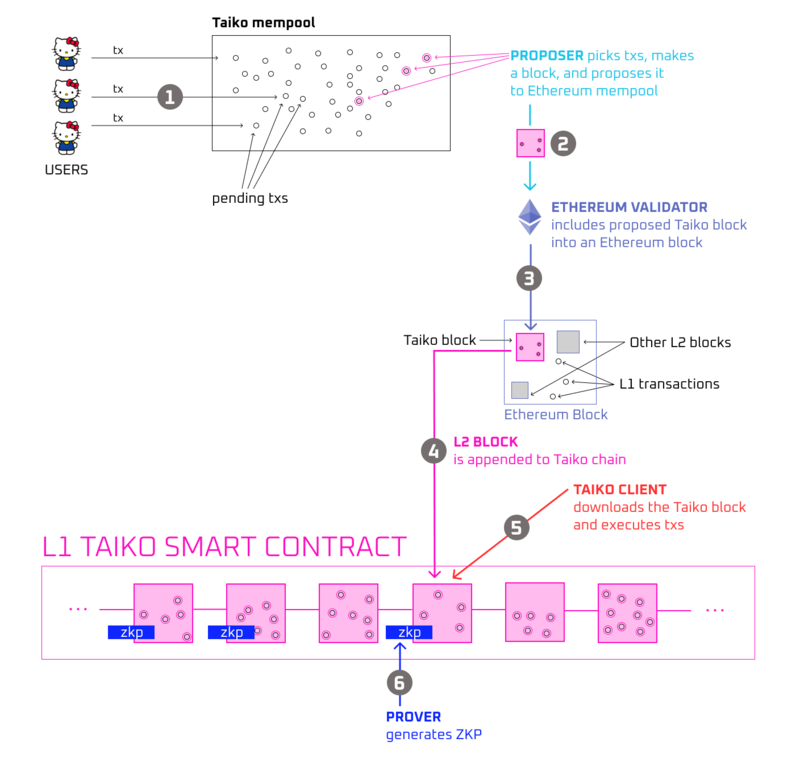
2.3.1 Functions and Features
1. Protocol Rule Definition
Rule Setting: The Taiko Protocol defines all operational rules for the Rollup, including transaction processing, validation, and state updates. All transactions must follow these rules to ensure operational consistency.
Smart Contract Execution: The protocol is implemented via smart contracts deployed on Ethereum, ensuring all rules and operations are publicly transparent.
2. Transaction Validation and State Updates
Transaction Validation: Every transaction submitted undergoes validation by the Taiko Protocol according to predefined rules, ensuring validity and correctness.
State Update: After validation, the protocol updates the Layer 2 transaction state and transmits relevant data to Ethereum Layer 1, ensuring state synchronization and consistency.
3. Decentralization and Security
Decentralized Verifiers: The Taiko Protocol supports a decentralized verifier model, allowing anyone to participate in validation. This enhances network security and integrity.
Zero-Knowledge Proofs: The protocol uses zero-knowledge proof technology (zkSNARKs or zkSTARKs) to validate transactions without exposing transaction details, ensuring privacy and security.
4. Data Transmission and Processing
Data Submission: Transaction data and generated zk proofs are submitted to Ethereum Layer 1 for verification by L1 validators.
Data Processing: After L1 verification, the protocol updates the Layer 2 state based on feedback, ensuring all participants observe consistent transaction results.
5. Smart Contract Functionality
Data Transfer Mechanism: Smart contracts handle transaction data and zk proof transfers between Layer 2 and Layer 1, ensuring data completeness and consistency.
Protocol Validation: Smart contracts also verify zk proofs, ensuring transaction validity and correctness.
6. Governance and Community-Driven Development
Decentralized Autonomous Organization (DAO): Governance of the Taiko Protocol is managed by the Taiko DAO, composed of TKO token holders who vote on major protocol upgrades and changes.
Community Participation: Protocol governance and development highly depend on community involvement and contributions, ensuring decisions are transparent, fair, and inclusive.
2.3.2 Working Principle:
1. Transaction Submission and Execution
Users submit transactions on Layer 2, which are initially executed on the Layer 2 Rollup node.
After execution, corresponding transaction data and state updates are generated.
2. Zero-Knowledge Proof Generation
Zero-knowledge proofs are generated to verify transaction correctness without revealing transaction details, ensuring privacy.
Generated zk proofs and transaction data are submitted to Ethereum Layer 1.
3. L1 Verification and State Update
Ethereum Layer 1 validators verify submitted zero-knowledge proofs to ensure transaction validity and correctness.
After successful verification, the Layer 2 state is updated based on L1 feedback, ensuring network-wide consistency and security.
4. Governance and Protocol Updates
The Taiko DAO determines protocol updates and changes through voting, ensuring community participation and transparent governance.
All protocol updates are implemented via smart contracts, ensuring public transparency of rules.
2.3.3 Advantages and Use Cases
1. Improved Ethereum Scalability
Through Layer 2 Rollup technology and zero-knowledge proofs, the Taiko Protocol significantly enhances Ethereum network scalability, capable of handling more transactions and meeting higher demand.
2. Reduced Transaction Costs
Processing transactions on Layer 2 reduces reliance on the Ethereum mainnet, thereby lowering transaction fees—particularly suitable for high-frequency, low-value transaction use cases.
3. Enhanced Security and Privacy
Zero-knowledge proof technology ensures transaction privacy and security, prevents data leakage, and maintains network decentralization.
4. Community-Driven and Transparent Governance
Through the Taiko DAO, community members participate in protocol governance and decision-making, ensuring development aligns with community interests and needs.
2.4 Base Competitive Rollup (BCR)
Base Competitive Rollup (BCR) is a key innovation in the Taiko Protocol aimed at enhancing network decentralization and security. Below is a detailed introduction to BCR:
2.4.1 Core Concept
BCR is an innovative Layer 2 solution designed to improve blockchain network decentralization and security through a competitive mechanism. In the BCR model, multiple participants compete to propose and validate blocks, eliminating control by a single entity.
2.4.2 Operating Mechanism
1. Competitive Proposing
Proposers: Anyone can become a proposer and submit block proposals. Proposers need to bundle user transactions and generate zero-knowledge proofs (zkProofs).
Proposal Competition: Multiple proposers can simultaneously compete to submit blocks, ensuring the block generation and submission process is decentralized with no centralized control point.
2. Validation Process
Verifiers: Verifiers are responsible for validating blocks and zero-knowledge proofs submitted by proposers. They verify transaction correctness and legitimacy, ensuring network security.
Competitive Verification: Multiple verifiers can compete to verify blocks, increasing network security as competition among verifiers ensures accuracy and transparency in the verification process.
2.4.3 Advantages of BCR
1. Enhanced Decentralization
Open Participation: The BCR model allows anyone to participate in block proposing and validation, eliminating dependence on a few entities and enhancing network decentralization.
Censorship Resistance: With multiple competing proposers and verifiers, no single entity can censor or control the network.
2. Increased Security
Multiple Verification: The competitive verification mechanism involves multiple independent verifiers checking blocks, ensuring reliability and security of the verification process.
Reduced Single Point of Failure: The BCR model reduces risks of single points of failure since network operation does not rely on a single proposer or verifier.
3. Economic Incentives
Fair Competition: Proposers and verifiers earn economic rewards through competition, incentivizing honest and efficient service provision.
Fee Burning: Proposers must burn a certain amount of TKO tokens to submit blocks, helping control token supply and stabilize token value.
2.5 Based Booster Rollup (BBR)
Based Booster Rollup (BBR) is a key component of the Taiko Protocol, designed to further extend Ethereum’s capabilities by improving transaction execution and storage efficiency. BBR aims to create a seamless experience for users and developers, enabling transactions to execute like on Layer 1 (L1) while maintaining their own storage on Layer 2 (L2).
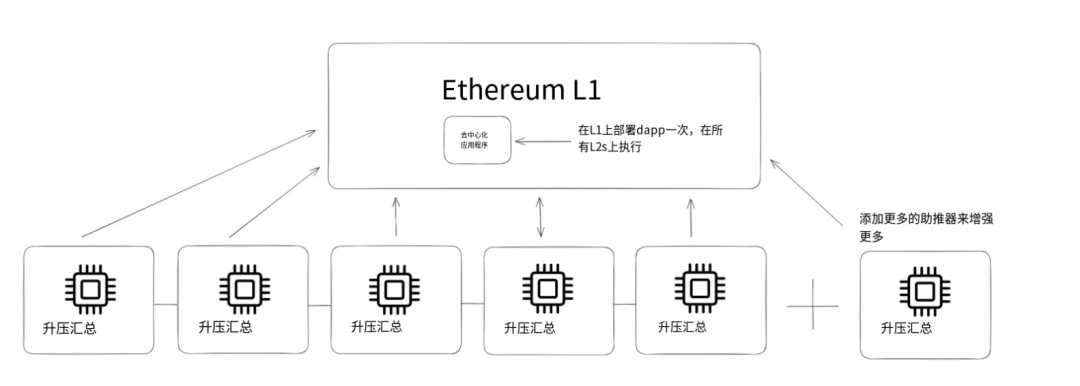
2.5.1 Core Features and Working Principles
1. Two-Layer Structure
Separation of Execution and Storage: BBR implements a two-layer structure separating transaction execution and storage. This design enables efficient transaction execution on L2 while preserving necessary security and decentralization on L1.
Seamless Integration with L1: This two-layer structure allows smart contracts to maintain consistent addresses across L1 and all BBRs, simplifying deployment and interaction.
2. Compatibility and Scalability
Full Ethereum Compatibility: BBR is fully compatible with Ethereum’s existing architecture, including hash functions, state trees, and gas costs per opcode. This means existing Ethereum smart contracts and dApps can seamlessly migrate to BBR.
Enhanced Scalability: BBR is designed to improve Ethereum’s scalability, enabling faster transaction processing and lower fees to support larger-scale users and applications.
3. Booster Functionality
Universality: BBR’s booster functionality can enhance any type of rollup, whether optimistic or zero-knowledge, leveraging BBR’s expansion capabilities.
Enhanced Ethereum Scalability: Through BBR, any rollup can directly enhance Ethereum’s scalability, enabling it to process more transactions and support more complex applications.
2.5.2 Technical Details
1. Smart Contract Consistency
Address Consistency: BBR ensures smart contract addresses remain consistent across L1 and L2, meaning smart contracts deployed on L1 can run seamlessly on L2, simplifying development and deployment.
Simplified Interaction: Interactions between layers are simplified, ensuring consistent user experience and convenient development processes.
2. Economic Incentive Mechanism
Fee Structure: BBR’s fee structure is reasonably designed to keep transaction fees low enough to encourage user and developer adoption, while providing strong economic incentives to maintain proposer and verifier engagement.
Reward Distribution: Through a fair reward distribution mechanism, BBR ensures all participants receive equitable incentives, maintaining network decentralization and security.
2.5.3 Advantages
1. Improved Transaction Efficiency
Fast Transaction Processing: By executing transactions on L2, BBR significantly increases transaction processing speed, reducing burden on the Ethereum mainnet.
Lower Transaction Costs: Executing transactions on L2 significantly reduces costs, making microtransactions and high-frequency trading more economically viable.
2. Enhanced Network Security
Decentralized Verification: BBR employs a decentralized verification mechanism, ensuring network security and decentralization, avoiding single points of failure and censorship risks.
Multiple Verification Mechanisms: Through multiple verification mechanisms, BBR provides higher security guarantees, ensuring correctness and legitimacy of all transactions.
3. Optimized User Experience
Seamless User Experience: BBR’s design ensures users experience L2 networks identically to L1, without concern for complex technical details.
Easy Development and Deployment: Developers can leverage existing Ethereum tools and infrastructure to easily develop and deploy smart contracts and dApps on BBR.
3. TKO Token

TKO is the native token of the Taiko network, designed to reward block verifiers and serve as part of transaction fees within the Taiko network.
3.1 Token Functions
-
Transaction Fees: Users conducting transactions on the Taiko Layer 2 network must pay transaction fees, collected by block proposers. Block proposers must burn a certain amount of TKO tokens and pay ETH to Ethereum validators to ensure their blocks are included in the Ethereum Layer 1 network.
-
Reward Mechanism: TKO tokens are used to reward block verifiers who generate and verify zero-knowledge proofs (zkProofs) to ensure transaction validity. The transparency of TKO tokens ensures a user experience similar to that on the Ethereum network.
-
Bonding System: TKO tokens are used in the bonding systems of BCR and BBR, ensuring network operational integrity and timeliness. Confiscated bonds are not lost but redirected to the L1 Taiko Treasury.
-
Governance Role: TKO token holders can participate in network governance, influencing network upgrades and managing the Taiko Treasury, maintaining the permissionless nature of the network on both L1 and L2.
3.2 Token Supply
-
Total Supply: 1 billion TKO tokens with 18 decimal places.
-
Token Management: Minting or burning of TKO tokens strictly follows governance regulations, ensuring supply changes are transparent and reflect token holder consensus.
3.3 Token Distribution
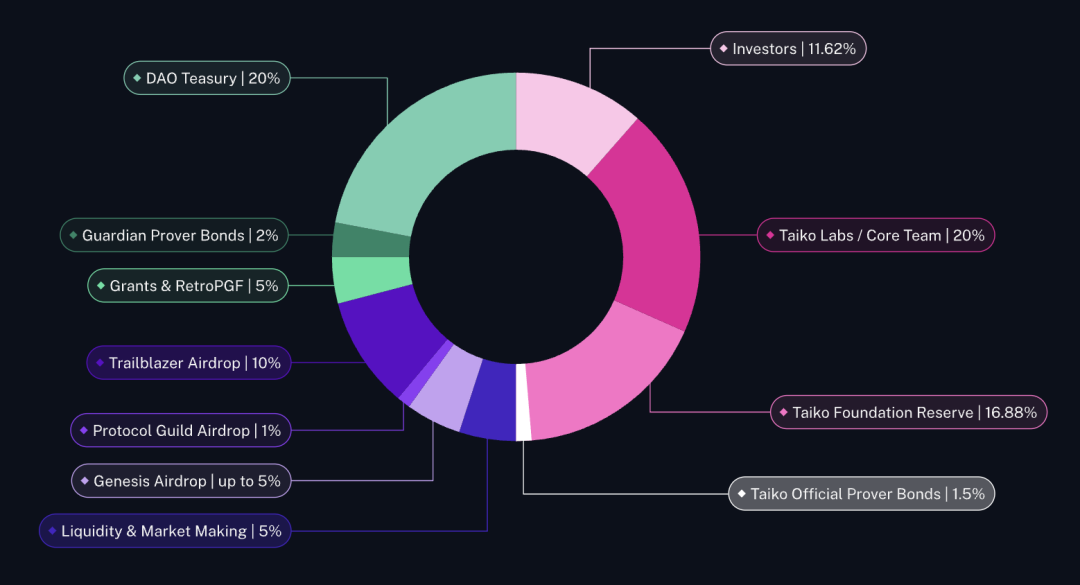
-
DAO Treasury: 20%
-
Guardian Prover Bonds: 2%
-
Grants & RetroPGF: 5%
-
Trailblazer Airdrop: 10%
-
Protocol Guild Airdrop: 1%
-
Genesis Airdrop: Up to 5%
-
Liquidity and Market Making: 5%
-
Investors: 11.62%
Join TechFlow official community to stay tuned
Telegram:https://t.me/TechFlowDaily
X (Twitter):https://x.com/TechFlowPost
X (Twitter) EN:https://x.com/BlockFlow_News


