Crouching Tiger, Hidden Dragon S1E03: The Way of DAO
TechFlow Selected TechFlow Selected
Crouching Tiger, Hidden Dragon S1E03: The Way of DAO
DAOs are a new organizational form that exists beyond the boundaries of traditional nation-states, corporations, and social organizations, and will ultimately replace nation-states as the new paradigm of "imagined communities" in the internet era.
 Navigating Web3 tides with focused insights
Author: ChineseIII
This is a commissioned piece for the Hidden Dragon & Crouching Tiger project. To be honest, I don't have a comprehensive grasp of the current state of Chinese DAOs—I've mostly been lurking in a few DAO communities. However, I recently delivered a talk at Hong Kong's Web3 Festival titled "The Possibility of Reviving Traditional Chinese Culture in Web3," which touches on relevant themes. So I've taken this opportunity to adapt and expand upon that speech. The original was quite lengthy, so here I aim to condense and streamline it.
This topic unfolds across three layers. First, we need to clarify what a DAO actually is, and what role it plays within the broader Web3 movement and the information age as a whole. Second, we should examine the unique characteristics of Chinese-language DAOs—Are they fundamentally the same as English-speaking DAOs, or are they less developed, or do they possess their own distinct traits? Finally, we zoom in on the influence of Chinese culture: beyond merely using Chinese, can our DAOs draw from traditional cultural foundations to forge a uniquely distinctive path?
In short, my conclusion is this: First, DAOs represent a new organizational form existing beyond the boundaries of traditional nation-states, corporations, and social institutions—and will ultimately replace the nation-state as the new paradigm of the digital era’s “imagined community.” Second, Chinese-speaking participants are already deeply involved in DAO practices. While these efforts may appear more chaotic and disorganized, this very wildness also carries revolutionary potential. Third, core traits of Chinese culture—such as reverence for history and emphasis on family—can offer valuable complements to modern Western culture and resonate strongly with the underlying ethos of blockchain.
01 Why Do We Need DAOs?
DAO stands for "Decentralized Autonomous Organization," but it generally implies being built atop blockchain technology—using NFTs as identity markers, tokens to establish economic systems, smart contracts for governance, or some combination thereof.
But the reason for relying on blockchain still comes down to "decentralization." If an organization adopts blockchain merely as a fundraising gimmick rather than pursuing genuine decentralization, then it's not a real DAO—it's just a traditional organization wearing a DAO mask.
A true DAO bears little resemblance to any traditional organization. Whether compared to clubs, fan groups, nonprofits, companies, conglomerates, political parties, or nations—a DAO might share features with all of them, yet differs fundamentally from each. It is a new kind of "city-state" rising above the nation-state model.
If we're truly using blockchain—not just for show—then it must be because our organization needs a foundation that transcends any single country, multinational corporation, or international institution. If I'm content operating under existing rules set by states or platforms, then in principle, I don’t need blockchain at all. Only when I want to act beyond the established boundaries of traditional institutions does this new technology become necessary.
Blockchain creates a "terra nullius" in the digital world: I can establish a digital identity without any registration or permission, use it to work in a DAO, complete digital tasks or create digital works, earn cryptocurrency, consume digital resources, play digital games, collect digital art, sponsor other digital city-states, and leave a lasting mark in the digital realm—even achieving fame and recognition. All of these activities—whether technological innovation or artistic appreciation, pursuit of status or mere entertainment—can unfold entirely within the digital world, leaving no trace in the physical one. As long as I never exchange digital assets for fiat currency or real-world goods, my entire digital life remains fully independent.
That is what true "self-governance" means: we can break free from old conventions in the digital world and create our own rules and consensus. Each DAO is such an autonomous community unit in the digital space, and in terms of digital life, this autonomy could be even more complete than the sovereignty of traditional nation-states.
Of course, not every DAO needs such radical independence. Many willingly affiliate with larger ecosystems and maintain ties to the legacy world. But ideally, the direction of a DAO is toward becoming a "network state"—a new political form surpassing the outdated nation-state paradigm.
Why must the nation-state model be transcended? Because it simply no longer fits the new environment of the information age. The nation-state is not ancient tradition—it's a product of modernity, emerging alongside the waves of Renaissance and Industrial Revolution. Before that, imagined communities were held together by myth or divine authority, and national borders were far less defined.
Many seemingly natural rules are actually tied to the nation-state framework—for example, fiat currency systems. Many people wonder why every blockchain project feels compelled to design its own tokenomics. I didn’t understand this either—at first—because indeed many tokens exist solely to "harvest韭菜 (literally 'chop leeks,' slang for exploiting investors)." But once I began viewing crypto communities as analogous to nation-states, it made sense. In fact, the fiat system is stranger: Why does every country or semi-autonomous region need its own currency? Tiny places like Singapore issue the Singapore dollar; Macau has the pataca. Why not just adopt the US dollar or renminbi? Clearly, they seek to draw a boundary between themselves and the global market through an independent monetary system, allowing greater flexibility and autonomy in governance. Similarly, a network state aiming to enforce its own rules independently would naturally design its own token economy.
02 DAOs as Public Spaces
Since DAOs aim to supersede traditional nation-states and build self-governing network states, they must provide a diverse, multi-layered public space—not settle for the vertical hierarchies typical of conventional companies.
A public space is where individual actions generate resonance. It cannot be too large—if everyone's voice becomes insignificant and echoes fade instantly. Nor can it be too small—turning into an echo chamber filled only with homogeneous opinions lacking richness.
As Hannah Arendt observed, human beings' sense of reality depends on the existence of a public sphere. Too much or too little resonance leads to nihilism. People need feedback from the world. Literary works often depict characters who pinch themselves to test if they’re dreaming—the pain confirms they’re in reality. Pinching oneself expresses will; feeling pain provides feedback. To feel our lives are real, we need responses from the world to our actions. If everything we do vanishes without a ripple, life itself feels meaningless.
From the electronic age (or mass media era) to the mobile internet (Web2), the overall trend has been the collapse of public space—achieved through acceleration and expansion. McLuhan’s prophecy of a “global village” hints at the terrifying outcome: billions crammed into one digital village. This isn’t ideal—in fact, public space disappears entirely in such a distance-less world. Everyone seems free to speak, yet voices drown instantly in noise and are quickly forgotten. Electronic media (telegraph and telephone in McLuhan’s time, now smartphones) deliver ever-faster feedback to satisfy our craving for response—but make it harder to create lasting impact. Political action in Arendt’s sense—actions that ripple infinitely through the public sphere—has become the privilege of a few. Even those whose actions seem impactful are often reduced to stereotypes: politicians and influencers alike serve “traffic,” presenting curated personas rather than authentic selves.
Two key trends drive this: first, individual atomization—more and more people avoid forming even small families, let alone anchoring themselves in clans or local communities. Second, the flattening of social platforms—we no longer gather in plazas, markets, alleys, or town halls. Instead, we interact on globalized platforms like Twitter or WeChat, spaces that erase boundaries and homogenize experience. Thus, the public spaces we access are either too small (no one hears us) or too vast (our actions cause no ripple).
If the mission of DAOs is to rebuild public space, then one of their central tasks is to re-establish diverse "terrains" in the flat, fluid digital world—creating appropriate boundaries while remaining open and interconnected. Within such bounded spaces, every person’s action receives meaningful feedback, and ripples can harmonize into a richer collective symphony.
In fact, niche subcultures have existed online—hacker communities, open-source projects, BBS forums, subtitle groups, fandoms. The rise of tipping economies reflects the human desire for public recognition. A top donor spends millions just to hear the streamer shout “Big Boss generous!” and see their name atop the leaderboard. Perhaps precisely because such public spaces are so scarce today, influencer culture has exploded.
The problem is that the “token economics” of influencer culture is distorted. The public space isn’t co-created by streamers and fans—it exists entirely under the platform’s control. Whether “fish coins” or “rockets,” these tokens are monopolized by the platform, unfairly minted, and heavily restricted in circulation. The platform takes the largest cut from every transaction.
High platform fees aren’t just about monopoly and exploitation—they reflect who sets the rules. Platform operators aren’t participants in public life; they remain within the traffic economy paradigm. To capital, every user is not a unique individual but a source of profitable “traffic.”
Thus, the mission of blockchain and DAOs—also known as Web3—is to overturn the Web2 paradigm, resist the monopolization of public space by big tech and capital, escape the traffic economy, and return the right to associate to every individual.
03 Characteristics of Chinese DAOs: The Positive Side of “Grind, Emigrate, Lie Flat, Get Rekt”
Having discussed the significance of DAOs, let’s now turn to the characteristics of Chinese-language DAOs.
By definition, the most basic trait is the use of Chinese as the primary language. Naturally, this creates a barrier: prioritizing Chinese raises entry hurdles for English and other language speakers, limiting participation mainly to Chinese users—especially attracting domestic players less comfortable with English.
But as argued earlier, this linguistic divide isn’t necessarily bad—it may enhance the sense of boundary and diversity essential to healthy public spaces. In the information age, physical boundaries have dissolved. What remains to define community borders are shared interests and cultural-linguistic backgrounds.
Even English-speaking communities recognize the value of cultural diversity—though their focus tends to be on gender, sexuality, and race. Compared to these biological traits, linguistic and cultural diversity are equally, if not more, precious aspects of humanity.
Of course, Chinese communities also face criticism. Some say there are more scammers and whales among Chinese users. I’ve addressed this in my earlier talk: during early phases of great exploration—like the Age of Discovery—this atmosphere is inevitable, and not unique to China. Here, I’ll explore additional behavioral patterns seen in Chinese Web3 circles.
There’s a popular meme chart titled “Analysis of Contemporary Chinese Social Mindset,” dividing attitudes along two axes: resistance vs. cooperation (horizontal), and passivity vs. activity (vertical), yielding four quadrants labeled “Grind (卷), Emigrate (润), Lie Flat (躺), and Get Rekt (韭).” These four terms aptly summarize the ecosystem of Chinese Web3 communities.
1. Grind (卷): Chinese communities tend to be hyper-competitive, often favoring PVP (player-vs-player) dynamics.
2. Emigrate (润): Some Chinese users actively seek entry into Western communities or favor Western projects—those endorsed by foreigners gain more traction.
3. Lie Flat (躺): Many prefer passive participation, happy to farm rewards without contributing to building.
4. Get Rekt (韭): Many willingly get “rekt,” enjoying Ponzi-like games with high gambling tendencies, ultimately becoming sacrificial lambs (“leeks”).
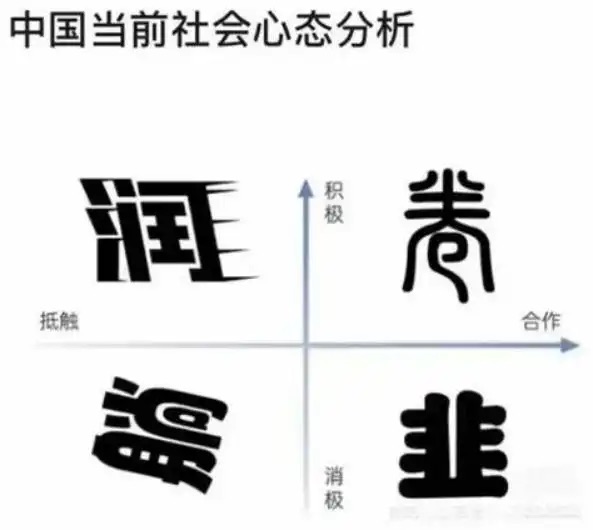
First, many of these phenomena aren’t exclusive to the East—especially in DAOs, successful Western examples are rare too. Second, some behaviors may be more pronounced in Chinese communities, but that doesn’t mean they’re purely negative. For a revolution aiming to create new order, these traits might actually be strengths.
The 19th-century proletariat was similarly mixed—rife with internal competition and fraud. Yet Marx saw revolutionary hope in them because they had nothing to lose, less attachment to the old world, and greater hunger for the new. When aligned with technological progress, they unleashed transformative power. While labor movements evolved in ways Marx couldn’t foresee, his judgment of their revolutionary potential was largely correct.
Today, the chaos in Chinese Web3 communities has little to do with inherent cultural flaws. It’s shaped primarily by contemporary Chinese social conditions. The same applies to “grinding, emigrating, lying flat, getting rekt.”
Widespread belief that “the old order needs revolution” only emerges when systemic failures become undeniable. In the West, especially the U.S., the 2008 financial crisis sparked a wave of revolutionary sentiment—“Occupy Wall Street” surged. But as America seemingly recovered and elites redirected discontent toward identity politics, the momentum faded.
Now, with Bitcoin ETFs approved, many celebrate Wall Street’s embrace of Bitcoin. Crypto traders take pride in becoming “Nasdaq traders,” forgetting that Wall Street was precisely what Bitcoin sought to revolutionize. The identity of a Bitcoiner should inherently stand above the beneficiaries of the old order.
We’re at a pivotal moment in the blockchain revolution. Is the Bitcoin ETF a sign that revolutionaries have been “co-opted”? Or the beginning of peaceful evolution of the old world? Or the last act of “cooperation” before intense conflict? The answer remains unclear.
The U.S. and China are two major exceptions in the Web3 world—many projects explicitly bar residents of both countries due to “compliance” concerns. But their roles differ: the U.S. leads the old rules, making compliance hardest; China, meanwhile, never fully joined the old globalization framework.
So many projects excluding the U.S. would likely accept U.S. approval if possible. But those excluding China probably haven’t even considered seeking Chinese regulatory approval.
U.S. blockchain users might wish the SEC were more open-minded. But Chinese users don’t care about CSRC reforms—they’ve already diverged.
A telling contrast: many see becoming a “Nasdaq trader or Wall Street analyst” as a triumph—finally gaining legitimacy. But would anyone consider becoming a “Beijing Stock Exchange trader or A-share analyst” a proud achievement?
Yet in truth, both A-shares and Nasdaq, CSRC and SEC, belong to outdated financial systems—the latter just appears shinier. The global market anxiously awaiting Yellen’s policy announcements isn’t fundamentally different from trading based on CCTV news bulletins—both are absurd.
Beyond challenging old finance, Web3 must also confront old social systems (Web2). Americans might still hope things improve under Musk’s Twitter. But Chinese users saw through centralized control much earlier.
Revisiting the “Grind, Emigrate, Lie Flat, Get Rekt” framework: none of these mindsets are satisfied with the old system—they all contain transformative energy. Moreover, each offers positive contributions to the Web3 cause. Let’s reinterpret these four traits:
1. Grind (卷): Intense internal competition in Chinese communities helps expose both vulnerabilities and potentials of new technologies and rules. DAOs are social experiments—better conducted under high pressure. Rather than waiting for maturity, let people exploit loopholes early, forcing contradictions to surface faster.
2. Emigrate (润): Chinese users often reject centralized financial orders, yearning for ideal communities—like the Mayflower pilgrims dissatisfied with British rule. Compared to polished European elites, those who left Britain pioneered the New World and ultimately enriched Anglo culture. Whether physically or digitally, participating in Web3 requires “going over the Great Wall,走向世界 (toward the world).” This revives the Mayflower spirit—or the historical Chinese spirit of “going south of the seas”—and will further open and develop Chinese culture.
3. Lie Flat (躺): Those joining Web3 aren’t truly “lying flat.” Their refusal to submit to traditional corporate structures and wage labor makes them receptive to new production models like digital nomadism. Also, the fully digital, self-sustaining lifestyle discussed earlier is most likely to emerge first among “laid-flat” individuals, whose lower material desires enable greater spiritual freedom in digital realms.
4. Get Rekt (韭): During transformation, speculative bubbles are unavoidable—Tulip Mania, South Sea Bubble, Ponzi schemes, dot-com bubble—all occurred during golden ages of Holland, Britain, and the U.S. After each crash, new economies flourished—but always at the cost of investor sacrifices. Blockchain revolutions rise repeatedly from bubble collapses. Harsh as it sounds, “leeks” are essential fuel for economic transformation—and the Chinese-speaking world has ample supply. More positively, “from patient to doctor”: once韭菜 (leeks) realize blind trust in authorities and capital leads to being harvested, they develop deeper affinity for crypto ideals like “fair launch,” “full circulation,” “bottom-up,” and “decentralization.” I believe the recent boom in Bitcoin’s Chinese ecosystem owes much to this awakening for fairness among Chinese investors.
04 Resonance Between Traditional Chinese Culture and Blockchain Spirit
This final section draws directly from my talk “The Possibility of Reviving Traditional Chinese Culture in Web3.” I won’t repeat it here—just highlight key points. For fuller discussion, please refer to the original.
At the position once occupied by the Mayflower, we are now carving out ideal homes in the blockchain’s terra nullius. “Ideal” implies something beyond mere materialism—something carrying transcendent meaning.
Spiritual pursuits are universal, but Western cultures often seek transcendence beyond this world—God, Heaven, etc. Traditional Chinese culture anchors meaning in the real world: historical records, ancestral rites, family temples.
Unlike the Western traditions of commerce, contract, and universality, Chinese culture emphasizes history, kinship, and realism.
This realism may hinder abstract thinking, but better supports bottom-up, rich, and pluralistic forms of social connection in today’s age of faith crisis.
The traditional Chinese method of building from the ground up—extending empathy from self to others—forms a chain of compassion: family → nation → world. The resulting concept of “All-Under-Heaven” (天下) holds unique appeal. Unlike the Western “global perspective”—which thinkers like Latour critique—this view enables “non-totalizing connectedness.” Without assuming a God’s-eye view, it fosters inter-personal and inter-community bonds, encouraging cooperation and coexistence.
Chinese “harmony without uniformity” (和而不同) ritual culture contrasts with the Western reliance on “sameness” in social contracts. Ideas like “small states with few people” and “great paths running parallel” resemble pluralistic city-state confederations rather than nation-states. Such communal models lacked suitable conditions in the industrial era—but in Web3 practice, the Chinese ideal of “harmony in diversity” can thrive within DAOs.
In sum, many features of Chinese culture find resonance in the Web3 world:
-
Ancestor worship: first is first—The reverence for “firstness” persists among Greek-style athletes and scientists, solidified in Chinese culture as ancestor/master veneration. In modern tech, however, “first” often doesn’t matter—Watt (steam engine), Stephenson (train), Edison (light bulb), Ford (car) weren’t “first” inventors, just best commercializers. In today’s fashion-tech industry, celebrities are disposable—no one cares who was “first.” But in crypto, Bitcoin has revived “first is first,” precisely because blockchain restores history.
-
Shaman-historian tradition: blockchain inscription—From NFTs to ordinals, users aren’t content with blockchain as mere ledger. They inscribe increasingly bizarre data onto chains. These inscriptions aren’t computationally efficient but serve to build collective memory and even ritual-like practices.
-
Focus on the present: long-termism—Blockchain, especially Bitcoin, reinforces long-term thinking.
-
Ethnic association: GM fam~—Token-based NFT and DAO micro-communities revive “family” culture. Though Web3 still relies on Web2 platforms for socializing, independent economic systems prevent flattening, enabling diverse, differentiated communities.
-
All-under-heaven as common good: open-source culture and public goods—Crypto extends hacker and free software movements, emphasizing publicness.
-
Zhou dynasty feudal system: autonomous worlds—Blockchain-powered network states will surpass industrial-era nation-states as the new paradigm of “imagined communities.” In a way, they revive both ancient Greek city-states and pre-Qin China’s Zhou system, with the Zhou emperor replaced by Bitcoin’s foundational consensus.
-
Ritual-and-music society: pluralistic identity politics—The ideal Web3 world resembles a ritual society of coexisting differences, where great paths run parallel in harmony.
05 Conclusion
Finally, a quick plug: I’ve launched a Web3 DAO dedicated to reviving Chinese culture, currently using Chinese character NFTs as community identity. Follow @epr510 on X (Twitter) for details.
Chinese characters are the common denominator of Chinese culture, embodying its depth and uniqueness. For over a century, Chinese writing has faced challenges from the “information age.” Many believed Chinese couldn’t adapt—from printing, typewriters, telegraphy, input methods, word processing—new technologies were initially designed for alphabetic scripts. Yet Chinese innovators created solutions: Mandarin reform, Chinese typewriters, Chinese telegraph codes, indexing systems, pinyin, computer encoding, input methods, laser typesetting, Chinese office software. Thanks to these efforts, Chinese has remained an active force in the information revolution—keeping pace globally while showcasing cultural distinctiveness.
In the Web3 era, I believe Chinese culture won’t fall behind. We will continue building a “Kingdom of Chinese Characters” in the Web3 world—a culturally cohesive yet independent and open community—contributing to the diversity of tomorrow’s world.
Join TechFlow official community to stay tuned
Telegram:https://t.me/TechFlowDaily
X (Twitter):https://x.com/TechFlowPost
X (Twitter) EN:https://x.com/BlockFlow_News