









Earn extra income with an extra job—Ethereum researchers are now "restaking" themselves
TechFlow Selected TechFlow Selected
Earn extra income with an extra job—Ethereum researchers are now "restaking" themselves
Million-dollar reward in EIGEN tokens? Ethereum Foundation researcher's third-party "advisor" role sparks major controversy.
 Navigating Web3 tides with focused insights
Author: Alex Liu, Foresight News
"With over 300 members at the Ethereum Foundation, just a few serving as advisors to the Eigen Foundation won't affect its neutrality." That sounds reasonable—unless those "few" include Dankrad Feist and Justin Drake.
Recently, several researchers from the Ethereum Foundation have publicly disclosed that they’ve accepted “advisor” roles with Eigen Foundation, the entity behind the restaking protocol EigenLayer, and will receive substantial amounts of EIGEN tokens in return. This has sparked significant controversy and heated debate within the community. The author believes that closely examining this incident can help us understand the challenges facing Ethereum developers and the broader community at the level of "social consensus."
Background: The Ethereum Community Starts Arguing
For some time, the Ethereum community hasn’t been particularly “lively.” Unlike Solana’s Mert, who consistently generates discussion through public commentary and debates, Ethereum lacked such a figure—even as influential developers like Vitalik moved their activity to platforms like Farcaster. But now, the calm has been broken: Péter Szilágyi, lead developer of Ethereum’s primary execution client Geth, and Dankrad Feist, a core member of the Ethereum Foundation, have started arguing publicly.
The dispute centers on MEV and development progress, with Peter expressing dissatisfaction with Ethereum’s current development trajectory. On the topic of MEV, he argues it was originally an attack on Ethereum, but by sharing profits with stakeholders, the problem ceases to be one.
This highlights a non-technical challenge: as the protocol grows larger and more decentralized, the number of participants—or stakeholders—increases. How do we coordinate and balance these competing interests?
Eventually, Vitalik weighed in with a post on X, joining the conversation.
Main Issue: Controversy Over Potential Conflicts of Interest
Vitalik praised the Ethereum community for its "open discussions." Yet, in a thread precisely about this theme, crypto legend and influencer Cobie replied: “What do you think about core Ethereum Foundation developers or researchers receiving life-changing large payouts from projects built on Ethereum, becoming advisors—while these projects may now or in the future have conflicts of interest with Ethereum? For example—and purely hypothetically—say, EigenLayer.”
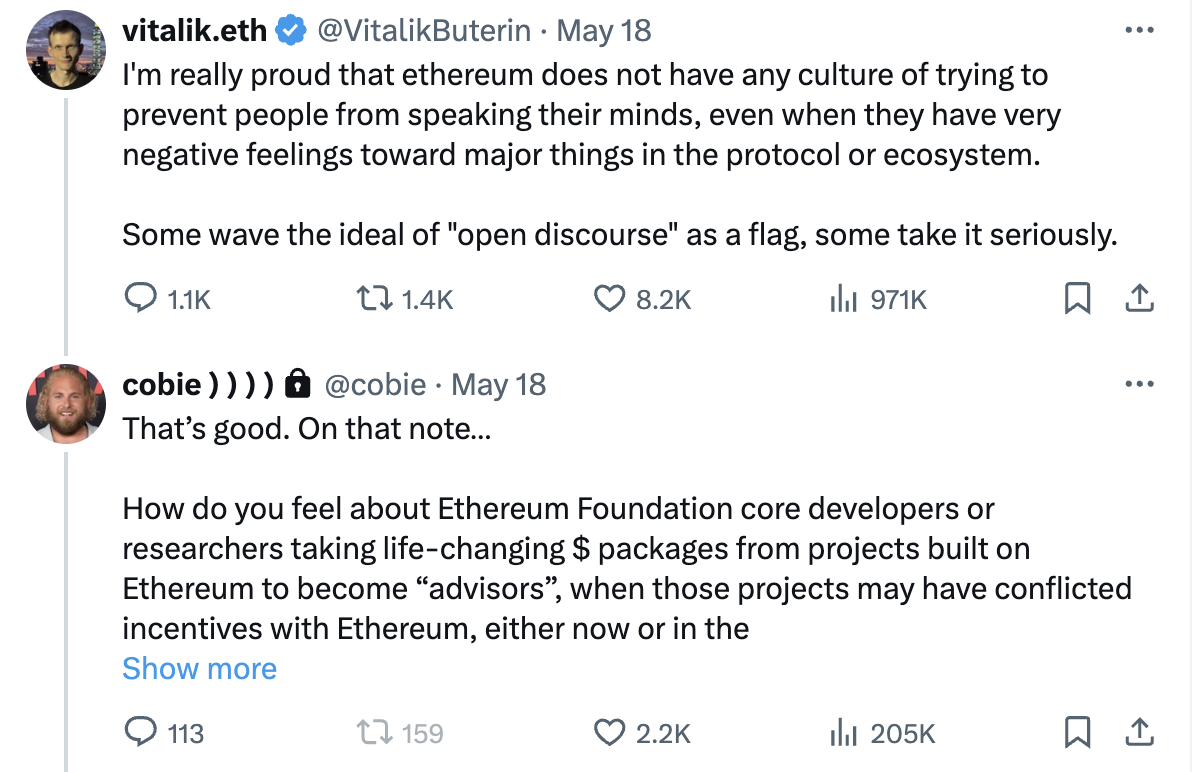
Cobie clearly had inside knowledge—he didn’t randomly pick EigenLayer. Shortly after his comment, Ethereum Foundation researcher Justin Drake published a long post on X announcing he would become an advisor to the Eigen Foundation and receive token incentives worth millions of dollars—“more than the sum of all my other personal assets combined.”
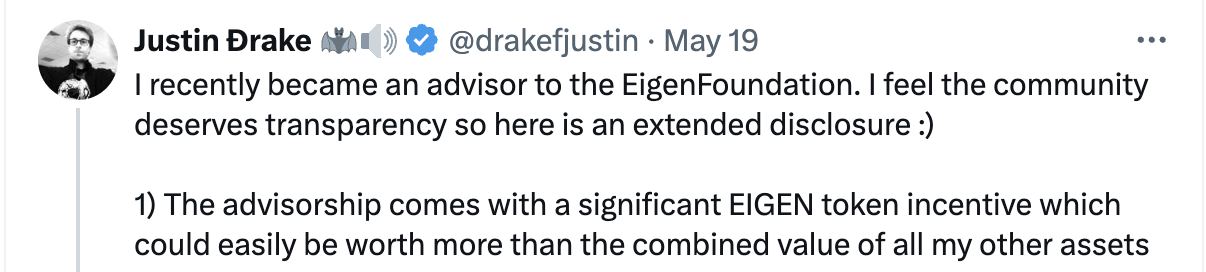
Why does this raise such controversy? Can’t someone hold multiple roles across organizations? The answer is yes—but things get complicated when the entities involved might have conflicting interests.
Restaking is generally seen as introducing additional risks to Ethereum at the protocol level. In simple terms, it may not necessarily benefit Ethereum and could create potential conflicts of interest—for instance, extra slashing events when providing security guarantees to third parties, which in the worst case could lead affected users to attempt a fork of Ethereum.
A common analogy for restaking is letting one asset work multiple jobs to earn multiple rewards. In this light, these Ethereum researchers also seem to be “restaking” themselves—taking on multiple roles. And just as restaking is risky, so too is working for multiple bosses. (If your employer turns out to be unreliable, your principal could be slashed.)
Although these researchers insist their advisory roles are personal and do not represent the Ethereum Foundation, and that they retain the right to criticize EigenLayer or terminate their advisory relationship if it acts against Ethereum’s interests, a key question remains—one posed powerfully by a community member:
"Do you really believe receiving massive compensation from an organization with different incentives won’t influence your decisions?" Does having researchers serve as advisors to for-profit projects compromise the neutrality of the Ethereum Foundation?
As stated at the beginning: "With over 300 people at the Ethereum Foundation, only a few serving as advisors to the Eigen Foundation won't affect its neutrality." That sounds convincing—unless those “few” include Dankrad Feist and Justin Drake. Because Dankrad Feist and Justin Drake are exactly the kind of individuals who can shape Ethereum’s strategic direction. Justin Drake played a pivotal role in Ethereum 2.0, and this year’s biggest narrative after ETFs is the Cancun upgrade, which implements proto-danksharding—the foundation for full danksharding. Indeed, the scaling solution adopted by Ethereum Mainnet was proposed by Dankrad Feist and named after him.
When figures like this stand to receive millions of dollars in EIGEN tokens for advising on EigenLayer, one must ask: Is the Eigen Foundation truly acting as a charitable public good? You decide.
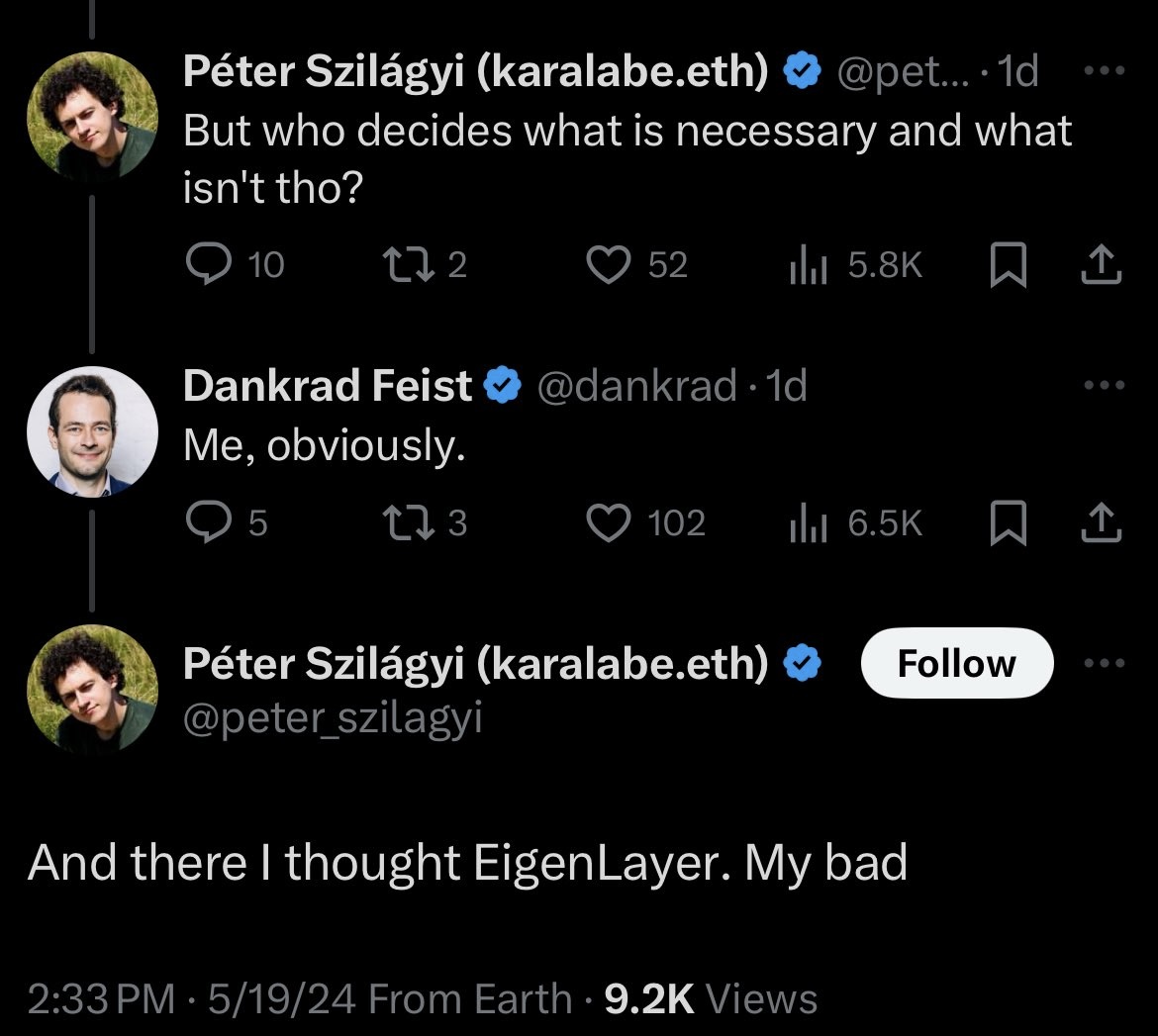
Later, Péter Szilágyi and Dankrad Feist clashed again. Péter asked, "So who decides what’s necessary for the protocol and what isn’t?" Dankrad replied, "Clearly, me."
Péter responded sarcastically: "I thought it was EigenLayer. My mistake."
Dankrad did not reply further.
Analysis: EigenLayer Buys Allies with Tokens
We don’t have direct evidence of EigenLayer’s intent in offering large token grants to recruit “advisors,” but we can observe an interesting fact.
Ten months ago, Bankless hosted a podcast titled “Restaking Alignment.” Of the seven participants, most held relatively negative views toward restaking—including Justin Drake and Dankrad.
Now, six of the seven individuals in the image below hold economic stakes in EigenLayer—through angel investment, advisory roles, or employment. The seventh person is Vitalik.
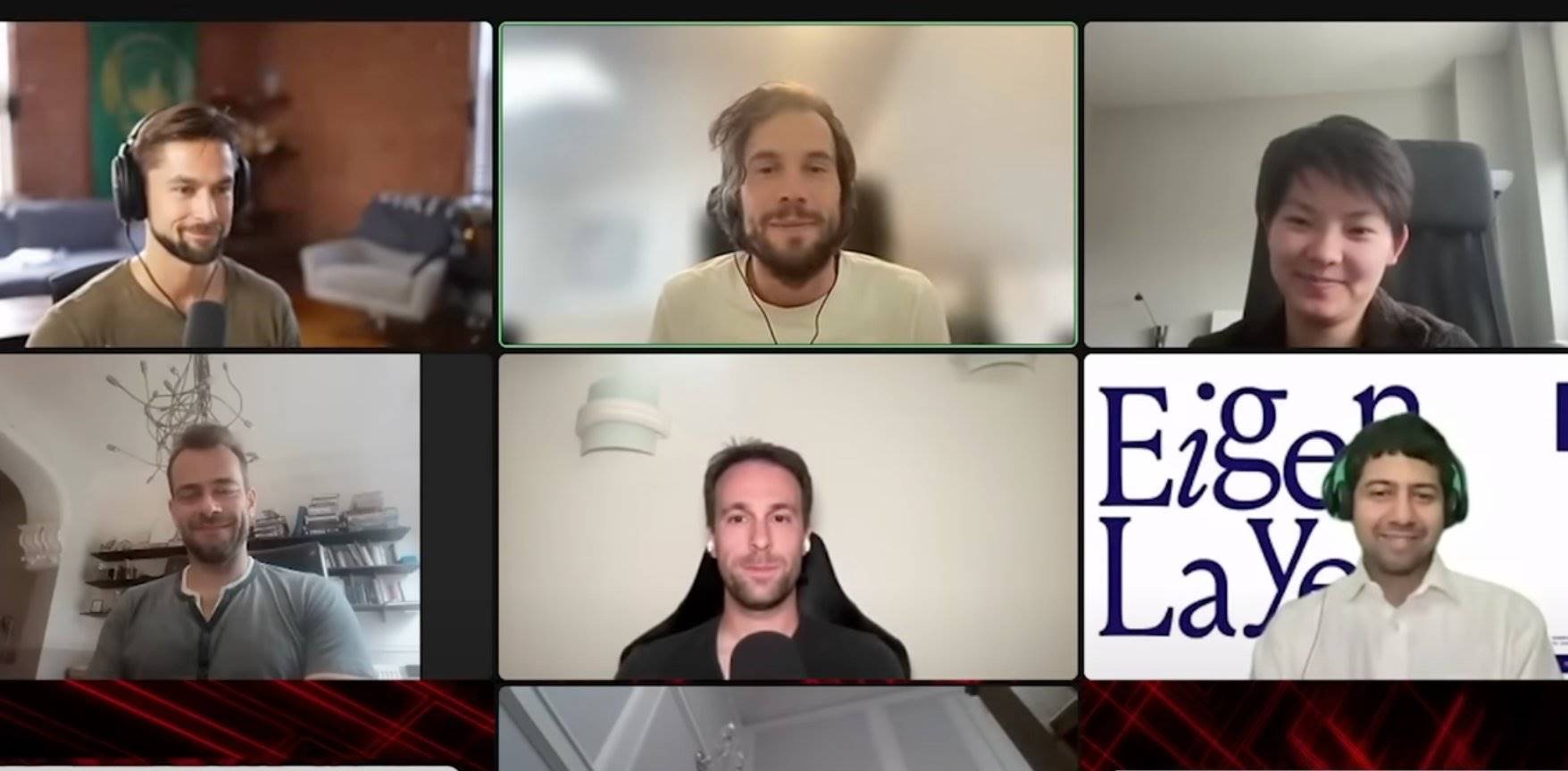
In this regard, Sreeram may be the most effective operator in history.
Reflection: Better and More Transparent Disclosure
At its core, the Ethereum Foundation is a nonprofit organization. In the crypto industry, such foundations tend to be far less transparent than traditional companies or institutions, lacking basic disclosure practices. This incident has exposed that weakness, prompting community concerns. As one observer noted:
"Compared to individual employees failing to disclose investments, I have bigger issues with the Ethereum Foundation as a whole. For years, it should have published financial reports, organizational charts, and similar information. A well-managed organization requires its staff to make disclosures."

Amid a trust crisis, the Ethereum Foundation should improve and adopt better, more transparent disclosure practices. Otherwise, people are already asking: "Should the Ethereum Foundation be disbanded?"
Extension: Social Consensus and Decentralization
Looking back, this incident reflects a crisis of trust in both individuals and the organization at the Ethereum Foundation. Community members question their neutrality, fearing private interests could steer Ethereum in the wrong direction.
In the author’s view, this is actually a positive sign. Different groups have different interests, leading to disagreements. An Ethereum that advances through debate is clearly more decentralized at the level of social consensus than one “closely united” around the Ethereum Foundation. Criticism leads to reflection, and reflection leads to progress.
Decentralization at only the technical and code level is insufficient. We must pay greater attention to decentralization at the level of social consensus. Just imagine: if there were only one decentralized computer in the world, would that itself be a form of centralization?
Ethereum pioneered smart contract platforms, but it also carries historical baggage, such as the relatively outdated EVM. Its current choice of modular architecture and rollup-centric roadmap aims to use the mainnet as a foundation, allowing divergent teams to move forward through debate, each building their own “decentralized computer” solutions—collectively shaping a better, more decentralized future.
Join TechFlow official community to stay tuned
Telegram:https://t.me/TechFlowDaily
X (Twitter):https://x.com/TechFlowPost
X (Twitter) EN:https://x.com/BlockFlow_News
 Foresight News











