








In-depth Analysis: What Sparks Can AI and Web3 Create Together?
TechFlow Selected TechFlow Selected
In-depth Analysis: What Sparks Can AI and Web3 Create Together?
The integration of AI and Web3 offers boundless possibilities for future technological innovation and economic development.
 Navigating Web3 tides with focused insights
Author: Fred
I. Introduction: The Development of AI + Web3
In recent years, the rapid advancement of artificial intelligence (AI) and Web3 technologies has attracted global attention. As a technology that simulates and imitates human intelligence, AI has achieved significant breakthroughs in areas such as facial recognition, natural language processing, and machine learning. The fast development of AI has brought tremendous transformation and innovation to various industries.
The AI industry reached a market size of $200 billion in 2023, with industry giants and standout players like OpenAI, Character.AI, and Midjourney emerging rapidly and leading the AI boom.
At the same time, Web3, as an emerging internet paradigm, is gradually changing our understanding and use of the internet. Based on decentralized blockchain technology, Web3 enables data sharing and control, user autonomy, and trust mechanisms through smart contracts, distributed storage, and decentralized identity verification. The core philosophy of Web3 is to liberate data from centralized authorities and grant users control over their data and a share in its value.
Currently, the Web3 industry has a market capitalization of $25 trillion. Whether Bitcoin, Ethereum, Solana, or application-layer projects like Uniswap and Stepn, new narratives and use cases continue to emerge, attracting increasing participation in the Web3 space.
It's clear that the convergence of AI and Web3 is a focal point for builders and VCs in both Eastern and Western markets. How to effectively integrate these two fields is a question well worth exploring.
This article will focus on the current state of AI+Web3, exploring the potential value and impact of this convergence. We will first introduce the fundamental concepts and characteristics of AI and Web3, then examine their interrelationships. Next, we will analyze the current landscape of AI+Web3 projects and delve into the limitations and challenges they face. Through this research, we aim to provide valuable insights and references for investors and industry practitioners.
II. Interaction Models Between AI and Web3
The development of AI and Web3 resembles two sides of a balance scale—AI drives productivity gains, while Web3 transforms production relationships. So what sparks can be generated when they collide? We will first analyze the challenges and improvement opportunities within each industry before exploring how they can help address each other’s limitations.
-
Challenges and potential improvements in the AI industry
-
Challenges and potential improvements in the Web3 industry
2.1 Challenges Facing the AI Industry
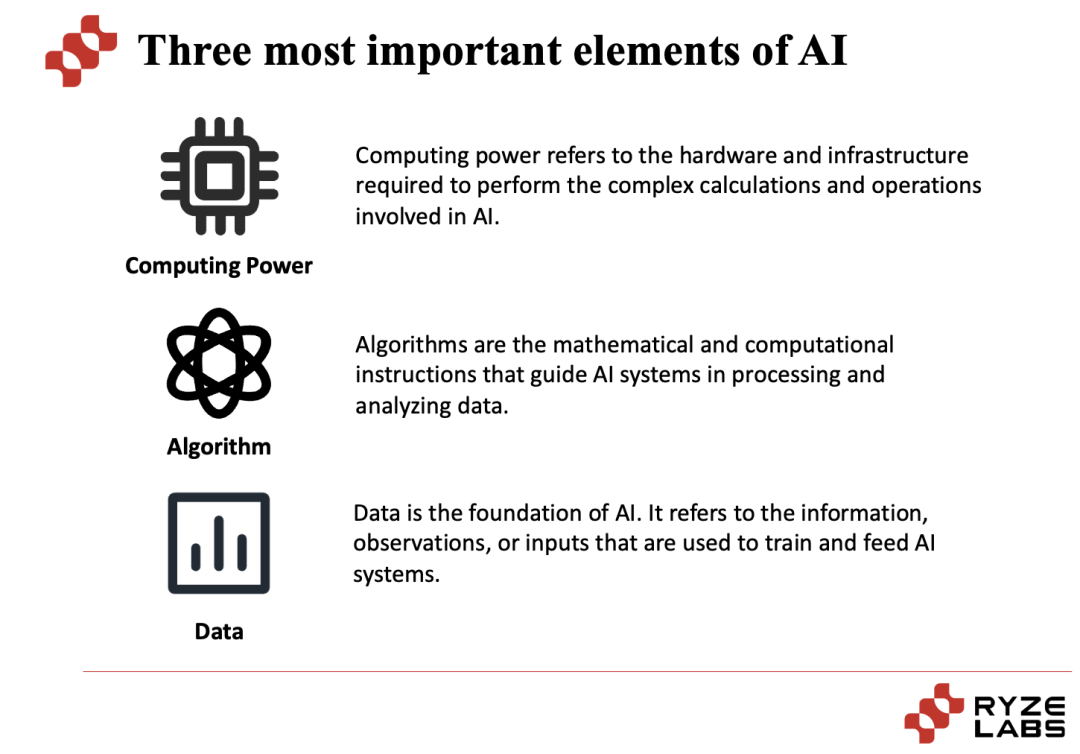
To understand the challenges facing the AI industry, let’s first look at its essence. The core of AI revolves around three key elements: computing power, algorithms, and data.
-
Computing Power: Computing power refers to the ability to perform large-scale computation and processing. AI tasks typically involve handling vast amounts of data and complex calculations, such as training deep neural network models. High computational capacity accelerates model training and inference, improving the performance and efficiency of AI systems. In recent years, advancements in hardware—such as graphics processing units (GPUs) and specialized AI chips (e.g., TPUs)—have significantly driven AI development. Nvidia, whose stock has surged in recent years, dominates the GPU market and earns substantial profits.
-
Algorithms: Algorithms are the core components of AI systems, serving as mathematical and statistical methods for solving problems and executing tasks. AI algorithms include traditional machine learning and deep learning, with the latter achieving major breakthroughs recently. Algorithm selection and design are crucial for system performance. Continuous improvements enhance accuracy, robustness, and generalization. Different algorithms yield different results, making algorithmic advancement essential for task effectiveness.
-
Data Importance: The core mission of AI systems is to extract patterns and rules from data through learning and training.
-
Data forms the foundation for training and optimizing models. Large-scale datasets enable AI systems to learn more accurate and intelligent models. Rich datasets offer comprehensive and diverse information, allowing models to better generalize to unseen data and improve real-world problem-solving capabilities.
With an understanding of AI’s three core components, let’s now explore the challenges faced in each area. First, regarding computing power: AI tasks require massive computational resources for model training and inference, especially deep learning models. However, acquiring and managing large-scale computing power is expensive and complex. High-performance computing equipment involves high costs, energy consumption, and maintenance issues. For startups and individual developers, obtaining sufficient computing power can be extremely difficult.
In terms of algorithms, despite the success of deep learning across many domains, several challenges remain. Training deep neural networks demands extensive data and computing resources, and model interpretability may be limited for certain tasks. Additionally, model robustness and generalization remain critical concerns—performance on unseen data can be unstable. Determining the optimal algorithm to deliver the best service is an ongoing process of exploration.
Regarding data, it is the driving force behind AI, yet obtaining high-quality, diverse datasets remains challenging. Data in sensitive domains like healthcare is particularly hard to access. Moreover, data quality, accuracy, and labeling pose risks—missing or biased data can lead to erroneous or skewed model behavior. Protecting data privacy and security is also paramount.
Additionally, issues such as explainability and transparency persist. The “black-box” nature of AI models raises public concern. In sectors like finance, healthcare, and justice, model decision-making processes must be interpretable and traceable—yet current deep learning models often lack transparency. Explaining decisions and providing trustworthy interpretations remains a challenge.
Moreover, many AI startups struggle with unclear business models, leaving entrepreneurs uncertain about their path forward.
2.2 Challenges Facing the Web3 Industry
The Web3 industry also faces numerous challenges—from data analytics and poor user experience to smart contract vulnerabilities and hacking incidents—all areas with significant room for improvement. As a productivity-enhancing tool, AI offers great potential in addressing these issues.
First, improvements in data analysis and prediction: AI’s application in data analytics profoundly impacts Web3. By intelligently analyzing massive datasets, Web3 platforms can extract valuable insights and make more accurate predictions and decisions—critical for risk assessment, market forecasting, and asset management in decentralized finance (DeFi).
Second, enhanced user experience and personalized services: AI enables Web3 platforms to offer improved UX and tailored services. By analyzing user data, platforms can provide personalized recommendations, customized features, and intelligent interactions—increasing user engagement and satisfaction, and promoting ecosystem growth. For example, many Web3 protocols integrate AI tools like ChatGPT to better serve users.
Third, security and privacy protection: AI plays a vital role in enhancing Web3 security. It can detect and defend against cyberattacks, identify anomalies, and strengthen overall security. AI also aids in data privacy through encryption and privacy-preserving computation techniques. In smart contract auditing, where coding and review processes may harbor vulnerabilities, AI can automate audits and vulnerability detection, improving contract reliability.
Clearly, AI offers significant support in overcoming the challenges and unlocking the potential of the Web3 industry.
III. Current State Analysis of AI+Web3 Projects
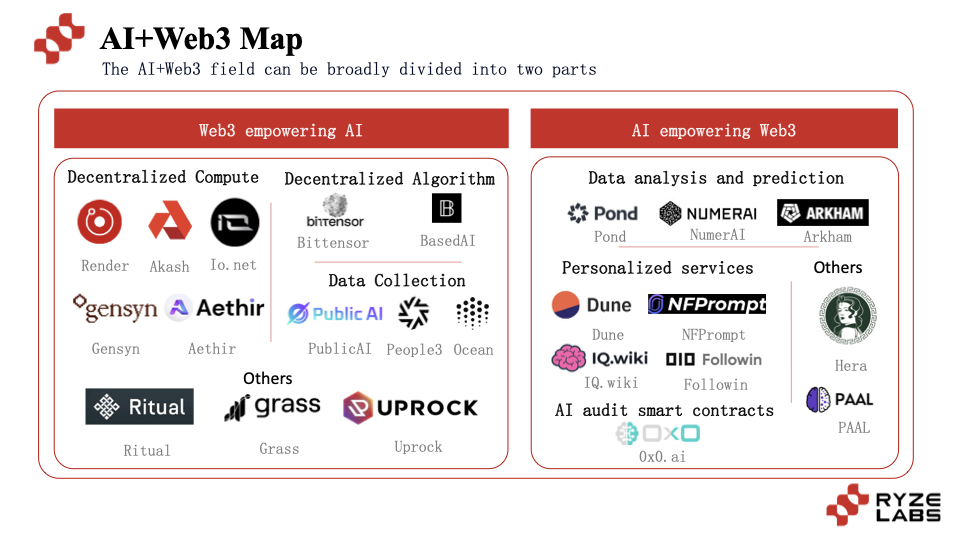
AI+Web3 integration efforts mainly fall into two broad categories: leveraging blockchain technology to enhance AI, and applying AI to improve Web3 applications.
Numerous projects have emerged in this space, including Io.net, Gensyn, Ritual, and others. This section will analyze the current status and development of these initiatives by examining sub-sectors where AI enhances Web3 and vice versa.
3.1 Web3 Empowering AI
3.1.1 Decentralized Computing Power
After OpenAI launched ChatGPT at the end of 2022, it sparked a global AI frenzy—reaching 1 million users in just five days, compared to Instagram’s two-and-a-half months. Within two months, ChatGPT hit 100 million monthly active users, and by November 2023, weekly active users reached 100 million. With ChatGPT’s emergence, AI rapidly evolved from a niche field into a mainstream industry.
According to Trendforce, running ChatGPT requires approximately 30,000 NVIDIA A100 GPUs, with future models like GPT-5 demanding even greater computational scales. This has triggered an arms race among AI companies—only those with sufficient computing power can maintain momentum and competitive advantage, resulting in a GPU shortage.
Before AI’s rise, Nvidia’s primary customers were the three major cloud providers: AWS, Azure, and GCP. With the AI boom, new buyers—including Meta, Oracle, and AI/data platform startups—joined the race to acquire GPUs for training models. Tech giants like Meta and Tesla significantly increased purchases for custom AI models and internal research. Foundational model firms like Anthropic and data platforms like Snowflake and Databricks also acquired more GPUs to enhance their AI offerings.
As Semi Analysis noted last year, there’s now a divide between "GPU-rich" and "GPU-poor" companies. A few firms own over 20,000 A100/H100 GPUs, enabling teams to use hundreds or thousands per project. These include cloud providers and LLM developers like OpenAI, Google, Meta, Anthropic, Inflection, Tesla, Oracle, and Mistral.
Most companies, however, fall into the "GPU-poor" category, struggling with limited GPU access and spending excessive time on infrastructure rather than ecosystem development. This isn’t limited to startups—even prominent AI firms like Hugging Face, Databricks (MosaicML), Together, and Snowflake possess fewer than 20K A100/H100 GPUs. Despite having world-class talent, they’re disadvantaged in the AI race due to constrained GPU supply.
This shortage extends even to leaders like OpenAI, which reportedly paused paid signups in late 2023 due to insufficient GPU availability while scrambling to secure more supply.

It’s evident that the rapid growth of AI has created a severe mismatch between GPU demand and supply—an urgent issue requiring solutions.
To address this, some Web3 projects are leveraging blockchain technology to offer decentralized computing services—such as Akash, Render, and Gensyn. These projects incentivize individuals to contribute idle GPU power via tokens, creating a decentralized supply side for AI computing needs.
The supply-side participants generally fall into three categories: cloud providers, cryptocurrency miners, and enterprises.
Cloud providers include major platforms (AWS, Azure, GCP) and specialized GPU clouds (Coreweave, Lambda, Crusoe), whose idle capacity can be resold for income. Miners, especially after Ethereum’s shift from PoW to PoS, now have idle GPUs available. Enterprises like Tesla and Meta, which strategically purchased large GPU inventories, can also contribute surplus computing power.
Current projects fall into two main types: those offering decentralized computing for AI inference, and those targeting AI training. Examples of the former include Render (focused on rendering but usable for AI), Akash, and Aethir; the latter include io.net (supports both inference and training) and Gensyn. The key difference lies in their computing requirements.
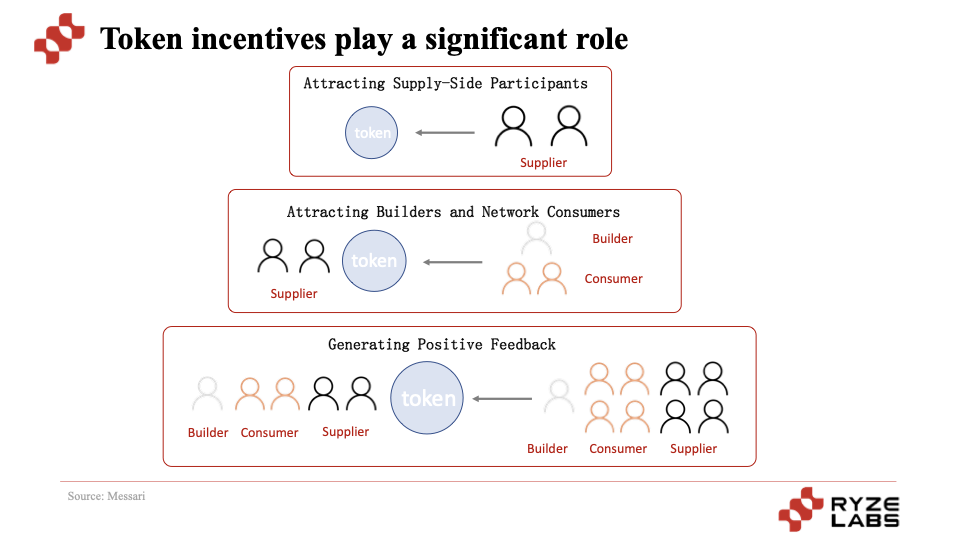
For inference-focused projects, token incentives attract contributors to form a supply network, which serves demand-side users—effectively matching idle computing resources. Details on such projects were covered in our earlier DePIN report from Ryze Labs—see here.
The core idea is using token incentives to bootstrap supply, attract users, and kickstart a self-sustaining cycle. As more suppliers join, users gain access to cheaper, high-performance services. Token value grows alongside user and supplier participation, attracting further contributors and speculators, thus capturing value.
Projects focused on AI training—like Gensyn and io.net—operate on similar principles: token incentives drive supply-side participation to meet demand.
io.net, as a decentralized computing network, currently boasts over 500,000 GPUs—making it one of the most prominent in the space. It has already integrated computing power from Render and Filecoin and continues expanding its ecosystem.

Gensyn uses smart contracts to assign and reward machine learning tasks, enabling cost-effective AI training. As shown below, Gensyn’s hourly training cost is around $0.40—far below AWS and GCP’s $2+.
Gensyn’s ecosystem includes four roles:
-
Submitters: Users who submit AI training tasks and pay for computation
-
Executors: Participants who run training jobs and generate proofs for verification
-
Verifiers: Entities that compare executor proofs against expected thresholds
-
Challengers: Participants who audit verifiers’ work and earn rewards for identifying errors
Clearly, Gensyn aims to become a globally accessible, ultra-large-scale, and economically efficient computing protocol for deep learning models. But why do most projects focus on inference rather than training?
Let’s clarify the difference between AI training and inference:
-
AI Training: If we liken AI to a student, training is akin to providing vast knowledge and examples (i.e., data) for the student to learn from. Since learning involves absorbing and memorizing large volumes of information, this process demands immense computational power and time.
-
AI Inference: Inference is like applying learned knowledge to solve problems or take exams. During inference, AI uses existing knowledge without acquiring new information, requiring significantly less computation.
The computing demands differ greatly. The feasibility of decentralized computing for inference versus training will be further analyzed in the challenges section.
Additionally, Ritual aims to combine distributed networks with model creators to preserve decentralization and security. Its first product, Infernet, allows blockchain smart contracts to access AI models off-chain, enabling such contracts to use AI while maintaining verification, decentralization, and privacy.
Infernet’s coordinator manages node behavior and responds to computation requests from consumers. When users interact with Infernet, inference and proof generation occur off-chain, with results returned to the coordinator and ultimately passed to on-chain consumers via smart contracts.
Beyond decentralized computing, projects like Grass offer decentralized bandwidth networks to enhance data transmission speed and efficiency. Overall, decentralized computing networks open new possibilities for AI’s computing supply, pushing the field forward.
3.1.2 Decentralized Algorithm Models
As mentioned in Chapter 2, AI’s three core elements are computing power, algorithms, and data. If computing power can be decentralized into a supply network, can algorithms follow a similar path?
Before analyzing specific projects, let’s understand the significance of decentralized algorithm networks. Many wonder: if we already have OpenAI, why do we need decentralized alternatives?
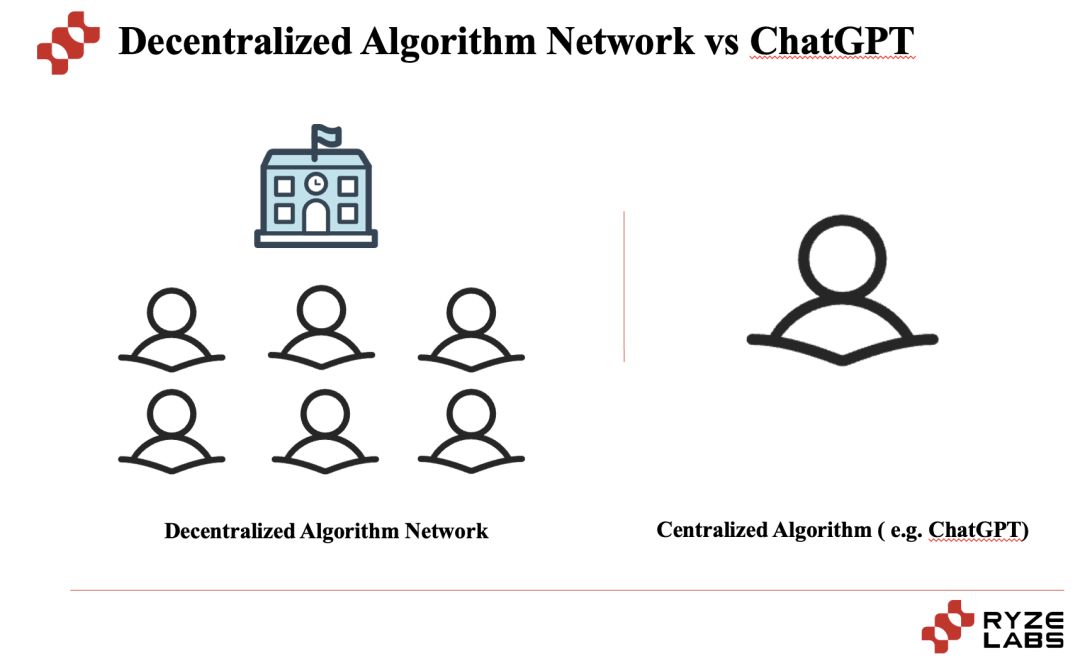
Essentially, a decentralized algorithm network is a decentralized AI service marketplace connecting multiple AI models—each with unique expertise. When a user submits a query, the network selects the most suitable model to respond. In contrast, ChatGPT is a single AI model developed by OpenAI capable of generating human-like text.
Simply put, ChatGPT is like a highly capable student solving various problems, while a decentralized algorithm network resembles a school full of students working together. While today’s top student excels, a globally inclusive “school” holds enormous long-term potential.
Several projects are exploring this space. Bittensor will serve as a representative case study to illustrate developments in this niche.
In Bittensor, algorithm suppliers (or “miners”) contribute their machine learning models to the network. These models analyze data and generate insights. Contributors are rewarded with TAO, the network’s native cryptocurrency.
To ensure answer quality, Bittensor uses a unique consensus mechanism to agree on the best response. When a question is posed, multiple miner models provide answers. Validators then evaluate these responses, select the best one, and return it to the user.
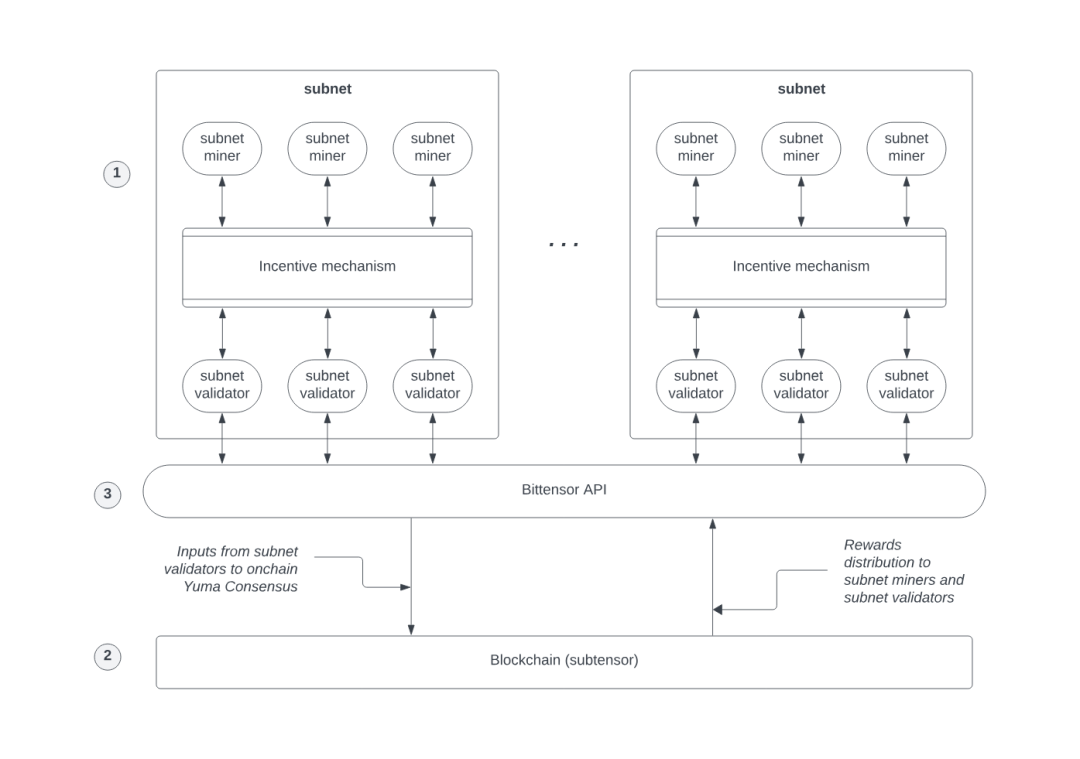
TAO tokens play two key roles: incentivizing miners to contribute models and enabling users to pay for queries and task execution.
Because Bittensor is decentralized, anyone with internet access can join—either as a questioner or a contributing miner—making powerful AI more accessible.
In summary, networks like Bittensor could foster a more open and transparent ecosystem where AI models are trained, shared, and utilized securely and distributively. Other projects, such as BasedAI, are attempting similar goals—with added emphasis on using zero-knowledge proofs (ZK) to protect data privacy during user-model interactions, a topic discussed further later.
As decentralized algorithm platforms evolve, small companies may compete with large organizations in accessing top-tier AI tools, potentially transforming multiple industries.
3.1.3 Decentralized Data Collection
Large-scale data is essential for training AI models. However, most Web2 companies still monopolize user data—platforms like X, Reddit, TikTok, Snapchat, Instagram, and YouTube prohibit data collection for AI training, posing a major obstacle to AI development.
Conversely, some Web2 platforms sell user data to AI firms without sharing profits. For instance, Reddit signed a $60 million deal with Google to train AI models on its posts. This concentration of data rights in the hands of big capital pushes the industry toward hyper-capital-intensive development.
To address this, some projects leverage Web3 and token incentives to enable decentralized data collection. PublicAI, for example, allows users to participate in two roles:
-
AI data providers: Users find valuable content on X, tag @PublicAI with insights, and use hashtags like #AI or #Web3 to send content to PublicAI’s data center.
-
Data validators: Users log into the PublicAI data center to vote on the most valuable data for AI training.
In return, contributors receive token rewards, fostering a win-win relationship between data providers and AI developers.
Beyond dedicated data-collecting projects like PublicAI, others use token incentives for decentralized data gathering—Ocean tokenizes user data for AI, Hivemapper collects map data via car cameras, DIMO gathers vehicle data, WiHi collects weather data, etc. These projects represent potential AI training data sources and thus fall under the broader “Web3 empowering AI” framework.
3.1.4 ZK for Privacy Protection in AI
Beyond decentralization, blockchain brings zero-knowledge proofs (ZK). ZK enables information verification without revealing private data.
Traditional machine learning typically requires centralized data storage and processing, raising privacy risks. Privacy-preserving methods like encryption or anonymization can limit model accuracy and performance.
ZK technology helps resolve this conflict between privacy and data sharing.
Zero-Knowledge Machine Learning (ZKML) allows training and inference without exposing raw data. ZK proofs verify data features and model outputs without revealing actual content.
ZKML aims to balance privacy protection and data sharing. It applies to healthcare analytics, financial modeling, and cross-organizational collaboration. With ZKML, individuals can protect sensitive data while sharing insights securely, enabling broader cooperation without privacy risks.
This field is still nascent, with most projects in early stages. BasedAI proposes a decentralized approach integrating fully homomorphic encryption (FHE) with large language models (LLMs) to maintain data confidentiality. Using zero-knowledge large language models (ZK-LLM), it embeds privacy into its distributed infrastructure, ensuring user data remains confidential throughout network operations.
A brief explanation of FHE: Fully Homomorphic Encryption allows computations on encrypted data without decryption. Mathematical operations (e.g., addition, multiplication) can be performed on ciphertexts, yielding results equivalent to those on plaintext—thus preserving data privacy.
Beyond the above, projects like Cortex support on-chain execution of AI programs. Running ML on traditional blockchains is inefficient due to virtual machines struggling with complex models. Cortex Virtual Machine (CVM), however, leverages GPUs to execute AI programs on-chain while remaining EVM-compatible. Thus, Cortex can run all Ethereum dApps and integrate AI into them, enabling decentralized, immutable, and transparent ML model execution—verified step-by-step through network consensus.
3.2 AI Empowering Web3
Beyond Web3 enhancing AI, AI’s contributions to Web3 are equally noteworthy. AI primarily boosts productivity, with applications in smart contract auditing, data analytics, personalization, and security.
3.2.1 Data Analytics and Prediction
Many Web3 projects now integrate existing AI services (e.g., ChatGPT) or develop proprietary solutions for data analytics and forecasting. Applications include AI-driven investment strategies, on-chain analysis tools, price and market predictions, and more.
For example, Pond uses AI graph algorithms to predict valuable alpha tokens, aiding investment decisions. BullBear AI analyzes user history, price trends, and market movements to forecast prices and maximize returns.
Numerai is an investment competition platform where participants use AI and LLMs to predict stock markets. They train models on free, high-quality data provided by Numerai and submit daily forecasts. Numerai evaluates performance over the next month, and participants stake NMR tokens on their models to earn rewards based on accuracy.
Platforms like Arkham also integrate AI for on-chain data analysis. Arkham links blockchain addresses to entities like exchanges, funds, and whales, displaying key data and insights to give users a strategic edge. Its AI component, Arkham Ultra, matches addresses to real-world entities—a system developed over three years with support from Palantir and OpenAI founders.
3.2.2 Personalized Services
In Web2, AI powers search and recommendation engines to meet personalized needs. Web3 follows suit, with many projects integrating AI to enhance user experience.
Dune, a well-known analytics platform, recently launched Wand—a tool that uses LLMs to write SQL queries. With Wand Create, users generate SQL from natural language questions, enabling non-SQL users to search easily.
Some Web3 content platforms integrate ChatGPT for summarization. Followin, a Web3 media platform, uses ChatGPT to summarize sector views and updates. IQ.wiki, a Web3 encyclopedia, integrates GPT-4 to summarize wiki articles, aiming to be the primary source of objective, high-quality blockchain knowledge. Kaito, an LLM-powered search engine, seeks to transform Web3 information discovery.
In content creation, projects like NFPrompt reduce user effort. NFPrompt lets users generate NFTs via AI, lowering creation costs and offering personalized creative services.
3.2.3 AI-Powered Smart Contract Auditing
Smart contract auditing is crucial in Web3. AI can efficiently and accurately identify code vulnerabilities.
As Vitalik once noted, one of crypto’s biggest challenges is code errors. A promising solution is using AI to simplify formal verification—proving code satisfies specific properties. Achieving this could lead to error-free SEK EVMs (e.g., Ethereum VM). Reducing bugs increases system security, and AI plays a key role in this vision.
For instance, 0x0.ai offers an AI-powered smart contract auditor—a tool using advanced algorithms to analyze contracts and flag potential vulnerabilities that could lead to fraud or security risks. Auditors use machine learning to detect code patterns and anomalies, marking issues for deeper review.
Beyond these, native AI+Web3 use cases include PAAL, which helps users create personalized AI bots deployable on Telegram and Discord for Web3 communities; and Hera, an AI-driven multi-chain DEX aggregator that finds optimal trading paths across any token pair. Overall, AI empowers Web3 primarily as a tool-level enhancement.
IV. Limitations and Challenges of AI+Web3 Projects
4.1 Real-World Barriers in Decentralized Computing
Many Web3-for-AI projects focus on decentralized computing, using token incentives to turn global users into computing suppliers—an innovative concept. However, practical challenges remain:
Compared to centralized providers, decentralized computing relies on globally distributed nodes, which may suffer from network latency and instability—potentially affecting performance and reliability.
Additionally, availability depends on supply-demand matching. Insufficient suppliers or high demand may lead to resource shortages.
Finally, decentralized computing involves greater technical complexity. Users may need to understand distributed networks, smart contracts, and crypto payments—raising the barrier to entry.
After deep discussions with project teams, it’s clear that current decentralized computing is largely limited to AI inference, not training.
We’ll explore four key questions to understand why:
1. Why do most decentralized computing projects focus on inference instead of training?
2. What makes Nvidia so dominant? What makes decentralized training difficult?
3. What is the ultimate outcome for decentralized computing (Render, Akash, io.net, etc.)?
4. What is the ultimate outcome for decentralized algorithms (Bittensor)?
Let’s break it down step by step:
1) Most decentralized computing projects choose inference over training due to differing computing and bandwidth requirements.
To clarify, think of AI as a student:
AI Training: Providing vast knowledge and examples (data) for the AI to learn—requiring immense computation and time, much like studying.
AI Inference: Applying learned knowledge to solve problems or take exams—requiring far less computation since no new learning occurs.
The key difference lies in large models needing massive data and extremely high-bandwidth communication. Decentralized training is thus extremely difficult. Inference, with lower data and bandwidth needs, is far more feasible.
For large models, stability is paramount—if training interrupts, restarting incurs high sunk costs. Conversely, lower-compute tasks like inference or domain-specific medium/small model training are achievable. Larger node providers in decentralized networks can serve these higher-demand cases.
Join TechFlow official community to stay tuned
Telegram:https://t.me/TechFlowDaily
X (Twitter):https://x.com/TechFlowPost
X (Twitter) EN:https://x.com/BlockFlow_News
 @RyzeLabs











