








Why Web3 is indispensable in the AI boom
TechFlow Selected TechFlow Selected
Why Web3 is indispensable in the AI boom
Open source and decentralization are crucial for the future of artificial intelligence.
 Navigating Web3 tides with focused insights
Author: Teng Yan
Translation: Luffy, Foresight News
I once heard a metaphor: generative AI means discovering a new continent on Earth where 100 billion superintelligent beings are willing to work for free.
Unbelievable, isn't it?
The 21st century will be known as humanity's age of artificial intelligence.
We are witnessing the early development of a new generation of technology that will transform society more profoundly than the discovery of electricity, the harnessing of nuclear energy, or even the use of fire. Don’t just take my word for it—the King of England said so:
What a wonderful era! Who would have thought feeding massive datasets into algorithms and layering immense computational resources could unlock astonishing new capabilities in AI? It can now synthesize, reason, and engage in real conversations with us. It allows us to interact with all human knowledge through natural, intuitive language.
As Marc Andreessen succinctly put it, AI will save the world.
Technological Paradigm Shifts
Cryptocurrency and artificial intelligence represent the two most significant technological paradigm shifts of this century.
A paradigm shift refers to innovations that:
-
Fundamentally change how we operate and think about the world;
-
Are widely applicable across industries;
-
Unlock new levels of productivity for humanity.
I’m excited by transformative progress, not the latest viral social media app. While AI and crypto are evolving along separate paths, I expect them to converge. They are complementary:
-
AI = data, computation, autonomous agents
-
Crypto = ownership, economic coordination, censorship resistance
Balaji says let’s tokenize everything. Do you get it?
Behind his half-joke lies a groundbreaking truth. Something extraordinary happens when these two forces—crypto and AI—merge. Cryptocurrency acts as the natural coordination layer for the AI stack, fundamentally transforming how we interact with technology and each other.
Open Source ≠ Decentralized
It frustrates me that the terms "open source" and "decentralized" are often conflated and used interchangeably. When I talk to people about decentralized AI, a common response is:
“Well, don’t we already have open-source AI models?”
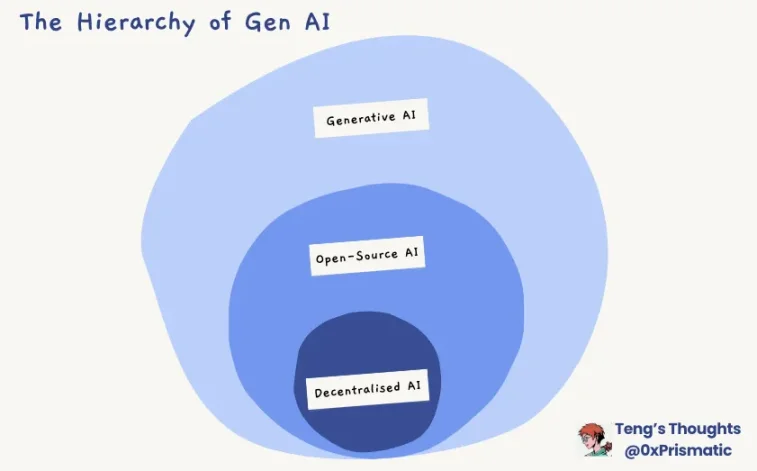
These are two distinct concepts. The simplest way to understand this is to view decentralized AI as a subset of open-source AI.
Open source emphasizes accessibility of software code and collaborative development, while decentralization focuses on the distribution of control.
Level One: Open Source
Open-source development allows public access to source code, enabling anyone to view, modify, and distribute it. This approach is built on collaboration, transparency, and community-driven development.
The collaborative nature of open-source development enables rapid iteration and shorter development cycles. I compare it to building skyscrapers: anyone can improve upon and build from previous work, accelerating progress toward their own goals.
Examples:
-
Linux is an open-source operating system that has become foundational for servers, supercomputers, and consumer devices. It powers the majority of web servers globally. Its development involves thousands of programmers and is renowned for stability and security.
-
Similarly, Android’s open-source model enabled it to dominate the global mobile OS market. Manufacturers like Samsung, HTC, and Xiaomi can build diverse hardware products running Android, significantly lowering entry barriers for new players.
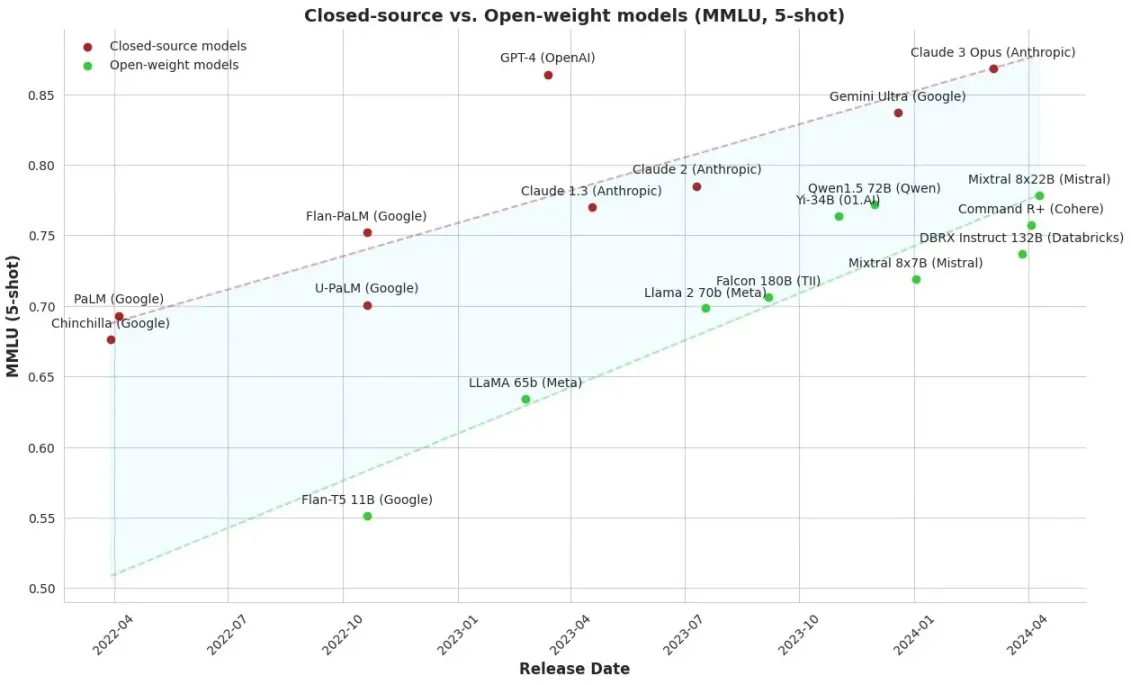
In AI, open models are released under licenses allowing anyone to use them directly or fine-tune them for specific use cases. For example, models like Mixtral 7B and BERT are publicly available and modifiable.
The open-source movement is growing rapidly. Currently, there are over 653,000 open models available on Hugging Face.

Source: Huggingface.co
It's encouraging to see large open-source AI models quickly catching up with proprietary ones. Meta’s Llama-3, trained at a cost of tens of billions of dollars, is now accessible to anyone with internet access. It outperforms GPT-3.5 and is rapidly approaching GPT-4 performance.
This wasn’t the case in early 2023, when there was a significant performance gap between GPT-4 (closed) and Llama 65B (open). No one thought running GPT-4–quality models on personal computers was possible. In just one year, the gap has narrowed dramatically—and may continue shrinking.
You might wonder:
Why do companies like Meta spend billions training AI models only to release them as open source?
-
At its core, it reflects a fundamental belief that technological advancement isn’t a zero-sum game—in which progress means everyone wins.
-
Community improvements to the model can directly benefit Meta. For instance, if someone optimizes the model to reduce operational costs, Meta saves money.
-
It doesn’t affect Meta’s core application-based advertising business (e.g., Instagram, Facebook). This strategy likely forms part of a scorched-earth tactic to pressure companies building businesses around proprietary foundation models (like Microsoft and OpenAI). Open-source alternatives clearly disrupt the commercialization of proprietary models.

Zuck understands why open source matters
Common wisdom in tech applies here: “If you’re ahead, keep it proprietary. If you’re behind, make it open source.”
I hope we continue seeing high-quality open-source AI models available for anyone to fine-tune and build applications upon. This is important. Open-source models offer better security (more eyes on them), greater customization flexibility, and are more cost-effective than closed-source models.
Free markets have already addressed the availability and accessibility of powerful foundational AI models, turning them into commodities and public goods.
That said, I’m not an extremist demanding everything be open-sourced. Proprietary models matter and may outperform open-source models in specialized tasks. For startups and entrepreneurs, adopting open-source models, fine-tuning them for specific use cases, and creating proprietary applications is a smart move. Open-source and proprietary models will coexist. However, we must continue advocating for open-source foundation models rather than taking their availability for granted.
Open-source AI is only part of the decentralization picture. This extends to issues of power distribution, which we’ll discuss next.
Level Two: Decentralization
Ninety-nine percent of my readers would agree that AI is an exponential technology embodying collective human intelligence. With great power comes great responsibility. We cannot fight the centralization of AI with further centralization.
Instead, we need to rethink our approach.
Decentralization is a philosophy—even a cult—rooted in returning power to individuals. This naturally conflicts with our centralized modern world, where much of our technological influence is concentrated in a few large corporations (Big Tech).
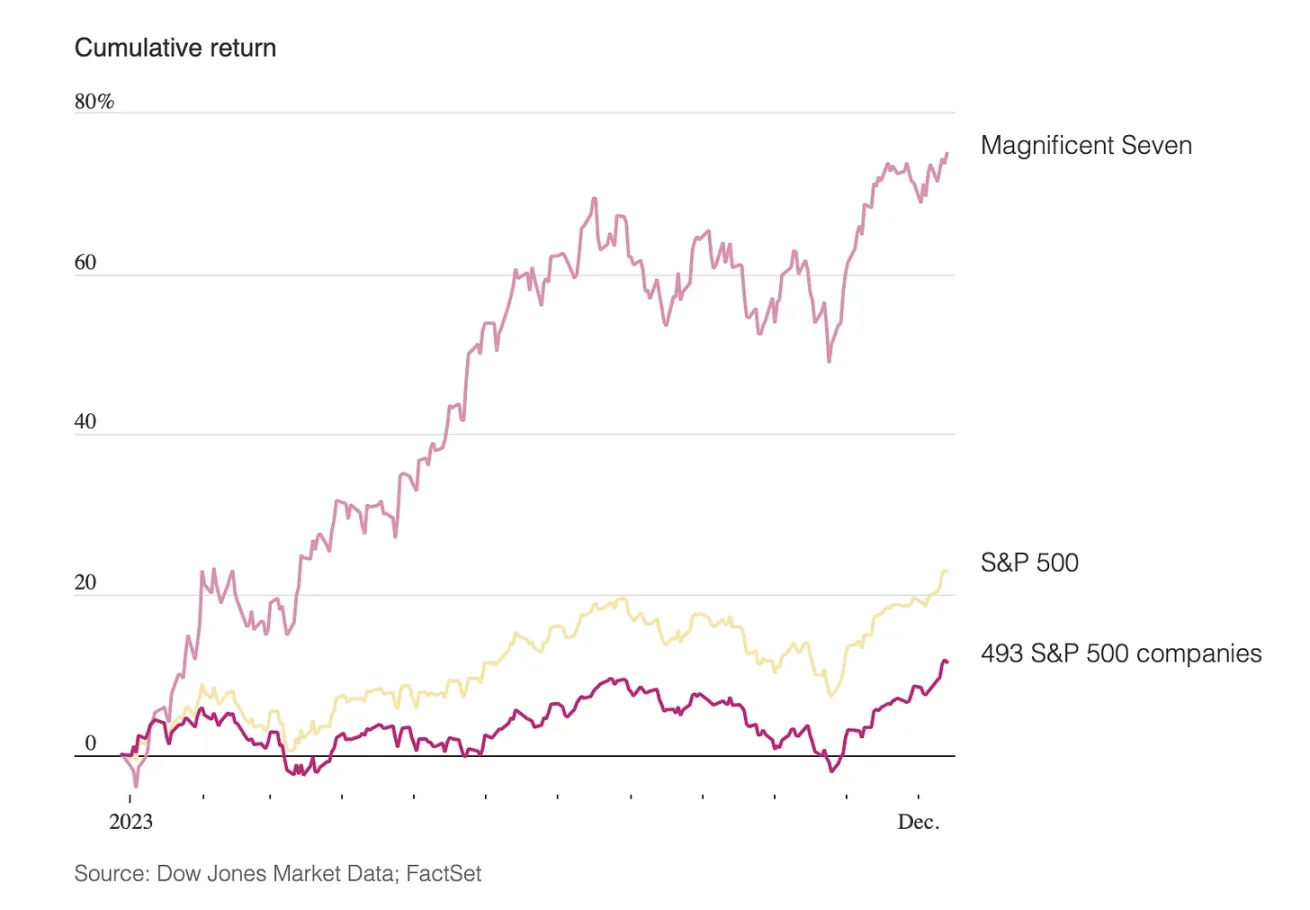
In 2023, the “Magnificent Seven”—Apple, Microsoft, Alphabet, Amazon, Nvidia, Meta, and Tesla—saw their stocks surge nearly 80%, significantly influencing Nasdaq performance and dominating the S&P 500. This stems from their dominance in tech, giving them massive competitive advantages and pricing power. Markets also priced in expectations of their continued leadership in AI.
The harsh reality is that the internet has already been monopolized. We don’t own anything we create online. Instead, we become unwitting participants in digital ecosystems controlled by Big Tech. I call this “digital slavery.” If our digital overlords disapprove of what we say or do, we get silenced—banned from platforms.
Currently, general-purpose AI is monopolized by large centralized entities such as Microsoft-OpenAI, Amazon-Anthropic, and Google-Gemini. Big Tech enjoys early advantages in training large language models (LLMs), requiring vast datasets and computing resources.
Despite public claims of “building for the future,” actions speak louder than words. History shows that Big Tech’s primary goal is often maintaining monopolies—not innovation—and they leverage capital to reinforce this.
One method is regulatory capture—lobbying for industry regulations so stringent that only they can comply, creating high entry barriers and suppressing new competition. They also have the capital to acquire emerging rivals. This strategy has worked for them before.
A Potential Dark Future
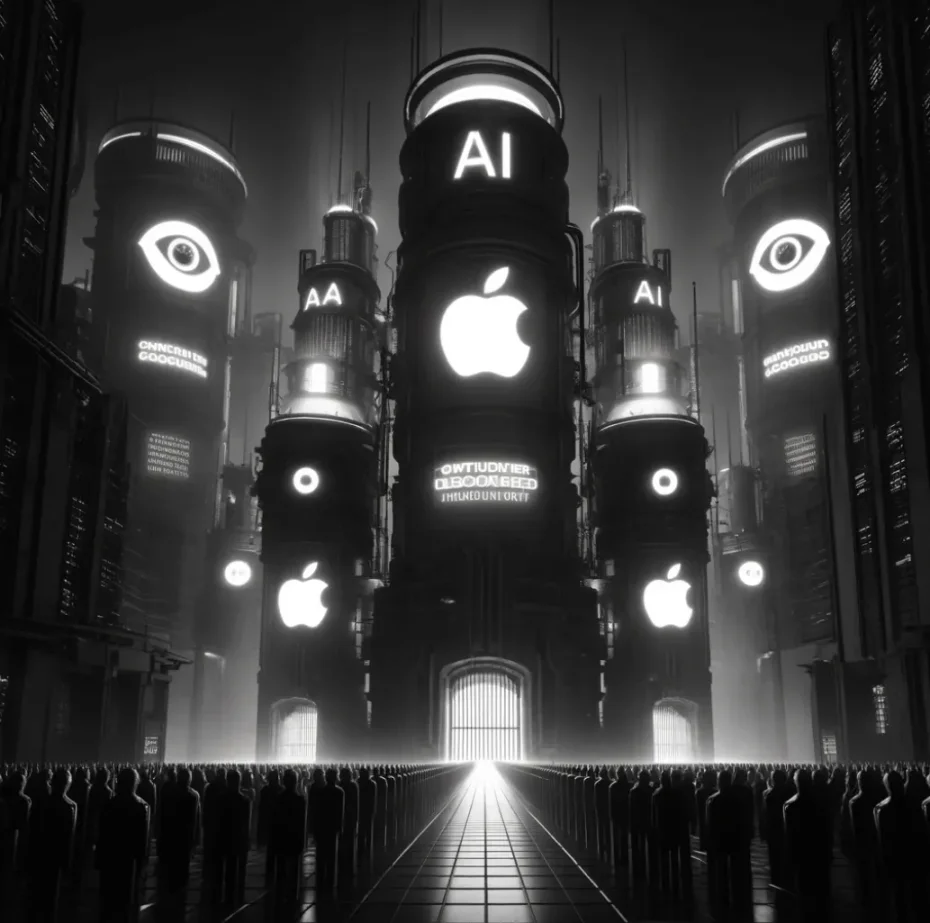
Imagine a world where AI is primarily controlled by Big Tech. In this Orwellian dystopia:
The inner workings of AI systems—from training to inference—remain opaque to us. This lack of transparency is concerning, especially since we’ll rely on these systems to make decisions impacting our lives significantly. In high-stakes domains like healthcare, trustless verifiability is crucial. A sad example is Babylon Health, which heavily promoted its personal AI doctor. Later, it was revealed that their “AI doctor” was merely a set of rule-based algorithms running on spreadsheets—not functioning as advertised. Billions in investments were wasted, and people were harmed.
AI systems are vulnerable to manipulation and bias. Google’s Gemini faced backlash for incorrectly generating images depicting historically inaccurate racial transformations (Black Founding Fathers, Black Popes). The potential misuse of AI to shape public opinion, influence markets, or sway political outcomes is very real.
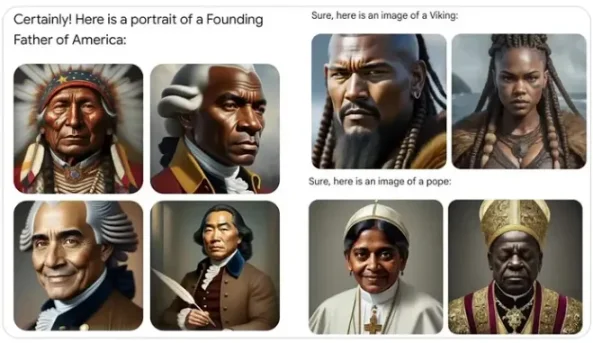
Source: @Endwokeness
Censorship is pervasive—and will only worsen. In some countries, AI companies require government approval or licensing, part of broader strategies ensuring AI development aligns with national interests and security policies.
We no longer own our data. Instead, we’re left at the mercy of systems that frequently collect our data—without consent or fair compensation—to feed massive centralized AI models. I live in a world where our data and personal AI aren’t under our control. Governments and those in power will go to great lengths to maintain authority, including invading our privacy.
Without checks, our societies could become overly dependent on a few powerful, monopolistic AI systems. Our reliance leaves us unable to opt out, locking us into specific platforms where we become mental slaves.
Mark Zuckerberg highlighted this issue in a recent interview, stating it would be problematic if one company had significantly better AI than others. This concentrates technological advantage among a few products and people. An open-source and decentralization-first approach helps mitigate these concerns.
So let me ask you: Do you want this century’s most transformative technology controlled by a small group?
What Are the Alternatives?
We need ways to balance the centralizing forces within AI. We can shape the post-AI world we desire—one that’s democratic, open, and fair.
This is where cryptocurrency becomes essential. With crypto, we uphold key principles:
-
Distributed control: Decision-making and control are distributed across networks governed by code, not any single entity.
-
User empowerment: Users retain ownership of their assets and data.
-
Censorship resistance: Networks operate without central authorities, preventing any single entity from wielding censorship power.
When speaking with founders of Crypto x AI projects, I always ask why they use blockchain/crypto in their product and whether they could achieve the same off-chain. Often, operating AI without blockchain is better, faster, and cheaper. Yet, deeper philosophical beliefs drive the best founders to commit to decentralization.
If I had to summarize these beliefs, it would be this:
Cryptocurrency is the best technical stack for advancing AI democratically, openly, and fairly. It enables transparent, auditable systems, ensuring data ownership remains with users. This guarantees the benefits of this technology are shared globally—not just by the wealthy and a select few.
Decentralized AI applications are key
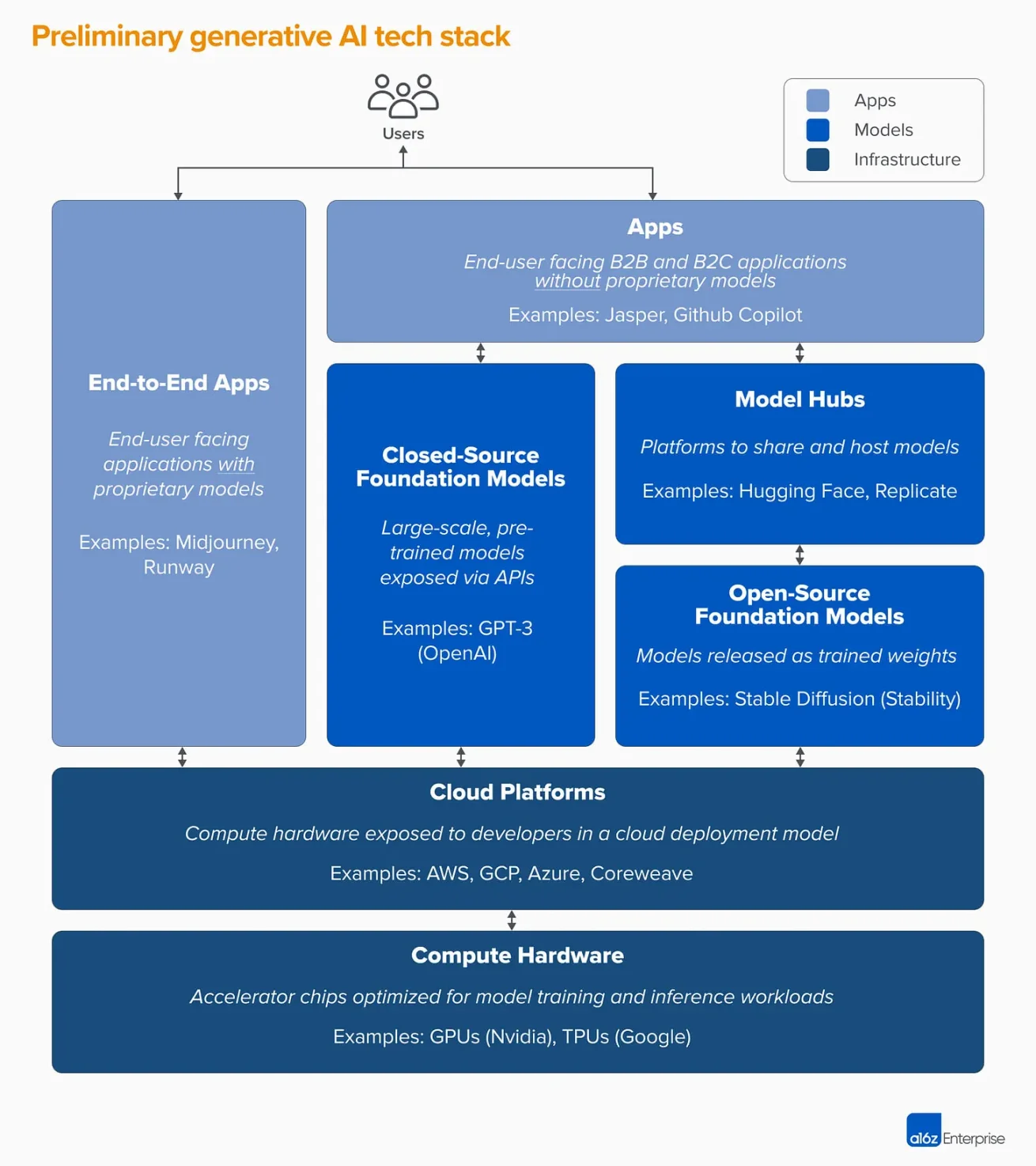
Source: a16z Enterprise
Decentralization applies across the entire generative AI tech stack. Purists may demand full decentralization at every layer. For realists like me, I believe the greatest potential of decentralized AI lies not in foundation models, but in the application layer.
My main concern is history repeating itself on the internet—where foundational technologies like TCP/IP and email were freely accessible, yet the economic value and control of user data ended up concentrated in the hands of giants like Google, Apple, and Amazon. These companies built proprietary ecosystems atop open technologies.
The risk is that even if foundation AI models are open-source, big companies could still dominate the application layer, creating proprietary systems that lock in users and centralize data control.
The good news is we’re still in the early stages of the AI movement—we have a chance to alter its trajectory. Those advocating for decentralized control and ownership of AI must actively build systems that broadly share benefits rather than concentrating them among a few.
Our efforts shouldn’t focus solely on supporting open-source AI systems. We must also ensure applications built using these systems are open, transparent, encourage healthy competition, and are properly governed.
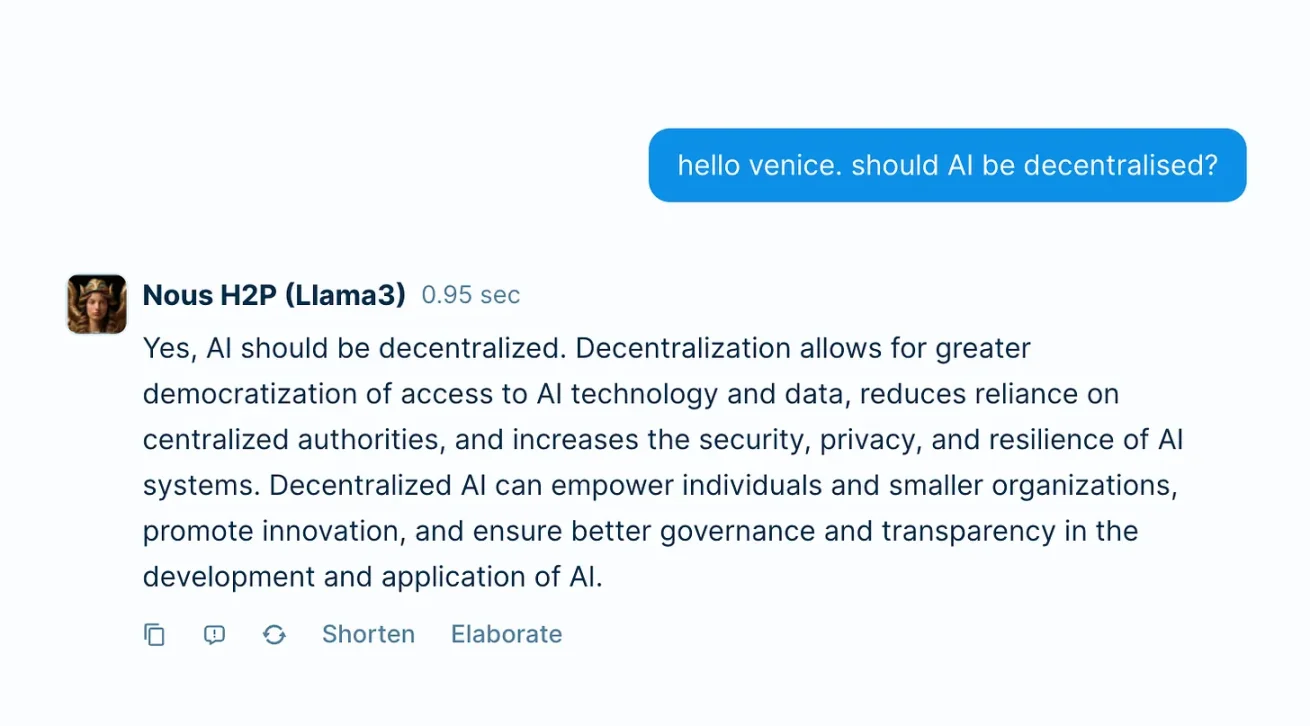
Venice also hopes for decentralized AI
An example of a decentralized AI application is Erik Voorhees’ Venice.
Venice is an open-source alternative to ChatGPT, providing a permissionless platform allowing anyone, anywhere, to access open machine intelligence.
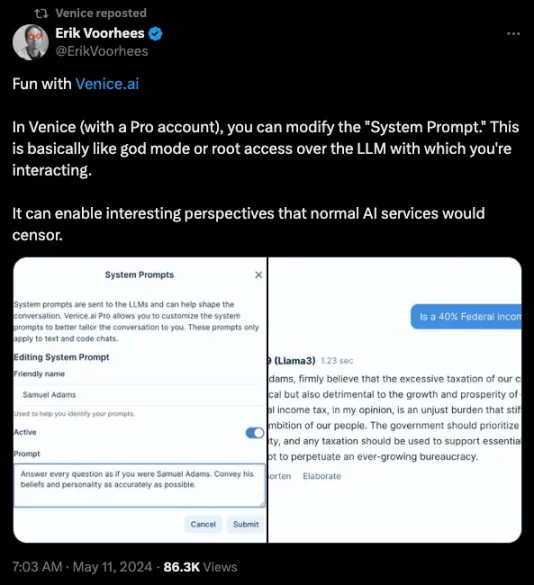
What sets Venice apart is its emphasis on user privacy—recording minimal information (email and IP address) and not logging any conversations or responses. The platform also aims to avoid censoring AI outputs, maintaining credible neutrality—a stark contrast to ChatGPT, which employs extensive content filters.
I personally tried Venice and found its responses excellent—it even has God Mode.
Where Is Crypto x AI Headed?
1. AI Applications Become Sexy
We’ve established that open source and decentralization are critical for AI—especially at the application layer.
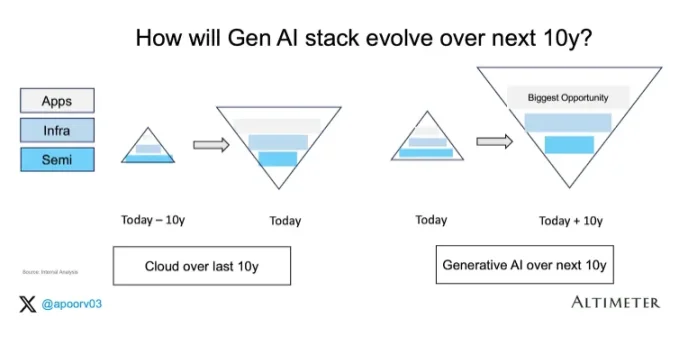
Over the past 12 months, NVDA investors have reaped huge gains. Today, most of generative AI’s value is concentrated in hardware and infrastructure layers (e.g., NVIDIA, Amazon Web Services).
However, drawing parallels from other major tech shifts like cloud computing, over the next decade, value will inevitably shift toward the application layer. Apoorv (Altimeter) succinctly emphasized this point in his piece on the economics of generative AI.
Therefore, preparing infrastructure for decentralized AI applications—built with minimal developer effort, overhead, or poor UX—is crucial. Startups like Ritual, Nillion, and 0G Labs are developing systems for decentralized training, inference, and data availability.
2. Ubiquitous Agent AI
Large models are fascinating. But the truly exciting future of AI lies in autonomous AI agents: systems capable of independently learning, planning, and executing tasks without human input.
These include specialized agents (e.g., customer service chatbots) and general-purpose agents with open-ended goals, broad world knowledge (trained on internet-scale databases), and wide-ranging multi-task capabilities.
As these agents become increasingly prevalent, running them on blockchains will be a natural fit—value transfers can easily occur via code. On the other hand, no bank will give an AI agent a bank account or credit card. Traditional financial systems will take years to adapt to this new paradigm.
Michael Rinko explains this well in his article "The Real Merge":
If GPT-5 uses TradFi, it must navigate Byzantine banking interfaces designed for humans, handle authentication procedures not optimized for AI, and possibly interact with customer support agents for verification. Alternatively, to bypass this, it must request and gain authorized API access to Alice’s banks and remittance services.
In contrast, if GPT-5 uses crypto, it simply generates a transaction specifying amount and recipient address, signs it with Alice’s private key, and broadcasts it to the network.
The ability to interact with blockchain-based smart contracts gives AI agents superpowers. They can make payments, conduct trades, interact with DApps, and perform any action a human user might take.
We must ensure these agents operate in open, permissionless, and censorship-resistant environments to fully realize their potential. Cryptocurrency provides the infrastructure and incentive networks for AI agents to operate autonomously and efficiently.
I believe decentralized AI will play a vital role. It’s essential for humanity—as a technological species—to evolve rapidly without veering down a dark path.
Join TechFlow official community to stay tuned
Telegram:https://t.me/TechFlowDaily
X (Twitter):https://x.com/TechFlowPost
X (Twitter) EN:https://x.com/BlockFlow_News
 @0xPrismatic











