Farcaster: Reshaping SocialFi Under the Cryptographic Night Sky
TechFlow Selected TechFlow Selected
Farcaster: Reshaping SocialFi Under the Cryptographic Night Sky
A new asset issuance method born on Farcaster, breaking through the traditional concept of SocialFi.
 Navigating Web3 tides with focused insights
Author: Chen Mo cmDeFi
Key Insight: Farcaster is a decentralized social media protocol that provides developers, creators, and regular users with an open and composable social layer.
At the user level, it focuses on privacy protection and self-sovereignty; at the protocol level, it emphasizes open-source and permissionless access; at the product level, it promotes applet-like interactivity, enabling direct access to diverse services and applications within social media posts through Frames.
-
Decentralized Architecture: Operates without reliance on central servers, running on blockchain infrastructure.
-
User Sovereignty: Users retain full control over their data and social graph. Even if an application is restricted, users still maintain ownership of their identity.
-
Open-Source & Permissionless: Anyone can integrate with Farcaster’s API or build new applications using its protocols.
-
Composability: Offers a platform-level social layer where apps can interoperate and share a unified social identity.
-
Mixed Architecture: Combines on-chain and off-chain systems to improve system efficiency and responsiveness.
-
Frames Functionality: Allows embedding mini-applications directly into posts, enhancing interactivity and user experience.
Research Report
1/8 · Solution Analysis
Currently, SocialFi has two main directions:
-
Financialization - Friend Tech
-
Base Layer Reconstruction - Farcaster
Farcaster fundamentally belongs to base-layer reconstruction—closer in concept to a "Layer." This foundational nature makes it possible to build financialized services atop it, enabling broader application scenarios.
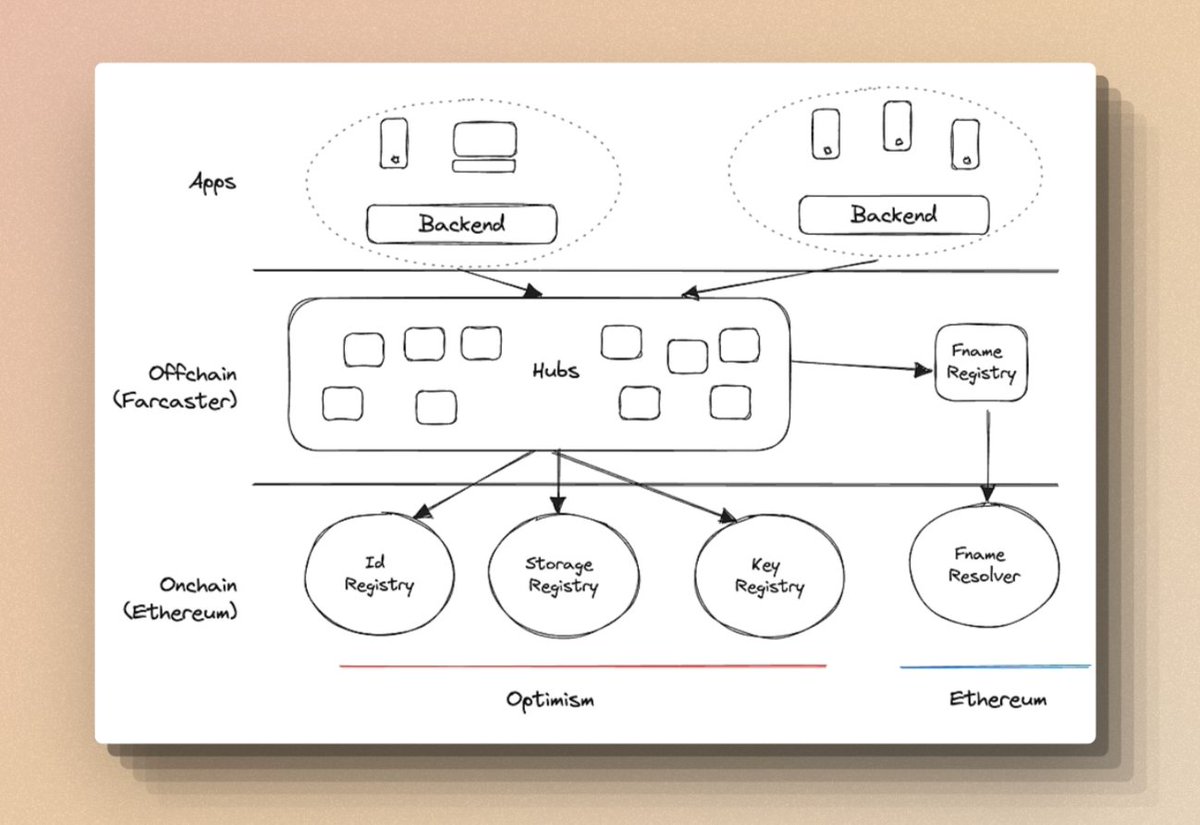
Farcaster uses a hybrid on-chain/off-chain architecture: critical information such as user identities and cryptographic keys are handled on-chain, while content storage, validation, and distribution occur off-chain. For example, Alice can create a message like "Hello Bob" and sign it with her private key. The message is stored on server nodes called "Hubs," each maintaining a copy of the entire network. These Hubs collectively form a new social consensus layer. A user can post a message to one Hub, which then propagates across the network within seconds.
1. On-Chain Components
Farcaster's on-chain elements primarily consist of smart contracts deployed on Ethereum Layer 2 (Optimism). These contracts handle core functions including:
-
ID Registration: Generates key pairs linked to a user’s Ethereum address, ensuring unique and secure identities.
-
Storage Registration: Manages allocation of user data storage space and collects annual fees to ensure reliable data retention.
-
Key Registration: Manages public and private keys, allowing users to authorize or revoke account access for secure message signing and authentication.
Regarding storage registration, this operates as a "pay-to-post" model. Farcaster accounts must pay rent to keep messages on the network. This mechanism prevents spam. Currently, the cost is approximately $5–7 per year—an early barrier for casual users, but a necessary measure to maintain performance and efficiency during periods of limited network robustness.
2. Off-Chain Components
Farcaster’s off-chain components include a set of servers known as Hubs, running on traditional hardware. They manage data operations that don’t require on-chain confirmation, improving speed and reducing costs. Key functions include:
-
Message Processing: Hubs receive, validate, and store user Casts (posts), verifying signatures and checking against on-chain identity records.
-
Data Synchronization & Distribution: Once validated, messages are stored locally and synchronized with other Hubs to ensure consistency and reliability.
-
Performance Optimization: By handling heavy data interactions off-chain, Hubs reduce dependency on blockchain transactions, lowering latency and cost—crucial for platforms requiring real-time engagement.
2/8 · Social Optimization
User relationships and interactions on Farcaster benefit significantly from this hybrid architecture:
-
Self-Sovereign Identity & Key Management: Users create a unified identity on-chain via the ID registration contract, tied to their Ethereum address and key pair. Key management enables secure, third-party-free control over account access and authorization. This ensures only the user controls their identity—eliminating risks like username confiscation by platform operators seen in traditional social media.
-
On-Chain/Off-Chain Data Separation: Core security functions (e.g., authentication) are processed on-chain, while non-sensitive interactions (e.g., messaging, social graph building) happen off-chain. This balances privacy with fast application performance.
-
Decentralized Storage: User data is distributed across a decentralized network rather than centralized servers, increasing resistance to censorship and attacks. As this distributed consensus strengthens, so does the underlying resilience of Farcaster—similar to how Chainlink’s decentralized oracle networks (DONs) enhance security and stability as more nodes join.
-
Autonomous Control Over Data Access & Sharing: Smart contracts enable granular control over data permissions. Users define who sees their activity and personal data, with these rules enforced on-chain. Applications access social graph data only with explicit user consent.
-
Cross-App Interoperability & Composability: With APIs and developer tools, third-party apps can integrate Farcaster identities. Users interact across different social apps using a single identity—akin to logging into various services with a WeChat account. However, Farcaster’s permissionless model fosters a richer ecosystem of embedded “applets” due to lower barriers for developers.
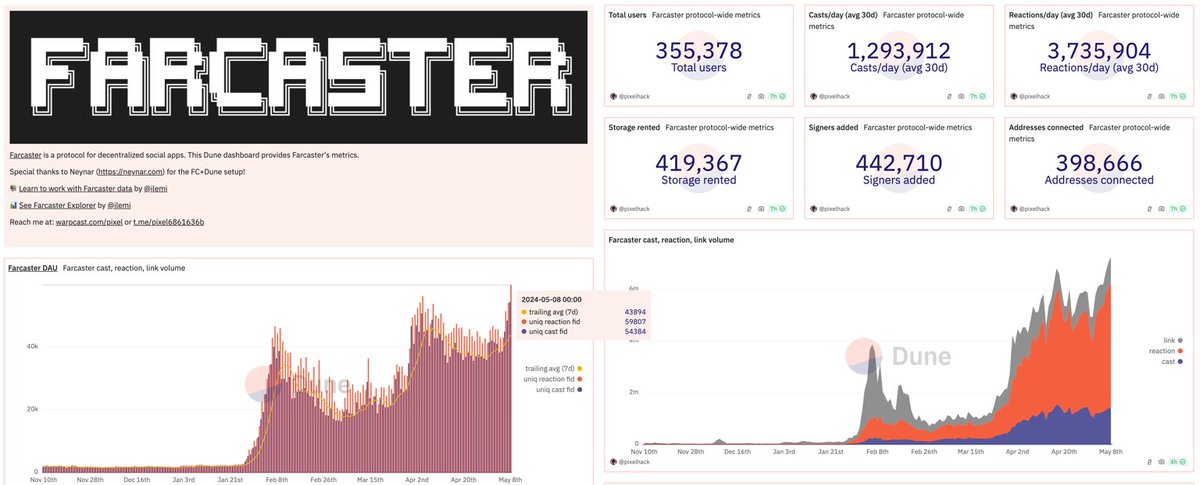
In May 2024, Farcaster reached a new high in daily active users, according to Dune Analytics.
3/8 · Frames
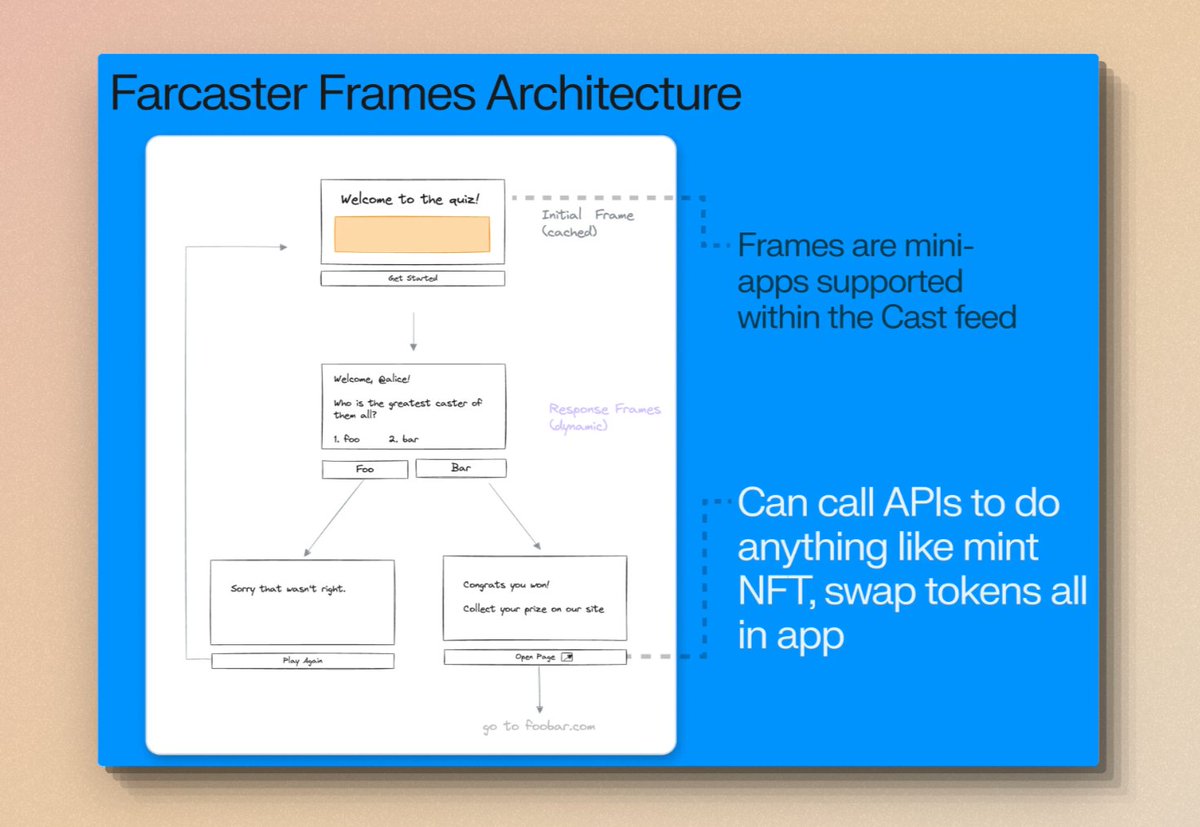
Frames are essentially mini-applications embedded within Farcaster posts. They transform static content into interactive experiences, allowing users to access features and services directly within the social feed—without leaving the platform.
Examples include:
-
NFT Interaction: Users can mint, display, or trade NFTs via Frames. An artist could showcase artwork and offer purchase/bidding options directly in a post.
-
Gaming: Developers embed lightweight games into posts, enabling users to play while browsing social content.
-
Content Subscriptions: Creators offer newsletter or media subscriptions via dedicated buttons powered by Frames.
4/8 · Asset Issuance
Farcaster introduces a novel approach to asset issuance, transcending conventional SocialFi paradigms. In typical SocialFi models, "Fi" refers to economic incentives designed to boost creator and user engagement—for instance, Friend Tech tokenizes creators and their content to generate revenue.
Farcaster’s “Layer” characteristic not only redefines the foundation of social interaction but also offers a new model for asset creation. It shifts away from designing complex internal financial structures, instead providing openness to the community and developers—effectively serving as a launchpad for community tokens, culture, and ecosystems.
While the entry fee creates friction for mass adoption, it results in highly concentrated user quality—over 90% of daily active users are crypto-natives.
This combination—providing an environment conducive to asset creation and cultivating a high-quality user base—lays fertile ground for future project growth, marketing, and community development.
5/8 · Ecosystem Economy – $DEGEN
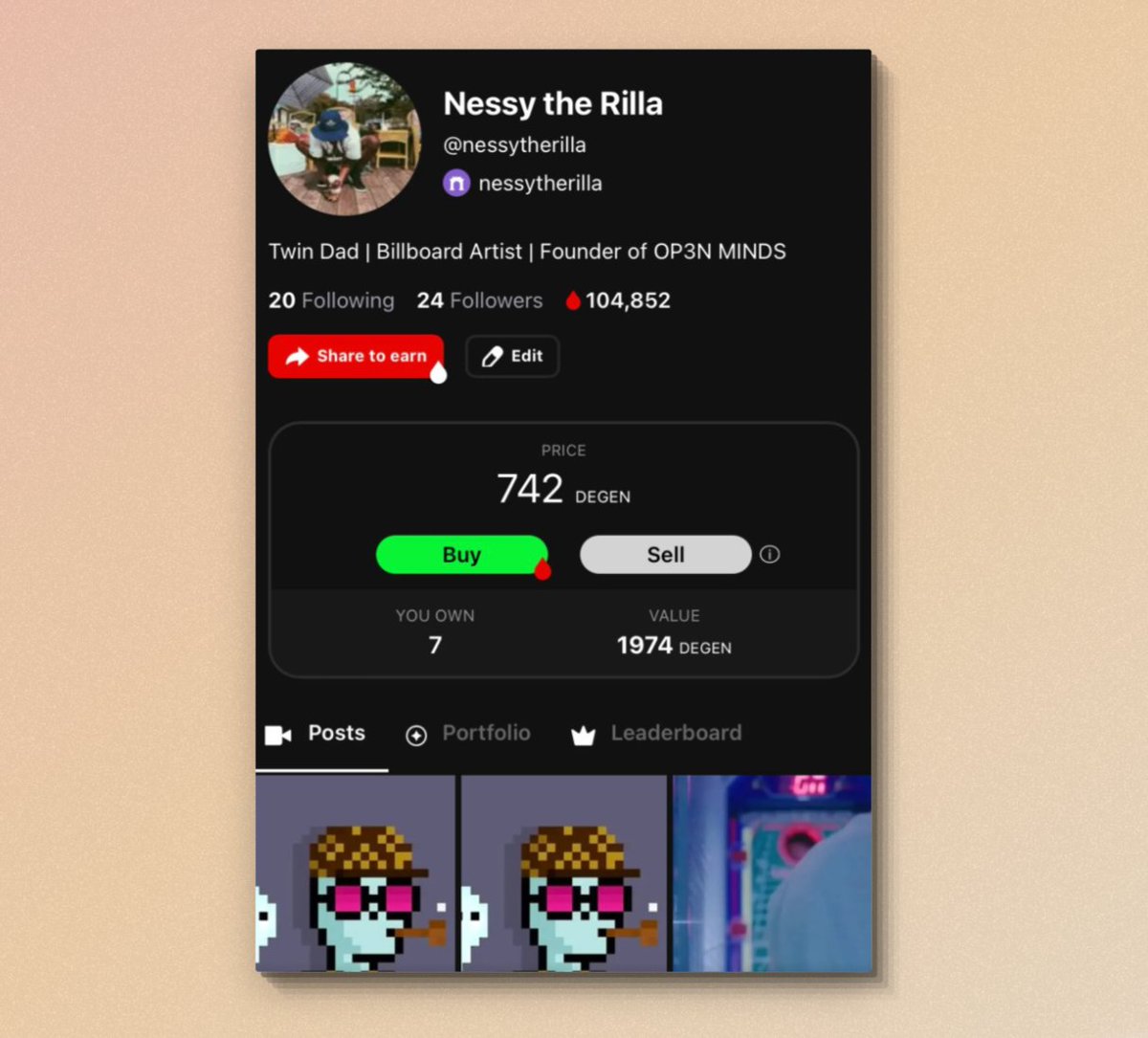
The token $DEGEN holds a unique position in the Farcaster ecosystem. Not officially issued, it emerged organically as a community-driven memecoin and has become the de facto primary token of the Farcaster community, spawning surrounding applications and ecosystem projects.
-
Tipping & Rewards: DEGEN is used to tip creators, encouraging content sharing and participation.
-
NFT Minting: Platforms like Zora and Highlight allow users to mint NFTs using DEGEN, increasing its utility in art and collectibles markets.
-
Transactions: DEGEN powers in-app purchases and gameplay in titles like Drakula and Bracket game.
-
Community Building: Used to fund and support community initiatives, such as development on the Degen L3 chain.
Drakula: An onchain short video app similar to TikTok, where users tip and interact using DEGEN.
Clubcast: An onchain Patreon-like platform enabling creators to deliver exclusive content via token-gated channels.
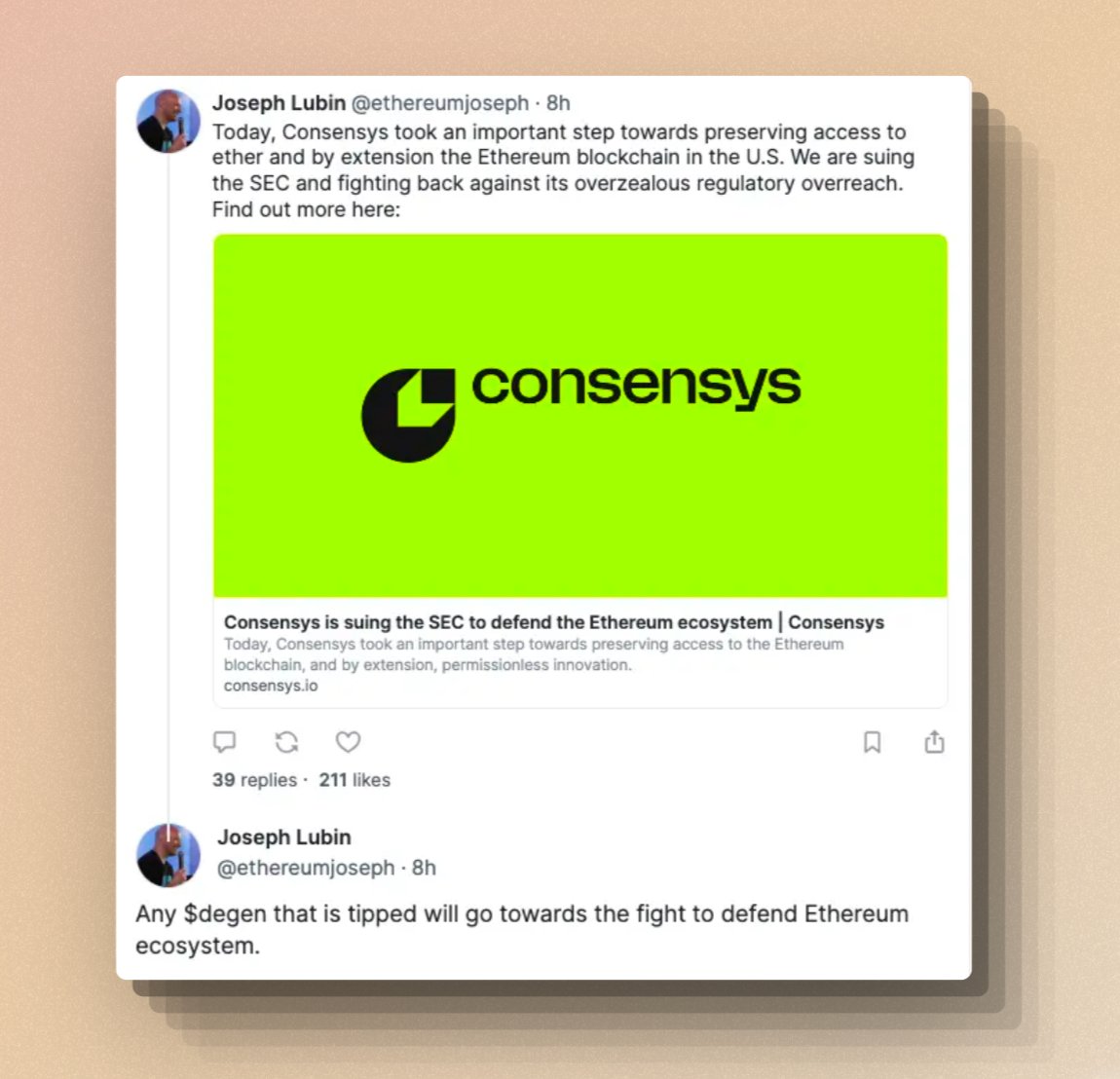
ConsenSys: When ConsenSys faced warnings from the SEC, founder Joseph Lubin solicited DEGEN donations on Farcaster, pledging all tips would support the defense of the Ethereum ecosystem—prompting widespread community support through tipping.
6/8 · Ecosystem Economy – Warps Points
Within the Farcaster ecosystem, Warps Points serve as a crucial mechanism to incentivize and reward user engagement. As an internal points system, Warps enhances platform interactivity and motivates active participation in community activities.
1. How to Earn Points
-
Active Participation: Users earn Warps Points by posting, commenting, and sharing content—encouraging frequent use and valuable contributions.
-
Task Completion: Farcaster may introduce specific social challenges or tasks, rewarding completion with Warps Points.
-
Community Contribution: Content creators or technical contributors may be recognized and rewarded with Warps Points based on community validation.
2. How to Use Points
-
Fee Payment: Users can spend Warps Points to participate in special events or unlock premium social features.
-
Create New Channels: Points can be used to launch topic-specific social channels.
-
Gift Points: Users can transfer points to others as recognition for quality content or engagement.
3. Point Management & Issuance
The Warps Points system is centrally managed by the Farcaster team, meaning issuance, distribution, and rules are controlled by platform administrators. Therefore, Warps Points are not equivalent to tokens—they function as internal utility points within the Farcaster ecosystem.
7/8 · Openness & Composability
Farcaster is essentially a large-scale hybrid on-chain/off-chain database. Based on this data foundation, any type of frontend interface can be built, offering varied user experiences. This brings several advantages:
-
Decentralization: Even if one frontend is restricted, users can still access the network via alternative frontends.
-
Ecosystem Diversity: Developers can focus on niche areas—building article platforms, live streaming apps, or microblog interfaces. Cross-application composability unlocks infinite potential for the Farcaster ecosystem.
Currently, Warpcast is the most popular and widely used frontend, closely resembling Twitter in UX. However, alternative clients are gaining traction:
-
Bountycaster: Functions as a job board where users post or complete bounties for monetary rewards.
-
Unlonely: Focuses on live streaming, offering real-time interaction and content sharing.
-
Kiosk: A new Farcaster client recently secured $10 million in funding from a16z and Electric.
8/8 · Advantages & Challenges
The core challenge in the SocialFi space is answering the question: “Why should users stay?” Web3 social platforms inherently face usability and accessibility disadvantages compared to established platforms like Twitter or WeChat. Previous solutions relied heavily on “Fi”—using financial incentives to attract creators first, effectively tokenizing creator value to enable monetization. But this approach shifts the burden of product adoption, user experience, and traffic acquisition onto creators: “You can make money here, so go bring your fans.”
Farcaster, by contrast, functions more like a Social Layer—a foundation upon which Fi, NFTs, music, games, and any imaginable application can be built. This development is driven by builders, not just creators. It’s an ecosystem co-created by developers, communities, and participants.
What Are Farcaster’s Advantages?
To be honest, Farcaster’s vision isn’t particularly novel. Its strength lies in having already achieved initial user accumulation and retaining a large base of crypto-native users who actively engage. This month’s activity metrics hit record highs. Farcaster hasn’t launched its own token yet, yet it has successfully attracted and unified creators, developers, and everyday users—not relying solely on financial incentives to retain them.
What Challenges Does Farcaster Face?
From a Chinese-speaking user perspective, the current registration/storage fee requires credit card payment and doesn't support native crypto payments—creating a barrier. Enabling cryptocurrency payments would greatly aid user expansion. Long-term, scaling user growth will test the capacity of Hubs and the strength of the Hub network’s social consensus. From an ecosystem standpoint, establishing a virtuous content cycle is critical. Social products are visually dominant—both high-quality and low-quality content are immediately visible. Spam and malicious content on social platforms cause far greater harm than junk code on smart contract networks. Many past Web3 social apps collapsed under waves of scams and adult content. Yet decentralization typically avoids manual content moderation. Balancing openness with content integrity—and achieving sustainable, positive feedback loops—is a key long-term challenge. Only sustained, healthy cycles can shift user behavior.
How Can Farcaster Break Out?
Regarding “breaking out,” Farcaster’s current goal is to attract and retain Web3 users from Twitter. For creators, especially those who’ve experienced account suspensions on Twitter, the value of decentralization and self-sovereignty becomes deeply apparent. Farcaster isn’t aiming to replicate the NFT Summer phenomenon—drawing in outsiders for speculative consumption. Instead, its target is the existing crypto community. For these users, Farcaster’s openness, programmability, and composability perfectly embody crypto values. Bringing Web3 natives onto a truly Web3-native Social Layer—that is Farcaster’s version of “going mainstream.”
Join TechFlow official community to stay tuned
Telegram:https://t.me/TechFlowDaily
X (Twitter):https://x.com/TechFlowPost
X (Twitter) EN:https://x.com/BlockFlow_News
 @cmdefi