









FTT surges again—can FTX creditors actually profit?
TechFlow Selected TechFlow Selected
FTT surges again—can FTX creditors actually profit?
If the restructuring plan is approved by the bankruptcy court, 98% of FTX creditors will receive approximately 118% of their allowed claim amount within 60 days after the plan becomes effective.
 Navigating Web3 tides with focused insights
By: Luccy
On May 8, FTX and its affiliated debtors filed a reorganization plan and disclosure statement with the U.S. Bankruptcy Court for the District of Delaware, which is expected to distribute nearly all of FTX’s assets at the time of its November 2022 collapse to customers and other creditors worldwide.
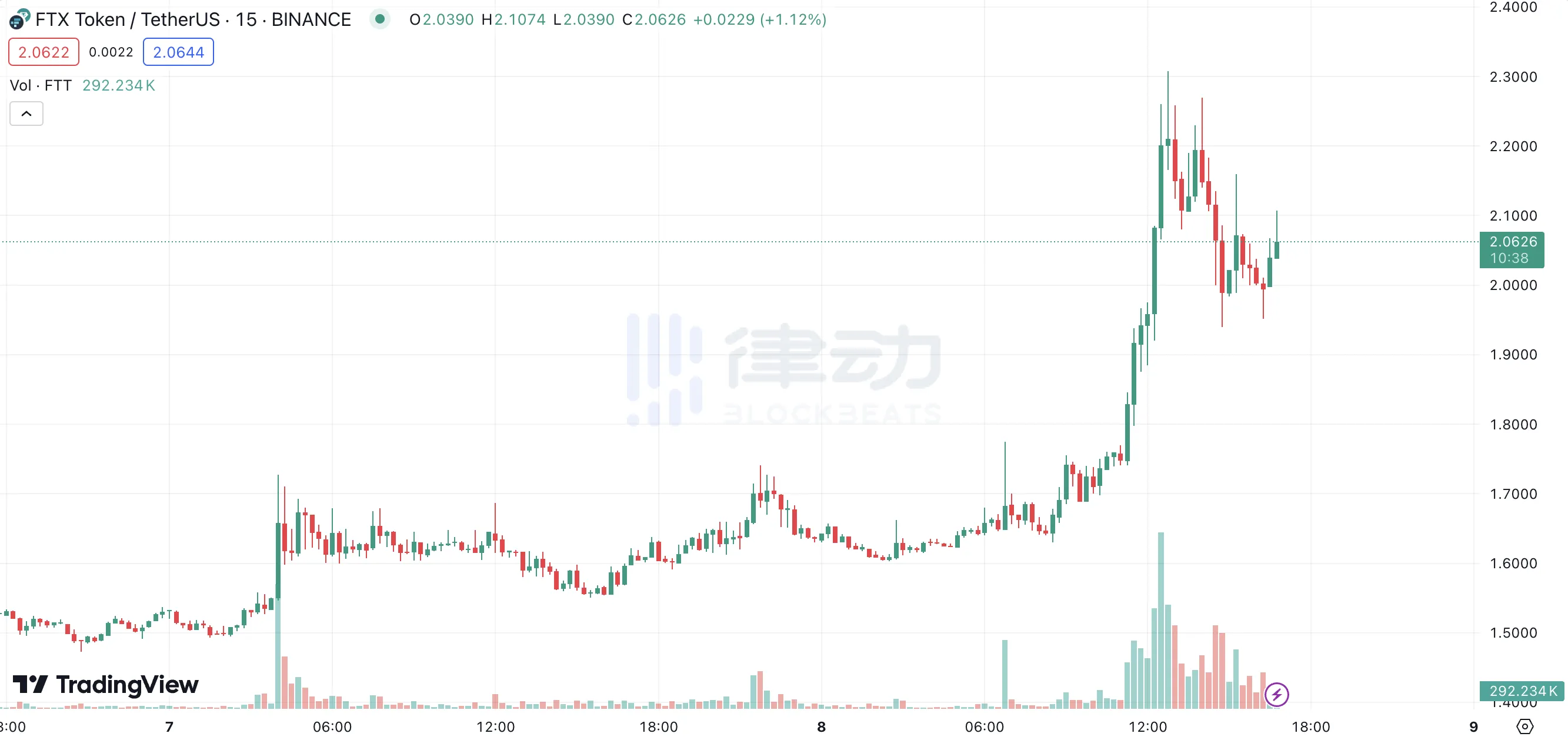
After enduring the dark era following FTX's collapse, “full repayment” may be the most desired phrase for creditors. Influenced by this news, FTX’s platform token FTT surged, rising above $2.10 with a 24-hour gain of 19.16%.
FTX Reboot: Creditors to Receive 118% Within 60 Days
When FTX declared bankruptcy, creditors faced a long legal process in court without any guarantee on how much of their claims would be repaid.
Since FTX filed for Chapter 11 bankruptcy protection on November 11, 2022, in Delaware, calculating the exact timing and value of claim transactions has been highly complex. Industry traders told Fortune magazine that some claim trades occurred on online platforms while others were conducted privately, where buyers aren't required to immediately file transfer applications—causing delays—and some claim trades were only reported as personal holdings.
Most creditors hoped to recover at least part of their funds; thus, uncertain about how claims would be settled, some might sell their claims at steep discounts, while buyers’ losses depend on how much debt the bankruptcy trustee manages to recover.
As of March 28, 49 transactions worth over $439 million in claims had been traded on Claims Market, a leading industry online trading platform. Meanwhile, according to court records through March 20, hedge funds had purchased more than $2.3 billion worth of deeply discounted claims.
FTX estimates that the total value of property collected, converted into cash, and available for distribution will range between $14.5 billion and $16.3 billion. This amount includes assets controlled by the Chapter 11 debtors as well as those managed by the Joint Official Liquidators of FTX Digital Markets, Ltd. (Bahamas), the Bahamas Securities Commission, and the Joint Official Liquidators of FTX Australia.
In other words, if the reorganization plan is approved by the bankruptcy court, approximately 98% of FTX creditors will receive around 118% of their allowed claim amounts within 60 days after the plan becomes effective. The remaining creditors will receive full payment on their claims, "plus billions of dollars in time-value compensation for their investment."
Bitcoin and SOL Are the Saviors
Much of FTX’s “resurrection” can be attributed to the explosive growth of Bitcoin and SOL.
According to data submitted in the FTX case filings, FTX’s estate includes approximately 59 million SOL and 21,482 bitcoins. Since the company filed for bankruptcy, these tokens have increased in value by roughly 1,000% and 343%, respectively. FTX plans to sell 41 million SOL to institutional investors at a price 68% below current market rates—worth approximately $6 billion at the time of publication.
Did Bitcoin’s Critics Anticipate the Bull Run?
In SBF’s view, Bitcoin had no future as a payment network, and he criticized it for being inefficient and environmentally costly. He once said, “The Bitcoin network isn’t a payments network, nor is it a scalable one.” Perhaps SBF’s disdain for Bitcoin was widely known—Ark Invest CEO Cathie Wood stated on her social media platform, “SBF doesn’t like Bitcoin because it’s transparent and decentralized; he cannot control Bitcoin.”

After SBF’s arrest and imprisonment, the crypto winter lasted nearly a year. However, under the anticipation of Bitcoin halving and ETF approvals, speculative sentiment gradually rose. On January 11, Bitcoin ETFs were successfully approved, ushering in a new chapter for the crypto industry, with massive capital flowing into the Bitcoin ecosystem via ETFs. Beyond meme coin frenzies, from inscriptions to runes and a flourishing array of Layer 2 solutions, it has truly become a “Bitcoin bull market.”
Even though SBF disliked Bitcoin, he did not deny its material value and continued to trade Bitcoin profitably as an investor. According to data submitted in the FTX case reports, FTX still held tens of thousands of bitcoins when it declared bankruptcy. Bitcoin has steadily climbed to new historical highs amid this bull market cycle, experiencing multiple pullbacks but maintaining strong confidence among most analysts regarding its future.
Though imprisoned, SBF may not have witnessed this historic moment firsthand—but there’s no denying that Bitcoin, which he once criticized, has once again injected capital into the crypto world.
Investors and SOL: A Mutual Choice
While Bitcoin led the charge during this period, SOL also emerged as a standout asset, and the relationship between FTX and Solana has become legendary in the crypto community.
Solana was never a team born with a silver spoon. After completing validator node fundraising in 2019, Anatoly and Raj insisted on focusing development efforts to launch the mainnet quickly—a move that caught SBF’s attention. At the time, SBF was actively seeking partnership chains, and among many prominent blockchains, Solana might not have stood out—until one event convinced SBF to make a deep investment.
After learning about Solana from Anatoly and Raj, SBF immediately instructed his engineers to flood the Solana blockchain with spam transactions to test its performance. Solana passed the stress test, and on that very day, SBF decided to invest. Just days later, FTX launched Serum, its own incubated decentralized order book matching engine.
It could be said that FTX and Solana chose each other, shaping each other’s success—and naturally, SBF became a loyal investor in SOL. SBF believed Solana could become the next Bitcoin, predicting its market cap might surpass Ethereum’s. Few blockchains could compare, he argued: “Solana is one of the few public blockchains today with a truly sound roadmap capable of scaling to millions of transactions per second at just a few cents each—offering the scale users actually need.”
After FTX’s collapse, the Solana blockchain suffered greatly, falling into crisis along with a sharp drop in SOL’s price. Yet, Solana continued attracting countless investors thanks to its high performance and low gas fees. Especially since last year’s meme coin boom, SOL’s price broke past triple digits, repeatedly setting new all-time highs.
Since his detention last summer, even from prison, SBF reportedly remained devoted to Solana—rumors even circulated that he “recommended investing in SOL to prison guards.” Though SOL pulled back during broader market corrections, it remains priced above triple digits to date, generating substantial profits for FTX.
Today, all seven charges against SBF have been upheld, resulting in a 25-year sentence handed down by the U.S. District Court in Manhattan, along with an unprecedented $11 billion fine. Thus ends the chapter of the legendary figure who led FTX. The restructured FTX may now begin a new chapter after fully compensating creditors, but given tightening regulatory scrutiny recently, whether the reorganization proposal will ultimately be approved remains uncertain.
Join TechFlow official community to stay tuned
Telegram:https://t.me/TechFlowDaily
X (Twitter):https://x.com/TechFlowPost
X (Twitter) EN:https://x.com/BlockFlow_News
 BlockBeats











