Behind the Meme Coin Feud: A Crypto Market Where No One Wants to Be Left Holding the Bag
TechFlow Selected TechFlow Selected
Behind the Meme Coin Feud: A Crypto Market Where No One Wants to Be Left Holding the Bag
Only daring to trade memes speaks volumes about retail investors' helplessness.
 Navigating Web3 tides with focused insights
Author: flowie, ChainCatcher
Editor: Marco, ChainCatcher
Doge took four years to break $1 billion in market cap, while BOME did it in just three days. "Better to hold a meme coin than a VC-backed project" has become the inner mantra for many retail investors.
But as memes grow increasingly popular among retail investors, VCs seem less than thrilled.
Top-tier VC firm a16z has repeatedly criticized meme coins. First, a16z published an article on its official website pointing fingers at the SEC, accusing crypto policies of enabling meme coins to thrive while failing to protect genuine blockchain innovation.
a16z Crypto CTO Lazarrin then complained on X (formerly Twitter): "Memecoins undermine the long-term vision that keeps many people in crypto; they're also technically uninteresting and unappealing to builders."

Compound VC managing partner Michael Dempsey also claimed that "meme coins are causing a massive exodus of real builders."
VCs blaming meme coins for undermining crypto innovation quickly sparked backlash from the crypto community.
Solana co-founder Raj defended meme coins, sarcastically responding to the claim that "meme coins cause real builders to leave": If so-called real builders are so fragile that they fear meme coins, they were never going to succeed anyway.

Retail investors, in turn, questioned the value propositions pushed by VCs. What started as a debate over meme value quickly turned into a broader critique of VC-backed "value coins."
A Reverse Education: The Community Teaches VCs a Lesson
VCs who love educating users ended up being educated by them.
First off, meme coins aren't responsible for killing crypto innovation. @MarinadeFinance mocked: People always look for excuses—nothing or no one can stop you from building something truly innovative.
@XBEBEeth added: Nobody hates real builders—it's the fake ones using grand narratives to deceive users that we hate.

Rather than attacking meme coins for lacking value, perhaps VCs should reflect on whether their promoted innovations are genuinely innovative. @mfer7166 believes pseudo-innovation deserves more criticism. And the problem isn’t with memes—it’s that this cycle lacks any epic narrative.

Being forced to only speculate on memes reflects retail investors’ helplessness.
AI+Crypto, DePIN, RWA, modular architectures, Bitcoin Layer 2s... VCs have become experts at fabricating impressive-sounding narratives, encouraging projects to stack these concepts and sell them to retail investors in the secondary market, hoping they’ll pay for these long-term visions.
Retail investors used to buy into this—hoping new narratives would lead to mass adoption, allowing them to profit even slightly from VC-endorsed projects.
But times have changed. Retail investors now realize that the technological innovations championed by VCs often amount to little more than hype, with few tangible results in actual applications. As for speculation, following VCs doesn’t even guarantee scraps—it might leave you completely wiped out.
The previously discussed "no mutual bagholding" bull market theory resonated with many. But @connectfarm1 bluntly stated: There’s no such thing as “no mutual bagholding”—people aren’t refusing to buy, they simply can’t afford to.
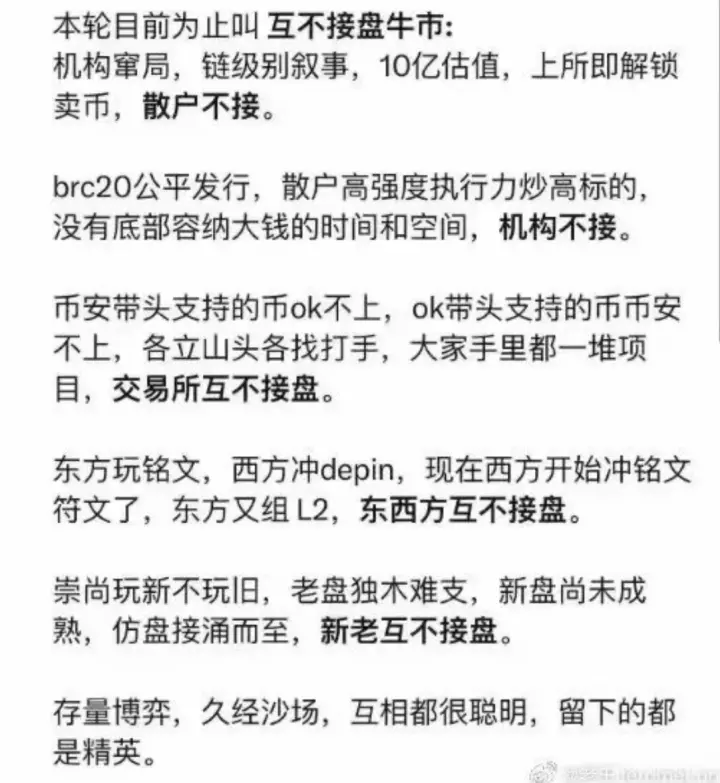
Currently, so-called value coins see rising market caps but flat token prices. Retail investors are exhausted by large market caps, high valuations, low circulating supply, and continuous unlocking schedules.
Newly listed value coins on exchanges have generally lost their wealth-generation effect. WLD was already valued at $3 billion before launch, and reached a fully diluted valuation (FDV) of $28 billion on day one—comparable to OpenAI’s valuation at the time. With such a massive valuation upfront, how much growth potential remains for the secondary market? New tokens like Merl, the leading Bitcoin Layer 2, have seen steady declines post-launch.
Too many new concepts emerge rapidly, making it impossible to keep up. @Eason_Jiang_ shared his experience: holding onto a value coin only to watch its price go on a rollercoaster back to "where the dream began," suffering major profit drawdowns or even losses due to shifting focus across sectors.
Even buying the dip or chasing highs no longer works. ARB, the leading Ethereum Layer 2 and poster child of value coins, dropped from $2 to $1. Retailers tried to buy the dip, but faced massive VC unlocks—VCs doubled their holdings, potentially burying retail investors.
With widespread adoption still far off, 90% of today’s market consists of speculators. While memes lack intrinsic value, they offer retail investors a closer shot at 100x or even 10,000x returns compared to value coins.
@BTCdayu voiced what many retail investors feel: "Meme coins are simple and straightforward—basically, everyone bets directly in a relatively fair environment. Their biggest value is really just saying 'Buy me—I might go 100x'."
Though the fairness of memes needs to be put in quotes, retail investors tolerate them more than VC-backed value coins with transparent ulterior motives.
At the end of the day, memes are just player-versus-player games. Life and death play out within days. Most users risk small amounts chasing big rewards—even if most lose, they do so cleanly, without enduring years of psychological manipulation.
Of course, not all VCs reject memes. Some recognize reality and adopt the "if you can't beat them, join them" approach.
Mechanism Capital has already begun building positions in memes. Co-founder Andrew Kang announced on social media that Mechanism Capital completed its first batch of 2024 allocations, investing in Trump-themed meme tokens and NFTs.
DWF Ventures publicly stated it would be interested in investing in projects with similar levels of broad community participation.
DWF Ventures said meme coins will become a new GTM (go-to-market) strategy for many ecosystems and projects, believing memes can serve as effective marketing tools in areas including infrastructure ecosystems, consumer apps and gaming, and new projects with meme coin backgrounds.
Variant co-founder Li Jin has started hosting meme marathons, writing: "Born too late to explore Earth; born too early to explore space; born at the right time to host meme hackathons."
Memes Temporarily Carry the Burden of Mass Adoption
Seemingly worthless memes may actually be carrying the torch for mass adoption.
@mdudas rebutted a16z’s CTO: "Meme coins attract many users, bringing chains like Base, Blast, and Solana to life."
In fact, contrary to some VCs’ disdain, meme coins have become critical for activating public chain ecosystems.
After Solana founder Anatoly personally hyped Silly Dragon last year, Solana continued reaping meme benefits. The explosive rise of a single coin, BOME, propelled Solana to the top in active addresses. Within three days of BOME’s launch, Solana’s active wallet count surged from 1.24 million to 2.42 million—an increase of 95%.
Additionally, Solana’s network fees and revenue saw significant growth.
Public chains previously criticized for having no real users now at least have users—thanks to memes. Solana’s massive success with memes has drawn attention and imitation from other blockchains.
The creator of Base stated that meme coins will be key to bringing millions of users onto the Base network. An Arbitrum community proposal suggests establishing a Memecoin Fund.
Some blockchains have even launched their own meme coins.
On March 17, Aptos launched its official meme coin $LME.
On March 18, Bitcoin Layer 2 chain Ligo announced the launch of the meme coin SOLIGO on Solana.
Other chains are hosting meme innovation contests to incentivize meme creation on their platforms.
BNB Chain recently officially launched its "Meme Innovation War" campaign, offering a prize pool totaling $1 million. TON announced the launch of Memelandia, a cultural center for meme coins and community tokens, rewarding top meme and community tokens on TON.
The TON Foundation also airdropped over $2 million worth of TON to active meme coin traders within its ecosystem.
Fantom is now working on establishing a standard framework for memes. Recently, Fantom Foundation co-founder Andre Cronje tweeted that he’s busy conducting due diligence on memecoins to create a framework for launching, supporting, and nurturing community-safe meme coins on Fantom.
Ethereum co-founder Vitalik Buterin previously commented on memes: "I hope to see higher-quality fun projects that make positive contributions to the ecosystem and the wider world—not just attracting users."
Indeed, beyond driving traffic for many public chains, some meme coins are starting to build real utility.
Shiba Inu, dubbed the "Dogecoin killer," announced last year the beta launch of its Layer 2 solution Shibarium, aiming to reduce blockchain congestion and improve user experience for metaverse and gaming applications.
Memes Take the Lead—Will the Altcoin Season Still Happen?
Meme coins and value coins aren’t entirely opposed. For most retail investors, both are part of the game.
Typically, bull markets unfold in three phases: first Bitcoin rises; after Bitcoin peaks, Ethereum and hot altcoins surge; finally, the entire crypto market enters a broad rally phase, and meme coins begin to rise.
But in this cycle, the sector rotation seems reshuffled—meme coins have taken the lead, becoming the main theme early on.
After the meme explosion, will the altcoin season—led by so-called value coins—still arrive? This is the question retail investors care about most.
Shen Yu expressed skepticism in a recent interview: "Altseason might not happen. Market participants today differ from previous cycles. On the miner side, for example, after Bitcoin spot ETFs were approved on January 10, miners had already hedged risks months in advance to prepare for the halving."
Shen Yu noted that this cycle is characterized by capital flowing into Bitcoin via channels like ETFs. Whether and when this capital will flow into other cryptocurrencies remains to be seen.
Crypto trader Thiccy also expressed pessimism about the arrival of altseason. He pointed out that with more and more projects launching tokens, FDVs are growing faster than circulating supplies—up about 70% since the beginning of the year. "Now there are 3-5 'high-quality' tokens added every week, and everyone looks happy. But ask yourself—who will buy all these tokens? Unless institutions or retail investors flood in, this will just be an endless PvP game."
Crypto KOL @BTCdayu believes altseason has already passed: "The total size of altcoins, especially various L2s and new narratives, has already reached or exceeded the peak of the last bull run."
Still, some investors believe altseason won’t be absent. Amid widespread skepticism toward value coins, crypto researcher @0xNing0x sees it as the perfect time to accumulate. "I’m quietly buying leading assets in modular blockchains, RollAPPs, AI Agents, ZK hardware acceleration, RWA, Bitcoin L2s, etc., voluntarily acting as exit liquidity for the market."
@0xNing0x’s logic follows the golden rule of investing: "Be greedy when others are fearful, and fearful when others are greedy." When meme coins dominate everyone’s portfolio, that’s precisely when high-risk-reward alpha opportunities start emerging in the value coin space.
Join TechFlow official community to stay tuned
Telegram:https://t.me/TechFlowDaily
X (Twitter):https://x.com/TechFlowPost
X (Twitter) EN:https://x.com/BlockFlow_News
 ChainCatcher 链捕手