
Legendary Meme Coin Hunter James: Turned $7,000 into $25 Million, But His Call-to-Buy Influence Is Now Fading
TechFlow Selected TechFlow Selected
Legendary Meme Coin Hunter James: Turned $7,000 into $25 Million, But His Call-to-Buy Influence Is Now Fading
James Wynn made approximately $25 million from the PEPE token surge, with a principal investment of just $7,644.
 Navigating Web3 tides with focused insights
By Frank, PANews
After the trust crisis surrounding ELON, James Wynn's endorsement effect seems to have worn off. The MONKE token he recently promoted failed to surge, and instead faced retail sell-offs during his pump campaign. As of 10 a.m. on April 29, James Wynn’s own holdings had turned unprofitable (though one of his secondary wallet addresses managed to break even due to an earlier exit).
How does one become a Meme coin guru? This may be the ultimate question for every Meme trader. Even if they can't reach legendary status themselves, many players believe that following in the footsteps of successful figures—“copy trading”—is a shortcut. Today, PANews dives into the on-chain activity of PEPE legend James Wynn (@JamesWynnReal) to uncover the secrets behind Meme coin success.
Among the pantheon of Meme coin hunters, James Wynn has recently been at the center of attention. His reported $12.8 million profit from PEPE (in fact, PANews found it was even higher) sparked widespread discussion after being highlighted by Lookonchain. Wynn then leveraged this momentum to aggressively promote the ELON token. After selling near the top and publicly stating “the project has issues,” the price plummeted over 70%, drawing fierce backlash from followers.
Based on PANews’ analysis of 26 wallet addresses linked to James Wynn, he made approximately $25 million from PEPE with an initial investment of just $7,644. During the ELON promotion, evidence suggests Wynn did indeed inflate the price before dumping on his followers.
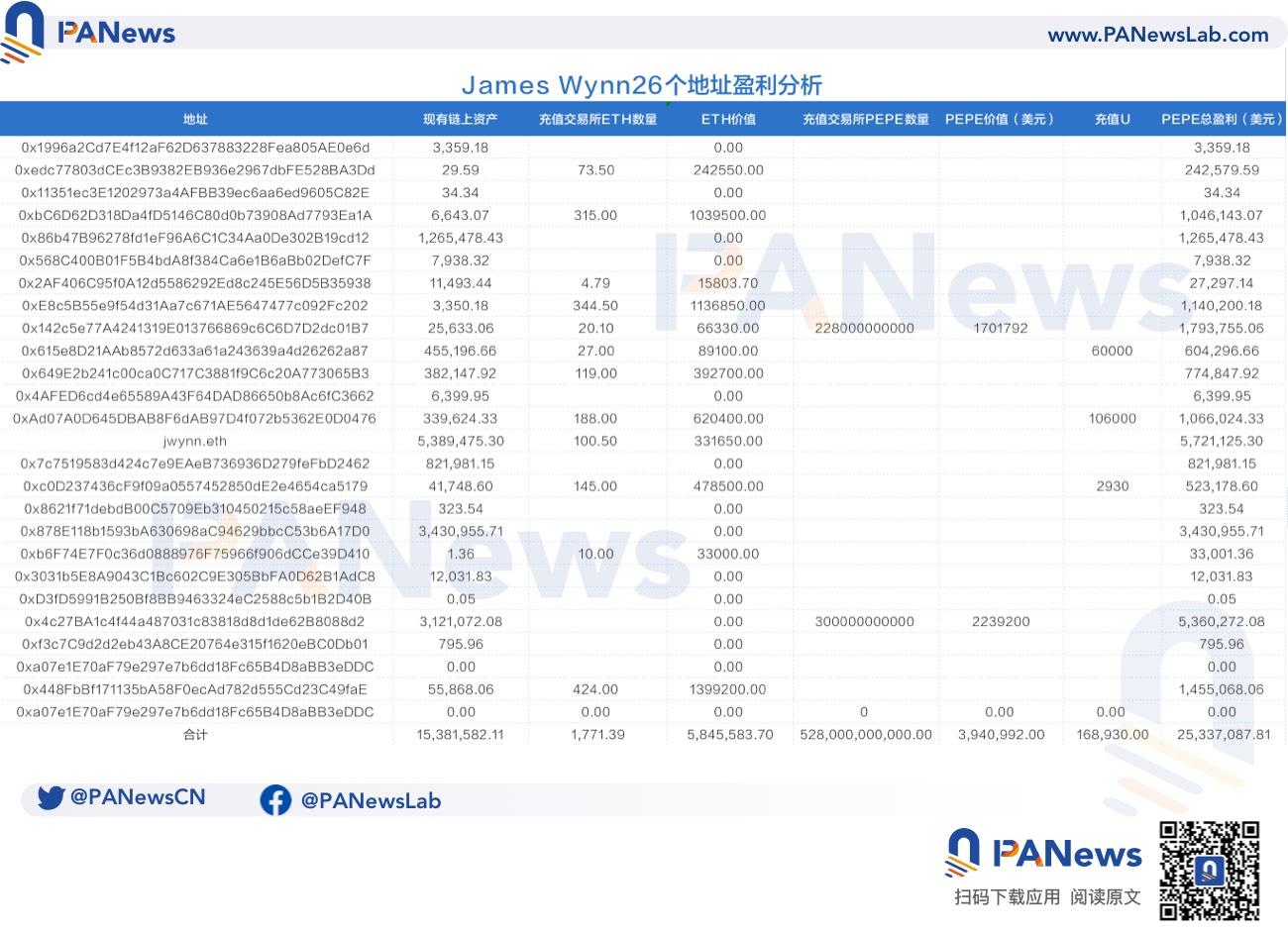
26 Addresses for PEPE: $7,000 Turned Into $25 Million
For most casual Meme traders, when buying a Meme coin, how many wallets would you use? Most likely just one or two—after all, Meme coins are about high-risk, high-reward bets, and no one knows which trade will pay off. So neither capital nor wallet preparation tends to be extensive. But James Wynn used up to 26 different wallet addresses in his PEPE trades, far beyond the three previously known to the public.

Wallet address linkage analysis of James Wynn
According to PANews’ investigation, James Wynn’s connection with PEPE runs deep.
PEPE launched on April 14, 2023. James Wynn registered his Twitter account in April 2023 and remained silent until April 16—his first-ever tweet was a shoutout for PEPE.
Within one day of PEPE’s launch, James Wynn used the address 0x4afed6cd4e65589a43f64dad86650b8ac6fc3662 to buy his first batch with 0.54 ETH. Within 30 minutes, he completed three transactions across three addresses, purchasing around 4.2 trillion PEPE tokens for a total of 3.5 ETH—roughly 1% of the total supply.

After establishing his initial position, James Wynn immediately began promoting PEPE on Twitter. On April 16 alone, he posted at least 24 promotional tweets—an unusually intense effort for an average user.

As PEPE gained traction on social media, Meme communities took notice. More supporters emerged, driving the price upward. From April 16 to April 19, PEPE saw daily growth of roughly 1–2 times.
On April 17, James Wynn sold off his initial principal. Then on April 18, he bought back a small amount using one of his accounts. By May 1, the price had risen 100-fold from his cost basis. Possibly to avoid drawing attention, he began distributing his PEPE holdings across multiple new addresses.
Take address 0x1996a2Cd7E4f12aF62D637883228Fea805AE0e6d as an example: it initially purchased 974 billion PEPE. After selling some ETH on April 17, it transferred the remaining PEPE to two other addresses. These two then sold the tokens in batches for ETH, funneling the proceeds into address 0xbC6D62D318Da4fD5146C80d0b73908Ad7793Ea1A, which ultimately sent funds to James Wynn’s main wallet, jwynn.eth. From there, portions were transferred to exchange addresses.
Throughout his trading activity, James Wynn deliberately obscured connections between the four original purchase addresses. Their linkage only became apparent after tracing through six to seven layers of intermediary wallets.
According to PANews’ calculations, over the following months, James Wynn deposited 1,771 ETH, 168,900 USDC, and PEPE worth $3.94 million into centralized exchanges. He still holds approximately $15.38 million in on-chain assets. His total profit amounts to roughly $25.33 million.
If such extraordinary returns were purely down to luck, it would be hard to believe. Before his PEPE windfall, James Wynn was just another small-time trader dealing in $10 increments, with typical wallet interactions involving tens of dollars. Yet suddenly, he went all-in. Notably, aside from three long-standing Binance Smart Chain users, most of these wallets were created specifically for the PEPE trade. Did he receive insider information or a divine revelation? Whatever it was, his first major bet on Ethereum paid off spectacularly.
The Hardworking Billionaire: Pumping While Dumping
Even after amassing millions, James Wynn didn’t change his habits—he kept hunting for new Memes and engaging on Twitter, posting dozens of updates daily. As his rags-to-riches story spread, his follower count grew to 19,000 within a year, earning him the title “PEPE God” in the community.
One year after his first PEPE purchase, at 4:38 p.m. on April 24, 2024, James Wynn tweeted: “I think I’ve got a 1000x for you guys. Who wants it?” About an hour earlier, he had already established positions in two accounts for the newly launched ELON token—less than half an hour after its debut.
As usual, James Wynn quickly shared details about ELON, lavishing praise on the new Meme coin with the same enthusiasm he once showed for PEPE. A year later, his influence was undeniable—many dedicated Meme coin analysts rushed in based solely on his call.
Within hours, ELON’s price surged nearly 100-fold above James Wynn’s entry point. Whether to prove solidarity with his followers or because he genuinely believed ELON could be the next PEPE, Wynn even added to his position after the initial spike.
But the price failed to replicate PEPE’s meteoric rise. On the evening of April 25, ELON rose slightly above the previous day’s peak before starting to decline. Around 3:35 a.m. on April 27, the price suddenly crashed by 70%. James Wynn then announced on Twitter that he had fully exited his position and claimed there were “issues” with the ELON token. Only then did people realize his sell-off had triggered the collapse. According to PANews, James Wynn wasn’t just using his well-known jwynn.eth address—he had quietly deployed another lesser-known address, 0x4afed6cd4e65589a43f64dad86650b8ac6fc3662, to buy ELON earlier and had already liquidated that position by 3 a.m. on April 25—while his promotional tweets were still flooding social media.

In this operation, both of James Wynn’s accounts ranked in the top 10 most profitable (positions #2 and #8), netting around $350,000. However, this return appears modest compared to his PEPE gains, and he has already moved on to promote other projects.
Perhaps now we can revisit the two questions posed at the beginning. How does one become a Meme coin god? James Wynn’s path to legend seems less about technical mastery of Meme trading and more like a textbook case of viral marketing.
And for the second question—if becoming a god is difficult, is copying such legends a viable shortcut? Those who lived through the ELON crash may already have their answer.
Join TechFlow official community to stay tuned
Telegram:https://t.me/TechFlowDaily
X (Twitter):https://x.com/TechFlowPost
X (Twitter) EN:https://x.com/BlockFlow_News
 PANews