








Decoding Gigagas: Will Paradigm, the master of coining terms, spark a new narrative once again?
TechFlow Selected TechFlow Selected
Decoding Gigagas: Will Paradigm, the master of coining terms, spark a new narrative once again?
The invention of new terms never stops, but customer acquisition has never begun.
 Navigating Web3 tides with focused insights
By TechFlow
Question the narrative, understand the narrative, become the narrative—this is the classic three-step playbook in crypto hype cycles.
Yet a narrative often begins with a lofty-sounding term—intent, modularity, parallelization—short, punchy, and just vague enough to spark intrigue. That’s precisely the kind of technical allure that sells.
And when it comes to sourcing these buzzwords, top-tier VC Paradigm deserves the crown as the ultimate "wordsmith."
Back in July last year, Paradigm outlined its ten key trends of interest, introducing for the first time the concept of “intent-centric” systems.
The idea quickly caught fire. Projects rushed to associate themselves with the buzzword. A mundane goal like “improving user experience” could now be elegantly repackaged with just the word “intent.” Protocols built on intent soon became a standard bio line in project Twitter profiles.
Now, the wordsmith strikes again. Recently, Paradigm’s CTO published an article titled “Reth's Path to 1 Gigagas Per Second, and Beyond”, where the star of the show is clearly the newly minted term: “gigagas”.
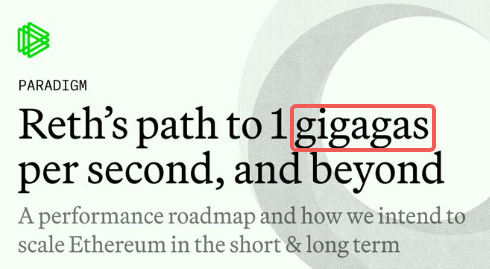
“Giga” is a familiar prefix meaning billion or gigabyte; “gas,” of course, refers to the well-known transaction fee unit in Ethereum.
But combine them—billion gas?
Ah, yes—that same familiar sensation: concise, powerful, slightly cryptic, yet undeniably impressive.
From TPS to GPS: The VC’s New Benchmark
In reality, Paradigm’s new “gigagas” relates to blockchain performance.
Conventionally, we measure how fast a blockchain is by TPS—transactions per second.
But Paradigm’s CTO argues that “Gas Per Second” (GPS) is a more precise metric. Here’s why:
-
Measuring Computational Workload: Gas quantifies the computational effort required to execute operations like transactions or smart contracts. Thus, GPS better reflects the actual computational throughput a network can handle per second.
-
Reflecting Capacity and Efficiency: Using GPS as a performance indicator offers clearer insight into a blockchain’s capacity and efficiency, aiding in system cost evaluation.
-
Resisting DOS Attacks: Standardizing performance around GPS helps mitigate potential Denial-of-Service (DOS) attacks that exploit less accurate metrics.
-
Cross-Chain Performance Comparison: GPS enables more meaningful comparisons between different EVM-compatible chains, which may vary significantly in computational complexity per transaction.
Therefore, using GPS instead of TPS provides a superior measure of blockchain performance. Paradigm advocates that the EVM community adopt gas-per-second as a standard metric, combined with other gas pricing dimensions, to form a comprehensive performance benchmark.
Following Paradigm’s framework—assessing EVM network performance by gas consumption per second while accounting for both computation and storage costs—the current ranking of major L1s and L2s by GPS would look like this:
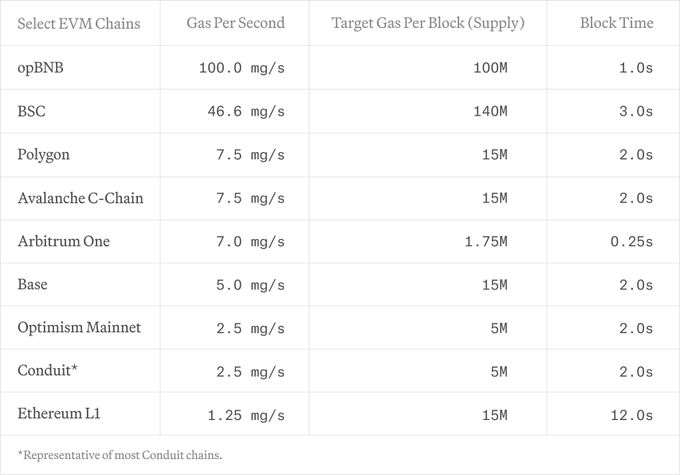
*TechFlow note: The values in the table are in mg, short for milligas (one-thousandth of a gas unit). Higher numbers indicate greater computational throughput per second—i.e., better performance. According to the data, opBNB leads among all listed networks.
This means opBNB can execute more computations per unit of time compared to other blockchain networks, handling more or more complex transactions and smart contracts. However, performance evaluation should also consider factors such as network security, decentralization level, and fee structure.
1 Gigagas: When VCs Build the Infrastructure Themselves
Still, Paradigm aims far beyond the figures in that table—they’re targeting 1 gigagas, meaning a blockchain capable of consuming one billion gas units per second.
Paradigm has long been developing Reth, an Ethereum execution client written in Rust.
Reth’s goal is to optimize execution performance, increasing the number of gas units processed per second and thereby enhancing the overall performance of the Ethereum network.

According to public data from the article, Reth already achieves 100–200 megagas per second (including sender recovery, transaction execution, and trie computation across blocks). To reach 1 gigagas, it needs to scale up by another 10x.
Paradigm’s solution? Vertical and horizontal scaling of their own Reth client.
The technical details are too deep for general readers, so here we simplify the explanation to grasp the essence quickly.
Vertical scaling is like upgrading a machine with a more powerful engine or more memory—boosting the processing power of individual servers or nodes.
Specific methods Paradigm envisions include:
-
JIT / AOT EVM: By using Just-In-Time (JIT) or Ahead-Of-Time (AOT) compilation for the EVM, the overhead of the EVM interpreter is reduced, speeding up single-threaded transaction processing. This could reportedly halve execution time.
-
Parallel EVM: Leveraging multi-core processors to run the EVM allows simultaneous execution of more transactions. Historically, up to 80% of EVM transactions have no conflicting dependencies and can be executed in parallel.
-
Parallelization, pipelining, modified state root: Reducing the overhead of computing the state root—currently over 75% of block production time—is a critical step toward significant efficiency gains.
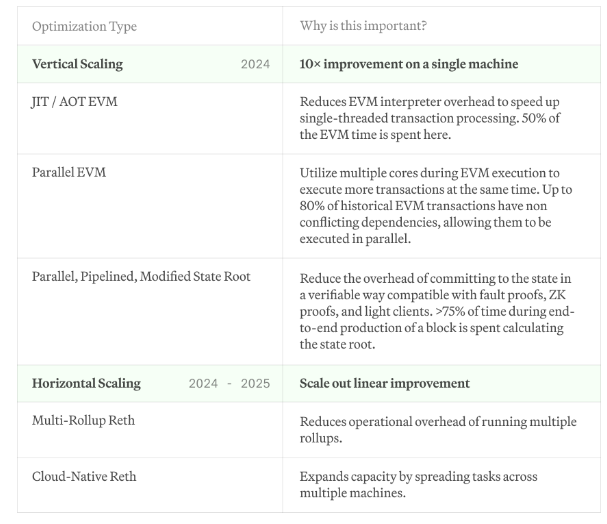
Horizontal scaling, on the other hand, adds more processing units—like adding extra production lines in a factory. It distributes workloads across multiple units, expanding overall system capacity without overburdening individual nodes.
Paradigm’s proposed approaches include:
-
Multi-Rollup Reth: Reduces operational overhead when running multiple rollups, enabling thousands of rollups to operate within a single process at minimal cost.
-
Cloud-native Reth: Scales capacity by distributing tasks across multiple machines—akin to cloud computing architecture—allowing automatic, on-demand scaling with cloud object storage for data persistence.
You don’t need to fully grasp the technicalities. What matters is understanding the core idea:
Paradigm built its own Ethereum client, introduced a new EVM performance metric (GPS), and is aggressively pursuing ways to scale it to 1 gigagas.
A venture capital firm is now leading infrastructure development, stacking performance improvements to achieve execution speeds far surpassing existing Ethereum and other EVM chains—enabling more gas consumption and task execution per second, paving the way for blockchains to support large-scale applications.
This reveals Paradigm’s dual strategy: funding others to build L1s/L2s while also investing directly in performance engineering—hedging bets and advancing the entire infrastructure landscape.
The Wordmaking Never Stops, But User Acquisition Does
Clearly, “gigagas” is a much more technical and niche concept than “intent”—not something every project can easily co-opt.
Perhaps in the future, various L1s and L2s will boast about achieving 1 gigagas or beyond. But for most application-layer projects, the term may remain irrelevant.
Still, in today’s narrative-starved environment, every new concept offers another chance to grab attention.
As Professor Pan astutely observes, successful crypto neologisms must be easy to pronounce, intuitive, and original. From this perspective, “gigagas” checks all the boxes—it genuinely feels fresh and intriguing.
Yet despite the proliferation of L1s and L2s, and endless new stories and concepts about performance—one chasing another in an endless race—where are the breakout applications?
Or is the belief simply that if infrastructure is strong enough, killer apps will inevitably follow—so we should focus on building infrastructure first?
In this writer’s view, the importance of gigagas may pale in comparison to gigauser—achieving a billion users. While performance might be a prerequisite for massive user adoption, it doesn’t guarantee it.
Real, tangible improvements in crypto product experience and actual user growth remain a long and challenging journey ahead.
Join TechFlow official community to stay tuned
Telegram:https://t.me/TechFlowDaily
X (Twitter):https://x.com/TechFlowPost
X (Twitter) EN:https://x.com/BlockFlow_News
 深潮TechFlow


