








The Bitcoin network is moving beyond basic transactions, leading the thriving development of the DeFi ecosystem.
TechFlow Selected TechFlow Selected
The Bitcoin network is moving beyond basic transactions, leading the thriving development of the DeFi ecosystem.
BTC still has the highest adoption rate among cryptocurrencies and is recognized by both individual and institutional investors, which could bring greater stability and growth potential.
 Navigating Web3 tides with focused insights
Author: Greythorn
● Opening Remarks
As the original and highest market-cap blockchain, Bitcoin has not only paved the way for digital assets but continues to dominate the market in terms of capitalization. Historically viewed as “digital gold,” Bitcoin has been primarily known for its role as a store of value rather than for decentralized applications.
However, recent developments suggest that Bitcoin’s potential to develop an active DeFi ecosystem is greater than previously expected. This shift occurs at a time when Bitcoin's interests and technical capabilities are aligning unprecedentedly.
Source: X
Recent developments indicate that Bitcoin's potential to build a vibrant DeFi ecosystem is larger than previously anticipated. This transformation is occurring as Bitcoin's incentives and technological capabilities come into alignment.
The coming years could be pivotal for Bitcoin, as it may transition from a passive store of value to an active ecosystem filled with innovation and investment opportunities.
We believe this represents a promising opportunity worth exploring, especially because most people have not yet invested in this ecosystem due to its novelty and the upcoming launch of features like Runes.
This will be the first bull market where individuals can directly invest in protocols and assets on the Bitcoin blockchain—assets that stand to benefit from rising Bitcoin prices, with profits filtering down when people sell their BTC.
This article aims to highlight and deeply analyze potential future opportunities within the Bitcoin ecosystem.
● Bitcoin Ecosystem
The core code of the Bitcoin protocol has remained nearly unchanged over the years, primarily serving as a medium of exchange.
In 2017, the Bitcoin protocol adopted the SegWit upgrade, which separated digital signatures (“witnesses”) from transaction data. This separation effectively freed up space, allowing more transactions to be included on the blockchain.
Following this, the Taproot upgrade was introduced in 2021. This enhancement enables the combination of multiple signatures and transactions, facilitating signature aggregation. Essentially, this means multiple signatures can be grouped together for verification. Despite these upgrades, Bitcoin still faces challenges in scalability, slow transaction speeds, and high costs.
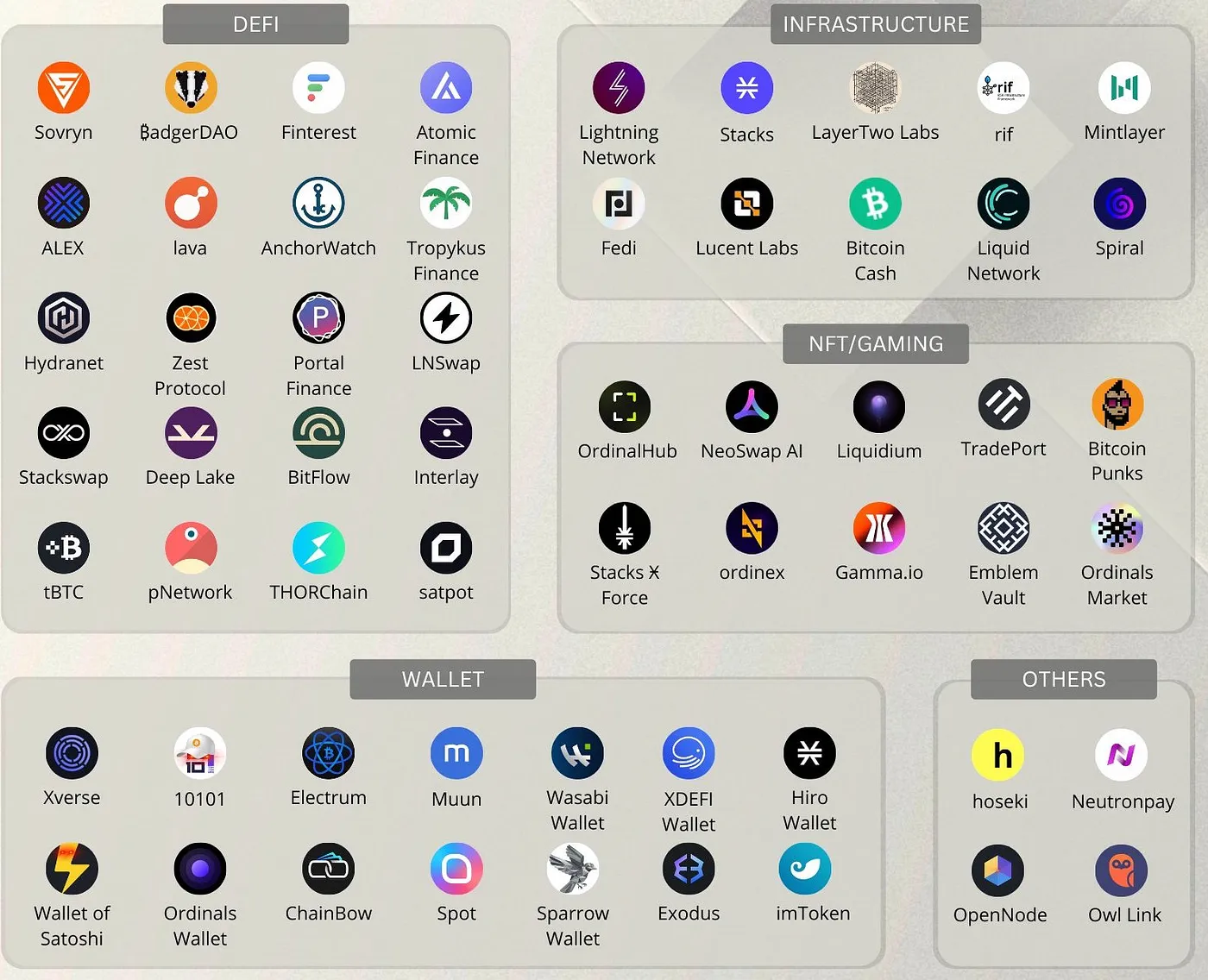
Currently, the Bitcoin network consists of miners, nodes, stakeholders, developers, and various Layer 2 solutions, sidechains, and DApps. Miners and nodes maintain the network by validating transactions and ensuring consensus through the proof-of-work mechanism. The developer community contributes by expanding the native ecosystem and occasionally updating the core protocol, although reaching consensus on such upgrades can be challenging, resulting in few substantial changes over time.
Here is a brief overview of the ecosystem:
- Layer-2 Solutions
Several solutions have been proposed to address Bitcoin’s scalability issues, but the majority of Bitcoin users regard the proof-of-work system as a fundamental part of Bitcoin’s identity and are generally reluctant to support major protocol changes.
Nevertheless, Layer 2 solutions present a more practical approach and appear to be gaining traction, as they do not require significant modifications to the core blockchain. These operate as independent blockchains atop the main Bitcoin network, making them easier to implement and more realistically effective in addressing scalability issues.
Three notable players are leading the charge:
Lightning Network, introduced in 2016, was the first Layer 2 payment protocol developed on the Bitcoin blockchain. Designed to increase transaction speed and reduce costs, it leverages Bitcoin’s smart contract functionality to enable near-instant payments. While the Lightning Network has successfully improved transaction efficiency and attracted over $287 million in total value locked (TVL), it lacks the advanced smart contract capabilities needed to develop a diverse DApp ecosystem. Instead, it focuses on its peer-to-peer payment functionality.
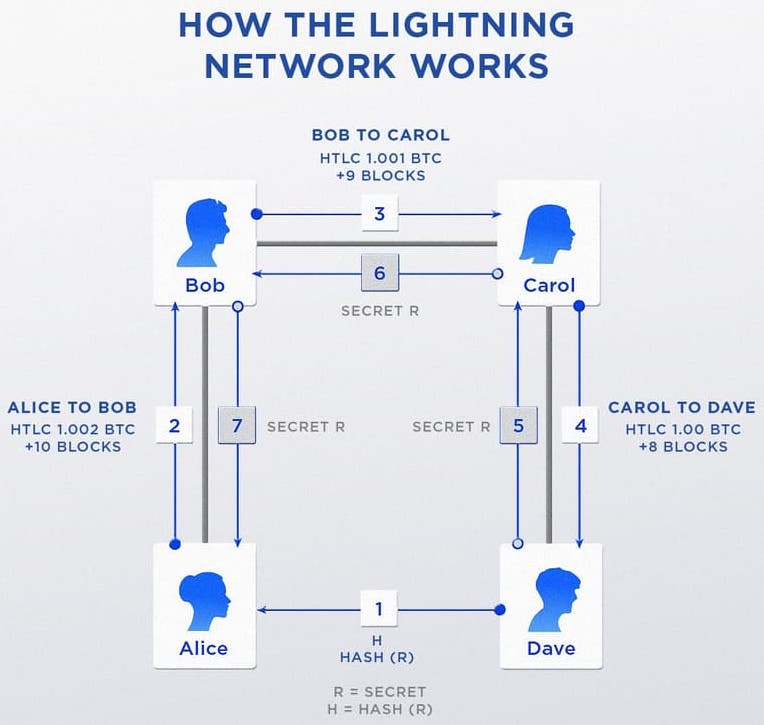
Source: The Lightning Network
Stacks is the current market leader and is about to undergo the Nakamoto upgrade, which will bring significant improvements in security and speed. The technology was founded by computer scientist Muneeb Ali at Princeton University in 2013, who spent four years developing it. Stacks enables smart contracts and decentralized applications to use Bitcoin as an asset and settle transactions on the Bitcoin blockchain. All transactions on the Stacks layer are automatically hashed and settled on Bitcoin. It boasts a highly qualified team, and its technology has undergone peer review by experts from Stanford and Princeton.
The BVM Network is tackling Bitcoin’s limitations in smart contracts and scalability through its Layer 2 meta-protocol. BVM makes it possible to create DApps and smart contracts and facilitates the expansion of Bitcoin L2 blockchains. Currently, BVM is emerging on-chain, particularly during recent market downturns. Its relatively strong performance indicates potential growth, especially as interest in BTC L2 solutions increases. As a Rollup-as-a-Service (RaaS) protocol, BVM allows users to easily launch new Bitcoin L2 blockchains, with all value flowing back to $BVM token holders as new L2s continuously pay fees in $BVM. Notable developments include ecosystems launched using the BVM SDK, such as Tuna Chain and Naka Chain. Additionally, planned integration of Runes functionality suggests further growth for BVM.
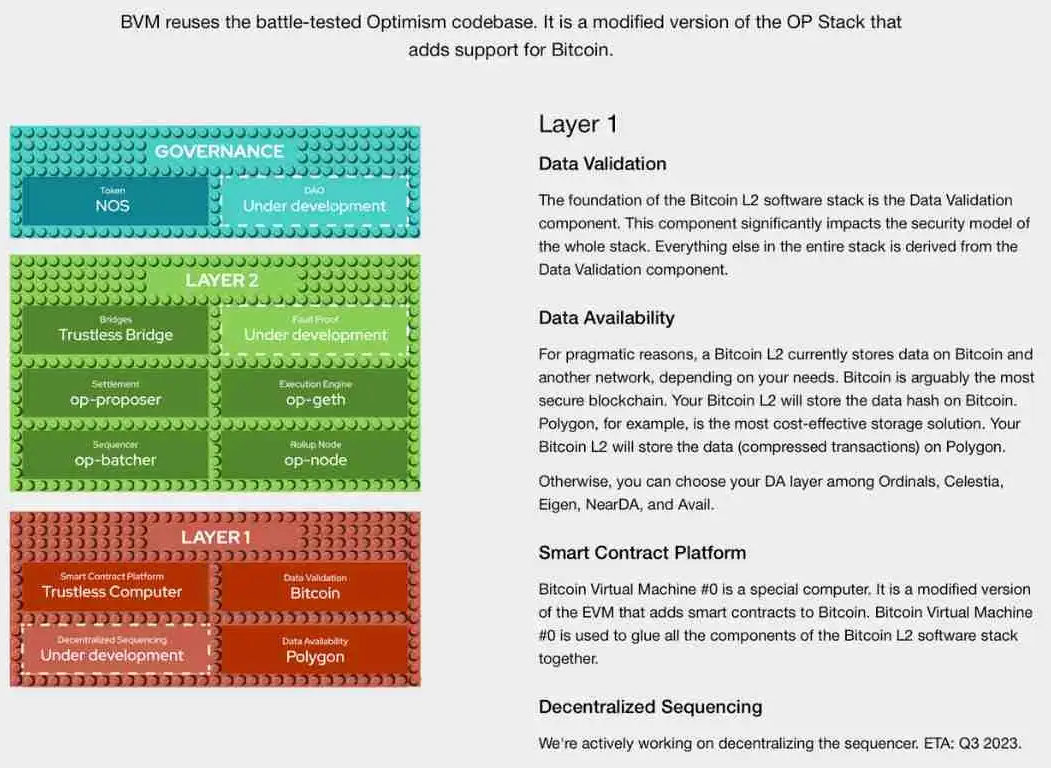
Source: BVM
Several other scaling solutions have been developed to enable smart contracts on Bitcoin:
● RGB: An off-chain layer that uses Bitcoin’s UTXOs to create digital assets like tokens and NFTs, fully compatible with the Lightning Network.
● Counterparty: Allows token creation and crowdfunding; revitalized through innovations like Ordinals.
● Rootstock (RSK): A merge-mined sidechain compatible with EVM smart contracts, using a token pegged to Bitcoin called RBTC.
● Liquid Network: A sidechain by Blockstream supporting decentralized exchanges and asset issuance, including NFTs and stablecoins.
● Omni Layer: Supports token minting and decentralized exchanges; enhanced with Omni Bolt for faster transactions via the Lightning Network.
● Mintlayer: Combines proof-of-stake with Bitcoin’s proof-of-work on a sidechain, supporting smart contracts and cross-blockchain transfers.
● DeFi on Bitcoin
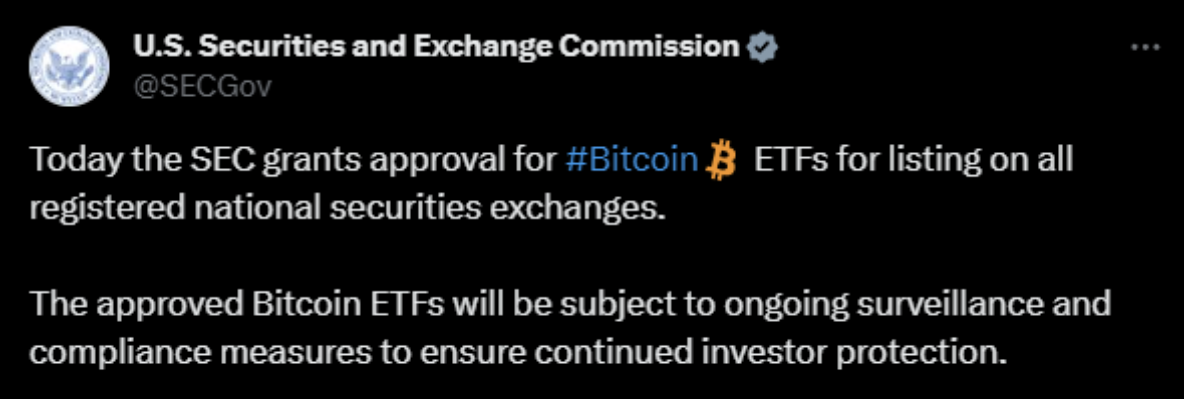
Ethereum has long been the dominant Layer 1 blockchain for DeFi. However, recent developments may position Bitcoin as a key player in mainstream DeFi adoption. With regulatory shifts in the U.S., anticipation around the Bitcoin halving, and the introduction of Bitcoin ordinals, Bitcoin is gaining momentum.
The Bitcoin network is moving beyond basic transactions, leading the development of a rich DeFi ecosystem. This has led to projects supporting more complex financial applications, challenging Ethereum’s dominance.
For example, Sovryn provides a non-custodial, permissionless environment on RSK—a second-layer EVM smart contract blockchain based on Bitcoin—for trading, lending, and borrowing Bitcoin and other selected assets.
Additionally, platforms like Zest Protocol, backed by Primal Capital, are pioneering peer-to-peer decentralized lending backed by Bitcoin. Meanwhile, Bitcoin DEXs like Bisq Network operate under decentralized autonomous organizations, facilitating P2P trading.
● Ordinals and Runes
With the evolution of the Bitcoin network, the Runes protocol has gained widespread attention. Nevertheless, many remain unfamiliar with how Runes simplifies transactions on Bitcoin by leveraging UTXO-based accounting, which is more cost-effective than traditional methods, such as those used on the Unisat marketplace. Previously, Bitcoin transactions were mainly managed through account models requiring specific transaction amounts, which were less user-friendly compared to trading tokens on Ethereum.
Created by the innovator behind Ordinals, Runes aims to become Bitcoin’s equivalent of Ethereum’s ERC-20, enabling fungible tokens. The protocol launched after the Bitcoin halving on April 19, temporarily increasing first-layer transaction fees significantly. Greythorn is closely monitoring its impact on Bitcoin’s Layer 2 solutions.
Unlike Ordinals, which stores data in transaction witnesses and attaches information to individual satoshis, Runes embeds token records directly into Bitcoin’s unspent transaction outputs (UTXOs). This approach integrates seamlessly with Bitcoin’s existing system, enhancing both functionality and blockchain integrity. It is specifically designed for easy implementation across various L2 platforms, such as Stacks.
Below are some key projects associated with the Runes protocol:
● PUPS / Rune Pups: An NFT collection with post-Runes activation, where 23% of the PUPS supply will be distributed via airdrop to participants.
● WZRD: A cultural token and early participant in the Ordinal ecosystem, which has rapidly gained popularity.
● Runestones: This project will transition to Runes tokens after the Bitcoin halving. It has already been airdropped to various ordinal collections, including Bitcoin Puppets.
As the ecosystem grows, more projects will emerge—stay tuned.
The bullish case for Runes can be summarized as follows:
● Innovation in Bitcoin Fungibility: Runes introduces a new token standard on the Bitcoin blockchain, aiming to improve upon the current BRC-20 fungible token standard. This innovation is considered significant enough to trigger a reassessment of Bitcoin’s potential for decentralized applications.
● Efficiency and Design: The Runes token standard is designed to be more efficient, adopting a UTXO-based model. This marks a shift from the account-based designs of Bitcoin’s BRC-20 and Ethereum’s ERC-20 tokens, potentially reducing the bloating of “junk” UTXOs and lowering fees generated in the current process.
● Market Positioning: Compared to Ethereum and Solana, Bitcoin’s fungible token market cap is relatively small. However, the introduction of more efficient token standards like Runes could help Bitcoin close the gap.
● Compatibility and Privacy: Runes is designed to be compatible with the Lightning Network and promises enhanced privacy, as data is hidden within UTXOs. These compatibility and privacy features represent significant improvements over existing standards, potentially making Bitcoin a more attractive platform for DeFi.
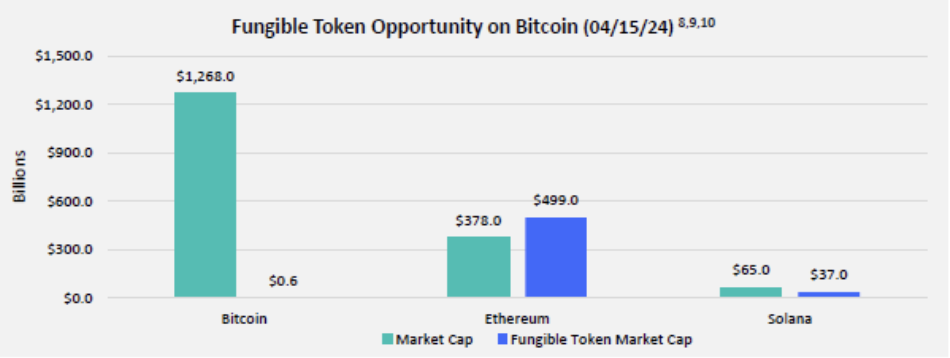
Source: Franklin Templeton
● RGB++
RGB++ enhances Bitcoin’s functionality by integrating smart contracts on the Nervos CKB blockchain. A standout feature of RGB++ is its isomorphic binding, which synchronizes asset management between the Bitcoin and CKB Nervos blockchains. Practically speaking, each Bitcoin UTXO is linked to a corresponding Cell on the CKB blockchain (imagine it as a “transaction block”). Thus, when a Bitcoin UTXO is used in a transaction, it is automatically recorded on the CKB blockchain, and the corresponding Cell on CKB is updated.
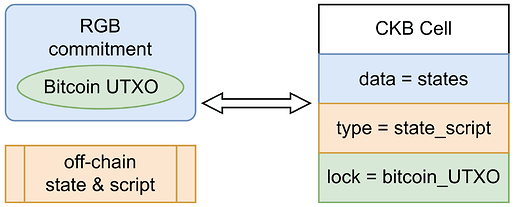
Source: Nervos
This system enables trustless transactions between these blockchains without third-party multi-signature bridges, while ensuring accurate reflection of activity on both networks. RGB++ is regarded as a promising BTC Layer 2 solution, especially as we approach the Bitcoin halving.
From an investment standpoint, the token directly associated with RGB++ is $CKB, which has a market cap of $1 billion, with over 99% of tokens already in circulation. This reduces concerns about market impact from new token releases.
● Conclusion
Greythorn notes that the Bitcoin ecosystem is highly worth watching, as BTC still holds the highest adoption rate in cryptocurrency and is recognized by both individual and institutional investors, potentially bringing greater stability and growth potential.
Thanks to ongoing developments in the BTC ecosystem—such as the Lightning Network accelerating transactions and initiatives like Runes enhancing token fungibility—we anticipate continuous improvements and expanded applications for Bitcoin, ushering in new transformations.
Join TechFlow official community to stay tuned
Telegram:https://t.me/TechFlowDaily
X (Twitter):https://x.com/TechFlowPost
X (Twitter) EN:https://x.com/BlockFlow_News
 Greythorn











