Conversation with BITWU: The Bigger the Waves, the Pricier the Fish?
TechFlow Selected TechFlow Selected
Conversation with BITWU: The Bigger the Waves, the Pricier the Fish?
The emergence of dappOS shattered all complexity.
 Navigating Web3 tides with focused insights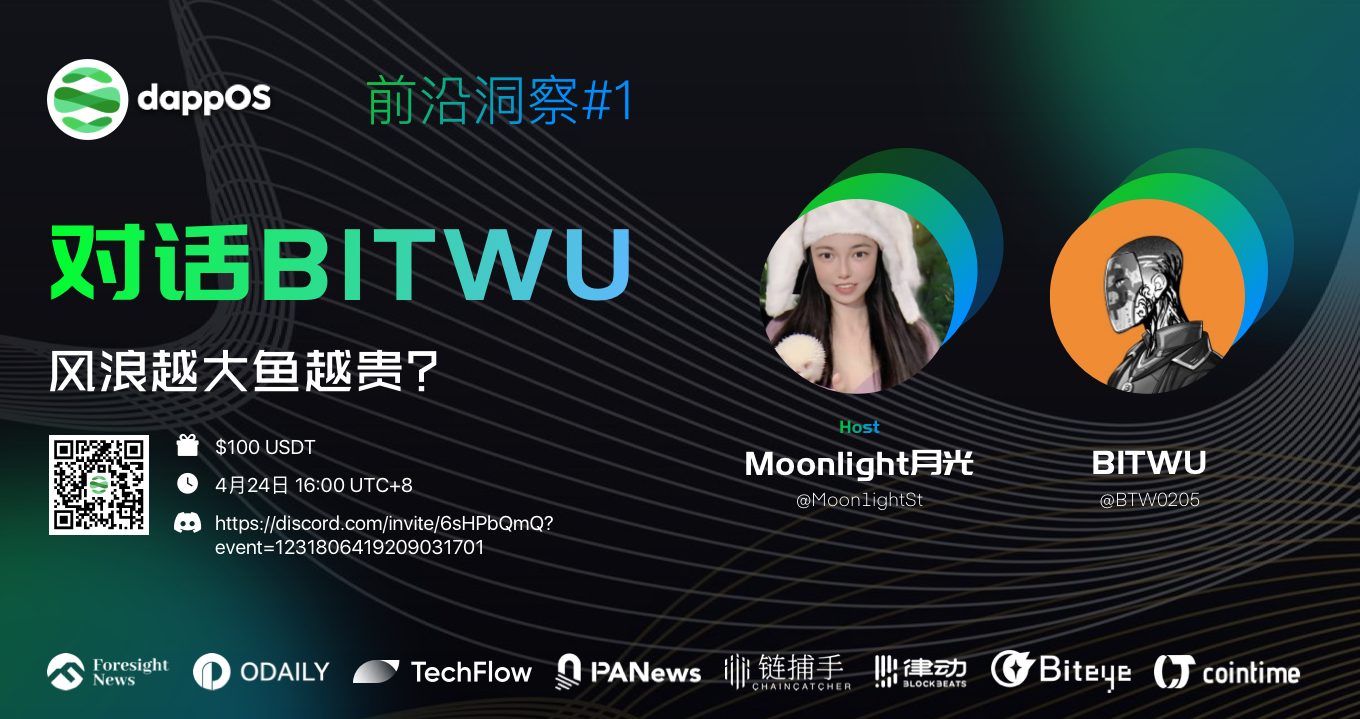
| The Impact of $BTC Halving on the Market
1. With $BTC having completed its halving, how do you analyze the long-term impact of this cyclical event on the overall cryptocurrency market?
Halving has become a self-fulfilling expectation—or another layer of consensus. Bitcoin halving is now widely anticipated; historically, each halving cycle coincided with a bull market in crypto. The halving itself has become a powerful symbolic event that significantly boosts $BTC's visibility. Whether within or outside the crypto community, people actively pay attention to this event, driving price increases, which in turn reinforce the halving expectations, creating a self-reinforcing loop. In this sense, I believe the power of halving will persist and continue to have a lasting influence.
Secondly, let’s talk about the turning point brought by ETFs. With approval of ETFs, this year marks the first year of $BTC’s mainstream adoption—signaling maturity for $BTC and recognition from traditional capital. Going forward, $BTC will increasingly integrate with traditional finance. Put simply, more new capital will flow into $BTC through conventional financial channels.
Additionally, the emergence of the $BTC ecosystem—whether it's inscriptions, $BTC L2 solutions, or shared security—is beginning to unlock Bitcoin's potential in this cycle. $BTC is no longer just “digital gold.” Increasing real-world applications will drive genuine demand for $BTC. Overall, while $BTC’s price trajectory may not perfectly align with every halving cycle, there is indeed a long-term bullish impact.
2. What advice would you give investors to maintain a rational mindset during decision-making and avoid blind FOMO?
Everyone needs to step into their own pits. Most people feel anxious because they fall into traps. We should get used to falling into traps and understand that doing so is normal and necessary—once you realize that, anxiety fades away. Why do I say this? Because experience and lessons cannot be fully transferred from one person to another. Human feelings are three-dimensional; they can't be conveyed through a single sentence. For example, even though I once read countless educational examples like everyone else, when I was personally caught up in a situation, I still couldn’t escape it.
Only real experience shapes people. A lesson without cost isn't truly a lesson. Just go through more experiences—the maturation of your mindset has no shortcuts. Strive to live by the principle: "Life is like a game of chess; once you place your piece, regret nothing."
Mental training happens in daily life—cultivate awareness and become the protagonist in your own investment game.
Investing should adopt a “single-player game” mentality—this is a method I’ve used before—treating investing as a standalone money management game. First, games can be restarted infinitely—you can accept failure. Then, within the game, you gradually evolve from a novice player into a master, and this progression takes time. Second, in the game, only I am the main character. Everyone else is just an NPC (non-player character) in the system. NPCs often brag about how much money they made, disturbing the protagonist’s mindset and luring them into losing control and money.
Treat everyone except yourself as an NPC in this financial game. This game is only about you. Once you do that, who would compare profits with NPCs? Without comparison, there's no anxiety; without anxiety, where does FOMO come from? Simply focus on leveling up in your own game.
| Web3’s 1995 Moment: Decoding Intent-Centric Infrastructure dappOS
1. Recently, dappOS, a leading project in the intent-centric sector valued at $300 million, has received backing and investment from top-tier institutions such as Polychain, Binance Labs, and Sequoia Capital. What are your expectations for dappOS’s future development and its influence in the intent-focused space?
First, I think the intent sector is a very promising space, but oddly enough, few people discuss it. Before diving in, I’d like to bring up a concept: contrast, or “dissonance.”
In investing, some enjoy talking about trends. I personally prefer focusing on “dissonance.” Trends are important—they represent hype and wealth effects—but once a trend is obvious, it may no longer offer major opportunities. Real breakthroughs exist before trends emerge, hidden within areas of confusion and dissonance where most people don’t understand what’s happening. Only in such dissonant spaces do we often find hundred-bagger opportunities.
Current popular topics include DePIN, AI, and others—these are high-hype sectors, but entering them doesn’t guarantee strong returns. Therefore, apart from allocating primary assets to #BTC and stablecoins, I set aside 10% of funds during each bull cycle to explore these “dissonant” areas—sectors or tokens overlooked by the crowd but with high potential to erupt into major trends.
Many friends know I’ve long emphasized the intent-centric sector. I see it as a quietly developing area with tremendous latent potential. I've published several research pieces on this topic before:
For instance, ERC-4337, abstracted wallets, chain abstraction, etc. So to me, the intent sector offers strong dissonance and explosive growth potential.
Back to dappOS—after completing this funding round, its investor lineup is exceptionally strong, including Polychain, Binance Labs, Sequoia China, and OKX Ventures, making it a clear leader in the intent space. Notably, Polychain Capital has delivered outstanding performance recently, achieving significant success in investments such as EigenLayer, Celestia, and TAO. In this new market cycle, Polychain is gaining momentum, precisely positioning itself in leading projects across hot sectors.
What excites me about dappOS is that, even within the Web3 world, whoever enables more efficient and seamless value transfer will hold the keys to wealth in the crypto era. Specifically, dappOS is an intent execution network—an infrastructure layer for the intent economy. It creates a two-sided market that transforms valuable user intents into on-chain outcomes. On one side, service nodes stake collateral to provide various intent execution services. On the other, it provides developers with infrastructure to efficiently generate intent tasks, fulfilling users’ needs to convert intentions into blockchain results. dappOS features its unique underlying mechanism called OMS—Optimistic Minimal Staking.
2. What advantages does dappOS’s proposed Optimistic Minimal Staking (OMS) mechanism offer in terms of security and execution efficiency? How do you view its potential impact in real-world applications?
First, it's a security model well-suited to intent-based tasks. This mechanism requires that intent tasks be value-specific, meaning users agree to receive a predetermined compensation if a task fails. If a task fails, the network reaches consensus to slash the relevant service provider, ensuring that every task either succeeds or users are appropriately compensated.
Second, since strict validation occurs after task execution, users benefit from high speed, while the network can employ a highly decentralized and rigorous verification strategy—achieving both security and speed.
This infrastructure enables seamless conversion between user intent and on-chain results, paving the way for a series of revolutionary use cases.
3. How do you evaluate dappOS’s introduction of the concept of “intent assets”?
dappOS innovatively introduces the concept of intent assets—tokens that can be seamlessly used across different scenarios, with dappOS handling all the complex backend details via its intent execution network. Simply put, we can think of intent assets as the “Yu'ebao” of Web3.
For example, dappOS plans to issue intentUSD as a dollar-pegged intent asset. When users need USDT, it functions as USDT; when they need USDC, it acts as USDC—all while automatically earning yield when idle in an account. These assets solve the biggest usability issues faced by stablecoins and LSD assets, and allow new users to bypass the need to understand differences between fungible assets like USDC and USDT.
4. What key role will dappOS play in promoting blockchain technology adoption, lowering technical barriers, and improving user experience?
Suggested narrative logic: dappOS helps various Web3 blockchains and dApps lower the barrier for users to engage with cryptocurrencies—even making blockchain itself imperceptible.
To me, dappOS feels like core infrastructure in the intent space.
You just need to understand that the ultimate goal of these concepts is to enable faster and more convenient value transfer, drastically reducing the entry barrier for users to participate in crypto—so low that they might not even notice blockchain exists.
5. Given dappOS’s breakthroughs in infrastructure and intent execution, does it really have the potential to usher in Web3’s “1995 moment”?
I believe it’s possible. First, the internet’s “1995 moment” was driven by two core factors: the TCP/IP model and graphical operating systems.
Particularly the graphical user interface (GUI), which optimized computer operations at the level of user intent, bears notable similarities to how dappOS optimizes blockchain interactions for users. Before GUIs, computer users had to operate via command lines, requiring multiple intermediate steps to fulfill an intent. After GUIs, a simple mouse click could achieve the same goal—dramatically lowering the barrier and accelerating user growth. Similarly, before dappOS, blockchain users needed wallets and multiple steps to execute their intent. With dappOS, intent can be fulfilled in one step.
As cryptocurrency continues to expand, more and more outsiders will want to join—but are held back by high entry barriers. dappOS shatters this complexity. In the future, as more users and developers enter the space, dappOS has the potential to become the critical hub and foundational infrastructure connecting diverse Web3 applications and services—just as Windows 95 did for the internet. When various Web3 applications launch in the future, they will inevitably encounter dappOS as a gateway they must pass through. In this way, dappOS could gain overarching control over the entire ecosystem, opening a bridge between insiders and outsiders, becoming next-generation infrastructural backbone—and thus, triggering Web3’s “1995 moment.”
Join TechFlow official community to stay tuned
Telegram:https://t.me/TechFlowDaily
X (Twitter):https://x.com/TechFlowPost
X (Twitter) EN:https://x.com/BlockFlow_News
 @dappOS_com