









Hong Kong approves first batch of 6 virtual asset ETFs, with in-kind creation and redemption potentially opening a compliant "cash-out" channel for cryptocurrencies
TechFlow Selected TechFlow Selected
Hong Kong approves first batch of 6 virtual asset ETFs, with in-kind creation and redemption potentially opening a compliant "cash-out" channel for cryptocurrencies
The regulatory green light for spot Bitcoin and Ethereum ETFs in Hong Kong has officially landed.
 Navigating Web3 tides with focused insights
By Weilin
The regulatory green light for spot Bitcoin and Ethereum ETFs in Hong Kong has officially landed.
On the evening of April 24, the website of the Securities and Futures Commission (SFC) of Hong Kong listed spot Bitcoin and Ethereum ETFs from three fund companies—China Asset Management (Hong Kong), Bosera International, and Harvest Fund International—with approval dates all set at April 23, 2024. The three institutions simultaneously announced official SFC approval and expect their ETFs to begin trading on exchanges by April 30.
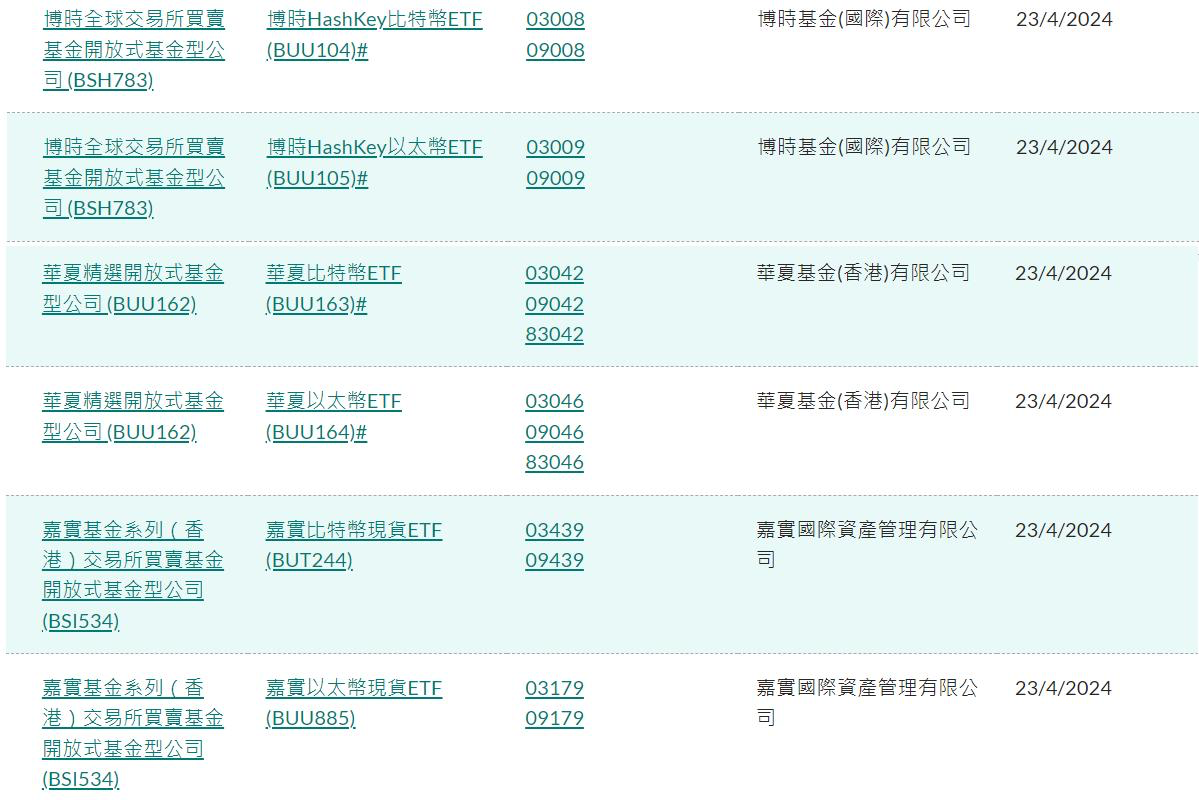
This marks the first time such products have been launched in Asia. Designed to track the spot prices of Bitcoin and Ether, these virtual asset spot ETFs lower investment barriers and risks. Professional fund management comes with strict investment processes and risk control mechanisms. ETFs can be traded on mainstream securities exchanges, simplifying operations and reducing risks. Additionally, the ETFs feature an in-kind creation and redemption mechanism, allowing investors to indirectly hold Bitcoin through ETF shares without worrying about cryptocurrency storage or security.
Currently, investors may subscribe to these ETFs using cash or cryptocurrency, but must open relevant accounts in Hong Kong to do so. According to Caixin, based on a joint circular issued in December 2023 by the SFC and the Hong Kong Monetary Authority, neither existing virtual asset futures ETFs nor upcoming spot ETFs in Hong Kong are permitted to be sold to retail investors in mainland China, where such products are banned. However, mainland Chinese individuals holding Hong Kong ID cards—even if not permanent residents—may participate in trading these ETFs under compliant conditions.
Fierce Fee Competition Among Six ETFs
Harvest Fund International was the first to file for a spot Bitcoin ETF in Hong Kong. According to Tencent Finance's "Frontline," the SFC urgently updated its list of approved virtual asset managers in the early hours of April 10, originally planning to approve four spot Bitcoin ETFs in the first batch—including Harvest, China Asset Management, Bosera, and Value Partners. However, Value Partners is absent from the final list.
Several fund firms rushed their applications. Some applicants, including China Asset Management, reportedly assembled teams just over a month ago and only submitted applications in mid-March. Two weeks later, China Asset Management received SFC approval. Launching a spot Bitcoin ETF in Hong Kong requires coordination with at least 20 partner institutions, including Bitcoin custodians, market makers, and entities holding comprehensive virtual asset trading accounts.
In terms of supported currencies, Bosera International and Harvest Fund International offer dual counter (HKD and USD) ETFs, while China Asset Management (Hong Kong) adds a third RMB counter, making it the only issuer launching tri-currency ETFs.
Mirroring the fee wars seen during the U.S. launch of spot Bitcoin ETFs, competition among Hong Kong’s three fund firms is intense. Harvest Fund International waives management fees for the first six months of holding; Bosera International offers a four-month fee waiver post-launch. According to Bloomberg analyst Eric Balchunas, management fees stand at 30 basis points (Harvest), 60 basis points (Bosera), and 99 basis points (China Asset Management)—on average lower than expected. He previously estimated fees would range between 1% and 2%. ETF analyst James Seyffart noted that Hong Kong could see an emerging fee war driven by these Bitcoin and Ethereum ETFs.
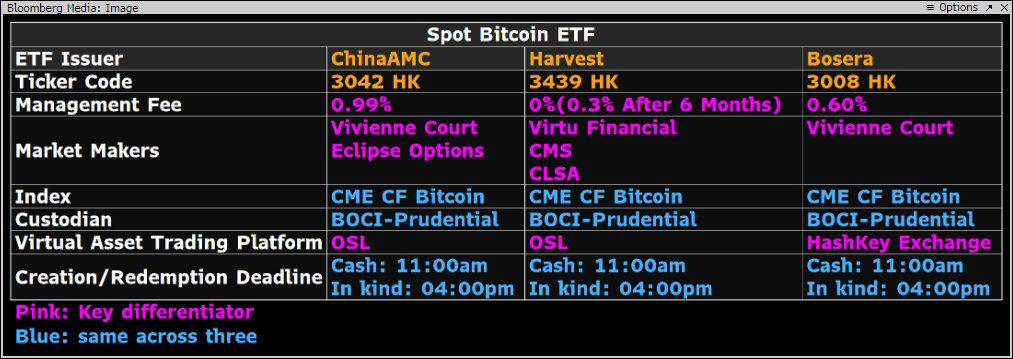
Currently, the 11 approved Bitcoin ETFs in the U.S. charge management fees ranging from 0.19% to 1.5%. Fidelity's Wise Origin Bitcoin Trust (FBTC) charges 0.25%, with fee waivers until July 31, 2024. BlackRock's iShares Bitcoin Trust also charges 0.25%, with a reduced rate of 0.12% for the first 12 months (or until assets reach $5 billion). ARK 21Shares Bitcoin ETF (ARKB) charges 0.21%, with zero fees for the first six months (or until assets hit $1 billion). Grayscale Bitcoin Trust (GBTC) remains the most expensive at 1.5%.
The approval of Hong Kong's spot Bitcoin ETFs comes roughly three months after the U.S. SEC approved the first U.S. spot Bitcoin ETFs on January 11. According to Bloomberg data, U.S. Bitcoin ETFs have already accumulated $56 billion in assets.
In-Kind ETFs Could Open Compliant “Cash-Out” Channels
In Hong Kong, virtual asset spot ETFs can operate via two models: cash (Cash Model) or in-kind (In-Kind Model). Under the cash model, funds must acquire virtual assets through licensed Hong Kong exchanges, either on-exchange or off-exchange. Under the in-kind model, cryptocurrencies are transferred directly into or out of the fund’s custody account via brokers.
This differs from the U.S. Securities and Exchange Commission (SEC) approach, which only permits cash redemptions for spot Bitcoin ETFs to reduce intermediaries and enhance oversight. Allowing in-kind creations and redemptions means investors can use actual cryptocurrencies to buy or sell ETF shares instead of relying solely on fiat currency like the U.S. dollar.
Analysts suggest that in-kind ETFs could create compliant "cash-out" channels for Bitcoin and Ethereum. For institutional and high-net-worth investors, converting Bitcoin into ETF shares at a near-fixed ratio helps avoid potential frozen bank accounts when withdrawing funds through traditional exchanges. It also reduces security risks associated with wallet and private key management, further protecting asset safety.
Earlier debates surrounded how much capital Hong Kong’s spot Bitcoin and Ethereum ETFs might attract. On April 15, Bloomberg senior ETF analyst Eric Balchunas posted on X: “We think they’d be lucky to pull in $500 million. Reasons: 1. The Hong Kong ETF market is tiny—only $50 billion—and mainland Chinese residents cannot buy these ETFs through official channels. 2. The three approved issuers (Bosera, China Asset, Harvest) are relatively small, with no giants like BlackRock involved yet. 3. Hong Kong’s underlying ecosystem suffers from low liquidity and inefficiency, likely leading to wider spreads and premiums/discounts. 4. Fees may run between 1–2%, far higher than the ultra-low rates in the U.S.”
Nonetheless, the approval of Hong Kong Bitcoin ETFs may represent a significant market opportunity. In another research note, Bloomberg ETF analyst Eric Balchunas stated, “This opportunity could substantially increase assets under management (AUM) and trading volume for Bitcoin ETFs in the region.”
Herbert Sim, COO of cryptocurrency exchange Websea, previously said externally that the approval of Hong Kong’s first spot Bitcoin ETF would boost demand and inflows from major U.S. ETF issuers like BlackRock, and he expects this trend to continue. “With Bitcoin halving reducing supply,” he said, “prices will surely surge.”
According to cryptocurrency commentator Bitcoin Munger in a post on April 12, large investors—or "whales"—holding at least 10,000 BTC were accumulating Bitcoin at current price levels ahead of the anticipated approval of Hong Kong’s virtual asset ETFs. “The net accumulators of Bitcoin are all the largest whales (>10k). If I had to guess, this is a positive contrarian signal.”
Join TechFlow official community to stay tuned
Telegram:https://t.me/TechFlowDaily
X (Twitter):https://x.com/TechFlowPost
X (Twitter) EN:https://x.com/BlockFlow_News
 PANews











