Can AI Become a New Narrative for Established Public Blockchains? A Review of 7 Blockchain and AI Integrations
TechFlow Selected TechFlow Selected
Can AI Become a New Narrative for Established Public Blockchains? A Review of 7 Blockchain and AI Integrations
Even when combining with AI, established public blockchains seem to show little vitality or determination, wavering between jumping on the hype bandwagon and genuinely pushing forward real progress.
 Navigating Web3 tides with focused insights
By Frank, PANews
Bull markets are constant, but public blockchains come and go. Each bull market brings a new wave of blockchains into the spotlight, while others fade into obscurity as the cycle ends. As the most critical crypto infrastructure, public blockchains command the highest market capitalization and share, carrying immense expectations from investors and projects alike. For chains lacking sticky user bases, continuously refreshing narratives and maintaining brand visibility may be their only way to stay relevant on the main stage of the next bull run.
AI is currently the hottest and most breakout-prone sector. PANews has observed that some star public blockchains from previous bull markets have failed to shine this time around, with AI emerging as a new narrative for legacy chains. This article reviews how seven established blockchains are integrating with AI. However, overall, even when combining with AI, these legacy blockchains appear to show limited vitality and determination, wavering between chasing trends and genuine innovation.
Qtum: Deploying 10,000 GPUs to Support AI
On April 18, the Qtum Foundation announced the acquisition and deployment of 10,000 Nvidia GPUs to support artificial intelligence projects.
In addition to launching its GPU support program, Qtum introduced two AI products: Qtum Solstice and Qtum Qurator.
Qtum Solstice: A conversational chatbot similar to ChatGPT, based on open-source models. This alpha release enables users to engage in useful and intelligent conversations.
Qtum Qurator: A text-to-image generation model akin to Midjourney, also built on open-source models. This tool allows users to generate images that would typically require tedious work in image editing software.
Miguel Palencia, co-founder of Qtum, said: "We have ambitious goals for artificial intelligence, requiring a three-phase rollout plan. Today, we unveil phase one—our chatbot and image generator. The next two phases will include a modeling layer, culminating in a decentralized economic layer that integrates everything on the Qtum blockchain."
The Qtum Foundation plans to launch up to 10 additional AI-related products in the coming months, further leveraging these 10,000 GPUs. This substantial computing power will help the Qtum Foundation seek partners for collaboration and joint development.
NEAR: AI Pioneer Returns to the AI Race
NEAR co-founder Illia Polosukhin's achievements in AI arguably surpass those in blockchain. He joined Google Research in 2014, focusing on developing models and tools that eventually contributed to AI. He was also a major code contributor to Google’s TensorFlow AI open-source project. Alongside seven other researchers, he co-authored the seminal paper “Attention Is All You Need,” introducing the Transformer model architecture—the foundation behind popular AI products like ChatGPT. In fact, NEAR’s connection to AI runs deep; at inception, NEAR.AI was a company fully dedicated to artificial intelligence.
However, during NEAR’s early years, its primary goal shifted toward building a convenient, user-friendly, and eco-friendly blockchain. It wasn’t until late 2023 that NEAR announced NEAR Tasks—a smart contract platform enabling automatic payments via NEAR tokens, designed to help AI projects better distribute rewards. In reality, this initiative appears more focused on using blockchain advantages to optimize AI development rather than enhancing blockchain through AI.
At NEARCON 2023, Illia Polosukhin named AI as one of the core verticals of the NEAR ecosystem. Ahead of NVIDIA’s GTC conference in 2024, anticipation surrounding Polosukhin’s participation as a speaker nearly doubled NERA’s price.
Currently, NEAR Tasks remains officially unreleased, and no formal category for AI applications exists yet within the NEAR ecosystem.
Algorand: Some Thoughts on AI, But Not Many
In July 2021, Algorand announced a partnership with Fortior to create AI-driven governance mechanisms and financial assets on the Algorand blockchain. Since then, there have been almost no further updates related to AI from Algorand.
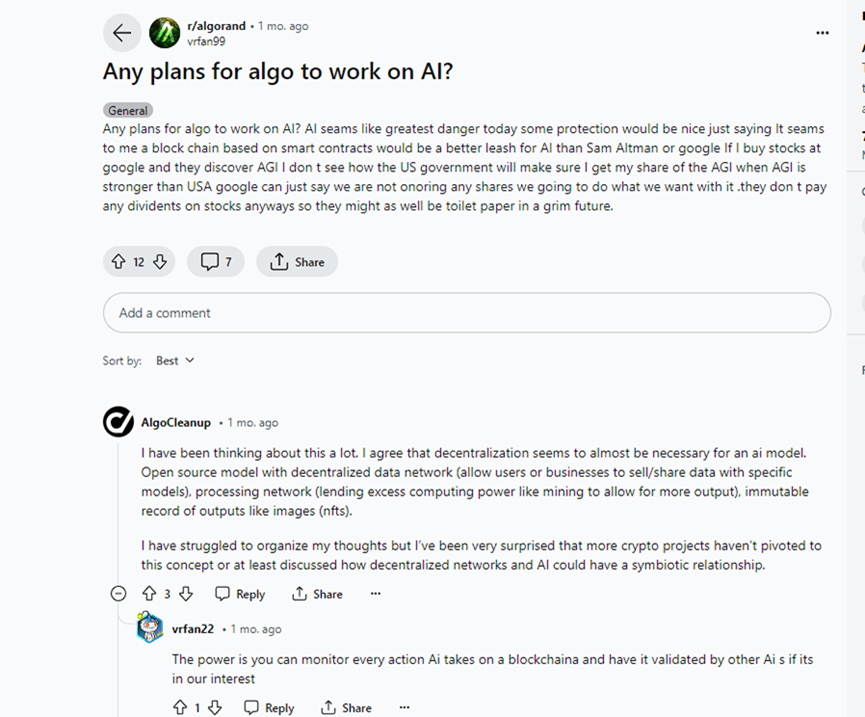
Earlier this year, a community member asked Algorand on a forum whether there were plans to apply ALGO to artificial intelligence.
The official ALGO team responded that they’ve been contemplating the idea. Decentralization is nearly essential for AI models, especially with open-source models supported by decentralized data networks (allowing users or enterprises to sell/share data via specific models), processing networks (lending excess computing power, similar to mining for greater output), and immutable records of outputs such as images (NFTs). Algorand stated it continues refining its thoughts, expressing surprise that more cryptocurrency projects haven’t embraced this concept—or at least discussed how decentralized networks and AI could form a symbiotic relationship.
DFINITY: Optimizing ICP to Run Large AI Models
Dominic Williams, founder and chief scientist of the DFINITY Foundation, wrote in a March 2024 blog post that AI, smart contracts, and blockchain represent a “perfect partnership.” He believes centralized large models carry risks of malicious behavior, so AI must be tamper-proof.
Williams stated that ICP will soon upgrade smart contracts to support 32GB of memory and 64-bit processing, enabling the execution of certain large language models directly on-chain.
Polygon: Launching AI Tools Based on GPT-4
Polygon appears sufficiently responsive to the AI trend, having launched Polygon Copilot as early as June 2023. However, according to PANews testing, the product fails to deliver expected results, showing no response to repeated queries.

Besides Polygon Copilot, another AI tool developed by Polygon called Brain offers enhanced functionality. It not only answers questions but also enables AI-assisted contract deployment and transaction sending.
Additionally, on April 19, ORA—an AI project gaining recent traction—announced a partnership with Polygon at Token2049 in Dubai, bringing its AI oracle OAO onto the Polygon chain.
Polkadot: Launching PolkaBot AI Chatbot
In 2024, PolkaBot launched an AI education platform called PolkaBot AI—an LLM similar to ChatGPT, currently offering content retrieval about PolkaBot.
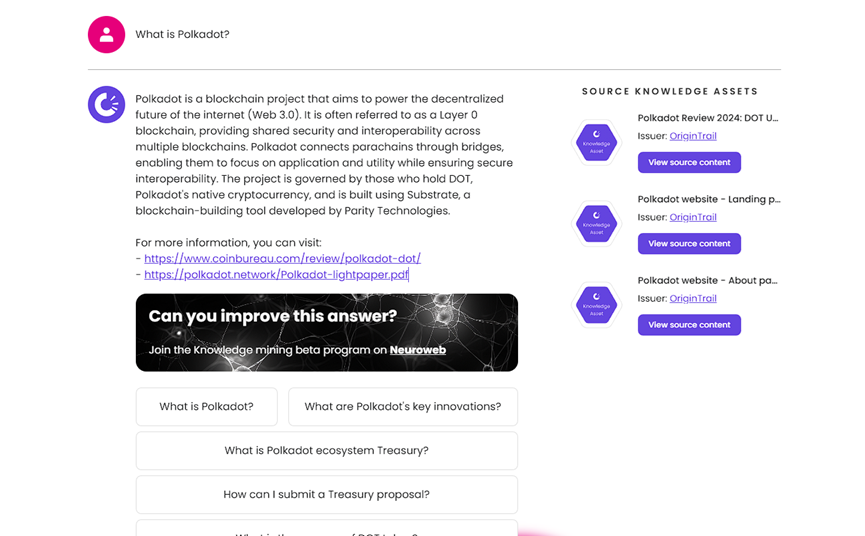
To date, Polkadot has not unveiled any official AI strategy, but appears highly supportive of AI projects within its ecosystem. On April 16, Polkadot highlighted several AI-related projects in a blog post, including the popular AI project Bittensor.
Polkadot emphasized: “Polkadot’s robust infrastructure uniquely positions it to support the AI revolution, providing the scalability, interoperability, and security needed to meet AI’s massive computational demands.” Clearly, Polkadot aims to serve as foundational infrastructure for Web3-AI convergence projects.
Cardano: Defending Cardano Through AI Model Comparisons
Although Cardano has not officially launched any AI initiatives, interestingly, in response to community criticism over perceived inactivity, its founder countered in April by drawing parallels between AI models and cryptocurrencies. He argued that short-term narratives aren't always effective, noting: “The problem in our industry is that short-term hype dominates discourse—and AI faces the same issue. A few months ago, OpenAI ruled everything, yet now faces growing competition from other language models—first Claude 3, now Grok 1.5, and soon Llama 3.”
Conclusion
From the above cases, it’s evident that legacy blockchains are attempting to leverage AI—a major societal trend—to boost visibility. However, none have deeply explored or committed significant resources to this space. Aside from Qtum, NEAR, and Polygon, which have invested more substantially in AI products, other chains seem largely stuck in trend-chasing mode. That said, the Web3+AI sector is far from quiet. According to CoinGecko, the total market cap of AI-related projects has already reached $23.2 billion, with most choosing Ethereum and Solana as their preferred technical platforms. For legacy blockchains aiming to revitalize themselves through AI, more compelling strategies and tangible products will be necessary to gain credibility.
Join TechFlow official community to stay tuned
Telegram:https://t.me/TechFlowDaily
X (Twitter):https://x.com/TechFlowPost
X (Twitter) EN:https://x.com/BlockFlow_News
 PANews