








Quickly Understand Reya Network: How to Build a Modular L2 Optimized for Trading Scenarios?
TechFlow Selected TechFlow Selected
Quickly Understand Reya Network: How to Build a Modular L2 Optimized for Trading Scenarios?
Reya Network is a phased revolution.
 Navigating Web3 tides with focused insights
Author: Reya Network
Translation: Halsman, ChainCatcher
Excerpted from the official documentation of Reya Network.
Why Build Reya Network?
Reya Network is not another generic L2, nor another meaningless hype narrative. Instead, we solve real problems in DeFi scaling that cannot be addressed by general-purpose designs. As a DeFi OG team, we know exactly what these problems are—and more importantly, we’ve already found solutions.
The most critical constraint in DeFi scaling is the massive liquidity fragmentation that has already emerged, where every new exchange built atop general-purpose rollups competes for a limited supply of liquidity. This results in shallow markets across all exchanges, harming traders and market participants alike. General-purpose designs also inherit issues like front-running and harmful MEV, and suffer performance limitations due to lack of parallel execution.
Reya Network changes how we think about scaling. We believe networks don’t need to be general-purpose—they can instead be optimized for specific use cases. By focusing on a single use case, we go beyond mere technical improvements to optimize financial logic and liquidity. Thus, Reya Network focuses exclusively on DeFi trading, optimizing around three core pillars: liquidity, capital efficiency, and performance.
The Three Pillars of Reya Network
Reya Network liberates the DeFi application layer by creating autonomous, specialized, and optimized infrastructure, addressing the following three core pillars:

Liquidity
Capital deposited into Reya Network is efficiently utilized to support trading through a novel passive liquidity pool mechanism. This design enables instant shared liquidity across all exchanges operating within the Reya ecosystem, enhancing market depth, lowering market entry barriers, and improving user trading experience.
But the benefits of liquidity go even further. By integrating financial logic directly into network design, Reya acts as a clearing protocol across exchanges. This eliminates liquidity fragmentation and allows liquidity to be organized into a network spanning multiple exchanges.
Because market makers can freely share liquidity across exchanges, ecosystem growth enhances potential trading conditions for each individual exchange. In this way, we create, for the first time in DeFi, a flywheel effect of "interoperable liquidity."
Capital Efficiency
Margin logic is embedded directly into Reya Network itself, meaning users have a margin account usable across multiple exchanges. In many ways, this creates the first decentralized clearinghouse.
Reya Network’s margin engine is among the most advanced in crypto, delivering up to 3.5x higher capital efficiency for traders and up to 6x for LPs. Any exchange on Reya Network automatically inherits this logic simply by running on the network.
Performance
Performance improvements are crucial, so we made Reya Network lightning-fast. With a block time of 100 milliseconds and throughput reaching 30,000 transactions per second, Reya Network is one of the fastest EVM rollups available.
Additionally, transactions are executed on a “first-in, first-out” (FIFO) basis with zero gas fees, eliminating front-running and harmful MEV. This feature is enabled by leveraging the Arbitrum Orbit technology stack. Over time, further optimizations will follow, including moving more application-specific logic directly into the network design.
The importance of performance cannot be overstated—currently, DeFi accounts for less than 5% of total crypto activity, partly because it fails to compete with CeFi venues in terms of high performance and superior user experience. However, when performance improvements are combined with modularity and integrated financial logic, why can’t we finally capture CeFi volumes and bring them on-chain for the first time? This would not only bring massive trading volume to DeFi but also significantly enhance transparency, robustness, and composability for all traders joining our DeFi ecosystem.
The Team Behind Reya
Reya Labs, the creator of Reya Network, is operated by a DeFi OG team with a track record of launching several successful startups, including Voltz Protocol, which grew to over $30 billion in notional trading volume within just 12 months.
We are backed by some of the most prominent figures in the industry and have raised nearly $10 million from top-tier VCs such as Framework, Coinbase, and Wintermute.
Roadmap
Reya Network is a revolution unfolding in phases.
As a liquidity network, the logical first step is bootstrapping the network via inflows of liquidity. That’s why our roadmap begins with a Liquidity Generation Event (LGE) scheduled for April.
Following the LGE, we will demonstrate Reya Network’s concept by deploying Reya Exchange—a fully functional perpetual DEX. Reya Exchange will be the first exchange on the network and will serve as a tool to attract more liquidity and traders, creating strong network effects for future exchanges.
Subsequently, Reya Network will open up to other exchanges, ultimately becoming the foundational layer upon which the next generation of DeFi is built.
Liquidity Generation Event
The Liquidity Generation Event (LGE) is the period before trading begins when Reya Network seeds initial liquidity. Since liquidity is essential for trading, our goal is to attract as much liquidity as possible.
Early LPs receive XP multipliers.
For example:
The earliest LPs depositing into the pool receive a 10x boost. This means they earn 500% APY in XP during that period instead of accumulating (for example) 50% APY in XP on their deposited capital.
LPs depositing later may receive a 2x boost.
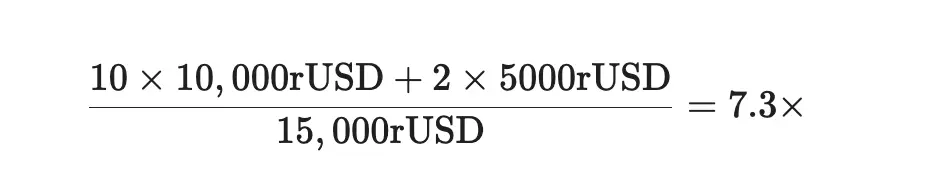
If multiple deposits have different boosts, the final boost is calculated as a capital-weighted average. For example, if you deposit 10,000 rUSD at a 10x boost and 5,000 rUSD at a 2x boost, your final boost is calculated as follows:
LPs continue to benefit from the multiplier on capital deposited during the LGE until withdrawal. When withdrawing, you lose the multiplier on the withdrawn amount (but retain it on the remaining deposited amount).
-
The mechanism is simple: stake assets to participate in the LGE. Eligible assets for this phase include USDC from Ethereum mainnet or USDC.e from supported L2s. Additional assets will be added later.
-
Funds on Reya Network are non-custodial and can be withdrawn at any time. A withdrawal button on the dApp is coming soon to improve UX, but in the meantime, you can withdraw directly from Reya Network smart contracts. However, if you withdraw funds, you permanently forfeit the XP boost associated with those withdrawn funds.
-
The LGE starts at noon UTC on April 22 and runs until noon UTC on May 6. Reya Perp DEX will then go live at noon UTC on May 7, marking the start of trading.
-
EVM-compatible wallets can connect to the LGE page. Funds can be deposited from Ethereum mainnet, Arbitrum One, Polygon PoS, and Optimism mainnet.
-
Event link: https://reya.network/lge
Join TechFlow official community to stay tuned
Telegram:https://t.me/TechFlowDaily
X (Twitter):https://x.com/TechFlowPost
X (Twitter) EN:https://x.com/BlockFlow_News
 @reya_xyz






