Why is the impact of halving on the Bitcoin ecosystem gradually "weakening"?
TechFlow Selected TechFlow Selected
Why is the impact of halving on the Bitcoin ecosystem gradually "weakening"?
After this halving, Bitcoin's inflation rate will drop from 1.75% to 0.85%, making it approximately half the supply growth rate of gold and positioning Bitcoin as a truly scarcer asset than gold.
 Navigating Web3 tides with focused insights
Produced by|OKG Research
Author|Jason Jiang
According to data from OKLink by OKG Group, Bitcoin successfully completed its fourth halving at block height 840,000 (8:09 AM Beijing time on April 20, 2024). The block mining reward has officially decreased from 6.25 BTC to 3.125 BTC. Following this halving, Bitcoin’s inflation rate will drop from 1.75% to 0.85%, roughly half the annual supply growth rate of gold, making Bitcoin a truly scarcer asset than gold in practical terms.
Bitcoin miners’ short-term income is theoretically affected directly after the halving. However, due to the simultaneous launch of Bitcoin Runes alongside the halving event, transaction fees on the Bitcoin network have surged over the past two days. As a result, within the first 100 blocks after the halving, miners did not experience any negative impact—on the contrary, they earned more than before: On April 20 alone, transaction fees generated by Rune-related activities accounted for as high as 57.7%; the transaction fee in block 840,000 reached 37.626 BTC, approximately six times the pre-halving block reward. Since the completion of this Bitcoin halving, transaction fees have accounted for nearly 60% of miners’ total income (as of 6:00 PM on April 22, 2024).
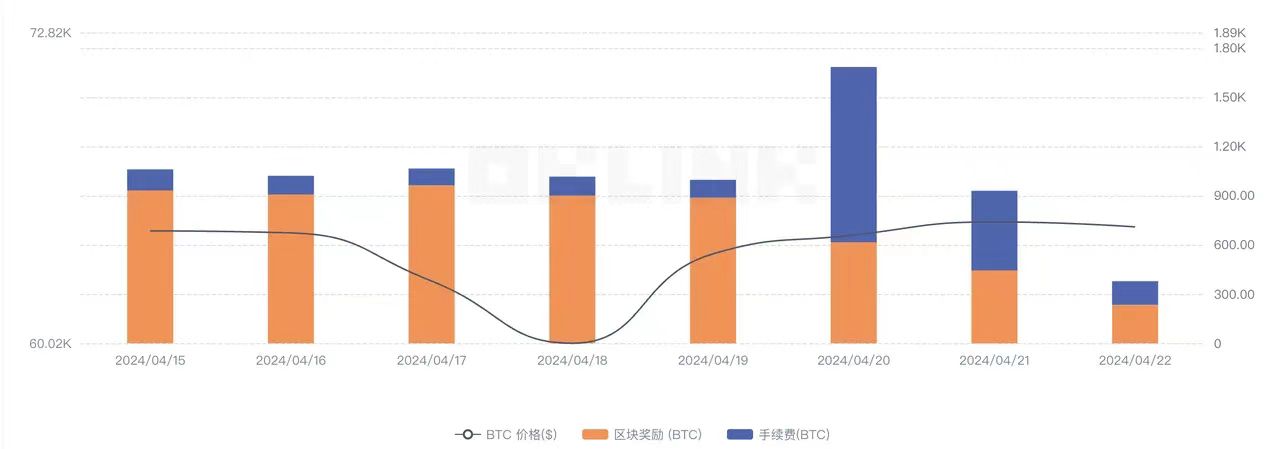
Figure: Bitcoin Miner Revenue Composition
Source: OKLink by OKG Group
However, as time passes and block rewards continue to decline, the urgent issue of incentivizing miners to sustainably participate in and secure the blockchain network remains. There are two ways to boost miner incentives during the post-halving cycle: one is ensuring that fixed block rewards increase in value due to heightened scarcity; the other is improving the variable component of miner income—transaction fees. The former is difficult to predict and cannot fundamentally solve the problem (sustained price growth would be required to meet demand, which is clearly unrealistic). In contrast, the latter presents a more rational and effective solution.
Satoshi Nakamoto mentioned in the original Bitcoin whitepaper: "Once a predetermined number of coins are in circulation, transaction fees will fully serve as incentives. At that point, the Bitcoin network will become entirely immune to the chronic ailments of traditional economies—such as inflation." This indicates that the reduction in block rewards and the rise in transaction fees were inherent design principles of the Bitcoin protocol from the outset.
In fact, with the continuous growth of the Bitcoin ecosystem since 2023, the level of network activity has significantly changed compared to the previous halving cycle, and the proportion of transaction fees in miner revenue has steadily increased. According to data from OKLink by OKG Group, Ordinals transactions account for about 40% of all Bitcoin network transactions today. Fees from Ordinals transactions have already contributed over 20% of miner income, generating more than $200 million in total for miners to date.

Figure: Proportion of Different Types of Bitcoin On-Chain Transactions
Source: OKLink by OKG Group
Even though, for most of the time, miners' primary source of income still comes from block rewards—and the surge in activity driven by Runes may not last long after this halving—the temporary phenomenon at least demonstrates that in the absence of block rewards, the growth in transaction fees driven by on-chain activity could theoretically provide sustained positive incentives for miners.
To sustain this scenario, the necessary precondition is sufficiently active on-chain activity and users willing to pay substantial transaction fees for these activities. In the past, Bitcoin transactions solely aimed at payment transfers were clearly insufficient to fill the income gap caused by halvings. Therefore, more on-chain applications like Bitcoin Runes are needed—those capable of attracting market attention and creating incremental value. Only through the continuous emergence of such high-traffic, valuable innovations can Bitcoin’s ecosystem maintain growing activity, enabling different stakeholders—including miners, users, and institutions—to benefit collectively.
From this perspective, I believe the Bitcoin halving may, to some extent, drive the development of Bitcoin’s on-chain ecosystem and act as a “catalyst” accelerating ecological innovation. Yet, as the Bitcoin ecosystem continues to thrive, the future market impact of Bitcoin halvings will gradually diminish. Although we will still pay attention to halvings, they may increasingly become symbolic events marking cyclical transitions rather than key factors influencing price trends.
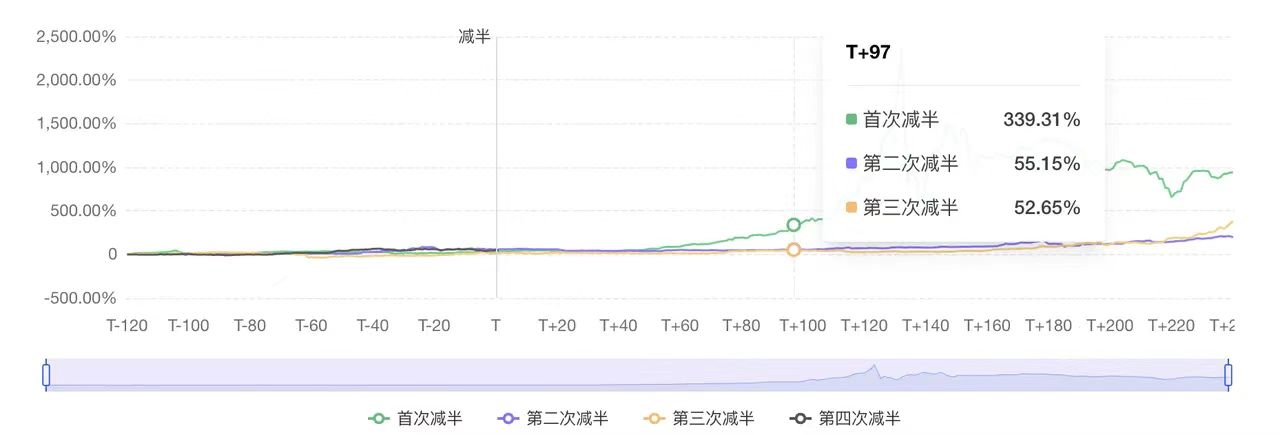
Figure: Bitcoin Price Changes Following Previous Halvings
Source: OKLink by OKG Group
Join TechFlow official community to stay tuned
Telegram:https://t.me/TechFlowDaily
X (Twitter):https://x.com/TechFlowPost
X (Twitter) EN:https://x.com/BlockFlow_News
 @OKGResearch