









The SEC intends to file a no-win lawsuit against Uniswap Labs
TechFlow Selected TechFlow Selected
The SEC intends to file a no-win lawsuit against Uniswap Labs
The more united we are, the stronger we become, and the harder we are to kill.
 Navigating Web3 tides with focused insights
By: Will Awang
On April 10, 2024, Uniswap Labs received a Wells Notice from the U.S. Securities and Exchange Commission (SEC) Enforcement Division, indicating that the SEC may take legal or regulatory enforcement action against Uniswap Labs.
Uniswap Labs is the initiator of the decentralized exchange protocol Uniswap Protocol. Since its launch five and a half years ago, it has facilitated over $2 trillion in trading volume, dominating the decentralized exchange market with 55.5% of total trading volume, making it a leader in the crypto and DeFi markets.
The SEC's move is seen as an open provocation against decentralized DeFi projects and will have significant implications for the crypto market. While we observed a strong reaction from $UNI, what stands out more is the unity within the market.
This article examines why the SEC’s potential lawsuit is one it cannot win, drawing on Uniswap Labs’ public response to the SEC and its relatively compliant governance structure.
1. What Is a Wells Notice?
First, it must be clarified that a Wells Notice is not a formal lawsuit or regulatory enforcement action but rather an official warning or notification, signaling the SEC’s intent to pursue enforcement against a suspected entity.
Second, the Wells Notice does not specify the exact grounds for potential enforcement, putting Uniswap Labs at a disadvantage by forcing it to comprehensively prove its innocence across all possible areas.
The Wells Notice process works as follows:
1. After internal investigation by the SEC into whether a company violated securities laws, staff may recommend enforcement action;
2. Upon receiving the notice, the subject company has a 30-day window to respond, refute allegations, and present arguments demonstrating compliance;
3. The SEC then evaluates the response before deciding whether to proceed with enforcement.
One of the most well-known recent cases involving a Wells Notice is SEC vs. Ripple.
Ripple received its Wells Notice from the SEC in December 2020, which immediately led to its delisting from Coinbase. Although Ripple successfully argued that it was never informed XRP would be classified as a security, the three-year legal battle severely damaged the company’s reputation and came at a high cost.
2. How Is Uniswap Labs Proving Its Innocence?

(blog.uniswap.org/fighting-for-defi)
Let’s examine Uniswap Labs’ article titled Fighting for DeFi:
Given the SEC’s continued enforcement actions against some of the most compliant and law-abiding participants in the market—such as Coinbase and now Uniswap—and its six-year failure to provide clear regulatory guidance, this latest move appears driven more by political motives (especially when viewed alongside recent legislative attacks on DeFi).
Uniswap Labs, a U.S.-based company, created the Uniswap Protocol, introducing unprecedented innovation to the market. These innovations are built on open-source code, enabling users to trade directly while retaining custody of their assets—without intermediaries.
Uniswap Labs believes its products are not only legal but transformative. By reducing gatekeepers, they create transparent and verifiable markets, empowering people worldwide to participate cheaply and easily in the global economy.
If the SEC continues protecting opaque traditional financial systems while attacking innovative, transparent technologies that create opportunities and reduce costs for Americans, Uniswap Labs will have no choice but to fight back against this government agency to defend innovation and economic freedom.
Regardless of the SEC’s ultimate decision, the law is clear on several key points:
1. SEC Enforcement Lacks Congressional Authorization — The SEC Only Has Jurisdiction Over “Securities”
The SEC Chair previously stated clearly to Congress that determining whether a digital asset qualifies as a “security” requires legislative clarification from Congress.
Additionally, in the Risley vs. Uniswap Labs case, the judge ruled that trading on Uniswap does not fall under securities law (neutral and permissionless), emphasizing: “Determining whether something is a security is best left to Congress.”
Furthermore, in the SEC vs. Ripple case, the court explicitly stated that secondary market trading of crypto assets generally does not constitute an investment contract.
Therefore, secondary market trading on Uniswap does not involve “securities.”
2. Does Not Meet the Definition of a Securities Exchange or Broker
Even if most cryptocurrencies were deemed “securities,” the Uniswap protocol, application, and wallet still do not meet the legal definitions of a securities exchange or broker.
This was clearly demonstrated in the recent SEC vs. Coinbase ruling, where the court dismissed the SEC’s claim—at the earliest stage—that non-custodial crypto wallets qualify as brokers, even when they charge fees.
3. No “Security” Issuance Occurred
The $UNI token is not a security because it fails to meet the legal definition of any type of security, including the definition of an “investment contract.” Under U.S. securities law and the Howey Test, an investment contract involves an investment of money in a common enterprise with an expectation of profit derived solely from the efforts of others. There is no contractual relationship or commitment between Uniswap Labs and the more than 300,000 UNI holders, no common enterprise exists, and the token’s value does not depend entirely on the efforts of Uniswap Labs.
Although the SEC recently investigated the Ethereum Foundation, the CFTC has made it clear that both Bitcoin and Ethereum are not securities. The Uniswap technology ecosystem is sufficiently decentralized, just like Bitcoin and Ethereum.
3. Uniswap’s Compliant Governance Structure
Previously, we outlined Uniswap Labs’ compliance path following its separation from the protocol—an approach that aligns perfectly with the legal defenses raised in its public statement. Under this framework, the SEC’s chances of success are slim.
This model also provides a regulatory-friendly blueprint for Web3 decentralized projects. The purpose of such structural separation is twofold: achieving progressive decentralization and creating greater flexibility for regulatory compliance.
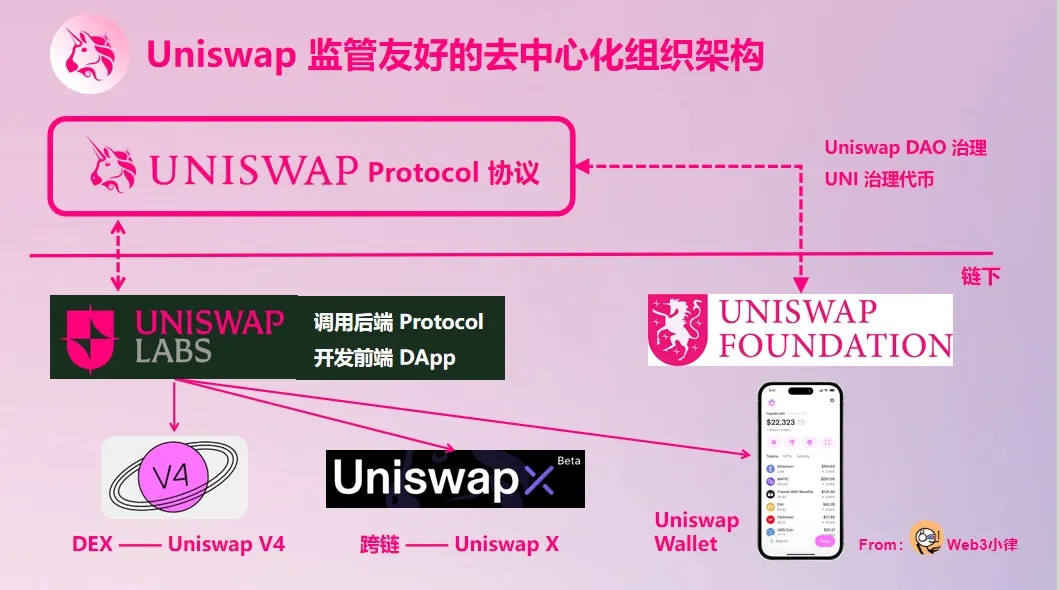
Decentralization + Non-Security Token: The Uniswap Protocol operates autonomously on-chain and is governed by Uniswap DAO, ensuring decentralization. The single-purpose UNI token serves solely as a governance token. This model avoids SEC classification as a security and has already led to favorable court rulings;
DAO Legal Wrapper + Member Limited Liability: Uniswap DAO established the Uniswap Foundation as a legal entity to serve as a legal wrapper for the DAO, protecting members with limited liability while enabling interaction with the Web2 world to expand influence;
Labs Operates Independently + Flexible Frontend Development: The Uniswap Labs team, previously responsible for developing and maintaining the protocol, now operates as a separate legal entity and acts as a primary contributor to the protocol. This independence frees them from protocol constraints and allows them to build and maintain frontend products by interfacing with the backend protocol—such as the recently monetized Uniswap DApp;
Regulate Applications, Not Protocols: As advocated by a16z, decentralized on-chain protocols are inherently difficult to regulate, whereas frontend applications can fully comply with regulatory requirements. This allows teams and products to mitigate regulatory risks. Like any app, frontends can implement KYC/AML/CTF checks, delist tokens flagged by regulators, and obtain necessary licenses.
If Uniswap Labs still faces SEC enforcement despite following this compliant path, it suggests either the SEC is acting stubbornly to fulfill a political agenda—or there is another motive.
The most likely target could be Uniswap’s automated market maker (AMM) mechanism. Without diving too deeply into specifics, the AMM is operated by the decentralized Uniswap Protocol—not Uniswap Labs. If the SEC challenges the Uniswap Protocol itself, it would essentially be challenging the freedom of code publication under free speech principles—opening a completely new and even less winnable legal frontier.
4. Market Impact
Whether considering Uniswap Labs’ legal defense or recent precedents in crypto regulation, the SEC’s case against Uniswap Labs appears weak and unlikely to succeed. Despite short-term pressure on $UNI,
we interpret this primarily as a politically motivated act.
The SEC’s actions will only strengthen unity within the crypto community, as Uniswap Labs founder hayden.eth said:
“I work in crypto because I believe it can have a profoundly positive impact on the world by removing gatekeepers (intermediaries) and expanding access to value and ownership—just as the internet enables seamless access to information.
I am incredibly proud of the various versions of Uniswap, the thousands of projects built on it, the web apps used by millions, the wallets downloaded hundreds of thousands of times, and the way this technology has improved the lives of tens of millions globally. We’re still in the early days—this technology and revolution will unfold over decades.
I hope our industry can come together more strongly. The more united we are, the stronger we become, and the harder we are to kill. So let’s be friends.”
Join TechFlow official community to stay tuned
Telegram:https://t.me/TechFlowDaily
X (Twitter):https://x.com/TechFlowPost
X (Twitter) EN:https://x.com/BlockFlow_News
 0xWillmfer











