








Secures $225 Million in Funding: Can "Parallel King" Monad Lead the L1 Scaling Narrative?
TechFlow Selected TechFlow Selected
Secures $225 Million in Funding: Can "Parallel King" Monad Lead the L1 Scaling Narrative?
Although the testnet has not launched yet, there are already airdrop farming strategies in place.
 Navigating Web3 tides with focused insights
Author: Azuma, Odaily Planet Daily
On the evening of April 9, Beijing time, Monad Labs announced a $225 million funding round led by Paradigm, with participation from Electric Capital, Greenoaks, and others.
As one of the most prominent projects in the Layer 1 space, Monad champions the concept of "Parallel EVM," aiming to introduce a parallel-processing execution layer scaling solution that dramatically improves network execution efficiency while maintaining 100% compatibility with all EVM bytecode.
The Scaling Vision of Jump’s Former “Brain”
In April 2022, Keone Hon, former head of research at trading giant Jump Trading, announced his departure to found Monad.
As mentioned above, unlike mainstream Layer 2 scaling approaches, Monad's vision is to significantly enhance EVM execution efficiency at the Layer 1 level through parallel processing, thereby unlocking the full potential of the EVM ecosystem.
In Keone’s view, thanks to Ethereum’s extensive user education, the EVM has become a de facto standard akin to JavaScript in the web2 world. However, he believes Ethereum’s current scaling path has certain flaws—its layered architecture of Layer 1 + Layer 2 divides blockchains into isolated execution environments, undermining composability across chains. Therefore, a higher-performance base layer network is needed.
At the time, Keone estimated that Monad could achieve over 1,000 times the performance of Ethereum, supporting more complex applications and enabling broader adoption.
In February 2023, Monad announced its initial $19 million seed round led by Dragonfly Capital, with participation from Placeholder Capital, Lemniscap, Shima Capital, Finality Capital, Naval Ravikant, Cobie, Hasu, among others.
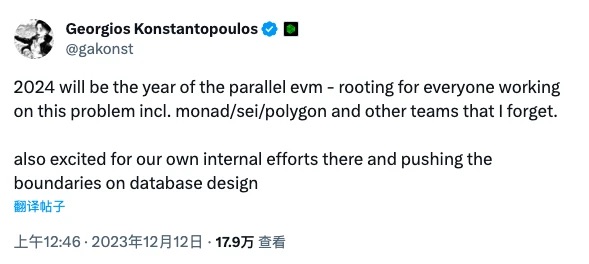
In December 2023, Georgios Konstantopoulos, Chief Technology Officer at top-tier VC Paradigm, gave high praise when discussing the future of "Parallel EVM." He predicted 2024 would be the year of Parallel EVM and named Monad—the longest-standing project dedicated to this concept—as the first representative example.
What Exactly Is “Parallel EVM”?
“Parallel EVM” essentially rethinks the order of transaction execution within the EVM environment.
In traditional EVM environments, transactions are executed sequentially (a clear example being users submitting multiple transactions—one only begins processing after the previous one is confirmed). We can temporarily refer to this execution model as “Single-File EVM.”
The design of “Single-File EVM” ensures deterministic execution of transactions and smart contracts, making blockchain state easier to manage and predict, which helps maintain network security. However, it also limits transaction execution throughput and constrains practical scalability options at the Layer 1 level.
Monad’s proposed “Parallel EVM” aims to break this bottleneck by partitioning or grouping pending transactions and leveraging scheduling algorithms to efficiently coordinate their concurrent processing. The ultimate goal is to allow independent transactions to execute simultaneously, greatly increasing execution efficiency on a single Layer 1 chain.
The Monad team has used vivid analogies to illustrate the difference between “Parallel EVM” and “Single-File EVM,” such as the laundry example shown below.

Suppose someone has four loads of laundry to wash, each requiring four steps from start to finish: washing, drying, folding, and putting away.
Under the “Single-File EVM” model, since each step (representing a transaction) must be completed sequentially, all four loads go through each phase one after another, totaling 16 time units.
Under the “Parallel EVM” model, however, independent operations (i.e., independent transactions) can proceed concurrently. As soon as one load moves to the next stage, the next load can immediately enter the prior stage. This reduces total time to just 7 units—more than doubling efficiency.
Another Marketing Genius?
Unlike teams with a more conservative tone, the Monad team has consistently adopted a down-to-earth, even meme-heavy marketing approach.
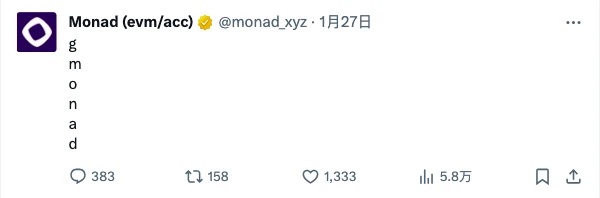
Every morning, the Monad team posts variations of “gmonad” (a community-specific version of “gm”) across different formats on X.
They’ve also hosted meme contests on X, inviting the community to create quirky and viral content around Monad. The contest is now in its 27th week. If you come across strange purple creatures while scrolling X, chances are it’s Monad spreading its cultural influence.
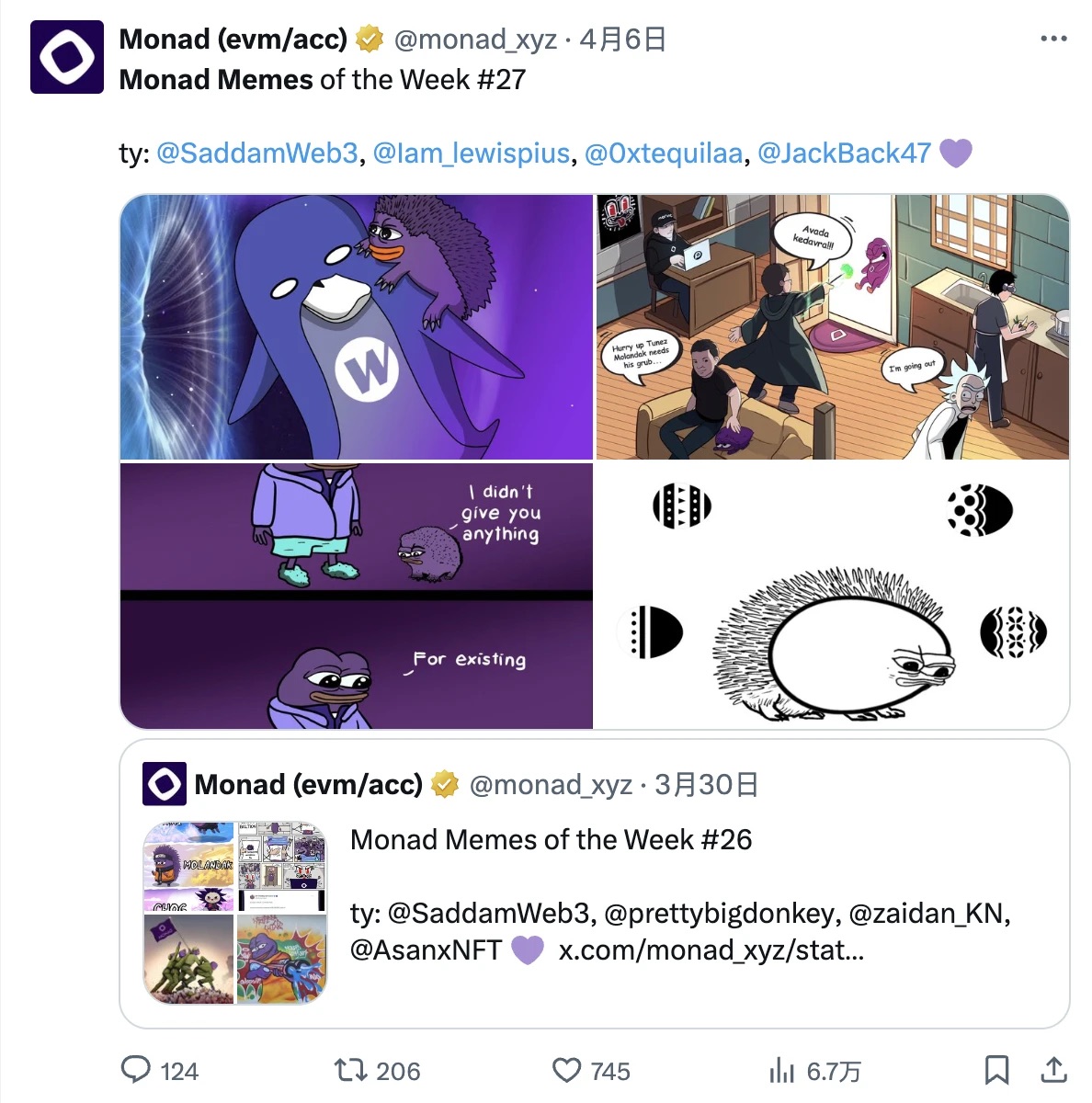
This marketing style inevitably draws comparisons to Solana, a predecessor equally skilled in meme-driven growth strategies that helped attract a highly loyal community.
Given that both Monad and Solana share a strong belief in pushing Layer 1 monolithic scaling to its limits, many in the community hope Monad might replicate Solana’s legendary trajectory.
Token Info & Interaction Strategies
Regarding Monad’s future token, the official team has not yet disclosed substantial details.
In September 2023, Monad briefly published technical documentation for its upcoming PoS chain, mentioning that its native token would be named MON and used for gas payments on the Monad chain. However, this information was later removed from the document.
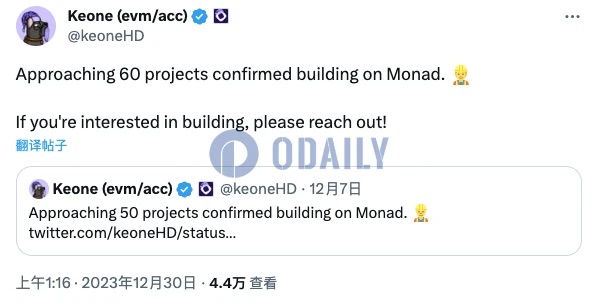
Since Monad has only launched a devnet that is not open to the public—and neither mainnet nor testnet is live—ordinary users currently have limited meaningful ways to interact. Those looking to position themselves early are advised to join the official Discord server and await testnet updates. Notably, Keone previously stated on X that nearly 60 projects have committed to building on Monad, and when the testnet launches, many of these will likely go live simultaneously, offering users early interaction opportunities.
For users eager to position themselves ahead of a potential Monad airdrop, there are currently two viable strategies.
The first strategy is clearer: stay active in Discord, help others, and aim to earn role identities like “nads” or “localnoads” that signify contributor status. However, there is no transparent mechanism for obtaining these roles, so users must simply remain highly visible and engaged.
The second strategy remains speculative. Previously, Wormhole—one of Jump’s other flagship projects—airdropped its W token to holders of the “nads” role in the Monad community (despite the fact that at the time, Monad hadn’t even launched a testnet, and there was no real integration between the two projects…). It’s therefore possible that Monad may reciprocate in a future airdrop. Once W becomes available for staking, users might consider staking W in anticipation of receiving a Monad airdrop.
Join TechFlow official community to stay tuned
Telegram:https://t.me/TechFlowDaily
X (Twitter):https://x.com/TechFlowPost
X (Twitter) EN:https://x.com/BlockFlow_News
 Odaily






