Finding the Next Alpha: A Look at 9 Hot Projects in the Intent-Centric Sector
TechFlow Selected TechFlow Selected
Finding the Next Alpha: A Look at 9 Hot Projects in the Intent-Centric Sector
The "Intent-Centric" track aims to solve this challenge for new users, enabling crypto mass adoption and allowing a broader Web2 user base to seamlessly transition into Web3 with a smooth and effortless experience.
 Navigating Web3 tides with focused insights
Author: Baize Research Institute
With the approval of spot Bitcoin ETFs in the U.S. and the development of RWA protocols in DeFi, cryptocurrencies are accelerating into the mainstream, drawing more users into on-chain DeFi to explore new yield opportunities. However, complex on-chain operations are deterring many Web3 newcomers.
The Web3 ecosystem already includes thousands of cryptocurrencies, countless Layer 1s, Layer 2s, and now Layer-3s, along with cross-chain bridges connecting different blockchains. In this vast and innovative landscape, it's increasingly difficult for new users to intuitively identify the best path for their transactions.
This is where the "Intent-Centric" sector comes in—aimed at solving these challenges to drive crypto mass adoption, offering a seamless experience that enables broader Web2 user bases to transition smoothly into Web3.
What Is an Intent?
In the Web3 world, an "intent" refers to a user’s desired outcome within the blockchain ecosystem—the expression of a specific end state they wish to achieve. While a transaction specifies exactly *how* to execute an operation, an intent defines *what* the desired result should be.
So what does an intent protocol offer that’s new? Simply put, users only need to state their goal, leaving the “how” to specialized solvers.
For example, if you want to get from point A to point E (your goal/intent), the current transaction model requires you to go step by step: A → B → C → D → E. This is just the tip of the iceberg in today’s DeFi world—not to mention the added complexity of transferring tokens from a CEX onto-chain. The actual interaction burden can be far greater than imagined.
With intent protocols, however, once you declare “I want to go from A to E,” the solver handles every step—A → B → C → D → E. These solvers can be humans, AI, or other protocols.
If a transaction says, “Go to A, then to B, pay a certain amount of C to receive E,” the intent would simply be: “I want X, and I’m willing to pay a certain amount of C.” Users submit their intents to the protocol, which then delegates execution steps to solvers.
With intent protocols and solvers, not only can tedious transaction flows be abstracted away for new users, but gas fees can also be reduced and trades executed at optimal prices, improving efficiency. As blockchain technology grows increasingly vital, this paradigm shift will make Web3 interactions more efficient, secure, and accessible—key to attracting billions of Web2 users.
The intent sector began gaining momentum following Paradigm’s June 2023 paper, “Intent Structures and Their Risks.” Since then, what notable projects have emerged?
Overview of Recent Hot Intent Networks/Protocols
dappOS
The intent execution network dappOS became a Twitter sensation due to its $300 million valuation in a Series A round and a major 100,000 $ARB airdrop from GMX targeted at active users.
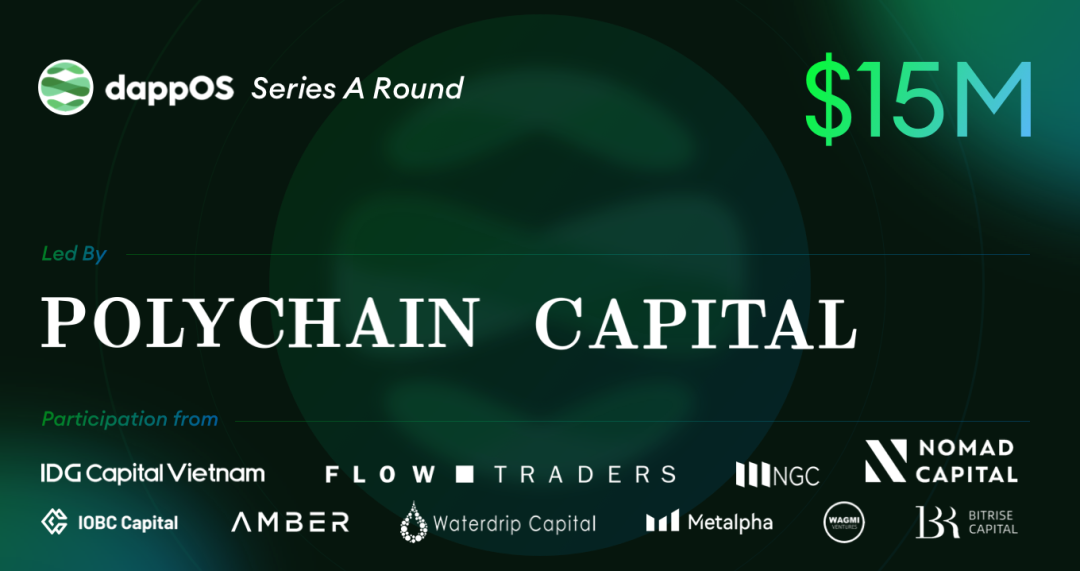
dappOS recently raised $15 million in a Series A round led by Polychain, achieving a $300 million valuation and establishing itself as a rising star in the intent space. The network had previously secured funding from top-tier VCs including Binance Labs, Sequoia China, and IDG.
Additionally, since GMX V2 integrated dappOS two months ago, it has gained 30,596 new users, with 15% of its TVL growth over the past 30 days coming from dappOS users. To incentivize active dappOS users, GMX distributed 100,000 $ARB. As the dappOS network expands, such airdrops are expected to become more frequent, positioning dappOS as a golden shovel tool for airdrop farming.
As an intent execution network focused on priceable intents, dappOS drastically lowers the barrier for on-chain interaction. Users simply submit their intents, and dappOS along with its solver nodes executes them in a decentralized manner. Supported intent types include smart contract interactions, inscription minting strategies, copy trading, and Telegram bot trading.
Moreover, dappOS offers compatible middleware, enabling developers to easily extend this “intent” capability to more dApps while preserving decentralization. Thus, dappOS is driving integrated dApps toward becoming “decentralized intent applications.”
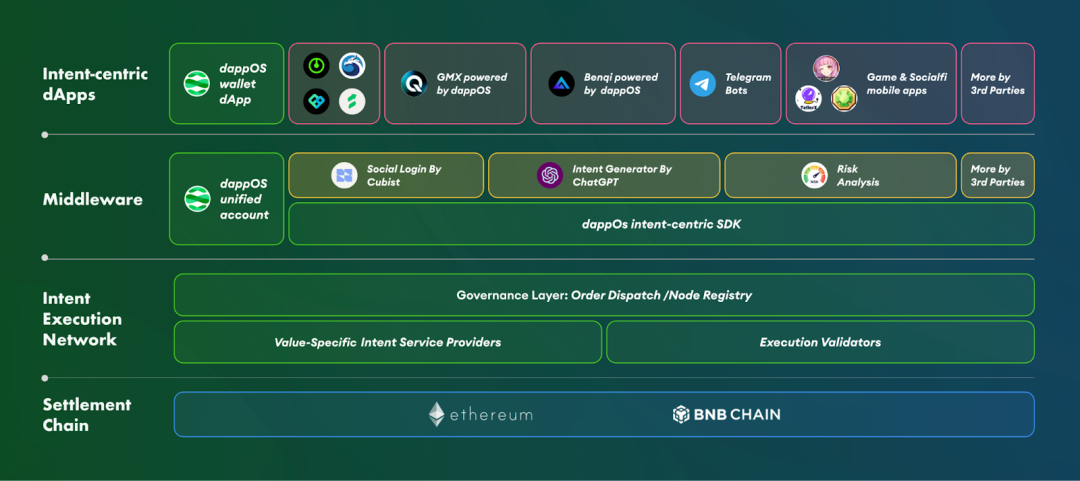
As the dappOS ecosystem grows, it will attract more users, especially accelerated by the “golden shovel” effect, converting them into sticky participants and gradually forming a network effect. This will further optimize service nodes within the dappOS intent network, making execution cheaper, faster, and more user-friendly—encouraging even more dApps to integrate with dappOS. Notably, dappOS is introducing a governance token $DOS, whose holders will benefit from network revenue and transaction growth.
Anoma
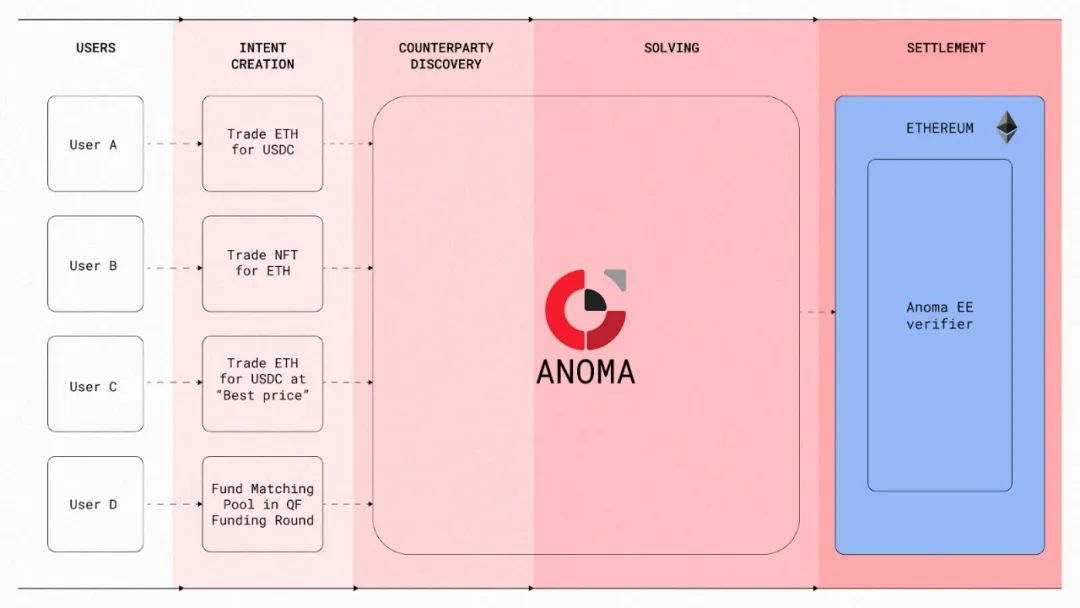
Anoma was one of the first protocols to introduce the concept of “intents,” providing a general-purpose, intent-centric dApp architecture. This framework aims to fulfill diverse requests, enabling service-providing dApps to align intents with solver networks, facilitating the matching of user intents with solvers across various applications and scenarios. Notably, Anoma functions as an “interface”—a set of freely replicable code—rather than a mediating chain, meaning there is no Anoma chain. Therefore, Anoma can be deployed on any existing L1, L1.5, L2, or non-EVM chains such as Ethereum, Arbitrum, Solana, Cosmos, or Eigenlayer AVS.
Particle Network
Many first encountered Particle Network through MerlinChain, which leverages Particle’s account abstraction and BTC Connect services behind the scenes. In fact, beyond its achievements in chain abstraction, Particle Network is actively expanding into the intent space.
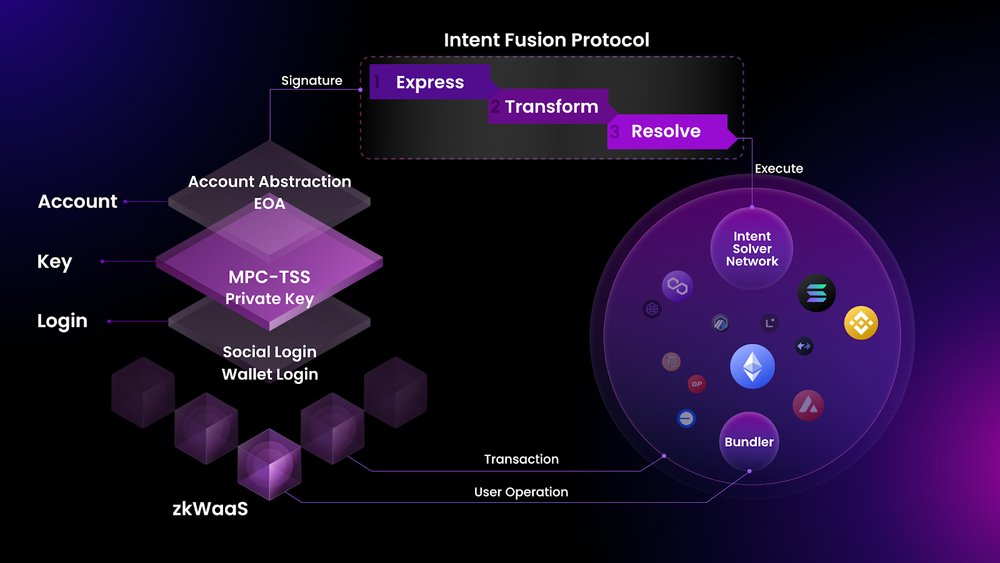
Particle Network is building the Intent Fusion Protocol—a universal dApp framework for expressing, transforming, and executing intents. Developers can use it to create intent-based applications, with user-submitted intents routed to solver networks for on-chain execution.
Within this ecosystem, developers gain direct access to Web3’s unique capabilities while delivering the best possible user experience, allowing them to focus 100% of their energy on solving problems.
By combining the Intent Fusion Protocol with Particle’s mature chain abstraction, modular smart WaaS, and cross-chain atomic swap solutions, Web2 developers can easily harness Web3’s strengths while offering users the simplest possible experience.
Essential
Essential describes itself as the first “declarative blockchain,” though it still revolves around the concept of “intents.”
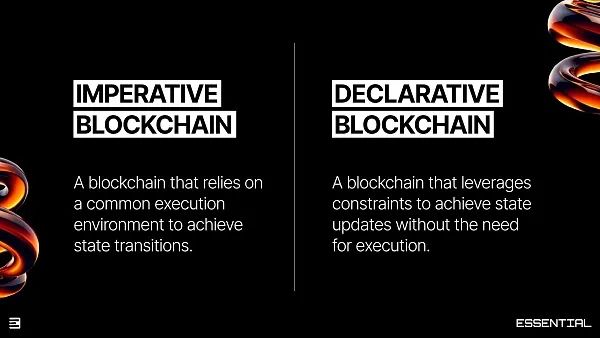
Essential argues that since the inception of the first general-purpose blockchain—Ethereum—every such blockchain has used an imperative programming model, relying on linear code execution for state updates. Thus, the only way users interact with these blockchains is through imperative instructions (e.g., transactions and smart contracts). Indeed, common criticisms from Web3 newcomers—unpredictable outcomes, failed transactions, MEV, high slippage—are all rooted in critiques of this underlying imperative model.
So how does Essential’s “declarative blockchain” work?
According to the official explanation, a declarative blockchain achieves state updates via constraints without requiring execution. Put differently, Essential allows users to sign transactions based on desired (declarative) outcomes rather than mandatory (imperative) instructions—still well within the scope of intents.
Essential sets high demands on its solvers. Unlike simple solvers that compute straightforward results (e.g., 1+1=2), when users submit intents, Essential’s solvers must strive to deliver optimal solutions—not only fulfilling the intent but maximizing user satisfaction. Simpler still: after a user submits an intent, each solver competes to answer: given the constraints and goal, which new state maximizes user satisfaction?
Essential’s tech stack rests on three core pillars:
-
Executionless Blockchain: Similar to ZK Rollups, computation for user intents occurs off-chain, while fraud-proof verification happens on-chain—delivering higher throughput and lower fees for apps and users.
-
Constraint-Based Domain-Specific Language (DSL): Allows users to express intents in natural language and developers to describe business logic simply, outsourcing transaction or computational logic to solvers—making it easier for users to achieve desired interactions and for developers to build complex dApps.
-
Solver Network: Provides optimal solutions for user-submitted intents across the network.
Self Chain
Self Chain is a new, modular, intent-centric blockchain built on the Cosmos SDK. In last month’s V2 incentivized testnet, Self Chain achieved impressive results with 366 applications and 19,000 users.
I originally intended to present this project alongside Ruby Network, which has already launched its mainnet, as they are quite similar—both launching under the mass adoption narrative and incorporating MPC, account abstraction, chain abstraction, and now intents, seemingly capitalizing on every trending topic. However, compared to the patchwork-like Ruby, Self Chain has invested significantly more technical depth into the intent narrative (whereas Ruby appears to merely label itself as “intent-driven”).
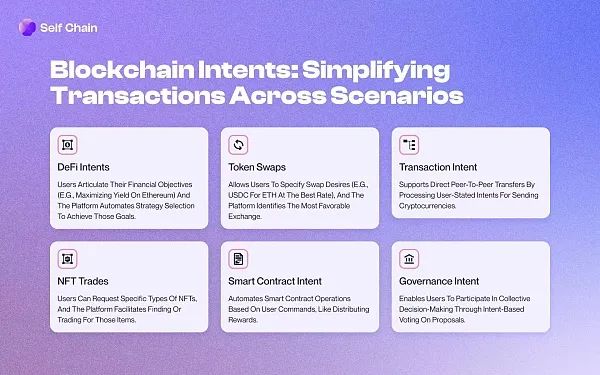
Self Chain integrates the intent concept into its blockchain architecture through a three-layer structure:
-
dApp Layer: Users interact with dApps via simplified interfaces. This layer collects user intents and uses large language models (LLMs), similar to GPT-4, to translate them into structured, simplified intents.
-
Intent Access Layer: Searches for various paths to fulfill user intents, identifying the optimal method to satisfy the request.
-
Intent Solver: Executes transactions efficiently.
Orb Stack, Orby
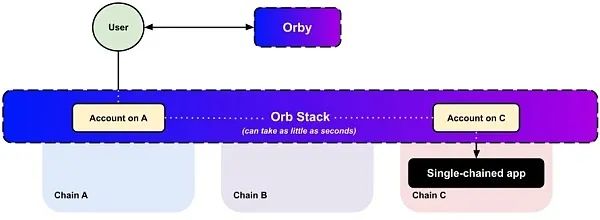
Orb Labs is developing Orb Stack, a modular cross-chain intent protocol stack that allows users to issue cross-domain intents. It consists of five layers:
-
Scalable light clients providing the system’s security foundation
-
Message framework optimized for speed, cost, and configurability
-
Token wrapping protocol supporting cross-chain assets
-
Cross-domain intent protocol
-
Unified account system allowing users to manage assets across different chains
Additionally, the team is developing Orby, an intent engine that can be integrated into any dApp frontend, enabling users from any chain to use it. It can also be embedded into wallets, allowing users to interact with any dApp on any chain without fragmenting wallet assets across multiple chain addresses. Orby aims to support multi-chain interactions, translating transactions into intents executable via Orb Stack on any chain.
Orbiter Finance (Orbiter Rollup)
Orbiter Finance is a leading Layer 2 cross-chain protocol, with over 3 million users having transferred assets between different L2s via the platform. In January this year, Orbiter Finance announced plans to launch Orbiter Rollup, a ZK-based solution that will serve as Ethereum’s intent layer, primarily aggregating cross-chain intents from Orbiter users. Through collaboration with partners, Orbiter Rollup will resolve execution issues, enabling users to achieve their desired outcomes without manually completing each cross-chain step.
Across v3
Another cross-chain protocol similar to Orbiter is Across. Its recently launched v3 version introduces a composable intent engine composed of the following components:
-
Intent-based RFQ order flow
-
Third-party solver network with off-chain liquidity
-
Settlement system with optimistic validation
Aperture Finance
Aperture Finance is a DeFi platform built on an intent architecture that combines AI with intent, creating a chatbot interface where users express their goals in natural language and leverage a solver network to achieve results.

This is a prime example of AI + Intent. By chatting directly with an AI assistant, users express their needs, the AI automatically extracts and confirms the intent, submits it to the solver network, which then finds the optimal solution and assigns execution to the best solver via bidding.
Beyond trading, another interesting use case is airdrop claiming. Simply tell the AI, “Help me claim available airdrops,” and the system automatically searches across chains for eligible airdrops based on your wallet address and permissions, then claims them. This automation saves users significant time interacting with individual airdrop sites and eliminates risks of phishing scams.
Join TechFlow official community to stay tuned
Telegram:https://t.me/TechFlowDaily
X (Twitter):https://x.com/TechFlowPost
X (Twitter) EN:https://x.com/BlockFlow_News
 Baize Research