Deep Dive into Bittensor Subnets and DeFi Ecosystem: What Practical Value Do Top AI Projects Offer?
TechFlow Selected TechFlow Selected
Deep Dive into Bittensor Subnets and DeFi Ecosystem: What Practical Value Do Top AI Projects Offer?
The key idea behind Bittensor is that it forms an interconnected neural network of machine intelligence.
 Navigating Web3 tides with focused insights
Author: Arjun Chand
Translation: TechFlow
AI x Crypto is a hot topic right now. It's one of the most popular investment themes in the current bull market.
Bittensor (TAO) is among the leading projects in the AI narrative, both by market cap and name recognition. But recently, there’s been some debate on crypto Twitter about its utility, with some even calling it “vaporware” and meaningless decentralization.
However, every token has two sides. While critics have concerns about Bittensor and its design, today we’ll focus on its brighter side.
There are many exciting developments happening within the Bittensor ecosystem. We'll highlight the most impressive subnets and examine DeFi projects growing alongside Bittensor and TAO.
Introduction to Bittensor
Bittensor aims to democratize the process of building AI-powered use cases by creating an open peer-to-peer marketplace where people can share and use machine learning models.
The key idea behind Bittensor is that it forms an interconnected neural network of machine intelligence. Anyone can leverage this network and build subnets—specialized protocols powered by this collective intelligence to drive a wide range of AI applications.
Currently, there are 32 subnets in the Bittensor ecosystem, each focused on a unique use case—such as speech-to-text, image generation, AI-powered search engines, advanced trading strategies, or fine-tuning large language models for other applications.
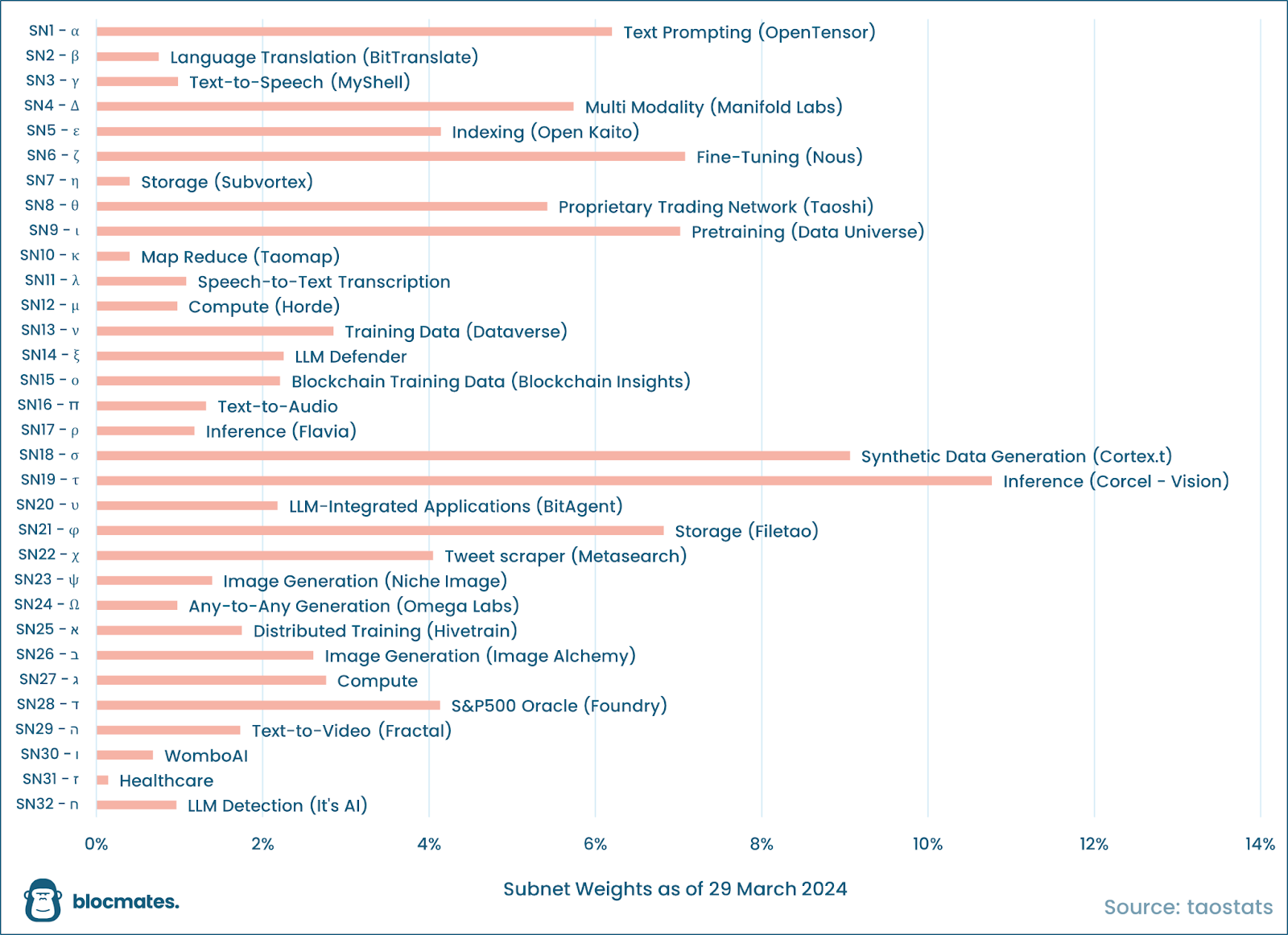
For example, some insights in this article come from Corcel, a user-friendly tool on subnet 18 of the Bittensor ecosystem, also known as Cortex.t. Functionally similar to ChatGPT, it leverages the collective intelligence of machine learning models across the Bittensor network to deliver optimal responses to user queries.
Bittensor Subnets
Now, let’s take a closer look at some standout subnets in the Bittensor ecosystem and their functionalities.
Subnet 6 — Nous Fine-tuning
Subnet 6, operated by the reputable Nous research team, stands out in the Bittensor ecosystem. This subnet specializes in using synthetic data from Corcel on subnet 18 to fine-tune large language models (LLMs).
Each miner on subnet 6 receives the same synthetic dataset daily and uses it to fine-tune LLMs for specific outcomes. They apply their own strategies and techniques to achieve optimal performance on this data.
The key competitive factor lies in TAO rewards. Miners whose LLMs achieve lower “head-to-head loss” (meaning fewer errors) receive a larger share of TAO rewards. This incentivizes everyone to perform at their best and continuously improve their models to climb the fine-tuning leaderboard.
This method of training LLMs using constantly refreshed synthetic data improves upon traditional approaches reliant on static datasets, as the evolving data forces LLMs to continuously adapt and learn, making them more resilient in real-world scenarios.
Subnet 8 — Proprietary Trading Network
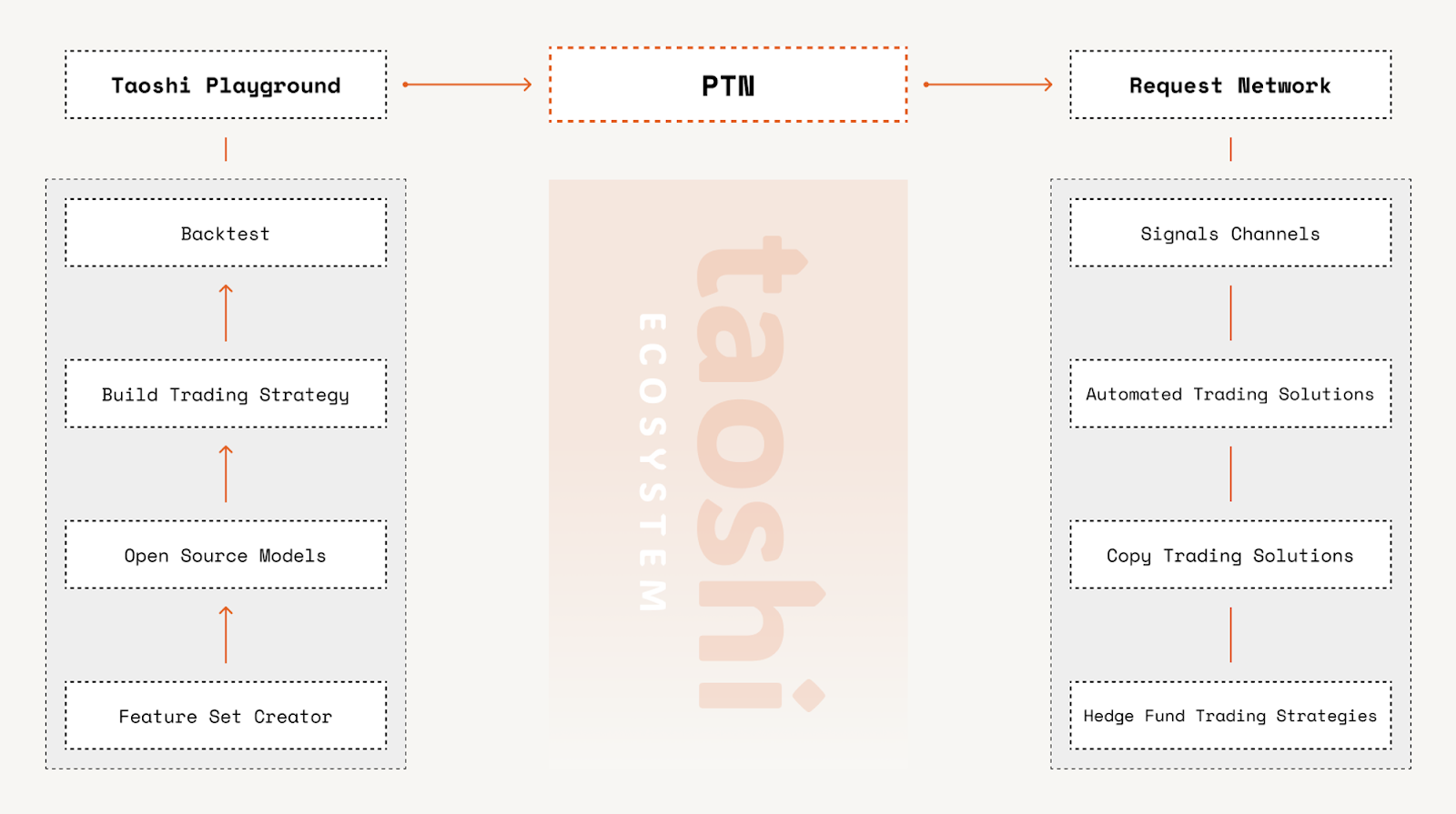
Subnet 8, run by τaoshi’s well-known Proprietary Trading Network (PTN), allows top algorithmic traders to deploy quantitative models analyzing markets and predicting price movements of assets like BTC and TAO. The most profitable algorithms win TAO rewards.
Miners who provide valuable trading signals earn TAO rewards, validators receive 100% of revenue from signal sales, and users gain insights that could help them outperform the market.
Subnet 8 generating revenue marks a significant milestone for the Bittensor community, proving viable businesses can be built on Bittensor. This signal may attract new talent, users, miners, and validators, fostering growth and development across the entire ecosystem.
Recently Registered Subnets on Bittensor
As Bittensor gains prominence, notable teams from across the ecosystem have shown strong interest in registering their own subnets. Notable examples include:
-
Subnet 3, MyShell TTS: Aims to democratize access to top-tier text-to-speech (TTS) models.
-
Subnet 5, Open Kaito: Dedicated to making Web3 information universally accessible, aiming to remove barriers and collectively organize and interpret the vast amount of Web3 data.
-
Subnet 30, WomboAI: Home to WOMBO, a highly popular app (over 100 million downloads) that enhances creativity with AI, transforming simple ideas into animated images or generating artwork from a few sentences.
Additionally, over 200 subnets are currently in testnet phase, awaiting registration on the mainnet, each with unique goals and reward structures.
Since the number of subnets in the Bittensor ecosystem is capped at 32, competition is fierce. The lowest-performing subnet will be replaced by a new one after a one-week immunity period. As more projects race to launch subnets on Bittensor, this competition will only intensify. The evolution of the subnet landscape over the coming quarters will be fascinating to watch.
Having explored Bittensor’s subnets, let’s move to the next part of this article: the Bittensor DeFi ecosystem.
Bittensor’s DeFi Ecosystem
The Bittensor DeFi ecosystem is forming in real time. Just six months ago, it didn’t exist. Now, there are over ten applications offering financial products centered around Bittensor and its native token, TAO.
Let’s explore some of these applications:
Tensorplex Stake (stTAO)
Tensorplex offers a suite of decentralized AI-focused products built on networks like Bittensor. As active participants in the Bittensor ecosystem, they provide services including Tensorplex Stream, which delivers AI-generated summaries of podcasts, Twitter Spaces, and news articles. They’re also active miners on Bittensor subnets.
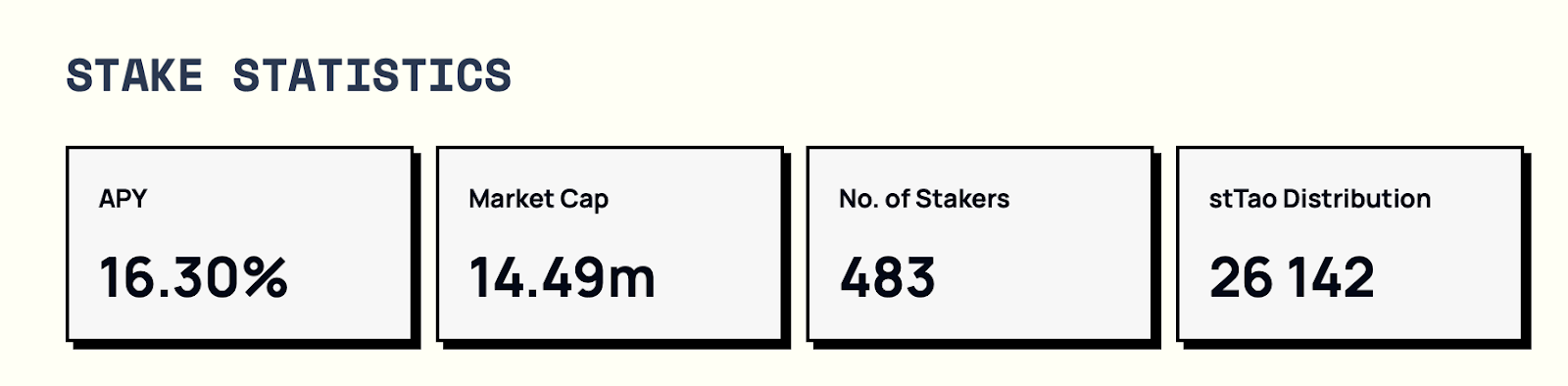
One of their products, Tensorplex Stake, launched on Ethereum in February 2024, enables users to stake on the Bittensor network and earn yield (currently over 16%).
Here’s how it works:
-
Tensorplex Stake allows users to stake their wTAO and receive stTAO in return. stTAO represents your staked TAO and tracks staking rewards.
-
The underlying wTAO is bridged to the Bittensor network and staked with validators to earn yield, which is then passed back to users on Ethereum.
This approach gives Ethereum-based users a convenient way to explore yield opportunities with TAO without needing to bridge assets onto the Bittensor network.
TaoPad: Building DeFi for TAO
TaoPad is the first launchpad focused exclusively on Bittensor, designed to enhance the value of the TAO token and support the broader Bittensor network.
TaoPad’s launchpad enables new projects—especially those focused on decentralized AI—to launch via token sales.
TAO is foundational to TaoPad’s design. Here’s how it leverages TAO for utility:
-
Reward System: TaoPad distributes rewards to holders in the form of wTAO.
-
Launchpad Participation: Users can participate in new project launches using wTAO on the TaoPad launchpad. This creates a use case for wTAO and drives growth in the TAO ecosystem by introducing new projects. To participate, investors allocate a portion of their $wTAO to a project’s funding pool. The more wTAO a user commits, the better the price they receive for the new project’s tokens.
TaoBank: Lending Protocol
TaoBank is a lending protocol operating on Ethereum and Arbitrum. It allows users to borrow interest-free loans using wTAO as collateral, with the loan asset being $taoUSD—a stablecoin soft-pegged to the US dollar designed for low volatility.
For TAO holders, TaoBank offers a way to unlock liquidity from their holdings without selling—especially attractive during bull markets. This functionality enables DeFi strategies such as looping, where users can leverage their loans to acquire additional TAO.
Interestingly, TaoBank was incubated by TaoPad and was in fact the first project on its launchpad. This is a great example of collaboration between two Bittensor-focused projects, creating new utility for TAO.

Tao Accounting System (TAS)
TAS is a protocol introducing token standards to the Bittensor network.
Its first experimental token standard, Tai Request for Comment (TRC-20), mirrors the ERC-20 standard in the EVM ecosystem. TRC-20 establishes unified rules for token creation, exchange, and governance on Bittensor, creating a standardized method for anyone to launch TRC-20 tokens.
TAS operates as a ledger system, recording TRC-20 token balances stored on its recently registered subnet 31. Soon, it plans to activate miners and validators on its subnet to maintain the accuracy of these records.
Once the TAS subnet launches, anyone will be able to easily deploy and trade TRC-20 tokens on Bittensor.
Currently, users can only participate by purchasing $TAS tokens and staking them to earn yield, benefiting from TAO emissions allocated to the TAS subnet.
Additionally, TAS provides a bridge to convert wTAO on Ethereum into tTAO (TAS’s wrapped version of TAO), enabling users to transfer it onto the Bittensor network or stake it for yield.
RivusDAO: Liquid Staking for TAO
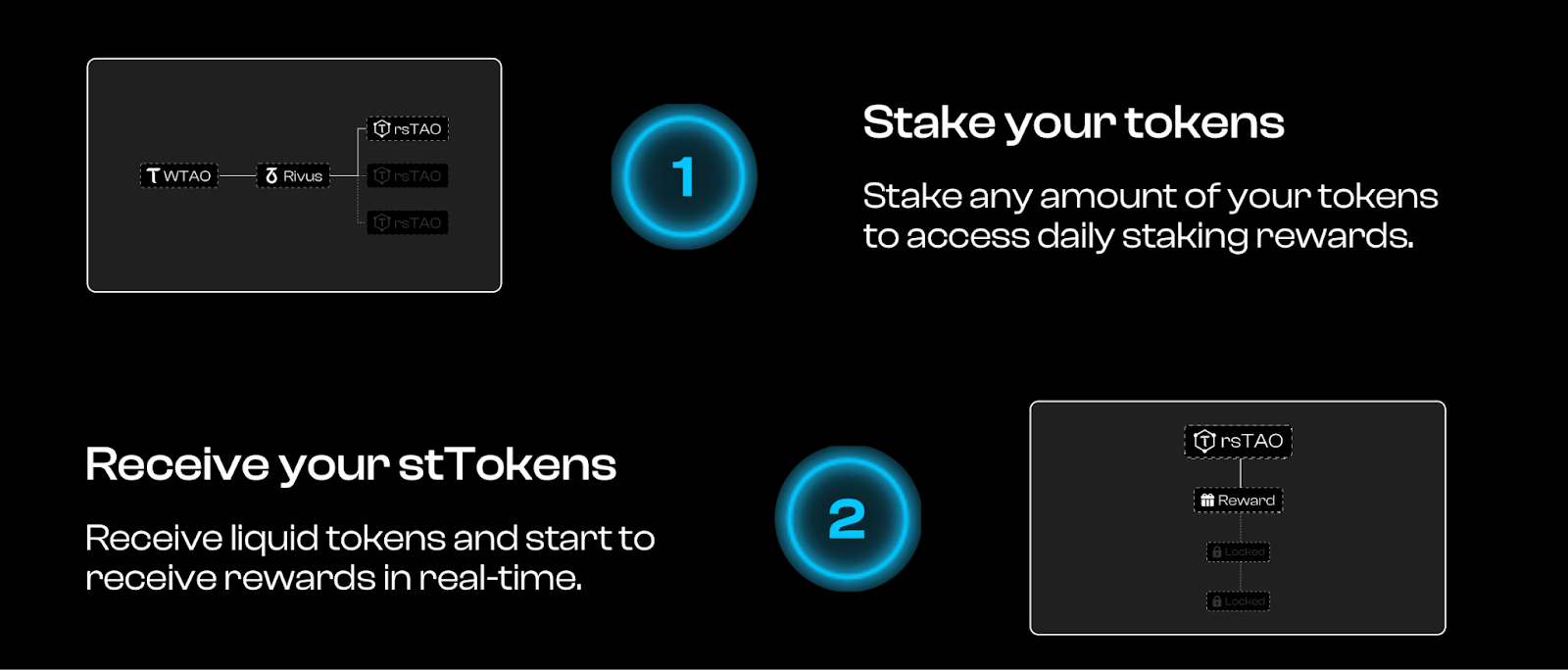
RivusDAO offers liquid staking services for AI-focused blockchains, including Bittensor. It introduces a liquid staking mechanism for TAO via $rsTAO, allowing users to stake their wTAO on Ethereum and receive $rsTAO in return to earn staking rewards.
The vision for $rsTAO is integration across DeFi applications in the ecosystem. For instance, rsTAO could serve as collateral on platforms like Aave and other lending protocols.
Additionally, RivusDAO is developing a bridge to transfer assets from selected blockchains to Bittensor.
Hyperliquid: Perpetual Contracts for TAO
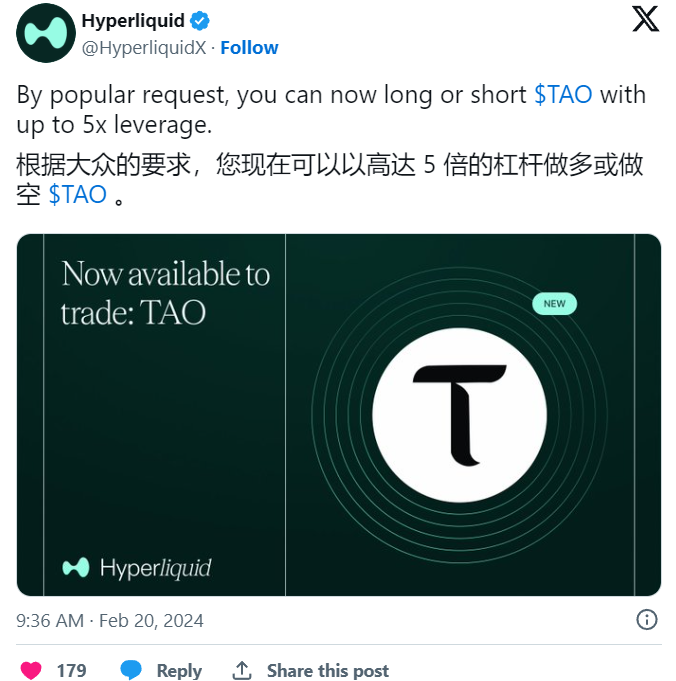
Hyperliquid has emerged as a leading perpetual contract DEX, with over $100 billion in total trading volume since launch. It offers an excellent user experience for trading perpetual contracts on-chain and has become the platform of choice for many traders.
In February, Hyperliquid expanded its product line by listing $TAO, giving users the opportunity to trade TAO with up to 5x leverage. This addition has boosted TAO’s trading volume.
DeFi Strategies Around TAO in the MultiversX Ecosystem
Last month, Hatom Labs launched several DeFi products around TAO within its MultiversX ecosystem, aiming to increase TAO’s utility and integrate it into DeFi platforms.
Key DeFi features for TAO in the MultiversX ecosystem include:
-
Liquid Staking: Users can stake their wTAO and receive swTAO, enabling them to earn yield on their staked assets.
-
Lending: wTAO and swTAO can be lent across various markets. Currently, these tokens offer annualized lending yields of 45% and 36%, respectively.
-
LP on xExchange: Users can provide wTAO in the wTAO/EGLD liquidity pool on xExchange.
-
LP on AshSwap: Users can provide wTAO in the wTAO/USDC liquidity pool on AshSwap.
Sturdy’s AI DeFi Subnet on Bittensor
Sturdy is a lending protocol operating on Ethereum and Mode, functioning as a two-layered money market with independent lending pairs and pooled vaults. These vaults aim to hold multiple loan pairs, maximizing yield and securing the best rates.
Currently, vault allocation relies on manual intervention or simple algorithms—an inefficient and centralized approach. To address these limitations, Sturdy launched a subnet on Bittensor.
On this subnet, miners propose optimal allocation strategies for the pooled vaults and compete with each other for TAO rewards. This way, users benefit from better rates, and the allocator becomes open and competitive.
While not exactly like the other DeFi opportunities discussed here, it sets a precedent for other DeFi apps to leverage Bittensor to optimize their existing products. Furthermore, applications can utilize Sturdy’s subnet to improve operations without launching their own subnet on Bittensor.
Conclusion
The Bittensor ecosystem is undergoing a period of growth and evolution, evident in rising interest from notable entities registering subnets and increasing user engagement with applications like Corcel.
The DeFi landscape within Bittensor is also expanding, though still in early stages—currently covering liquid staking, bridges, and a few lending protocols. Nevertheless, these are foundational elements for any ecosystem.
Clear signs of subnet registrations, growing application engagement, and an expanding DeFi ecosystem all suggest that Bittensor is poised to become a truly dynamic and innovative hub, opening new frontiers and opportunities at the intersection of AI and cryptocurrency.
Join TechFlow official community to stay tuned
Telegram:https://t.me/TechFlowDaily
X (Twitter):https://x.com/TechFlowPost
X (Twitter) EN:https://x.com/BlockFlow_News
 Bankless