Alpha Hunter | Bought $DEGEN in January and held until now—how did "Cobo Editor" achieve a 200x return?
TechFlow Selected TechFlow Selected
Alpha Hunter | Bought $DEGEN in January and held until now—how did "Cobo Editor" achieve a 200x return?
Looking at a project is essentially about understanding the people behind it.
 Navigating Web3 tides with focused insights
By: TechFlow

Bull markets always bring anxiety—especially when a once-casual group chat friend suddenly rockets to the moon thanks to a "golden dog" (a top-tier meme coin). Yet identifying and holding high-quality crypto assets early is no easy feat. Behind every success lies deep thinking and research.
Out of curiosity, TechFlow launches a new series called “Alpha Hunters,” interviewing these “golden dog hunters” to uncover their secret strategies for catching the next big thing.
In our first episode, we speak with LeftOfCenter (Twitter: @Eloisechou), former editor at ChainNews and now leading content at Cobo Argus. He first bought $DEGEN—the Farcaster ecosystem token on Base—on January 20th and has held every single token since, achieving over 200x returns from peak prices. But he doesn’t view $DEGEN as just a meme coin; otherwise, he couldn't have confidently gone all-in or held long-term. Below is his story of discovering $DEGEN early, along with his insights into the Farcaster ecosystem.
Tell us about yourself?
LeftOfCenter: My pen name is LeftOfCenter. I used to be an editor at ChainNews and did investment research at D1 Ventures. Currently, I lead content at Cobo Argus. Since late last year, we’ve been publishing a strategy newsletter, dedicating three issues so far to covering Degen.
I accumulated $DEGEN in multiple purchases, starting on January 20th this year. Based on the current price of $0.04198, my return ranges from approximately 15x to 205x between my lowest and highest entry points. Before buying, I also qualified for the first round of airdrops—I haven't sold a single token yet—but suffered over 3 million DEGEN in impermanent loss from providing liquidity.
How did you first discover $DEGEN?
LeftOfCenter: I discovered it through the Degen channel on Farcaster. Back when Farcaster was still invite-only and overall user activity was low, it was the Degen channel that drove up Farcaster’s qDAU. Prior to $DEGEN, several other meme coins were launched within this channel but ultimately failed—some were rug-pulled. Interestingly, early $DEGEN airdrops included allocations to holders of those defunct projects, almost like consolation prizes.
I wasn’t an early adopter of Farcaster, but once I joined, I couldn’t leave. I firmly believe the new meta of this bull market will emerge from Farcaster.
How did you manage to hold through volatility without taking profits? Why are you still holding?
LeftOfCenter: From day one, I never treated $DEGEN as a memecoin. It has fundamentals and intrinsic value—if not, no one would dare allocate more than $1,000 into what they perceive as just another meme.
While the industry tends to launch tokens recklessly, token distribution mechanisms are often undervalued. $DEGEN stands out as one of the few projects I've seen with truly exceptional token distribution—bottom-up, starting small and growing organically, outperforming most other projects in the market.
The issuance mechanism of $DEGEN is clearly goal-oriented, centered around builders on Farcaster—creators, artists, developers, and content producers. The allocation criteria and methods are maximally decentralized.
$DEGEN began its cold start in the Degen channel on Farcaster (think of it like a Douban group), targeting early builders on Farcaster as initial recipients. These users—artists, creators, developers—are among the rarest and most valuable resources in the space. What makes $DEGEN innovative is that the allocation rules weren’t dictated by a central team. Instead, the power to distribute tokens was given directly to early Farcaster users. Each user’s allocation depends on their influence within the platform—making both the process and standards of distribution fully decentralized.
As teacher Pingfeng put it: “DEGEN is like a group of people feeding each other with spoons—each person can only feed others, not themselves—and how much you can feed depends on your social influence within the platform.”
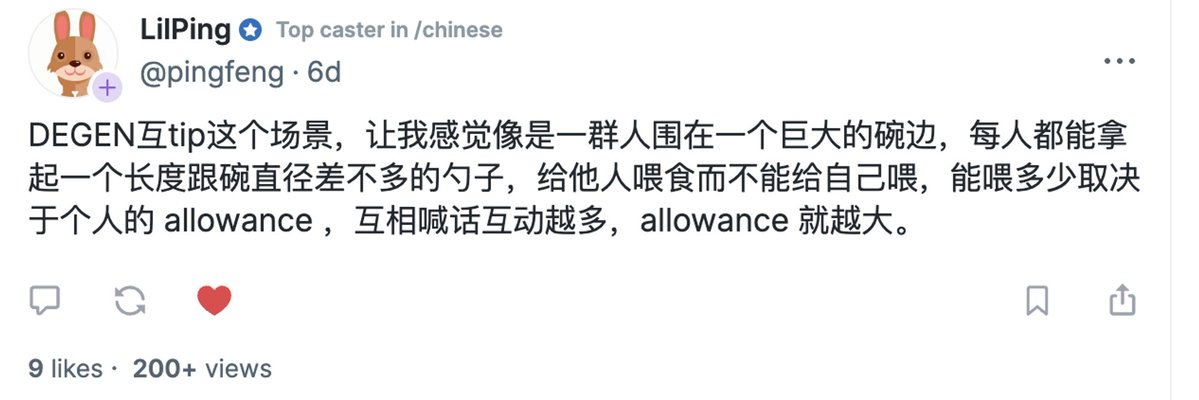
At its core, DEGEN is about giving. The size of your gifting power (your DEGEN allocation) isn’t determined by money, but by social influence (social capital). Given that this system was built around Farcaster—a platform with relatively few users at the time—this form of social capital hadn’t yet solidified. This means every user had—or could earn through active participation—the chance to give and receive rewards. This distribution model offers fairness and opportunity to all Farcaster users, serving as a powerful force capable of breaking rigid structures in an otherwise stagnant society or crypto ecosystem.
Every day on Farcaster sees various kinds of tipping. Active users can tip anyone’s project, idea, artwork, or article. Group tipping is common too. A community-organized daily event called “Tip o’ the Hat” selects one notable project for collective funding. If you don’t have time or can’t find someone worth supporting, you can simply follow the “Tip o’ the Hat” lead—for example, a recent donation supporting humanitarian relief efforts in Gaza.
Thanks to fair launch principles, non-concentrated distribution, and a strong focus on getting tokens into the hands of actual builders, productive developers and artists have begun building real utility and use cases around $DEGEN. This has energized numerous projects and expanded $DEGEN’s functionality beyond being merely a gas token. It's now integrated into applications such as Drakula, a Web3 short video platform, and Perl, a native prediction market game on Farcaster. All this progress happened within just three months—with much more potential ahead.
Every night after work, I log into Farcaster to recharge my conviction. I’ve essentially watched Degen “grow up.” What I see is a solid, bottom-up project deeply rooted in its community and reality. Projects that embody genuine community DNA possess the strongest fundamentals—something hard for capital-driven teams to replicate. In today’s crypto landscape, such projects hold an absolute edge. That’s why I never hesitated or considered cashing out early.
All of the above reflects my personal perspective. There are visible catalysts on the horizon, including potential listings on major exchanges and the upcoming FarCon event from May 2nd to May 5th.
Finally, judging by current market cap alone, $DEGEN still has significant room to grow:
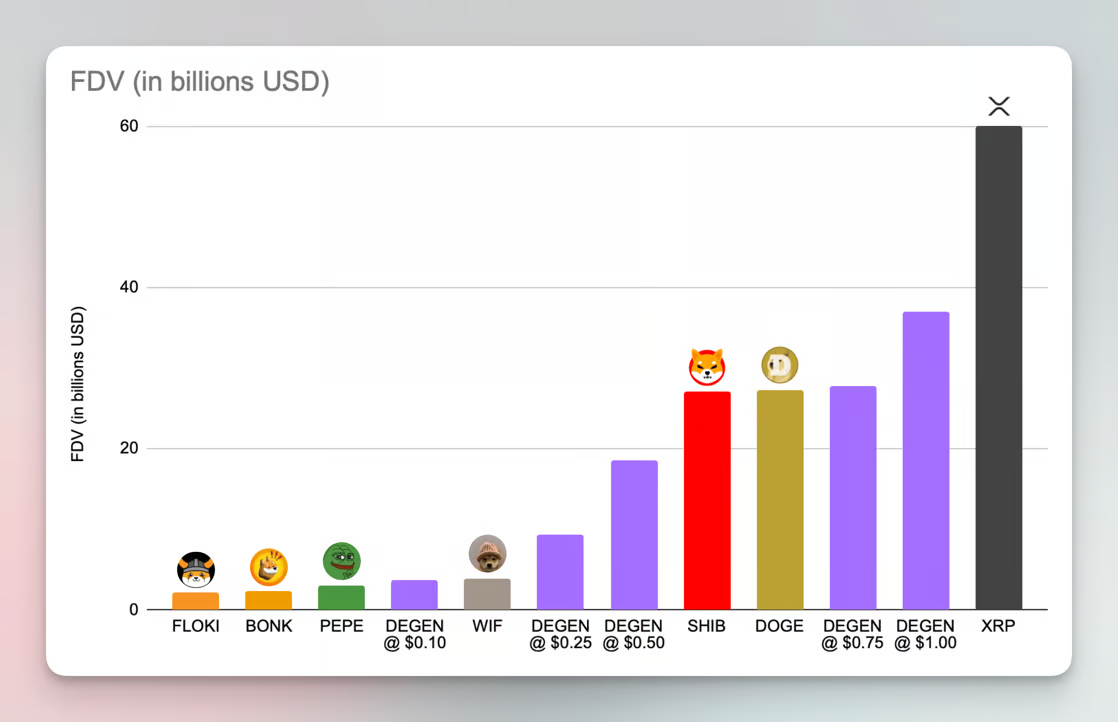
Source:https://warpcast.com/sathaxe/0x3a017ee5
As a memecoin, $DEGEN’s market cap can be compared to other leading meme coins.
As a proxy token, $DEGEN can be benchmarked against Farcaster’s valuation and Base’s scale.
As a meme coin with payment and tipping utility, $DEGEN could be compared to Dogecoin—considering Twitter’s push for Dogecoin payments, while its decentralized counterpart, Farcaster, aligns with $DEGEN.
As a Gas Token on an L3, $DEGEN could be valued relative to L2s or even L1s.
$DEGEN is the most fascinating experiment I’ve seen in this bull run—one that demonstrates what “the right incentives” can create for a protocol and its ecosystem. As the new meta of this cycle, its market cap has no ceiling. For a true new meta, previous valuation methodologies and metrics no longer apply.
Given all this, if a project like this isn’t worth holding long-term, I don’t know what is.
What’s your method or tools for spotting “golden dogs” (top-tier memes)?
LeftOfCenter: I rarely use tools or look at raw data—data can be faked. I prefer qualitative analysis. The number of followers a project’s official account has matters less than who those followers actually are. I mentally tag the Twitter users I follow across different dimensions, and when evaluating a project, I assess based on the profile of its followers to decide whether it’s worth following further.
Moreover, I believe evaluating a project ultimately comes down to evaluating people. I favor independent developers over VC-backed teams—most 100x projects in the past followed this pattern.
Lastly, everything is relative—including project quality. My framework focuses on a project’s relative advantage within the broader crypto market at any given moment. If it feels genuinely “new” and hasn’t reached mass adoption yet, it deserves attention.
What’s your logic for identifying a “golden dog”?
LeftOfCenter: Wild-born, community-native, small teams, developer-led (ideally solo founders who are coders), and not backed by major capital.
Any under-the-radar “golden dog” candidates to recommend?
LeftOfCenter: As a retail investor with limited capital, I stick to a contrarian, left-side investment principle—never chasing hype. I won’t recommend anything already well-known. Here are some lesser-known projects I’m watching—not financial advice:
FarCats, the first NFT on Farcaster, created by 0xen, who also founded Purpledao. The on-chain decentralized stablecoin DYAD, onchain gaias, and the upcoming swatches by jvmi. For more emerging projects, follow the Cobo Argus Strategy Weekly.
Note: All instances of Farcaster should be understood as Warpcast, which is the official client developed by the team behind the Farcaster protocol.
Join TechFlow official community to stay tuned
Telegram:https://t.me/TechFlowDaily
X (Twitter):https://x.com/TechFlowPost
X (Twitter) EN:https://x.com/BlockFlow_News
 深潮TechFlow