From Cradle to Unicorn: A Cyclical Theory of Public Goods Funding in Ethereum
TechFlow Selected TechFlow Selected
From Cradle to Unicorn: A Cyclical Theory of Public Goods Funding in Ethereum
From cradle to unicorn, or from cradle to grave.
 Navigating Web3 tides with focused insights
Authors: Carl Cervone, Kevin Owocki
Translation: Chunzhen
Editor's Note: Carl Cervone, a member of Open Source Observer—a product analyzing open-source projects—and Kevin Owocki, co-founder of Gitcoin, jointly explore the funding lifecycle of public goods within the Ethereum ecosystem, examining the challenges and opportunities at each stage. This article establishes a foundational framework for studying public goods cyclically, with its outlined opportunities offering significant insights for future development directions.
TLDR
-
This article discusses the end-to-end financing lifecycle of Ethereum public goods;
-
We believe solving these issues can create sustainable competitive advantages for the crypto ecosystem;
-
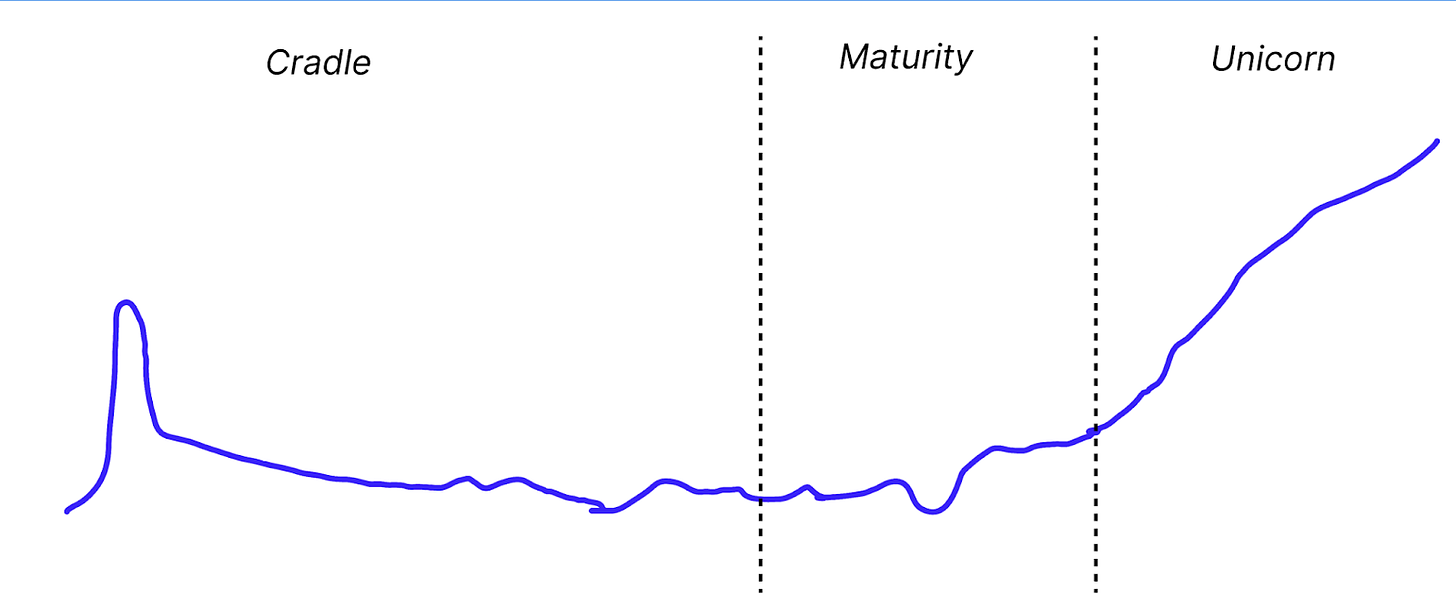
We outline the lifecycle of public goods funding:
-
The cradle phase focuses on building and securing initial funding;
-
The maturity phase includes community building and surviving the "trough of sorrow";
-
The unicorn phase is about achieving significant impact and receiving retroactive funding.
Private Goods Startup Funding Lifecycle
There’s a well-known chart depicting a startup’s lifecycle: from being first featured on TechCrunch, gradually losing novelty, enduring a prolonged "trough of sorrow," and finally crossing the chasm to be acquired for billions of dollars.
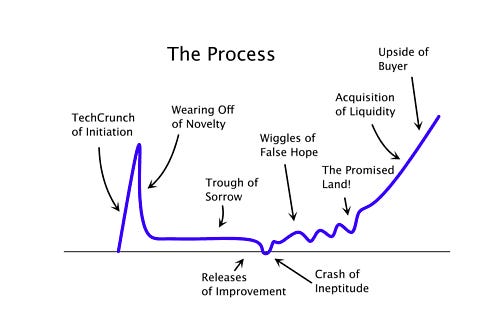
Such startups are typically funded by venture capital firms. Most die in the trough because they run out of funds before finding product-market fit.
Startup funding infrastructure is already quite mature: they receive initial VC funding to build around their idea; if they enter a growth phase, they secure more venture capital (and revenue); eventually, if everything goes well, everyone earns substantial returns during a liquidity event.
Additionally, there’s a value chain of different funders who specialize in funding various types and stages of startups. Early-stage investors are often entirely different from later-stage ones. Early investors mostly bet on people, requiring specialized domain knowledge and networks to find good deals. Later investors focus more on metrics, closely monitoring company KPIs and macroeconomic conditions. Investors in this space can provide valuable resources including education, hiring support, mentorship, and more.
Public Goods Funding Project Lifecycle
Let’s consider what a similar funding lifecycle diagram might look like for the Ethereum public goods ecosystem—ideally funding teams before, during, and after they generate impact.
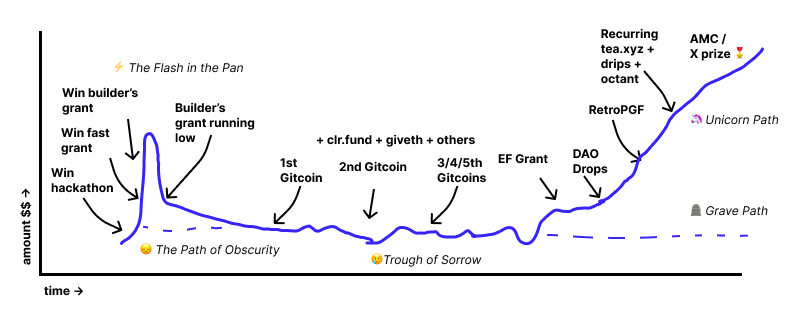
To accelerate innovation, every viable project across the public goods organizational lifecycle—from cradle to unicorn—should be funded.
Moreover, continuous funding, validation, and other resources are needed to help projects survive the “trough of sorrow” between initial building and becoming a unicorn. Not all projects will succeed. In fact, most won’t. If a project ultimately fails and the team moves on, we shouldn’t view that as shameful (we should especially encourage teams to publicly share their lessons learned so future teams don’t repeat the same mistakes).
1. Cradle: Potential Funding Stage
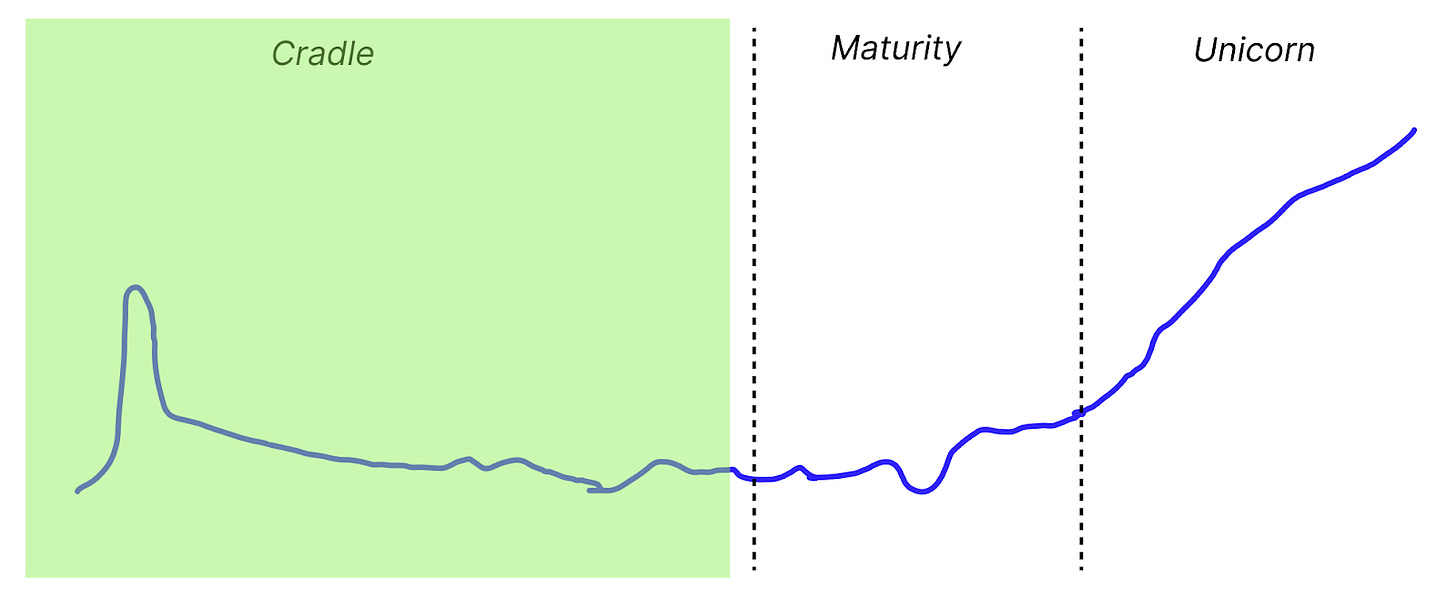
In the early stages (early to mid-phase in the above diagram), funding is needed to reduce upfront costs of starting up. People fear quitting their jobs, and applying to many grant programs is difficult and time-consuming.
However, funding shouldn’t be provided without scrutiny. To truly help builders, they also need validation on what creates value for how many people. Alongside funding, it’s important to validate whether your work matters.
Bounties and hackathons are good ways to seed ideas, but they’re unpredictable and incentivize teams to constantly switch projects or jump between ecosystems. There should be a better path from winning small hackathons to securing large grants—perhaps via several medium-sized, fast-turnaround grants in between. This would help more projects launch and give proven builders an easier path to quit their jobs and work full-time. It would also help keep builders focused on specific ecosystems rather than hopping from one grant to another.
During the cradle stage, projects should focus on the most important thing: building. They should build as publicly as possible. Anything that simplifies their lives and helps them focus on building and learning—whether finding insurance or hiring a top smart contract auditor—is worthwhile. Ideally, they shouldn’t spend too much time worrying about where the next round of funding will come from.
In our schematic, this stage begins with winning a hackathon and ends with securing a small grant from the Ethereum Foundation. They haven’t yet created any real impact, but they’ve proven worthy of substantial potential funding to build something.
2. Maturity: Community Funding Stage
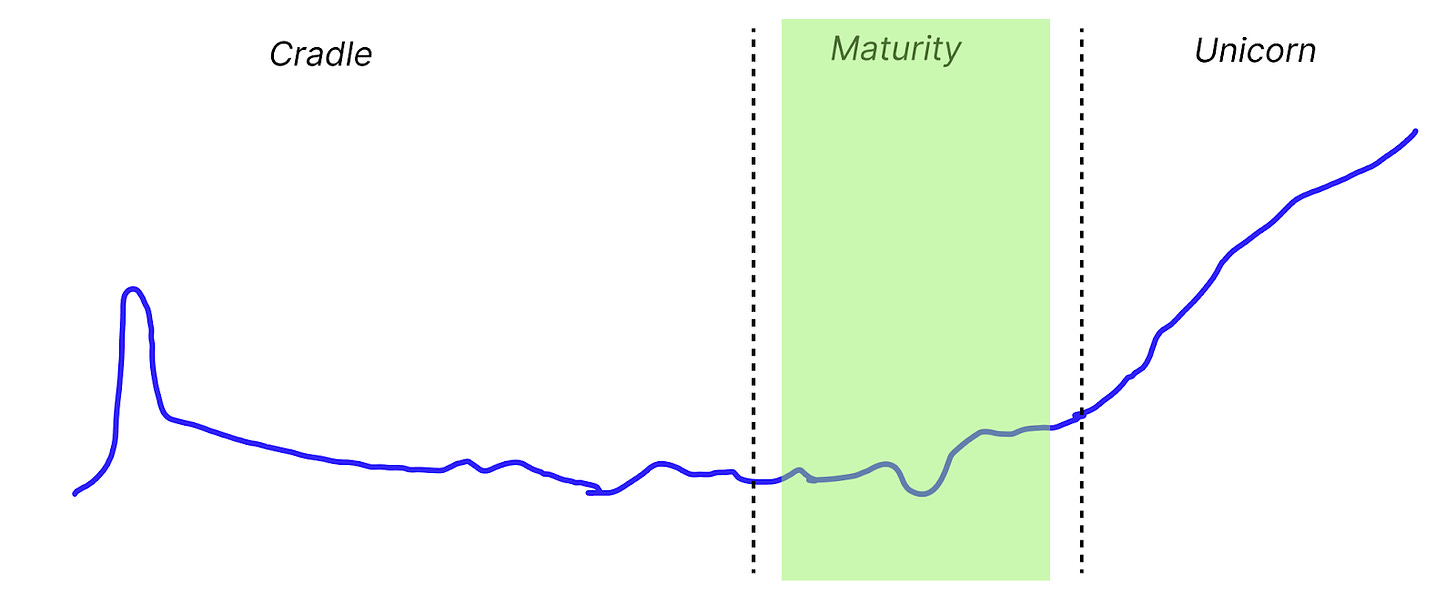
Now the project has some funding, but operations are far from optimal. It’s building and experimenting with different things, but often no one truly cares yet.
The "trough of sorrow" is like a bear market for projects. It becomes even harder when your personal “trough” coincides with a funding winter.
To survive the “trough of sorrow” and grow into a mature public goods project, you need to build a community and start creating real, demonstrable impact on those people. This is where community funding mechanisms like quadratic funding and direct grants are most valuable.
Although most projects cannot raise $100K through these means, they should be able to get enough funding to survive and continue developing. These mechanisms force projects to stay closely connected with their communities and increase community awareness.
The best-performing projects on Gitcoin Grants are those that already existed and had built reputations—not those announcing themselves to the world via Gitcoin. We observe the same pattern across other funding platforms like clr.fund and Giveth.
The strongest projects mature during this phase, earning strong reputations within communities for delivering useful public goods.
3. Unicorn: Retrospective Funding Stage
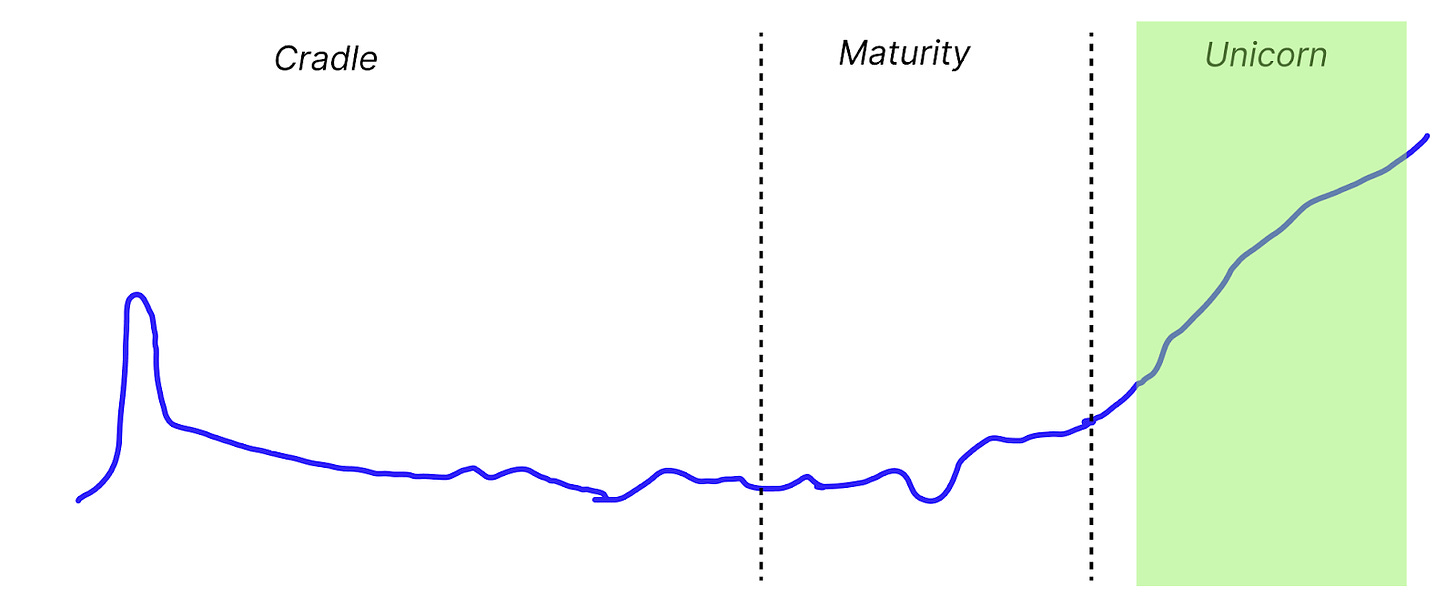
At some point, a project reaches an inflection point where its impact on the ecosystem far exceeds fair compensation. This is where large-scale retroactive funding should come into play.
Ideally, we’d begin seeing various complementary mechanisms fund these projects. Staking yields from ETH or ETF profits (e.g., Van Eck) could be awarded to reputable projects. Additional Optimism RetroPGF rounds, decided by badge holders, could be expanded.
Currently, these are mostly technical mechanisms, but over time, public goods projects could bring more bottom-up recurring revenue. tea.xyz and Drips v2 offer different funding portfolio approaches. The concept could extend to any form of public good. The better we become at tracking impact and cultivating a culture rewarding upstream impact, the more viable this becomes as a recurring income source for公益 projects.
Finally, it would be exciting to establish X-Prize-style awards or large Advance Market Commitments (AMCs) specifically for public goods.
4. Death (Sometimes) Is a Feature, Not a Bug
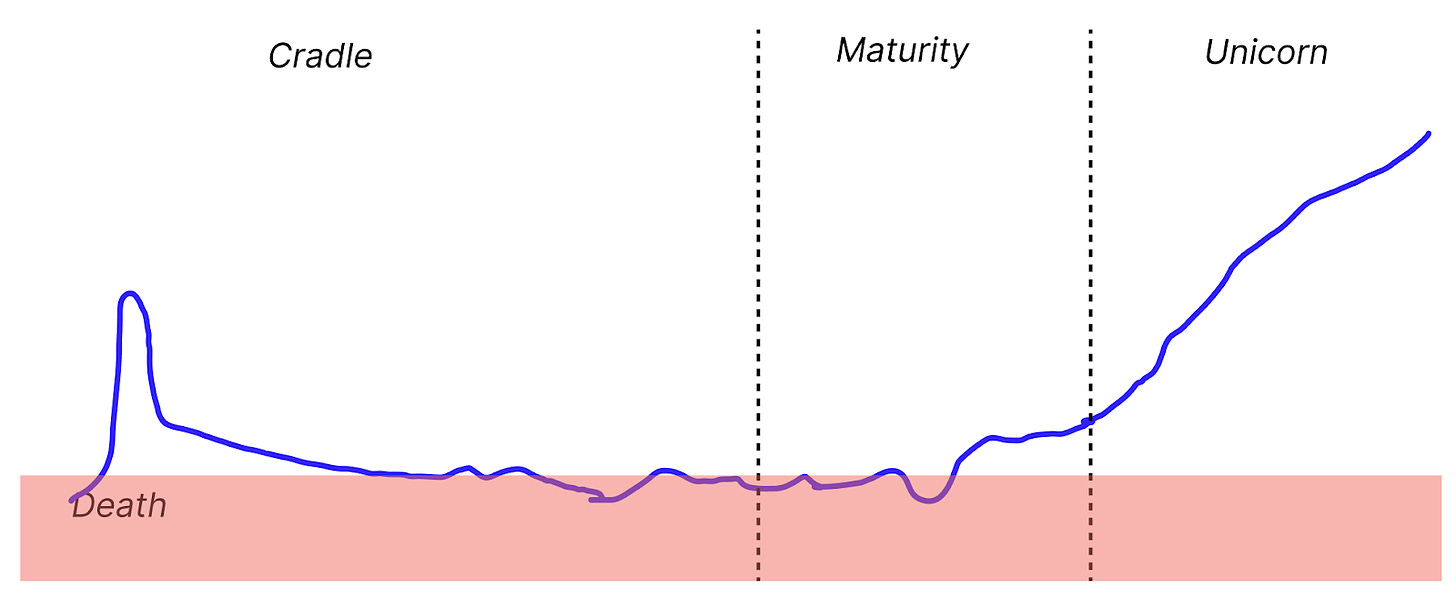
Many projects fail to achieve sustainability or become unicorns and instead die during development. In some cases, this is a feature, not a bug.
When a project fails, it provides valuable lessons for entrepreneurs, investors, and the broader community. One key lesson is the importance of market demand: many projects fail because they create products or services that don’t meet strong demand. This highlights the necessity of thorough market research and continuous customer feedback. A failed project can also underscore the importance of timing. Even the most innovative ideas must emerge when market demand begins to surface.
Another critical lesson is the importance of flexibility and adaptability. Projects operate in rapidly changing environments, and the ability to adjust based on market shifts, customer feedback, or technological advances is crucial to survival. Failure also teaches us about team dynamics and leadership. A common cause of project failure is internal conflict or lack of clear leadership and vision. Therefore, building a strong, cohesive team aligned with the startup’s goals is just as important as the idea itself.
As ecosystem builders, the most important principles are:
-
Don’t let promising projects die due to lack of funding;
-
If builders are on the wrong path, accelerate their path to death/reflection/rebirth;
-
If a project ultimately fails, the team should still move forward—it shouldn’t be a source of shame. We should especially encourage openly sharing these teams’ lessons learned so future teams avoid repeating the same mistakes.
5. Not Every Successful Project Needs to Be a Unicorn
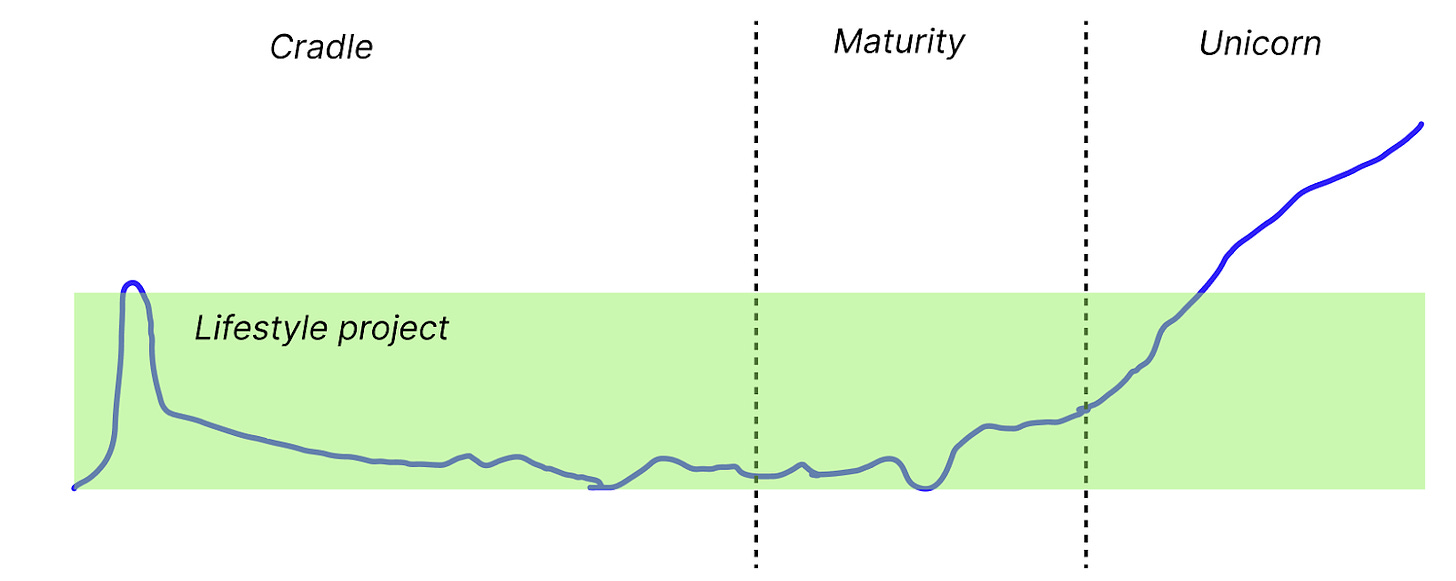
Perhaps “unicorn or bust” is the wrong framing. Many projects don’t want to become unicorns. In fact, unicorn worship is a legacy of the venture capital model, where the entire process depends on finding a 100x exit that returns the entire fund.
There needs to be a lifestyle and business model for public goods—an opportunity to build smaller tools that deliver immense value but will never experience exponential growth—i.e., change the world or become a unicorn.
Recommendations and Open Questions
1. Keep Growing the Pie
One parallel we can draw from venture capital/startups is that successful founders can become the next generation of investors.
We can envision today’s unicorn projects funding the next generation of public goods projects during their cradle phase. This is already happening: projects like 1inch and Uniswap have evolved from Gitcoin Grant recipients to contributors in matching pools and Protocol Guild donors. This should be socially encouraged.
We can amplify social incentives by creating credible cryptographic commitments to fund future projects. If every new project funded in the cradle phase issues an EAS attestation stating they plan to allocate 5% of their tokens to next-generation projects, this creates a quantifiable future commitment for future public goods funding.
Opportunities:
-
How do we attract the next generation of builders—once they become unicorns—to make highly credible commitments to give back to public goods?
-
How do we launch a social movement to make this a trend?
-
How do we pool these commitments to make credible promises for future funding?
2. RetroPGF Offers Opportunities Around “Impact = Profit”
VC pushes startups to accelerate and capture as much value as possible. The push for public goods should be to create as much value as possible for the ecosystem.
Retroactive public goods funding offers an opportunity to promote a different value capture mechanism aligned with the “impact = profit” model.
By introducing retroactive public goods funding into the ecosystem, we can create reliable monetary return commitments for public goods generating the greatest impact. Since retrospection makes it easier to judge project quality than prediction, retroactive funding aligns closer with “impact = profit.”
With this, future public goods funders could reshape earlier steps in the funding lifecycle. Speculators could anticipate which public goods are most likely to receive retroactive rewards later. Tools enabling users to make “angel investments” in public goods early in the cycle could advance this direction.
Another opportunity is creating proof of impact to credibly track which projects generate the most impact. These large-scale proofs of impact would form a trust network where all projects can verify each other’s impact. Tools like EAS and Hypercerts can provide the foundation for such impact proofs. As whale funders use these tools as signal detectors to decide what to fund, they become increasingly valuable—and also serve as valuable tools for builders to understand whether they’re on the right track.
Opportunities:
-
Integrate Hypercerts/EAS into existing public goods funding programs
-
Build new proof-of-impact services to help people distinguish impactful projects
-
Build new forward-looking public goods funding tools to capture future retroactive rewards.
3. Surviving the Cradle Phase
Creating a reliable pathway through the cradle phase is the most critical unsolved problem in this field.
Open questions here include:
-
If a builder fails to attract funding/proof, is it due to ecosystem flaws, or because the builder hasn’t yet found an important-enough problem worth funding?
-
What kind of safety nets do public goods builders specifically need? Reverse thinking: How can we design these safety nets to prevent abuse?
-
There are definitely services every team needs—legal, back-office, recruiting, auditing, office hours, etc. Would access to these services become key to empowering small teams toward independence?
-
Which of these services are most valuable to cradle-stage builders? What’s the TAM for each new service at the cradle stage? If TAM is large enough, we’ll see companies emerge serving these niches. If TAM is large enough, how can we gather DAOs to pool resources and provide these services? How do we attract builders to provide these services?
-
While funding is a good start, once developers and the ecosystem collaborate well, we need a second step in this relationship—building long-term, comfortable, “at-home” relationships. Developers perform best when deeply familiar with protocols and embedded in long-term ecosystem relationships. The hit-and-run model doesn’t work. How can developers transition from episodic funding to recurring funding?
4. Are We Just Recreating Venture Capital?
In some ways, this ecosystem’s funding lifecycle may begin to resemble a recreation of venture capital.
In venture capital, funds typically assemble a portfolio of top developers and other service providers who can offer founders any help they need.
We should adopt the successes here, but also watch for opportunities to rebuild these ecosystem services from first principles.
Composable funding models offer builders access to multiple diverse sources of funding and services (rather than relying on a single VC firm).
Retroactive public goods funding gives builders room to focus on public goods, not just extractable value. Value is captured by the network and fed back into it.
The hyper-modularity of Web3 systems is also an opportunity. Because smart contracts are anti-rivalrous—the more people use them, the more valuable they become—there’s an opportunity to power exponential growth curves early and reap rewards later.
Solving This Problem Defines META
Does solving the “cradle-to-unicorn” public goods funding challenge establish a new META (most effective strategy) for the crypto ecosystem?
We believe that as crypto matures and fundamentals grow more important, funding public goods for the ecosystem will become a sustainable competitive advantage—just as work, education, healthcare, and entertainment are competitive advantages for cities.
Prosocial behavior has independently evolved dozens of times across economic and natural ecosystems worldwide (wolves hunting in packs, humans forming corporations or nations, etc.). In our view, it will clearly evolve into crypto-economic systems as well.
In a sense, the theme of an “Ethereum alliance” is already emerging. Projects adopting pro-Ethereum mindsets and business models enjoy numerous privileges within a mutually supportive network (driven by either altruism or rational economic interest in seeing both succeed).
As the ecosystem grows, there’s an opportunity to expand this mindset into the thousands of DAOs already present in the Ethereum ecosystem. Each project competes for a place in the value chain to add value, and within their communities, they’ll foster prosocial environments.
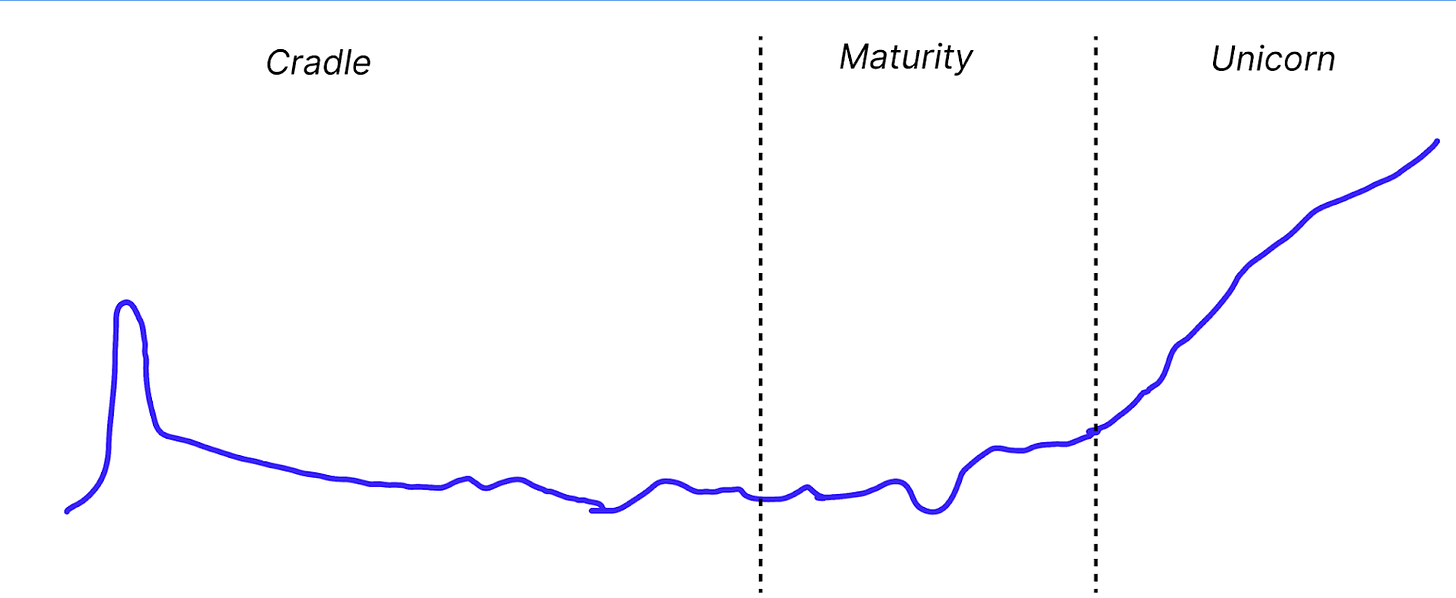
In this article, we’ve explored how to do this throughout the entire lifecycle of public goods projects—from cradle to unicorn, or from cradle to death.
Join TechFlow official community to stay tuned
Telegram:https://t.me/TechFlowDaily
X (Twitter):https://x.com/TechFlowPost
X (Twitter) EN:https://x.com/BlockFlow_News