









RWA Narrative Investment Guide: Choose Projects with Strong Marketing, Wait for Pullback Opportunities
TechFlow Selected TechFlow Selected
RWA Narrative Investment Guide: Choose Projects with Strong Marketing, Wait for Pullback Opportunities
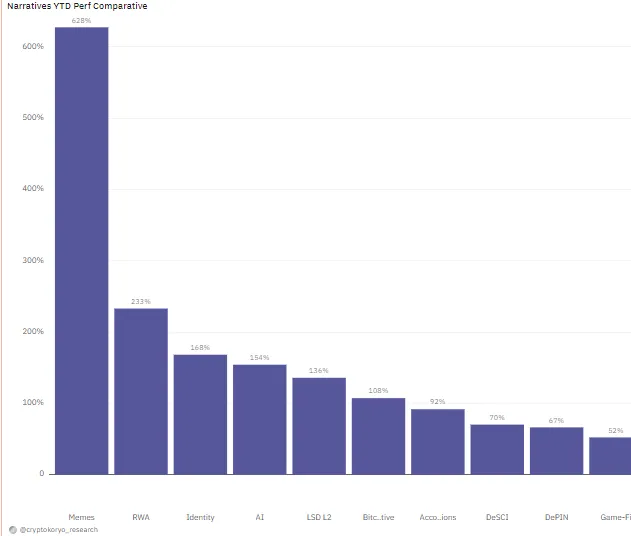
This year, the RWA narrative was the second-best performing narrative, outperforming AI.
 Navigating Web3 tides with focused insights
Author: The DeFi Investor
Translation: TechFlow
The Real-World Assets (RWA) sector is one of the areas with the highest long-term potential. Clearly, this is not just a short-term narrative.
Tokenizing real-world assets brings many benefits:
-
Easier access
-
Transparent audits
-
Near-instant settlement speed
-
Composability (imagine opening a loan against your tokenized car on a decentralized money market like AAVE)
I believe that cryptocurrency will play an important role in the RWA/tokenization industry.
In this article, I’ll discuss why I’m bullish on RWAs, highlight some RWA projects on my watchlist, and share strategies for selecting the right tokens in this space.
Why I'm Bullish on the RWA Narrative
Real-world assets in crypto refer to the tokenization of tangible assets and putting them on-chain.
According to Crypto Koryo's dashboard, the real-world assets narrative has been the second-best performing theme this year, outperforming even artificial intelligence.
Nevertheless, the total market cap of real-world assets within the crypto industry remains small: slightly over $9 billion according to Coingecko.
For context, Boston Consulting Group estimates that tokenization of illiquid assets could reach $16 trillion by 2030. While this forecast may be overly optimistic, it’s clear that tokenization holds massive growth potential.
Stablecoins are a prime example of real-world assets already tokenized and product-market fit achieved, with a current market cap exceeding $150 billion.
Recent news from BlackRock only adds fuel to the fire.
You’ve probably heard that BlackRock, the world’s largest asset management firm, announced a few days ago the launch of a tokenized fund worth over $100 million on Ethereum.
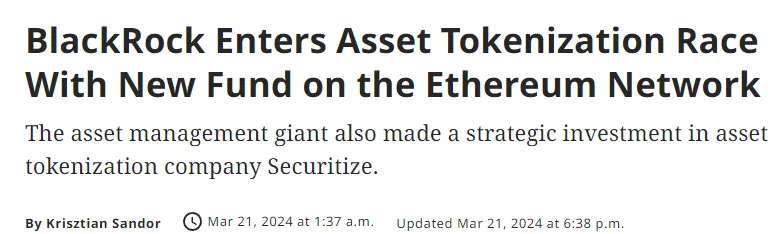
Although this announcement isn’t directly linked to any crypto-based RWA project, speculation around it led to significant price increases in RWA tokens.
Beyond that, there’s one main reason why this news is so significant:
BlackRock launching an on-chain tokenized fund legitimizes the on-chain RWA industry and paves the way for other institutions to follow suit.
Just as after BlackRock filed for a spot Bitcoin ETF last year, financial giants like Fidelity followed with their own applications—I expect the same pattern this time.
Additionally, RWA/tokenization is a narrative easily understood by retail investors. To outperform the market, you must invest in tokens that retail investors will want to buy once they turn their attention to crypto.
Given all the factors mentioned above, I expect real-world assets to be one of the top-performing narratives during this bull market.
RWA Market Landscape
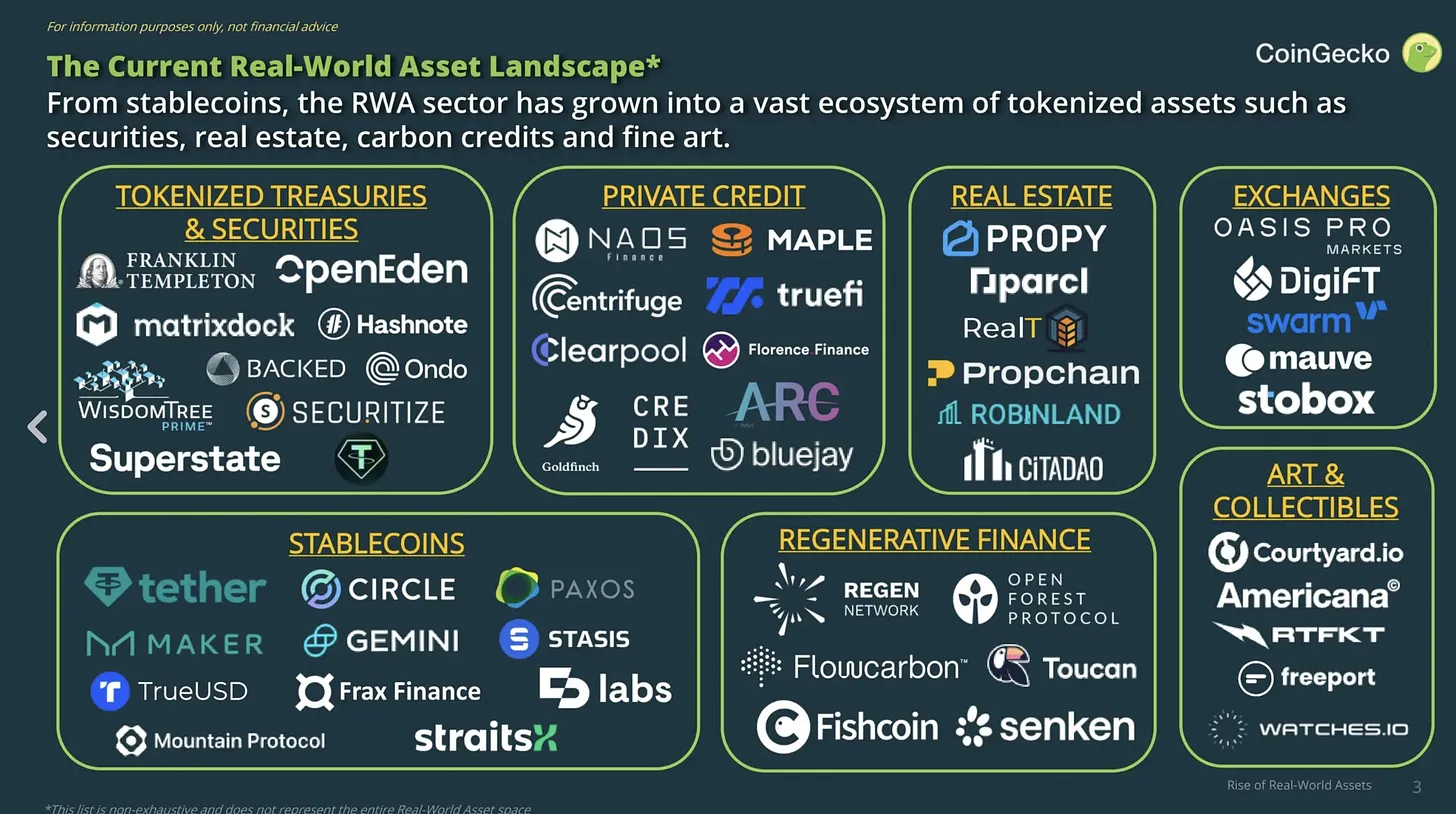
As shown in the image above, this sector includes several subcategories, among which some of the most important are:
-
Tokenized government bonds and securities
-
On-chain private credit
-
Infrastructure projects (e.g., RWA blockchains)
-
Real estate
-
Regenerative finance (ReFi)
There are dozens of interesting RWA projects—too many to cover all. But I’ll focus on some market leaders and standout projects:
Mantra
Mantra is the first blockchain specifically designed for real-world assets.
Just days ago, the team announced raising $11 million.
Key features of this blockchain include:
-
MANTRA Compliance Module: A suite of tools helping Web3 platforms meet regulatory requirements, including KYC protocols and sanctions screening
-
MANTRA Token Services Module: An SDK enabling enterprises to easily create, issue, distribute, and manage digital assets compliant with various regulatory frameworks
-
Mantra DEX: A DeFi hub leveraging the Cosmos ecosystem to simplify and enhance trading efficiency for real-world assets
Overall, the project aims to make it easier for businesses and investors to launch and trade tokenized assets on-chain.
Compliance with regulations has always been a major hurdle for Web3 companies, and Mantra provides several tools to streamline this process.
Ondo Finance
Ondo offers liquid exposure to institutional-grade financial products such as short-term U.S. Treasuries and ETFs.
The protocol has $220 million in TVL and is backed by Pantera Capital and Coinbase.
As I mentioned earlier, through Ondo, you can invest in tokenized U.S. Treasury bonds.
Interestingly, afterward, you can use protocols like Flux Finance to borrow assets against these tokenized Treasuries in DeFi.
Composability is a key feature of DeFi, allowing developers to combine multiple DeFi products into entirely new offerings—just as Flux does.
It will be fascinating to see more RWA projects leverage DeFi composability for novel use cases.
Avalanche
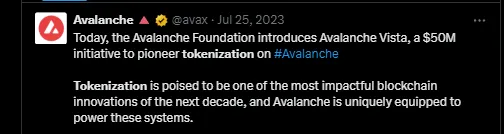
While Avalanche is primarily known as an L1 platform hosting various dApps, its team has also heavily invested in tokenization and institutional adoption.
For instance, last year Avalanche:
-
Launched a $50 million ecosystem fund dedicated to advancing tokenization
-
Announced partnerships with financial giants such as WisdomTree and JPMorgan
-
Introduced Evergreen subnet, customized for institutional users
More recently, Citigroup announced it successfully explored private fund tokenization using an Avalanche subnet.
Another notable development: Securitize, a well-known asset tokenization company, chose Avalanche last year to launch its first tokenized asset.
Parcl

Parcl is the first derivatives DEX focused on real estate markets.
The project is backed by Coinbase Ventures, Solana Ventures, and Dragonfly. Its token launch is confirmed for the coming weeks.
Parcl is one of the largest dApps on Solana, with nearly $200 million in TVL.
With Parcl, you can easily speculate on real estate price movements, as the platform offers city indices.
Clearpool
Clearpool is a decentralized credit market.
Through it, you can lend USDC to institutional borrowers and earn yields up to 23% APY.
All borrowers sign legal agreements before receiving funds, ensuring recourse in case of default.
Interestingly, Clearpool’s TVL has grown nearly 50% over the past few weeks.
LandX
LandX has a unique offering as the first decentralized RWA platform for investing in and trading farmland and agricultural commodities.
The protocol provides funding to real-world farmers in exchange for legal shares of their crops. Since LandX farmers’ crop shares are tokenized, you can easily invest via the platform and gain inflation-resistant returns.
Thanks to LandX, commodity inventories can be offered as liquid digital assets.
Other Notable Projects:
Florence Finance: A leading euro-denominated RWA project connecting DeFi with physical loans
MakerDAO: While technically not solely an RWA project, MakerDAO’s stablecoin $DAI is largely backed by real-world assets. DAI holders can also stake their stablecoins to receive sDAI, earning yield generated from DAI-backed collateral
Centrifuge: Centrifuge allows anyone to lend assets to institutions in exchange for steady returns
Selecting Winners in the RWA Narrative
Now I’ll outline the criteria I look for in RWA projects when deciding which RWA tokens might be good investments.
Generally, here’s what I seek:
-
Strong community: No community = no buyers
-
Increasing adoption: You can use tools like DefiLlama to view statistics for nearly any protocol (I typically focus on Total Value Locked (TVL) and revenue)
-
Active social media presence: We live in an attention economy. Ideally, bet on teams that understand the importance of marketing
-
Doxxed teams: While not mandatory for most projects, I’d say it’s crucial for real-world asset protocols
-
Strong backers: Projects with investors like Binance Labs, Coinbase Ventures, a16z, or other well-known names usually have a solid grasp of adapting to new narratives
-
Partnerships with financial giants: Not essential, but for example, in Avalanche’s case, $AVAX consistently surges after announcements of major new partnerships
-
Token utility: During bull markets, token utility isn’t extremely critical, but ideally, I prefer investing in tokens that directly benefit from the project’s success
It’s unlikely you’ll find a project meeting all these criteria. But the more boxes checked, the better.
As I noted earlier, the entire real-world assets crypto sector currently has a total market cap of about $9 billion. In my view, that’s extremely low, and I believe it has enormous growth potential throughout this bull cycle.
Almost every token will rise when the altcoin season begins.
Hopefully, with the investment framework I’ve outlined above, you’ll be able to identify and invest in future top performers.
One final piece of advice:
If you plan to hold RWA tokens long-term, don’t blindly buy into RWA tokens that have surged 2–3x due to recent BlackRock news. Wait for a -25% to -35% price correction, then place your order.
If you’re patient, the market will give you the chance to buy them at a slight discount.
Join TechFlow official community to stay tuned
Telegram:https://t.me/TechFlowDaily
X (Twitter):https://x.com/TechFlowPost
X (Twitter) EN:https://x.com/BlockFlow_News
 The DeFi Investor






