Will AI application platforms in the Web3 world succeed?
TechFlow Selected TechFlow Selected
Will AI application platforms in the Web3 world succeed?
Is the integration of AI and Web3 necessary?
 Navigating Web3 tides with focused insights
Text by: Wan Chen,GeekPark
Editor: Zheng Xuan
Since OpenAI launched the GPT Store at its developer conference, this opportunity—seen as the App Store of the large model era—has come into broader view. Chatbot platforms and agent platforms have become one of the hottest startup directions in 2024.
But some tech enthusiasts are no longer satisfied with building AI-era application distribution platforms using Web2.0 or even Web1.0 approaches—they’re setting their sights on Web3.0.
A startup called MyShell aims to use blockchain technology to create fair and rational mechanisms for fostering a thriving chatbot ecosystem. Under MyShell’s economic model, every participant and contributor could theoretically receive appropriate rewards.
While many AI application platforms showcase chatbots that can “talk fluently and dance gracefully,” MyShell focuses on the creators behind these bots—the people. This approach is naturally appealing to creators and aligns closely with interests familiar to the Web3 startup community.
Frost, an investor at Qiming Venture Partners, believes combining Web3 and AI—as MyShell does—holds significant value.
On centralized platforms like Apple’s App Store, app rankings and traffic exposure are rarely distributed strictly according to user adoption metrics; decisions are influenced by corporate priorities. In contrast, platforms like Hugging Face remain relatively neutral, which is why major model providers such as Meta and Google contribute their models there. If Hugging Face continues scaling commercially, it could offer a more equitable distribution of benefits.
However, crypto-based solutions go further: no single entity owns the platform or controls profit allocation. Instead, usage data determines each individual’s share of rewards. “If there’s a fully independent third party to record and quantify everyone’s contributions and tokenize them, that would be quite reasonable,” Frost said.
01 Building an AI Application Platform with Web3
In March 2023, without any funding, the MyShell team spent three days building a Telegram bot named Samantha—a “visibly rudimentary” chatbot capable of conversing with users through expressive voice interactions.
Despite its simplicity, this bot attracted 30,000 users within its first month, some of whom became early financial supporters of MyShell.
The immediate attention stemmed from the relative scarcity of multimodal chatbots at the time, which lowered usage barriers and enhanced practicality—for instance, many users began using MyShell’s bots to learn foreign languages.
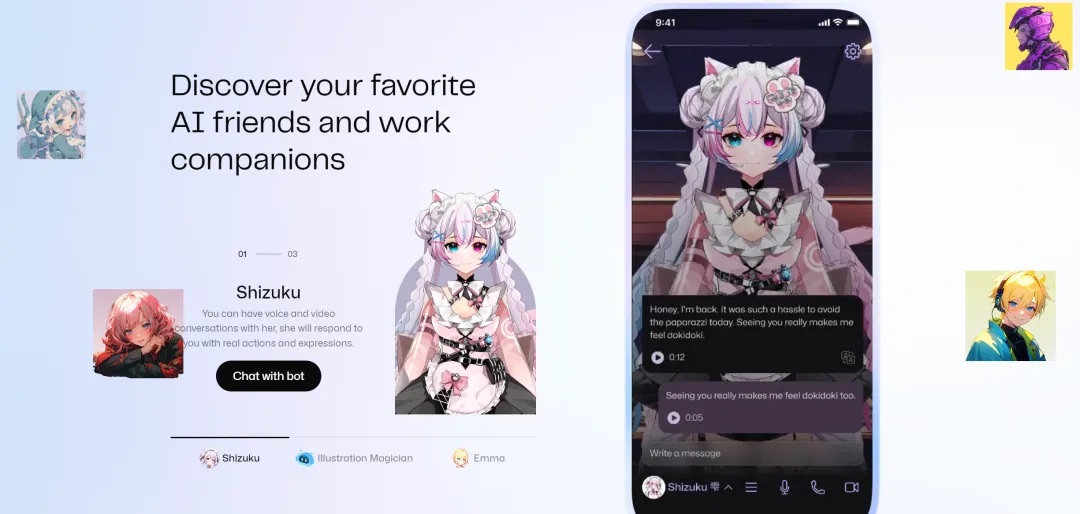
An example chatbot shown on MyShell’s official site, Shizuku: “You can have voice and video conversations with her, and she responds with real gestures and facial expressions.”
Starting from a single chatbot, the MyShell team gradually evolved toward a platform model, offering tools like text-to-text, text-to-speech, and text-to-image models to attract users to develop and publish chatbots on MyShell.
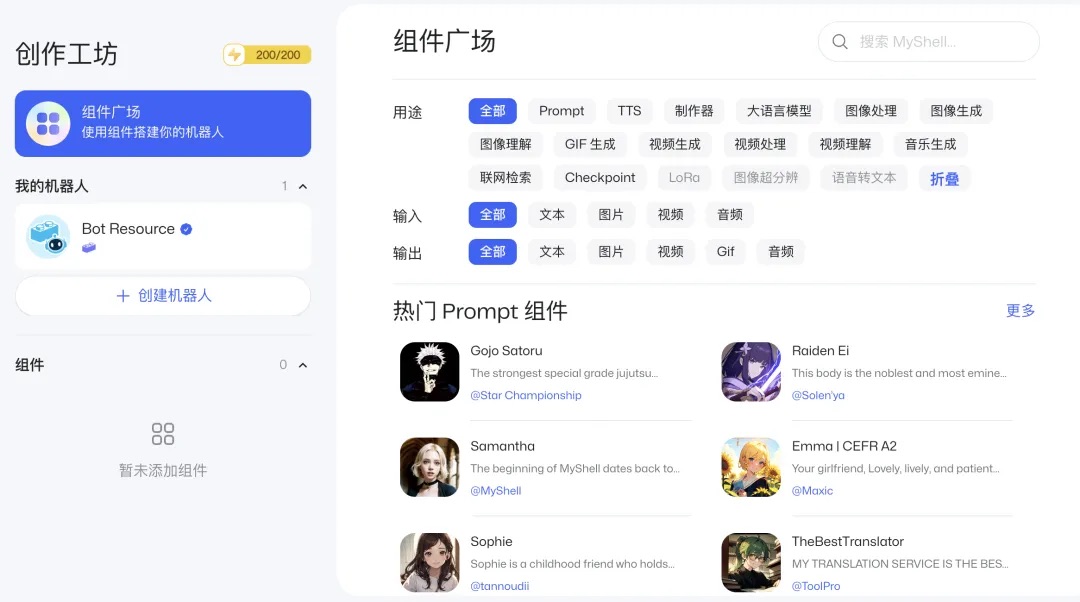
Tool components provided by the MyShell platform
Visiting MyShell’s homepage, users can explore various published chatbots under the "Discover" section. Through conversation, MyShell aims to help users “find the best AI friend or work partner.” Meanwhile, users (or creators/developers) can use toolkits in the “Creation Workshop” to DIY chatbots tailored to specific scenarios and publish them on the platform.

In terms of product design, MyShell doesn’t seem fundamentally different from other chatbot platforms like Character.ai or Poe. By aggregating multimodal AI tools, the platform helps creators quickly build and share personalized chatbots, while users can interact with existing ones.
The key difference lies in incentive mechanisms for users and developers. On MyShell, users can earn points and incentives by creating bots, or even “invest” in platform creators and receive profit shares.
Specifically, users and developers earn points by chatting with MyShell’s bots or creating new ones. These points can unlock GPT-4 chat packages or be exchanged for $SHELL tokens (50 points = 1 Shell Coin), with $SHELL listed on Binance’s opBNB chain.
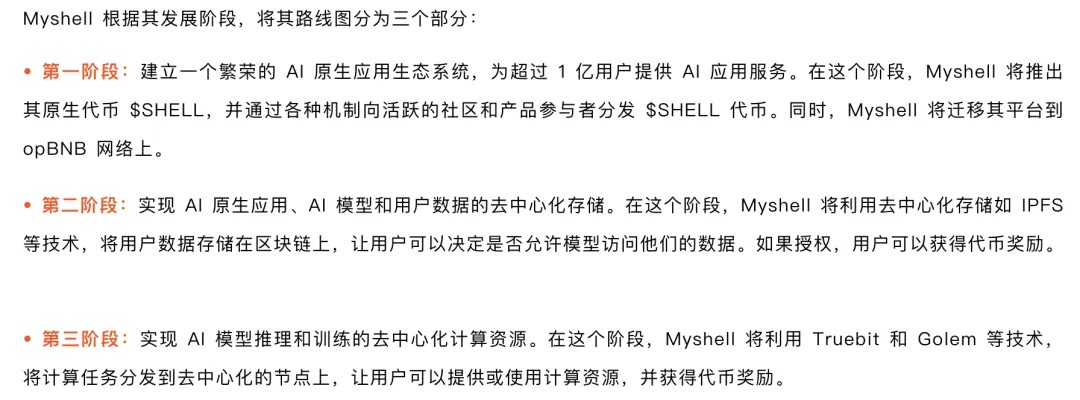
MyShell’s $SHELL token mechanism concept | Source: Shilian Research
With $SHELL tokens, users can “invest” in chatbots and their creators. By clicking to collect a sponsor badge of a favorite bot, users help boost its ranking. When that bot earns points, investors also receive a portion of the revenue.
In other words, when the invested bot and its creator grow in value, the investor’s holdings appreciate too—creating incentives for users to invest in and promote bots.
Ethan, co-founder of MyShell, said in a podcast that the system is gradually expanding: in the future, users holding points will gain greater influence over platform governance, including decisions about traffic distribution, funding allocations for creators, and how funds are used—all currently under development.
No central authority—more like a project collectively owned and built by users. “We hope to return rights over content distribution and creation governance back to users and the community, enabling collective decision-making and governance,” he said.
02 Will Web3 Be the Endgame for AI?
Using Web3 to enter the AI application space is, according to MyShell co-founder Ethan, necessary because Web3’s economic mechanisms better align with the technical characteristics brought by generative AI centered around large models:
AI 2.0 has simplified development—anyone can now create AI applications like chatbots through drag-and-drop, no-code interfaces. This will lead to an explosion of AI apps, requiring efficient economic systems to allocate resources among them.
Additionally, this Lego-like, modular approach to AI development drastically reduces team size, development cycles, and startup capital compared to pre-AI eras, making traditional VC support less viable. MyShell’s economic model enables direct user investment in creators.
In institutional economics, clearly defined property rights are prerequisites for commercial prosperity. MyShell’s decentralized vision offers creators predictable returns—could it break through and become the App Store of the AI 2.0 era?
According to Shilian Research, by last November, MyShell had surpassed 100,000 registered users. In comparison, another AI platform, Poe, already has millions. Judging from MyShell’s primary promotional ground—X.com—it hasn’t sparked widespread discussion. Its user base and discourse remain largely confined to Web3 circles, not yet reaching broader AI application enthusiasts.
Indeed, the idea of using blockchain’s decentralized structure to let creators earn income fairly—without platform “exploitation”—was popular across projects like DeFi and GameFi during the 2022 Web3 boom. Now, this philosophy is being applied to AI chatbot platforms.
But the core issue here isn’t technological or ideological.
One creator told GeekPark that while blockchain enabling fair income for creators on AI platforms sounds theoretically sound, he remains skeptical about real-world progress. He emphasized: “Creators aren’t exploited by platforms—they’re given a livelihood by them.”
There’s an overlooked premise: creators can only earn substantial income if users actually use their creations. “Only when users adopt a platform at scale does a new platform stand a chance.”
A long-term industry observer noted that without a solid user base, fair profit distribution among creators is impossible—most wouldn’t earn anything. AI application platforms are still in the land-grab phase, focused on user acquisition and growth. Even platforms like GPT Store, Poe, and Character.ai have relatively small active user bases. Adding Web3 only increases complexity for end-users. From this perspective, MyShell is destined to remain a niche world.
Join TechFlow official community to stay tuned
Telegram:https://t.me/TechFlowDaily
X (Twitter):https://x.com/TechFlowPost
X (Twitter) EN:https://x.com/BlockFlow_News
 极客公园
极客公园