








Recapping Seven Talks from ETH Denver 2024: MEV, ERC-4377, Block Space Business Models, Public Goods Funding, Community
TechFlow Selected TechFlow Selected
Recapping Seven Talks from ETH Denver 2024: MEV, ERC-4377, Block Space Business Models, Public Goods Funding, Community
From technological innovation to community development, these talks are not to be missed.
 Navigating Web3 tides with focused insights
By 0XNATALIE
ETH Denver 2024 has concluded successfully. Throughout the event, speakers covered a wide range of topics—from technological innovation to community development—exploring the future prospects of Web3. Now, let's revisit some of these standout talks and gain deeper insights into the industry’s latest developments.
TL;DR:
1. EigenPhi Data Analyst - The Evolving Landscape of MEV:
-
Private order flows and transaction observability impact MEV dynamics.
-
Collaboration between searchers and builders may lead to certain searchers monopolizing MEV revenue, undermining ecosystem fairness.
2. Ethereum Foundation Member - Understanding ERC-4377:
-
ERC-4377 aims to improve usability and decentralization of smart contract accounts.
-
Validation stages for smart contract transactions are resource-limited to prevent network abuse.
3. Ethereum Foundation Member - The Importance of Core Developers:
-
Ethereum core developers maintain protocols and drive improvements.
-
The Ethereum Protocol Fellowship and study groups support the cultivation of core developers.
4. Galaxy Digital Investment Lead - The Business Model of Block Space:
-
Block space cost depends on transaction complexity and network congestion.
-
Block space offers high net profit margins and significant profit potential.
5. Gitcoin Founder - The Importance of Public Goods Funding:
-
Public goods funding supports the crypto ecosystem across different stages.
-
Gitcoin’s Allo Protocol provides multiple funding allocation strategies to support ecosystem growth.
6. Gitcoin Co-founder & Optimism Foundation Member - Retroactive Public Goods Funding:
-
RPGF funds public goods after projects are built and their value is realized.
-
A new mechanism design combining upfront funding with retroactive public goods funding is proposed.
7. Ethereum Denver Community Founder - Building Community Ecosystems with Rollup Technology:
-
Community rollups use rollup technology to build shared chains.
-
Membership subscriptions, donations, and transaction fees serve as funding and maintenance mechanisms for community rollups.
The New Era of Transaction Observability: Deciphering MEV’s Shifting Value Landscape
EigenPhi data analyst Yeah Wang discussed how private order flows and transaction observability on Ethereum affect MEV. He argued that privacy-preserving order routing and reduced transaction transparency could lead to unfair MEV distribution and imbalanced competition. Collaboration between searchers and block builders enables privileged searchers to backrun orders at lower costs, while others lack access to the same opportunities, creating an uneven playing field. Such partnerships may allow dominant searchers to monopolize MEV revenue, harming overall ecosystem fairness.
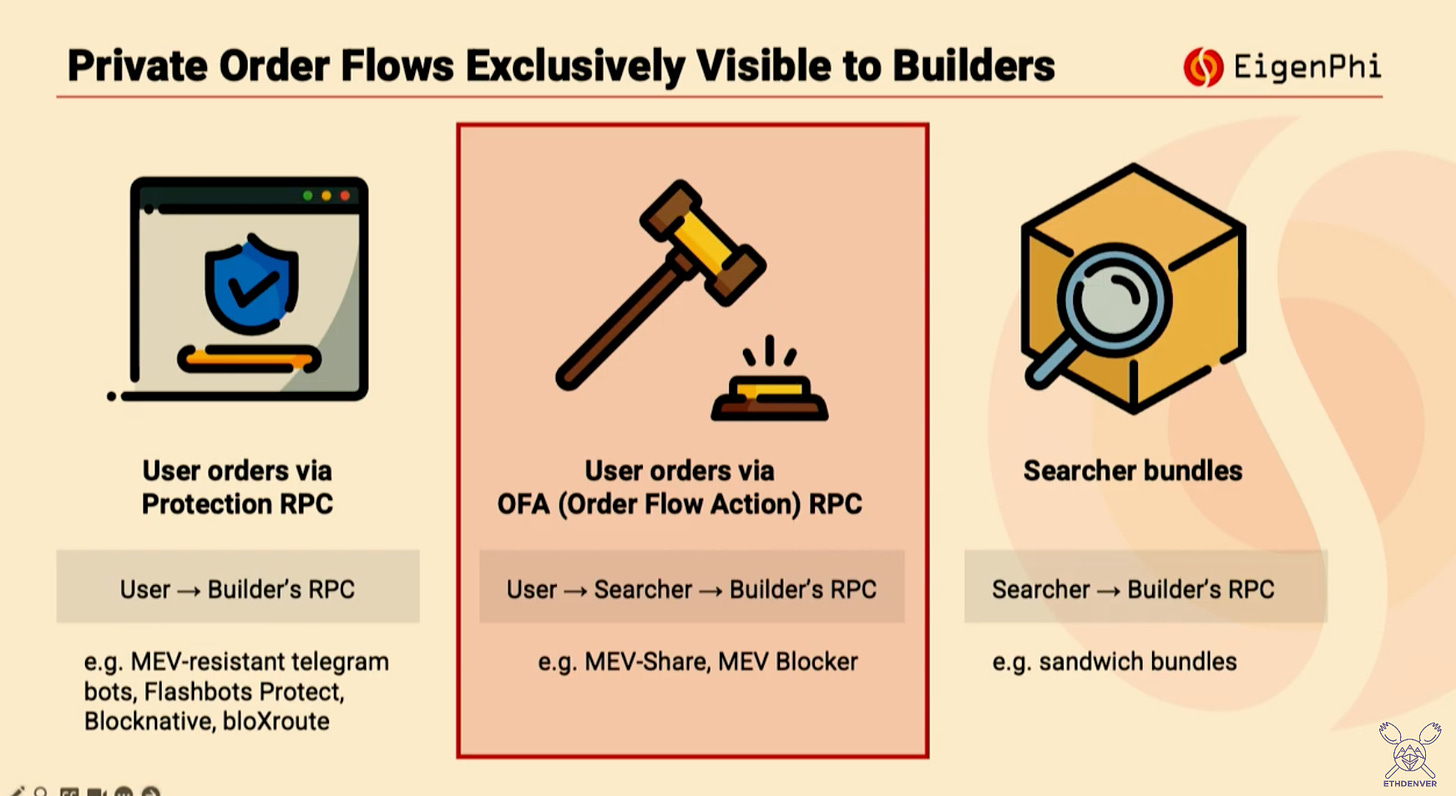
Types of private order flows and their impact on searcher and builder profits:
-
MEV Protection RPC: User transactions are sent directly to a builder’s RPC, visible only to selected builders, increasing their revenue stream. This effectively shields users from being frontrun or backrun by general searchers.
-
Order Flow Auction RPC: User transactions are submitted to clients, allowing searchers to bid for them. Once a searcher includes a user’s transaction in their bundle and sends it to the builder’s RPC, they can extract MEV via backrunning—but must share a portion of the MEV revenue with the user.
-
Searcher Bundles: Searchers rely on bundling mechanisms to uncover hidden MEV opportunities within user transactions. Upon discovery, they can backrun based on known execution sequences. These searchers retain full MEV revenue and enjoy easier access to backrunning opportunities.
AA Is Easy, if You Don't Care About Decentralization
Ethereum Foundation member Yoav Weiss explored the differences between externally owned accounts (EOAs) and smart contract accounts. Smart contract accounts require EOAs to pay gas fees, creating friction for users who must manage two accounts and perform additional signature operations. This complexity hinders widespread adoption of smart contract accounts.
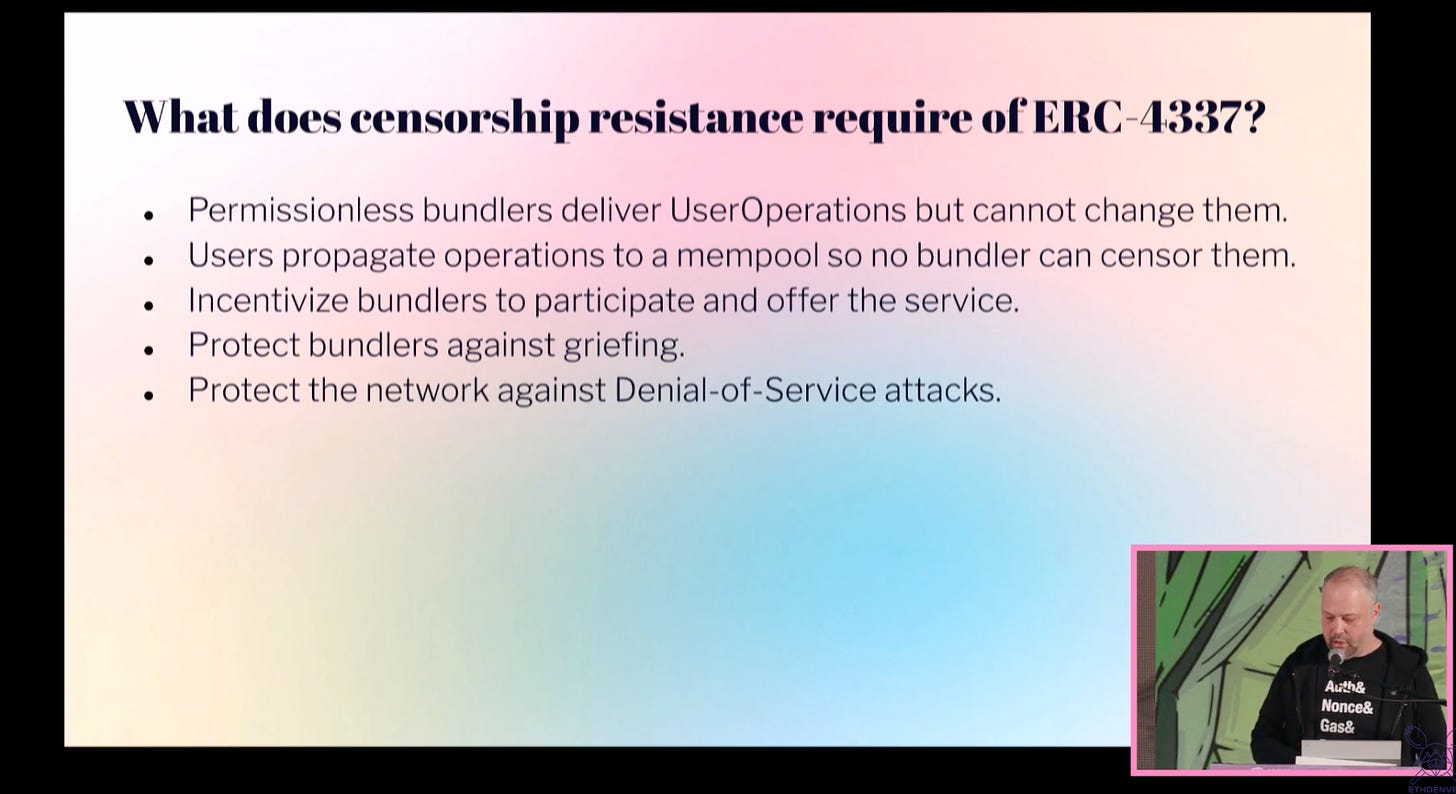
ERC-4377 aims to achieve account abstraction, making smart contract accounts more user-friendly while preserving blockchain decentralization. Validating smart contract transactions consumes computational resources. Without limits, malicious actors could flood the network with invalid transactions, causing congestion and performance degradation. To prevent this, ERC-4377 imposes constraints on validation workloads, ensuring acceptable resource usage per transaction. Under ERC-4377, transactions are structured into two phases: validation and execution. During validation, only minimal computation is allowed, mitigating DoS risks and network abuse. Once validated, transactions propagate across nodes for execution, where the actual logic of the smart contract is carried out.
Core Devs Are Ethereum’s Scarcest Resource
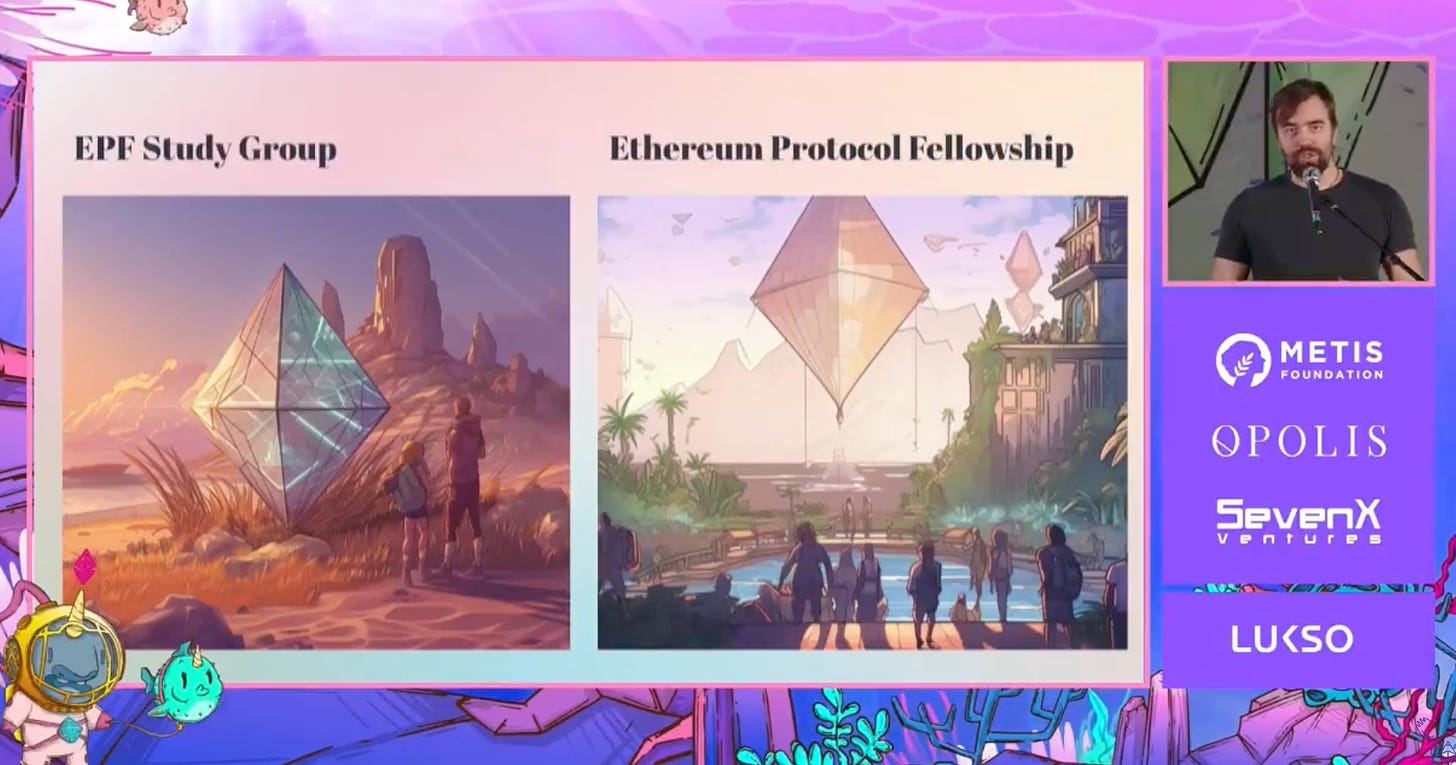
Ethereum Foundation member Josh Davis emphasized the importance of Ethereum core developers in protocol evolution. They maintain execution and consensus layer clients, implement EIPs (Ethereum Improvement Proposals), conduct testing, and drive research—key contributors to Ethereum’s ongoing advancement. He introduced two initiatives supporting and nurturing core developers: the Ethereum Protocol Fellowship and the Fellowship Study Group.
-
Ethereum Protocol Fellowship: Designed to simplify the path to becoming a core developer, researcher, or contributor, offering mentorship and enabling broader participation. Participants work like core developers, choosing their own projects and writing technical updates. Coordination happens via GitHub and Discord, with twice-weekly meetings for progress reports and Q&A sessions.
-
Fellowship Study Group: A precursor to the Fellowship, running for 10 weeks with current core developers or researchers teaching one to two 90-minute sessions weekly. It includes an onboarding phase, learning and project selection phase, and project execution. Open and free to join, participants can attend lectures, engage in Discord discussions, and collaboratively build knowledge around core protocol development.
Business of Block Space Pt. 2: Mevconomics
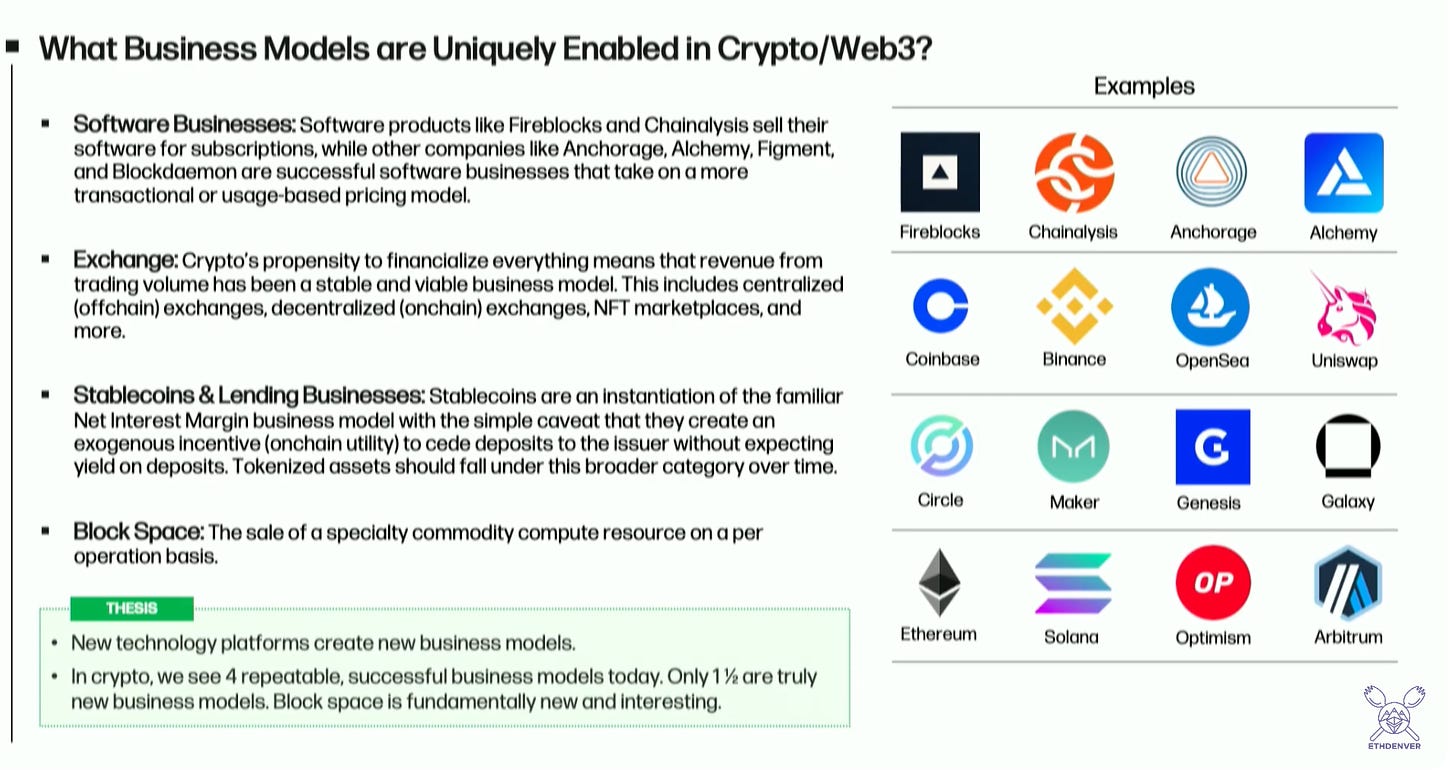
Will Nuelle, Investment Lead at Galaxy Digital, noted that block space cost depends on transaction complexity and network congestion. There are significant differences in the amount of block space sold across blockchains, influenced by the strength of network effects. Major blockchains like Ethereum sell millions of dollars worth of block space daily, while others sell much less.
Block space as a business model exhibits the following characteristics:
-
High Net Profit Margin: Block space sales generate substantial net income because direct revenue scales with volume and incurs no indirect costs. Most revenue translates directly into profit, making block space a highly lucrative business model.
-
Network Effects: The value of block space benefits from network effects. As more users, app developers, and liquidity enter the ecosystem, its value and demand grow. This strengthens block space sales and unlocks further profit opportunities.
-
Significant Profit Potential: With advancing blockchain technology and expanding use cases, block space holds vast profit potential. As markets evolve and expand, so too will demand and value for block space, creating new opportunities and profit margins for participants.
Public Goods Funding: The New Meta
Gitcoin founder Kevin Owocki pointed out that different eras in crypto have featured distinct strategies and trends. For example, Initial Coin Offerings (ICOs) were once the dominant fundraising method, but over time, their effectiveness waned. Public goods funding has now emerged as the next major "meta-strategy" in crypto, capable of supporting and driving ecosystem development across various stages.
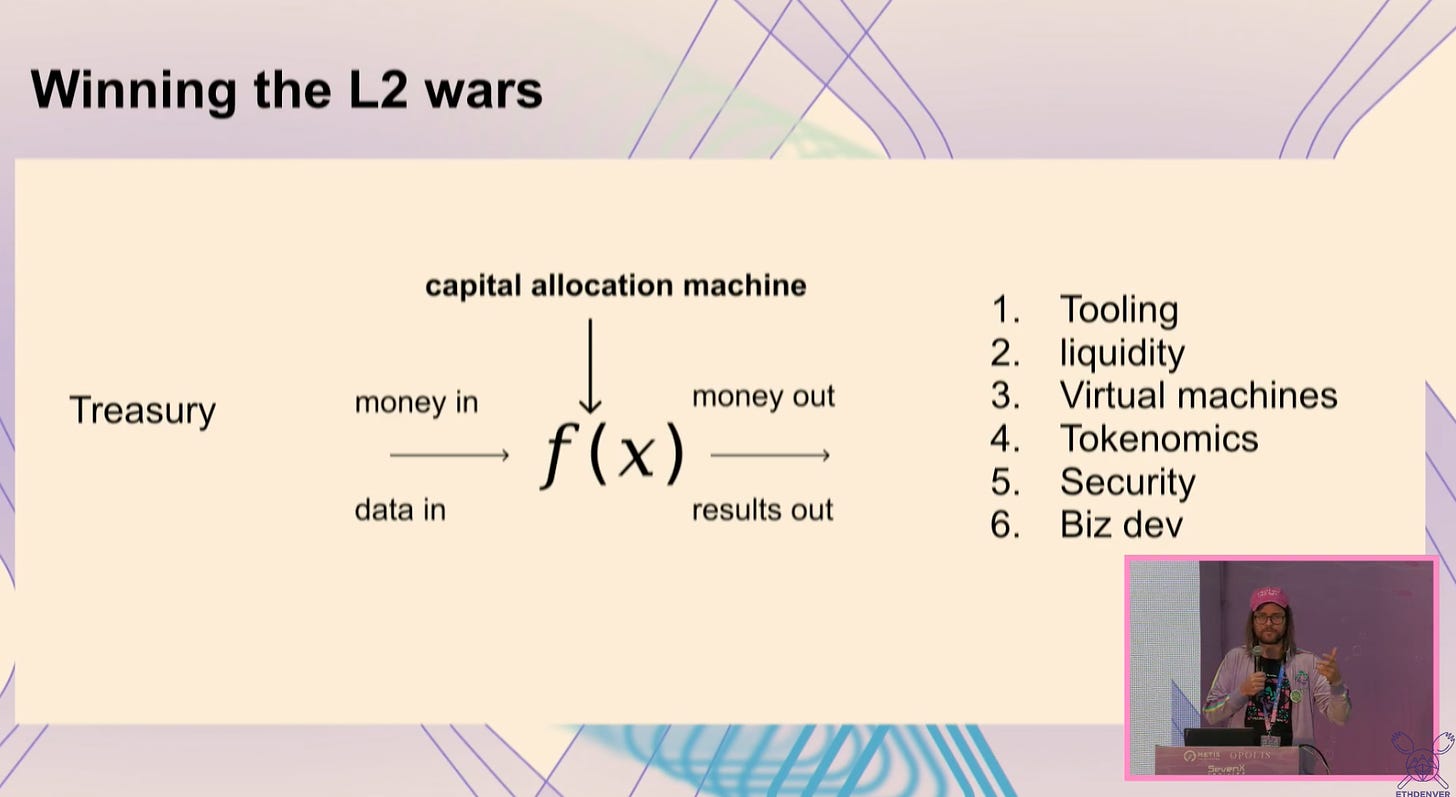
Public goods funding is crucial for Layer 2 ecosystem competitiveness, including tools, liquidity, virtual machines, tokenomics, and security. He believes it is key to advancing these areas. Gitcoin primarily supports ecosystem growth through diverse funding allocation mechanisms. Among them, Allo Protocol is a funding distribution protocol designed to support multiple funding strategies. Its core function is to absorb data and capital, then allocate funds to ecosystem projects, thereby fostering ecosystem development. It supports various funding models, allowing projects to choose the most suitable approach based on their needs and goals.
Scaling RPGF With Retro Public Goods Organizations
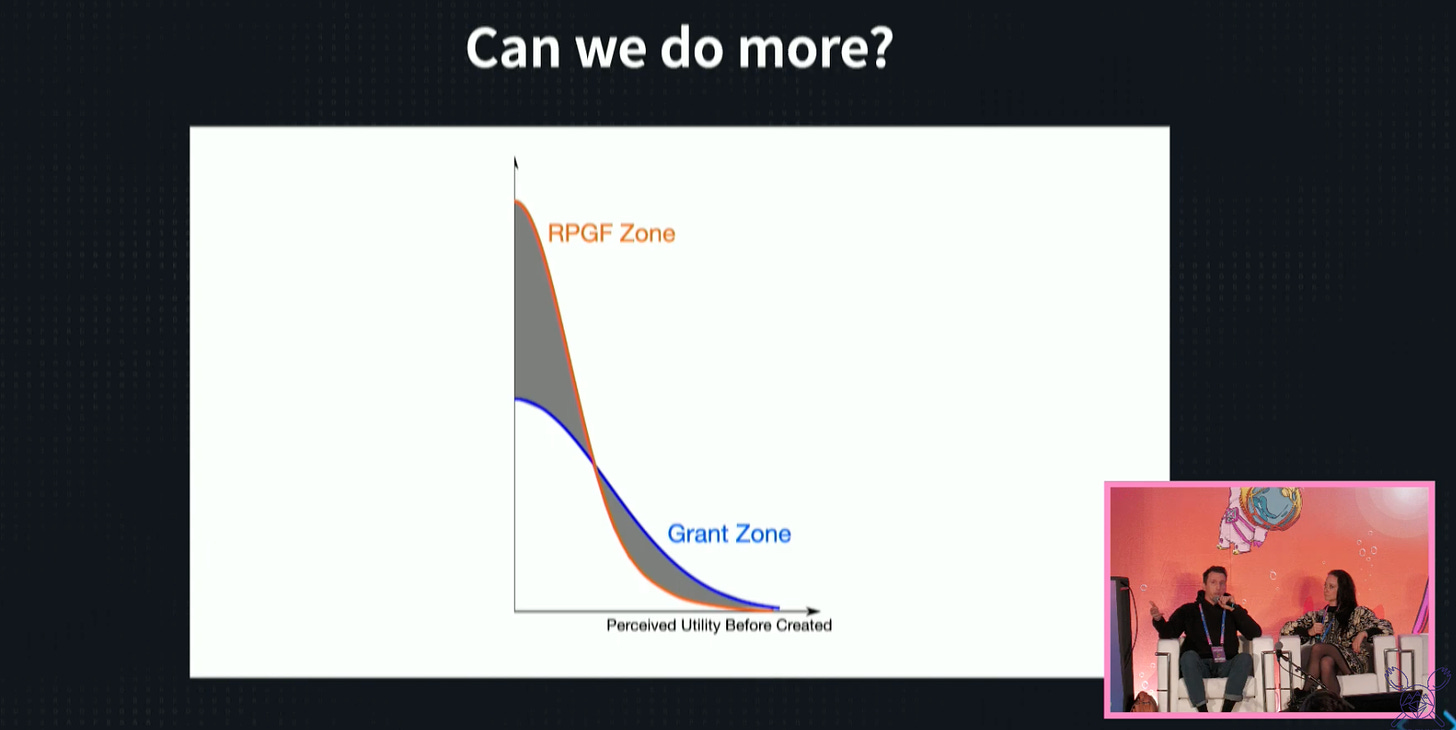
Gitcoin co-founder Scott M and Optimism Foundation member Justine H discussed how retroactive public goods often only reveal their true value after completion. Thus, it's difficult to accurately assess their potential at inception. Due to this uncertainty, investors may hesitate to fund such projects early. Retroactive Public Goods Funding (RPGF) addresses this by funding projects post-completion, based on their actual community impact rather than speculative assumptions.
They also proposed a novel mechanism design combining upfront funding with retroactive funding:
-
Introduce Upfront Funding: Provide early-stage financial support to help projects launch and develop. This funding can come from foundations like Gitcoin or even venture capital sources.
-
Retroactive Public Goods Funding: After project completion, supplement funding based on demonstrated value and real-world impact, reducing early-stage uncertainty.
-
Establish Credible Commitment: Projects can opt to become "retro profit organizations," committing not to pursue traditional profits but instead to maximize public value. This commitment enhances trust and credibility among investors and funders.
Scaling the Community: We're Gonna Need a Bigger Tent | Kent Barton - Ethereum Denver
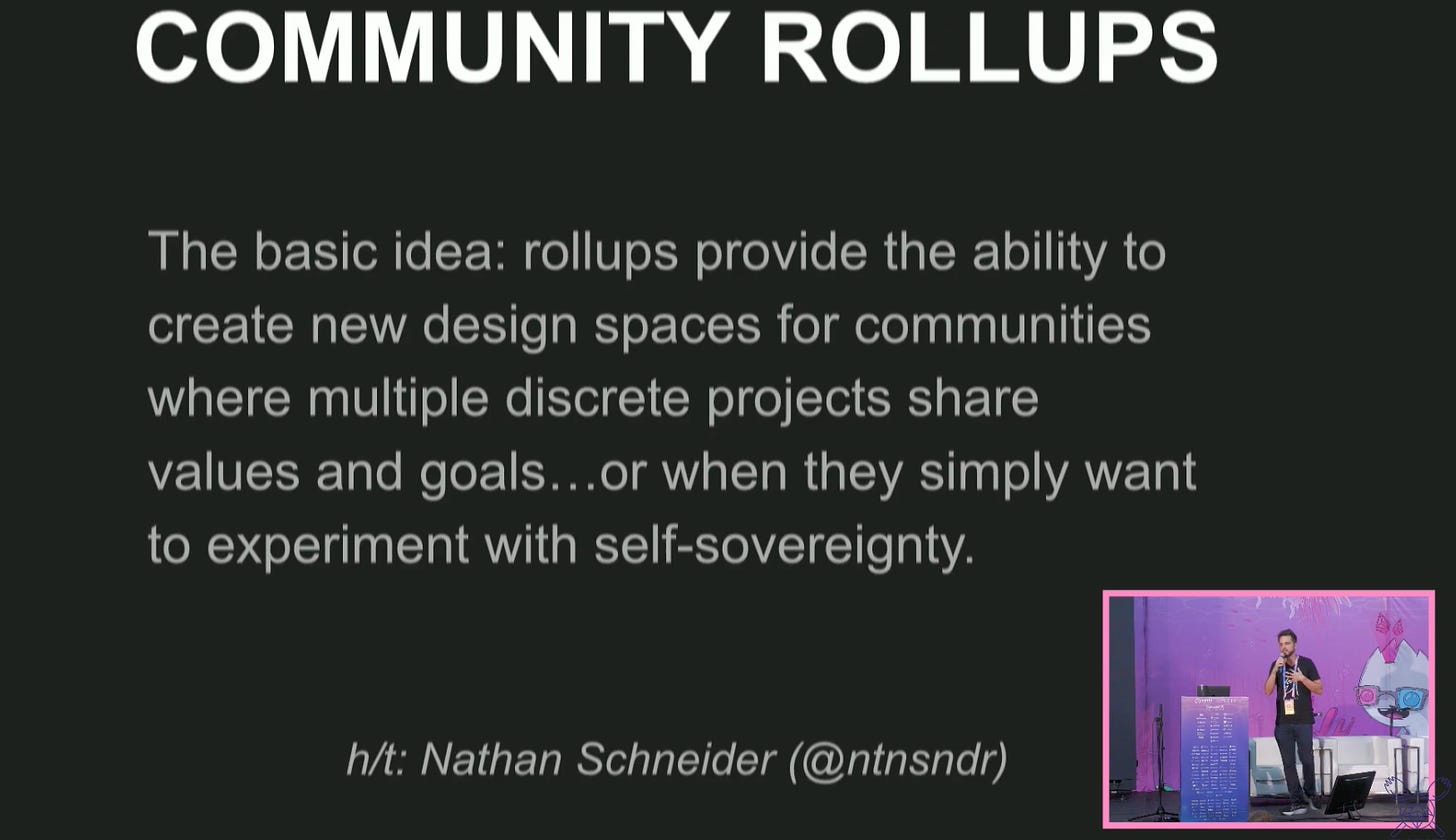
Kent Barton, founder of the Ethereum Denver community, believes communities are the core force behind building and promoting decentralized technologies and ideas—key drivers of innovation and progress. He introduced a design space for community-centric rollups.
A community rollup is a community ecosystem built using rollup technology, where multiple projects or organizations share the same rollup chain. This allows different projects to benefit from shared security and scalability, reducing development and operational costs while enhancing interoperability and composability. To ensure the sustainability and security of community rollups, Kent Barton proposed several funding and maintenance mechanisms:
1) Membership subscriptions: Community members pay fees to support the rollup’s security and operations;
2) Donations: Members voluntarily contribute funds;
3) Transaction fees: The community rollup generates revenue by processing transactions, which covers operational and security expenses.
Join TechFlow official community to stay tuned
Telegram:https://t.me/TechFlowDaily
X (Twitter):https://x.com/TechFlowPost
X (Twitter) EN:https://x.com/BlockFlow_News
 @ChainFeedsxyz











