Get stoned, does the surge in Runestone signify the beginning of the Rune era?
TechFlow Selected TechFlow Selected
Get stoned, does the surge in Runestone signify the beginning of the Rune era?
"Fairness" + "Airdrop" + "Rune"
 Navigating Web3 tides with focused insights
By HAMSTER
Runestone is currently the largest Ordinals airdrop event, with a floor price of 0.04177 BTC on the OKX NFT marketplace. What exactly is Runestone? And what features of the underlying Runes protocol have triggered such intense market FOMO?
What is Runestone?
Inspired by RSIC, Leonidas—the OG of Ordinals and founder of Ord.io—launched Runestone to celebrate the debut of Ordinals technology. By airdropping to over 112,383 Bitcoin addresses, it became one of the largest Bitcoin Ordinals airdrops to date. Leonidas emphasized that while Runestone as a project does not aim for any practical application or functionality, its cultural and commemorative value has drawn significant attention within the crypto community.
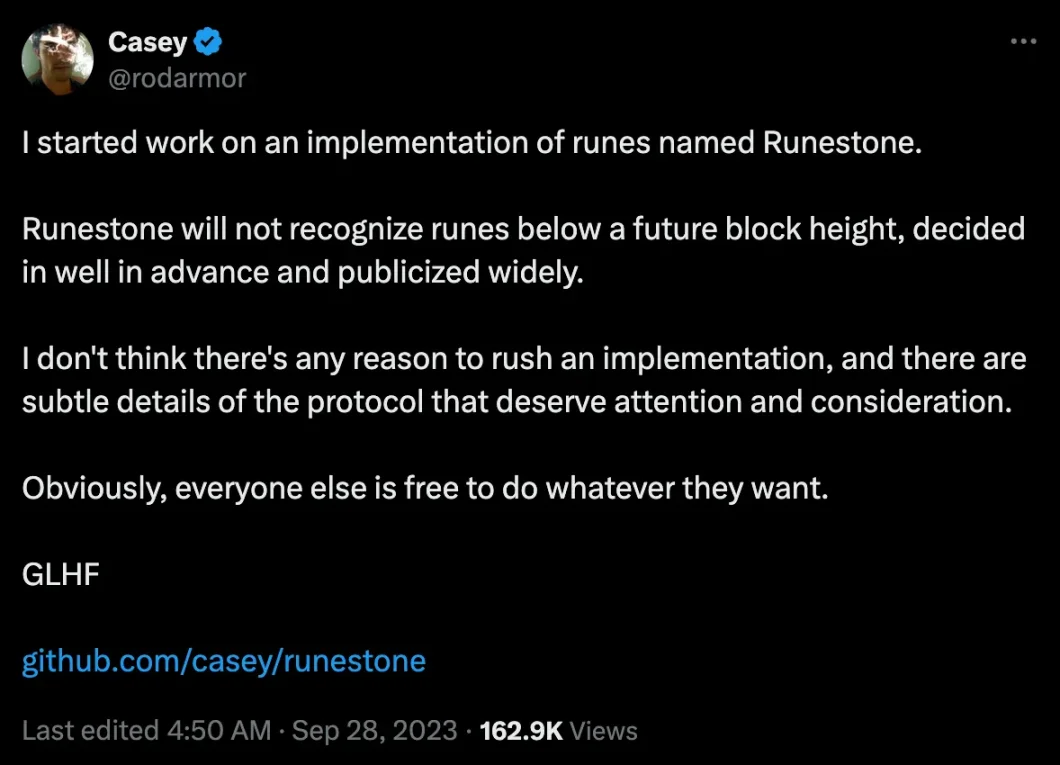
The Runestone project is built on the Ordinals protocol and was designed as a pre-Runes initiative. This means that once Casey Rodarmor’s Runes protocol launches, participants in the Runestone airdrop will be able to convert their Runestones into Runes tokens. This conversion is expected to occur within eight weeks after the Runes protocol goes live. When Leonidas first proposed the idea of this airdrop, Casey commented beneath the tweet discussing ways to reduce gas costs—an interaction interpreted by the community as soft support. The name "Runestone" itself originates from a tweet by Casey, the founder of Ordinals, who mentioned developing a feature called Runestone under the upcoming Runes protocol. This subtle connection has significantly amplified Runestone's meme appeal.
Although Runestone currently lacks direct utility, its broad distribution and strong community culture have captured widespread interest. It not only signals innovation in digital assets and NFTs on the Bitcoin network but also offers a fresh perspective on cultural and community development within the crypto space.
Another key milestone for the Runestone project was mining the largest block ever recorded on the Bitcoin blockchain. Thanks to collaborations with Marathon Digital and Ordinals Bot, this 3.97 MB block demonstrated both technical capability and deep exploration of Ordinals technology. Furthermore, Runestone auctioned off this historic block, which sold for a record-breaking 8 BTC. All proceeds were used to cover network fees associated with the airdrop—an approach that not only supported the Bitcoin ecosystem but also highlighted Runestone’s commitment to giving back to the community.
Beyond the narrative of “fairness,” “airdrop,” and “runes,” much of Runestone’s FOMO in the secondary market stems from its rare alignment across both Western and Chinese crypto communities. Unlike previous BRC-20 trends, which were largely driven by Mandarin-speaking users, Runestone enjoys broader global consensus. Some even believe Runestone could become the biggest MEME of this bull cycle.
In summary, the Runestone project showcases not only the innovative potential of Ordinals technology and market anticipation for the Runes protocol but also explores new forms of crypto assets as collectibles and cultural symbols. Whether the successful airdrop and frenzied trading in secondary markets signal the official beginning of the Runes era remains an important topic to watch.
What is Runes?
Now that we’ve covered Runestone, let’s dive deeper into the Runes protocol.
Created by Casey Rodarmor, the founder of Ordinals, the Runes protocol introduces a new type of asset—“runes”—on the Bitcoin network. Positioned as an improved version of BRC-20, Runes aims to resolve inefficiencies and operational complexities caused by reliance on inscriptions, offering a cleaner and more efficient framework for issuing and managing Bitcoin-based assets.
First, the Runes protocol excels in compatibility and scalability, seamlessly integrating with Bitcoin’s UTXO model and second-layer protocols like the Lightning Network and CKB. Compared to other fungible token protocols such as BRC-20, Runes significantly improves operational efficiency and user experience through simplified transactions and direct binding of token balances to UTXOs.
Runes supports Simple Payment Verification (SPV) wallets, enabling lightweight transaction experiences—a feature not achievable with traditional BRC-20. Additionally, by providing reference implementations and emphasizing compatibility with existing Bitcoin scripts and address types, Runes offers developers a more accessible and friendly environment for integration.
Second, Runes provides greater flexibility in token issuance, allowing token names between 1 and 28 characters long and introducing various innovative issuance mechanisms—including fixed-supply issuance and public inscription issuance—with possibilities for even more expressive models. Fixed-supply issuance is more centralized, where the issuer mints all runes upfront and distributes them; public inscription issuance sets specific parameters such as block height or timestamp, with the final total supply determined by how many runes users inscribe within a given timeframe. These approaches not only enrich token design possibilities within the Bitcoin ecosystem but also enhance security, effectively mitigating common risks.
In terms of UTXO management, Runes uses OP_RETURN scripts to avoid the complexity and security risks associated with witness data in transactions, minimizing unnecessary UTXO creation and thereby improving overall network health and efficiency.
The core philosophy of the Runes protocol is minimizing on-chain footprint and encouraging optimized UTXO usage, ensuring seamless integration with Bitcoin’s foundational architecture. By handling fungible tokens on the Bitcoin blockchain in a simpler and more intuitive way, Runes aims to drive innovation and growth across the Bitcoin ecosystem.
With Bitcoin approaching its next halving event, the Runes protocol is set to officially launch around block height 840,000. The exact timing depends on block mining speed, but based on current rates, deployment is anticipated in late April 2024. This moment marks the formal entry of Runes into the Bitcoin ecosystem, opening a new chapter for fungible token issuance and management on the Bitcoin network.
Notably, ahead of launch, protocols such as Merlin have announced full support for Runestone and the Runes protocol—including cross-chain bridges, DEXs, indexers, minting services, and additional incentives. This comprehensive backing reflects the BTC community’s recognition of Runes’ potential and underscores the broader crypto community’s shared pursuit of innovation and progress.
Despite being in its early stages, the extensive attention and discussion generated by Runes within the crypto community already demonstrate its innovativeness and practical value. Through a streamlined UTXO model and efficient token transfer mechanism, the Runes protocol brings renewed vitality to the Bitcoin network and opens new avenues for diversification and technological advancement in the Bitcoin ecosystem.
Join TechFlow official community to stay tuned
Telegram:https://t.me/TechFlowDaily
X (Twitter):https://x.com/TechFlowPost
X (Twitter) EN:https://x.com/BlockFlow_News
 @ChainFeedsxyz