









The Redemption Path of "Web3": Let Assets Belong to Assets, Platforms to Platforms
TechFlow Selected TechFlow Selected
The Redemption Path of "Web3": Let Assets Belong to Assets, Platforms to Platforms
Storing content in decentralized storage is the first step toward independence from platforms.
 Navigating Web3 tides with focused insights
Author: YUUU
Recent market trends have led many people to believe that being a successful casino is all crypto needs—launching Memes and running Ponzi schemes are now seen as the only viable paths forward, while earlier visions like Web3 seem increasingly unattainable. Indeed, crypto is well-suited for casino-like activities and demand remains strong—this is undeniable. However, this doesn't mean the ideals of Web3 are impractical; in fact, they're becoming clearer than ever. Past attempts in areas like Web3 Social and content platforms took many wrong turns, with projects trying to build entirely new systems to replace Web2. But blockchain changes the underlying infrastructure, not the surface-level product design—replacing Web2 by building parallel ecosystems from scratch is nearly impossible. So what's the viable path forward? Simply put: let assets belong to assets, and platforms to platforms—integrate blockchain-based assetization into existing centralized platforms, transforming their mechanics and business models. How can we achieve this? Let’s dive deeper below.
Starting with Rental Housing
To better explain and understand this shift, let’s look at an analogous example from another domain—the rental housing market. The current rental market suffers from serious problems, chief among them being the monopolization of housing listings by intermediaries (agents). These agents manipulate the market by profiting from information asymmetry while providing rental services. As a result, rents keep rising, and tenants find the process increasingly exhausting and frustrating. This has led some to propose an alternative—already being piloted by certain local governments—an officially operated public housing listing platform where all rental information must be published, often with government-guided pricing. Such a platform wouldn’t eliminate agents altogether. For instance, landlords may still prefer to delegate document submissions, property management, and showing units to agents; tenants lacking experience might rely on agents to help filter suitable options. In this model, agents become service providers earning labor fees rather than gatekeepers profiting from information control. The role of the public platform is to separate housing data from intermediaries, making listings independent.
Parallels in Digital Content and Data
First, it's important to clarify that "content" here refers broadly to social media posts and social graphs, blog articles, YouTube videos, digital art, music, photo books, digital copyrights, video games, and more. Drawing parallels to the rental market, today’s internet platforms function much like real estate agents—they monopolize the entire pipeline from digital content creation to distribution and consumption. This differs significantly from pre-internet or non-digital domains. For example, publishing a book involves authors writing independently (on paper or digitally), partnering with publishers for production, distributing through bookstores, and readers consuming privately at home—each stage handled by separate entities. In contrast, online platforms consolidate everything: creation, distribution, and consumption happen within a single ecosystem. Social media platforms, for instance, create bilateral markets between creators and audiences, leading to a snowball effect—more content attracts more users, which in turn attracts more creators—ultimately resulting in unavoidable platform monopolies. This creates numerous issues: users complain endlessly but remain trapped due to lack of alternatives.
That said, the blame shouldn’t fall solely on platforms. Previous platforms couldn’t escape this model—not because they didn’t want to, but because they couldn’t. Unlike physical works, digital content lacks inherent carriers—it requires external ones for access and dissemination. This includes devices (computers, phones), storage (local drives or cloud servers), and networks (websites, P2P). Crucially, the digital world needs identities to identify creators—a function historically fulfilled only by platform-specific accounts. All these factors created ideal conditions for today’s platform-centric model: creators need places to assert ownership and distribute content easily; consumers need convenient ways to discover and consume. Thus, when creators choose a platform to publish, they’re locked into that ecosystem, and consumers must follow—leading naturally (and necessarily) to full-process monopolization within a single platform.
A key point here is that under current mechanisms, if creators wish to distribute work and protect their rights, they must publish directly on platforms—tying content inseparably to the platform itself—because platforms are needed for both content authentication and distribution. Now, returning to our rental analogy: if content could become independent—like housing listings freed from agent control—and no longer rely on specific platforms for verification and discovery—then the platform monopoly would naturally break down.
Therefore, similar to housing, content also needs an independent publishing channel. However, there’s a difference: housing data was decoupled via government regulation, whereas content cannot follow the same route. So how can we achieve independence for content today?

How Can Content Independence Be Achieved?
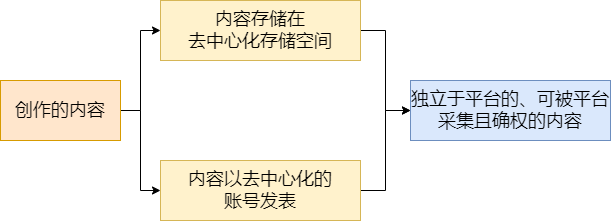
From the above, we see that content dependence on platforms stems mainly from three aspects: (1) relying on platform account systems for attribution and creator identity; (2) storing content on platform servers; and (3) depending on platform traffic for distribution. True content independence means detaching the first two from platforms, leaving only the third—distribution—to be handled by platforms.
Content Storage
In current Web2 platforms, content resides on centralized servers—this is the root limitation. A decentralized storage solution is therefore required. Today’s most common options include IPFS/Filecoin and Arweave. Take Mirror, a decentralized content publishing protocol, which uses Arweave—a decentralized network enabling “pay once, store forever.” Storing content on decentralized networks is the first step toward breaking ties with platforms.
Account System
Decentralized storage alone isn’t enough. If the publishing account system remains tied to centralized platforms, true independence isn’t achieved. Centralized accounts are closed ecosystems—other platforms can’t directly link back to creators. Instead, a platform-agnostic, decentralized identity is needed. The best candidate today is blockchain addresses (most commonly Ethereum wallet addresses). By binding decentralized content to blockchain addresses—and optionally minting NFTs whose metadata points to the stored content—we establish verifiable ownership. Because the identity is decentralized, any platform reading the content can also retrieve author information, enabling direct interactions like comments and tips.
Additional Benefits of Independent Content
Beyond breaking platform monopolies, independent content offers other advantages. Two stand out:
First, content becomes more durable—no longer vanishing when a centralized platform shuts down. While decentralized storage (e.g., Arweave) is still maturing—its promise of permanent storage remains to be fully proven over time—its long-term reliability will likely surpass that of centralized platforms.
Second, plagiarism and unauthorized redistribution can be reduced—not just through blockchain-based proof of ownership, though that helps. Currently, platforms often ignore or even benefit from stolen content because it drives traffic. In an independent content model, platforms can freely index open, permissionless content without needing to copy anything, reducing incentives for theft. Combined with on-chain provenance, enforcement becomes easier—potentially creating a healthier ecosystem overall.
Building Service-Oriented Platforms
What Is a Service-Oriented Platform?
With content published independently, platforms must similarly “downgrade” like rental agents did—evolving from full-stack monopolists into value-added service providers. They offer reading, subscription, and engagement features, competing on user experience rather than content control. These resemble physical stores: bookshops don’t write or publish books—they just sell them; game stores don’t develop games or manage accounts—they sell discs.
But a natural question arises: how can such platforms survive financially? Most current platforms profit from monopolizing content and creators, monetizing traffic. Without exclusive control, monetization becomes harder. Here lies a crucial difference from brick-and-mortar stores: platforms can introduce a novel service—data assetization.
Data Assetization as Value-Added Service
This concept may sound abstract, but there’s already a Web2 precedent: the fitness app Keep. Despite dominating China’s fitness app space, Keep struggled with monetization—ads, courses, merchandise yielded limited returns—until it discovered a breakthrough: selling medals. Introduced in 2015 with virtual marathons, users who completed marathon distances in-app could earn digital and physical medals (the latter paid). Over time, Keep rolled out themed medals that unexpectedly went viral on social media, sparking widespread sharing and strengthening its social appeal. By February 2023, rumors claimed medal sales reached ¥500 million. Keep denied the figure, but acknowledged substantial revenue.
Keep succeeded because years of operation built brand credibility—users trust its data validation. On the surface, Keep sells medals; in reality, it sells data certification—the medal is merely a tangible representation. This aligns perfectly with Web3 principles and points toward a new direction for platform operations. It’s widely recognized that user data holds immense value—enabling better recommendations, targeted ads, etc.—so data itself can be assetized. Individual data points may have low value, but aggregated insights (e.g., reader demographics, sentiment analysis) become powerful. One monetization path: platforms package such data into standardized assets. Using a universal data schema, creators could purchase audience analytics for their content—similar to buying a Keep medal—and resell them to advertisers or other platforms.
The logic is clear: creators pay for data only if it increases their earnings. That happens when third parties recognize the data’s validity—which depends on the platform having a large, trusted user base. This incentivizes platforms to focus on superior UX, grow their communities, and build reputations—aligning platform and user interests. Revenue grows without heavily exploiting users.
Moreover, assetizable data isn’t limited to economically valuable metrics. Like Keep’s run stats—used for bragging and social signaling—many data types gain value through visibility and usage. As long as data has expressive or functional utility, platforms can tokenize it and allow users to own and trade their personal data assets.
Let Assets Belong to Assets, Platforms to Platforms
Earlier, we discussed platforms issuing assets—but doing so requires an underlying asset protocol to ensure cross-platform compatibility. Blockchain excels at precisely this: managing issuance and provenance. “Let assets belong to assets” means leveraging blockchain for secure, standardized asset creation.
Some Web3 social projects attempt to move every interaction—likes, comments—on-chain. While possible, individual actions rarely justify the cost of on-chain transactions. A more practical early-stage approach: keep non-asset interactions (follows, reactions) on centralized platforms, then assetize them only when they accumulate meaningful value. Newly created data assets can also inspire native crypto use cases, generating fresh narratives and opportunities.
For platforms, this blends Web2 efficiency with Web3 innovation. Traditional centralized publishing continues, but independent content is also supported. Once centralized content generates value, it can be assetized—opening new revenue streams and enabling organic integration between Web2 and Web3.
What Are the Challenges?
All this sounds promising, but implementation faces two major hurdles:
First, missing infrastructure—particularly around displaying cryptographic assets. Twitter once allowed users to set NFT profile pictures verified via wallet signatures, showing ownership details upon click. Though discontinued, it illustrated the potential. Without such tools, socially valuable data assets lose visibility—they can’t be shown off.
Second—and most critical—existing platforms lack incentive to transform. Large incumbents especially benefit from monopolistic profits; change brings them no advantage.
Overcoming the Challenges
Are there solutions to these obstacles? Here are some preliminary thoughts.
On infrastructure: a vicious cycle exists. Few people hold crypto assets, high-value NFTs are rare, so big platforms see little reason to support display features. Without visibility, NFTs can’t develop social value, further limiting adoption. Breaking this loop may require one thing: bringing more people into crypto. Recent trends—meme coins, speculative schemes—are doing exactly that. As more users engage with FTs and NFTs, demand for showcasing assets will grow, eventually pressuring major platforms to integrate support. That said, I must criticize: industry leaders should drive this progress, yet they’ve failed—not just in bridging to Web2, but even within crypto. Despite countless “on-chain reputation NFTs” and “behavioral data NFTs,” KOLs still share investment results via screenshots, breeding legions of fake “eternal profit bloggers.” If we can’t fix basics internally, expansion is hopeless.
As for platform transformation, the entry point may lie with mid-sized or niche platforms. These have decent content and user bases—sometimes high quality—but operate at a structural disadvantage under current models, struggling to monetize. Under pressure, they may be more willing to experiment with new paradigms and business models.
Conclusion
By combining decentralized storage and decentralized identities, creators can detach digital content from platforms, ending monopolistic control. Platforms evolve into service layers offering enhanced experiences, monetizing through data assetization—fueling new Crypto Native applications. Of course, this framework isn’t mature: supporting technologies need time to prove themselves, and the service-platform business model requires further exploration. Most importantly, this transition demands effort from industry leaders—who too often focus on hype and fundraising—to actively promote adoption. For smaller players in the space, even building effective “casinos” that expand the user base contributes meaningfully to this evolution.
Join TechFlow official community to stay tuned
Telegram:https://t.me/TechFlowDaily
X (Twitter):https://x.com/TechFlowPost
X (Twitter) EN:https://x.com/BlockFlow_News
 @Web3_Yuuu











