








February Public Chain Industry Report: DeFi Takes Off, Bitcoin Layer2 Emerges
TechFlow Selected TechFlow Selected
February Public Chain Industry Report: DeFi Takes Off, Bitcoin Layer2 Emerges
Sectors such as AI, DePin, Web3 gaming, and Memes show clear rotation trends, especially the DeFi sector.
 Navigating Web3 tides with focused insights
Author: [email protected]
In February, the cryptocurrency market demonstrated strong upward momentum, primarily driven by Bitcoin and Ethereum increasing in value by over 45%. This optimistic trend also affected other tokens, with the top ten cryptocurrencies all achieving growth exceeding 25%.
Significant progress was made in blockchain data storage, while multiple sub-sectors within the blockchain space—including AI, DePIN, Web3 gaming, and Meme coins—exhibited clear rotation trends. Notably, the DeFi sector saw a resurgence led by projects such as Uniswap and EigenLayer driving industry innovation.
Additionally, Layer 2 solutions for Ethereum, including Blast and Starknet, along with the Bitcoin Layer 2 ecosystem led by Merlin Chain, achieved notable breakthroughs.
Cryptocurrency Market Overview
The significant rise in the cryptocurrency market in February stemmed from multiple converging factors. U.S. spot Bitcoin ETFs attracted inflows of up to $6 billion during the month, underscoring investor confidence in cryptocurrencies as a reliable store of value. Additionally, market anticipation surrounding Ethereum's upcoming Cancun upgrade in March and the Bitcoin halving event in April further fueled price increases. These combined forces provided robust support for the market’s upward trajectory.
However, broader macroeconomic dynamics such as inflation concerns and Federal Reserve policy could pose challenges to sustained growth. Rising inflation rates in February suggest that anticipated interest rate cuts in the U.S. may be delayed until later this year or beyond, introducing uncertainty into the continued expansion of the crypto market.
Public Blockchain Overview
As February concluded, the total market capitalization of public blockchain cryptocurrencies surged to $1.9 trillion—an increase of 42% compared to January. Leading this surge were Bitcoin, Ethereum, BNB Chain, and Solana, which held market shares of 64.0%, 21.4%, 3.3%, and 3.0%, respectively.
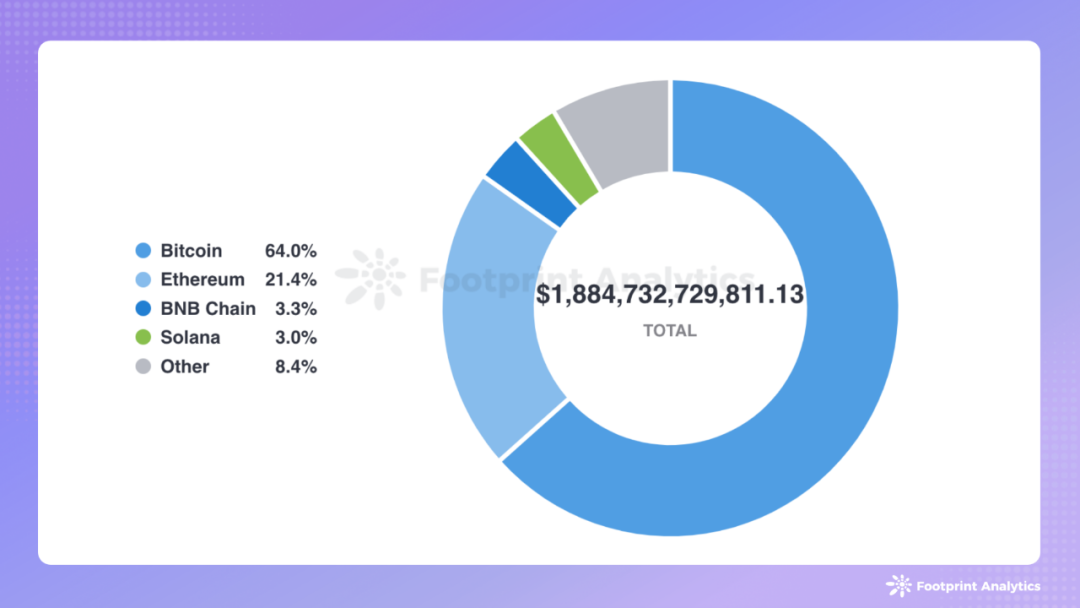
Data source: Public chain token market cap share - Footprint Analytics
Both Bitcoin and Ethereum showed substantial growth. Bitcoin surged strongly, gaining 46.5%, closing the month at $62,404—breaking the $60,000 mark for the first time since Q4 2021 and only 9% below its all-time high. Ethereum performed even better, slightly outperforming Bitcoin with a gain of 48.1%, ending the month at $3,383.
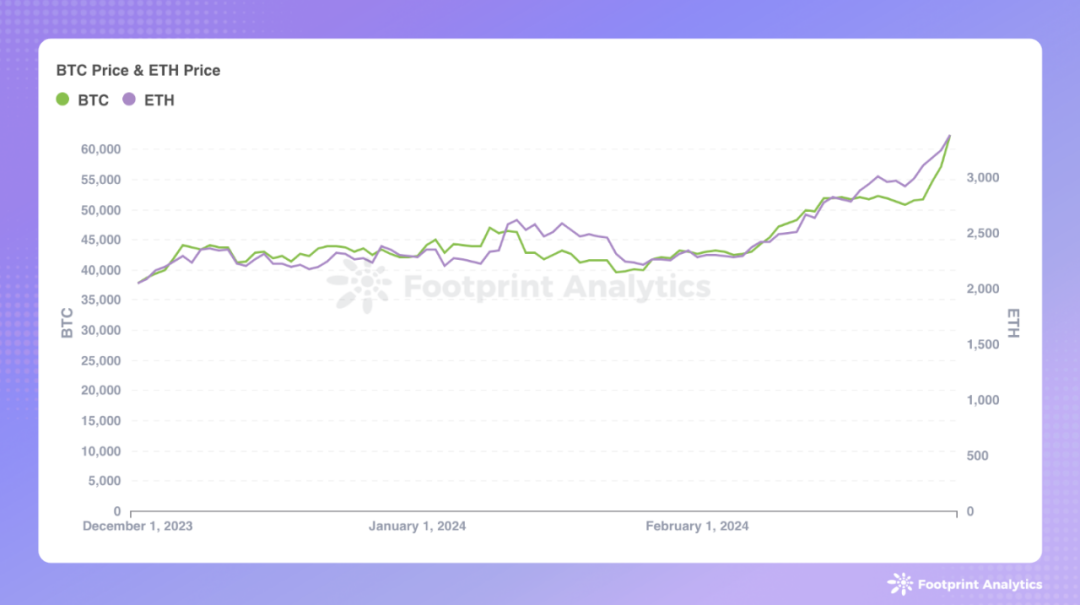
Data source: Bitcoin and Ethereum prices - Footprint Analytics
Fueled by gains exceeding 45% in Bitcoin and Ethereum, other tokens also exhibited strong performance. The average value increase among the top ten tokens exceeded 25%. Arweave (AR) stood out particularly, surging 205.8%, while Stacks (STX) and Filecoin (FIL) rose 88.3% and 57.1%, respectively.
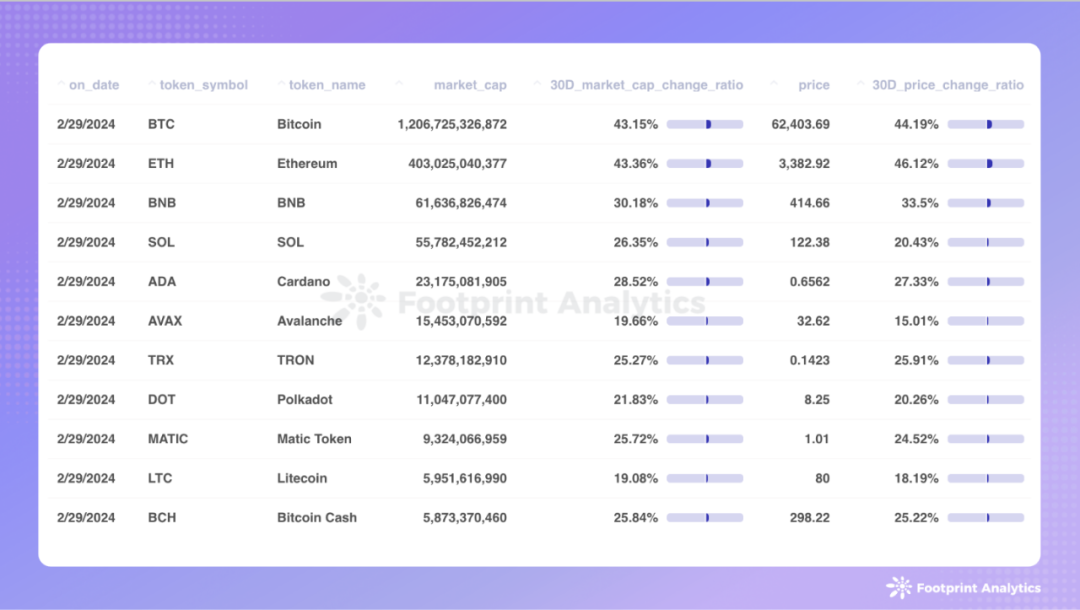
Data source: Public chain token market cap and price - Footprint Analytics
Over the past month, the blockchain data storage sector made significant strides. On February 14, distributed data storage solution Arweave officially launched Arweave AO and planned to roll out its testnet by February 27. Arweave AO aims to enhance blockchain scalability through a modular architecture, enabling higher transaction throughput and parallel processing capabilities.
Furthermore, on February 16, decentralized storage network Filecoin announced integration with Solana. This collaboration leverages Filecoin’s infrastructure to improve accessibility to Solana’s historical data.
In terms of TVL, the public blockchain sector reached $97.7 billion by the end of February. Bitcoin’s TVL soared to $2.05 billion, a 600% increase from January. This dramatic rise was largely driven by advancements in Bitcoin Layer 2 technologies and burgeoning staking activities, with the Merlin's Seal project standing out notably.
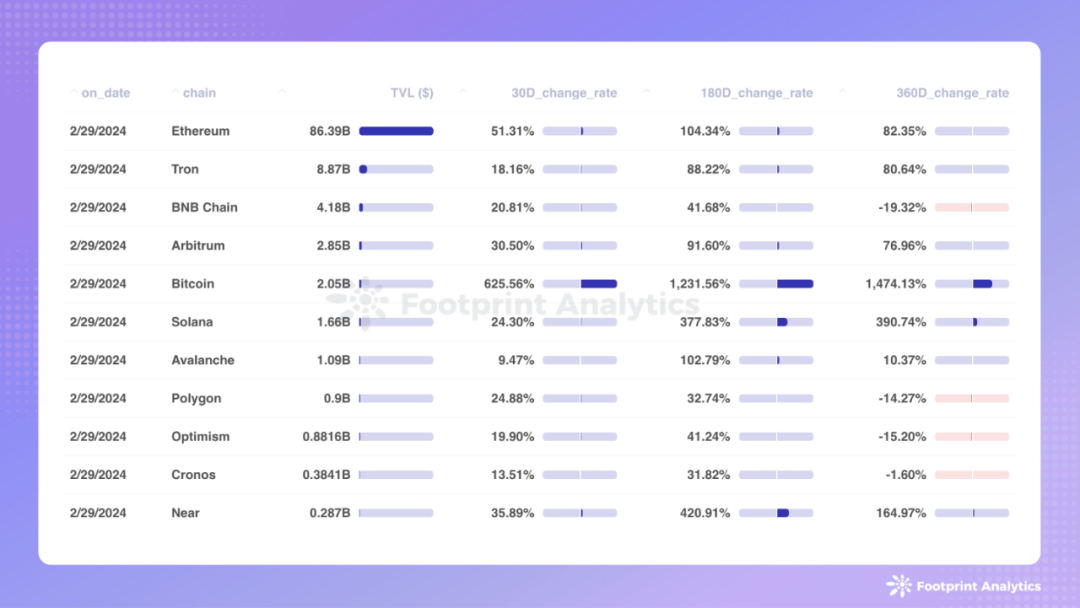
Data source: Public chain TVL - Footprint Analytics
February witnessed strong upward momentum across the blockchain industry, with clear rotation observed among sectors such as AI, DePIN, Web3 gaming, Meme coins, and DeFi. The DeFi sector finally rebounded strongly, with standout performances from projects like Uniswap and EigenLayer.
On February 23, the Uniswap Foundation proposed a fee adjustment mechanism to benefit UNI token holders—a move known as the "fee switch." Despite some controversy, the proposal triggered positive market reactions, boosting the value of the UNI token and revitalizing overall DeFi sector performance.
Additionally, Ethereum-based project EigenLayer gained significant attention due to its restaking functionality and secured a $100 million investment from a16z Crypto. This funding propelled EigenLayer’s TVL above $10 billion, placing it among the top three DeFi projects.
Layer 2
Amid the booming crypto market and growing expectations around a potential Ethereum ETF, Ethereum Layer 2 solutions experienced remarkable TVL growth. Arbitrum and Optimism maintained their leadership positions, with TVL increasing by 31.1% and 22.1%, respectively.
Blast also saw explosive growth, with its TVL skyrocketing 106.4% to $2.8 billion. The platform’s Big Bang dApp competition was highly successful, significantly boosting network activity and prompting several dApps to migrate from other blockchains to Blast. Moreover, Blast confirmed its mainnet launch would go live on March 1.
Starknet launched its Provisions Program—the largest token airdrop in the history of crypto—greatly enhancing network engagement and increasing its TVL by nearly 900%.
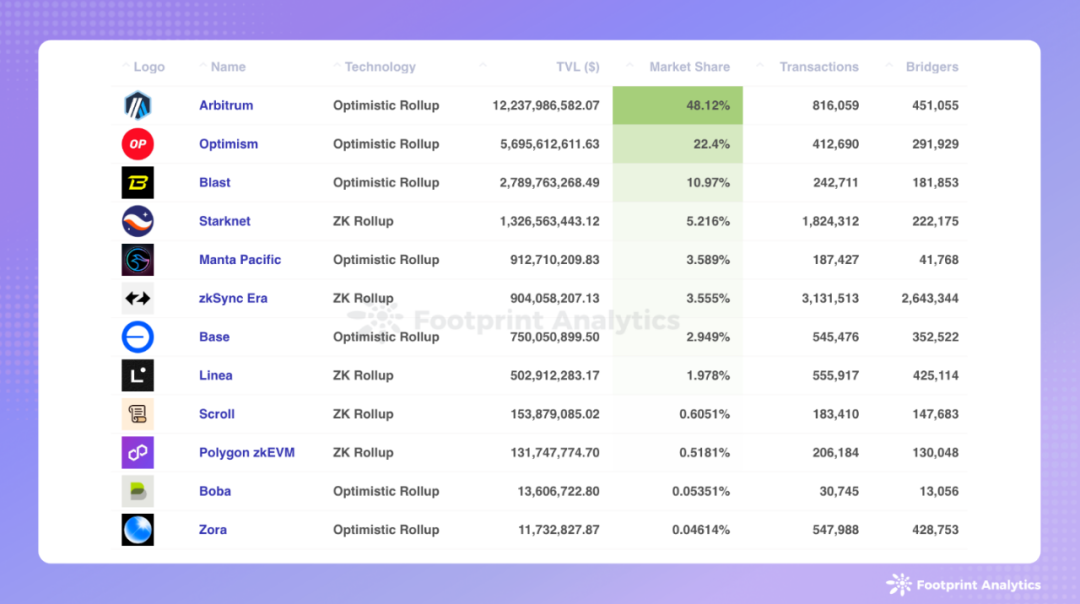
Data source: Ethereum Layer 2 overview - Footprint Analytics
The Bitcoin Layer 2 ecosystem is now impossible to ignore. In February, Merlin Chain’s rapid expansion successfully pushed Bitcoin’s DeFi TVL past the $2 billion threshold. This notable growth was primarily driven by the popularity of Merlin Chain’s fair launch initiative, Merlin's Seal. Meanwhile, Lightning Network, Stacks, and Rootstock are also emerging as key players in the Bitcoin Layer 2 space.
Moreover, a new wave of projects is making major progress within Bitcoin’s Layer 2 domain, emphasizing compatibility with EVM smart contracts. This development trend will greatly expand Bitcoin’s utility beyond just payments. Projects such as Conflux, Bitfinity, and Botanix are leading this transformation, working toward diversifying applications and functionalities on the Bitcoin network.
Blockchain Gaming
February’s gaming leaderboard shows Ronin, BNB Chain, and Polygon excelling in user engagement, capturing 29.1%, 13.4%, and 13.1% of the market share, respectively. In terms of trading volume, Ethereum, BNB Chain, and Ronin ranked at the top, demonstrating strong market performance.
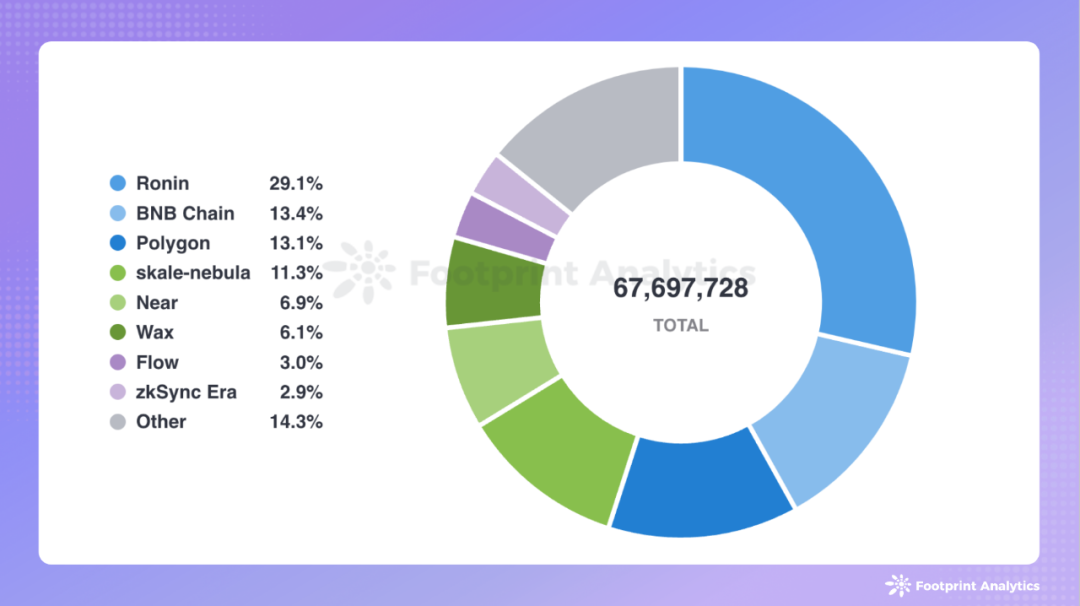
Data source: Public chain active gamer share - Footprint Analytics
Public chains are seizing growth opportunities through deep collaborations with content creators. Facing local regulatory challenges, South Korea’s Web3 game developers are actively shifting focus to global markets to find broader growth potential for their blockchain games.
Oasys stands out as a leader in this trend, offering not only a Layer 1 network but also launching a Layer 2 solution built on Ethereum to provide diversified technical support for game developers. Recently, Oasys announced a strategic partnership with Com2uS, a renowned South Korean game developer, followed by another collaboration with Metabora SG, the Web3 gaming division of Korean internet giant Kakao.
Additionally, expanding ecosystems through mutual growth between games and blockchain platforms represents another growth strategy for public chains. Web3 game Pixels migrated from Polygon to Ronin at the end of October 2023, fully leveraging Ronin’s superior interoperability and marketing support. This transition significantly boosted the game’s visibility and on-chain activity. In February alone, Pixels recorded over 1.5 million on-chain interactions, approaching the milestone of one million users. This growth trend has positively impacted Ronin as well, highlighting the mutually beneficial nature of their collaboration.
NFT
In February, Ethereum maintained its dominant position in the NFT market, recording $810 million in trading volume—accounting for 97.1% of the total market. Although this figure represented a decline from January, Ethereum’s market share actually increased slightly. In contrast, Polygon underperformed. Its trading volume plummeted from $110 million in January to just $20.4 million, causing its market share to drop sharply from 10.4% to 2.4%.
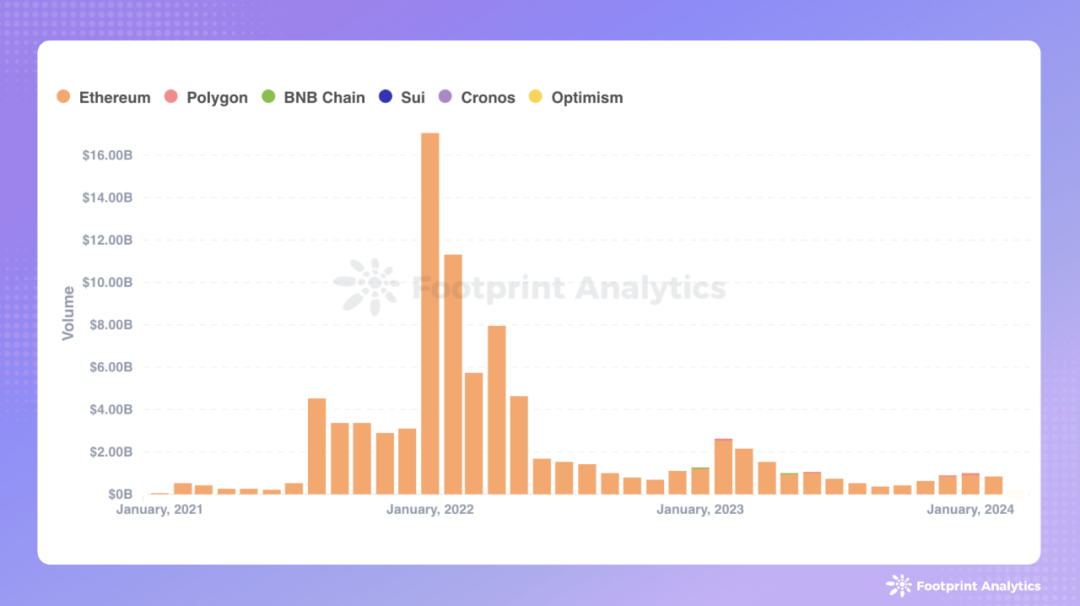
Data source: Monthly NFT trading volume by public chain - Footprint Analytics
Ethereum’s number of unique users (wallets) decreased from 163,000 in January to 150,000 in February. Nevertheless, its market share rose from 42.7% to 46.9%. Polygon also saw a decline in user count, falling to 129,000, reducing its market share to 40.4%. Meanwhile, BNB Chain experienced modest growth of 9.7%, reaching 31,000 users.
Public Chain Funding Activity
In February, the public blockchain sector saw 11 funding events, raising a total of $150 million. Compared to January, both the number and scale of investments showed significant growth.
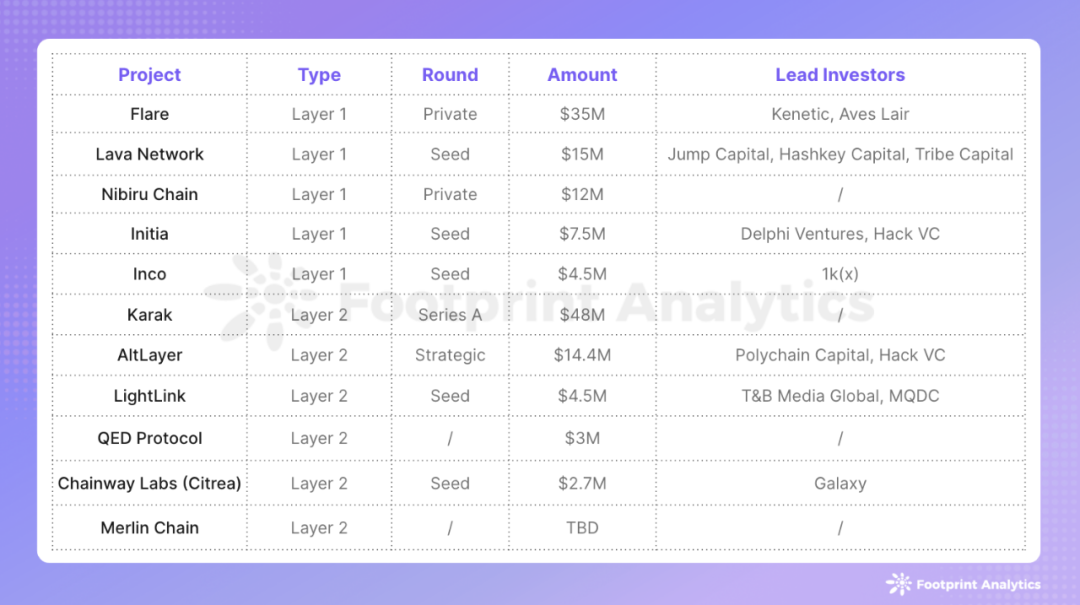
Public chain funding events – February 2024
In the Layer 1 space, Flare raised $35 million in a private sale round led by Kenetic and Aves Lair. Flare positions itself as a data-centric network focused on advancing smart contract protocols and price oracle development.
In the Ethereum Layer 2 space, Karak stood out with an $48 million Series A round—the largest single funding event of the month. Karak introduced a cutting-edge risk management framework for blockchain, Web3, and global financial ecosystems. Other Ethereum Layer 2 solutions such as AltLayer and LightLink also successfully secured funding.
This momentum extended to Bitcoin Layer 2 platforms as well, with QED Protocol, Citrea, and Merlin Chain all securing new investments in February—indicating growing market interest in Bitcoin scaling solutions.
Key Developments This Month
-
Sei Labs plans to launch the Sei V2 upgrade in the first half of 2024.
-
Web3 infrastructure provider Particle Network announced its first Launchpad will feature MERL, the token of Bitcoin Layer 2 network Merlin Chain.
-
The Bitcoin Cats project successfully launched the testnet for its Bitcoin Layer 2 solution, 1CAT Chain.
-
Layer 1 blockchain project Nibiru Chain plans to launch its public mainnet in March 2024.
-
Decentralized finance protocol Frax Finance successfully launched Fraxtal, its Layer 2 solution built on OP Bedrock and EVM-compatible.
-
USDC issuer Circle decided to discontinue support for its stablecoin on the TRON blockchain.
-
Blockchain projects Klaytn and Finschia announced they will merge in Q2 2024 through "Project Dragon," aiming to build Asia’s largest Web3 network.
Join TechFlow official community to stay tuned
Telegram:https://t.me/TechFlowDaily
X (Twitter):https://x.com/TechFlowPost
X (Twitter) EN:https://x.com/BlockFlow_News
 Footprint Analytics











