








Multicoin: News Is Price — The Theory of Attention Value in Crypto Markets
TechFlow Selected TechFlow Selected
Multicoin: News Is Price — The Theory of Attention Value in Crypto Markets
The internet makes arbitrary, two-way information transmission possible.
 Navigating Web3 tides with focused insights
Author: Multicoin Capital
Compiled by: TechFlow
"Price is the news" is a common adage in crypto, as network participation and awareness tend to increase following rapid price movements. To me, the inverse may be even more true: "News is the price."
In my article on What Multicoin is Excited About For 2024, I described a visible shift in how markets price assets—one I call the "Theory of Value Attention." In crypto, the primary inputs for asset pricing are not multifactor models around risk premiums or cash flows, but rather the perceived amount of time, energy, and money that a community dedicates to an asset. Note this is not a normative statement, but an observation of historical capital flows within tokens as an asset class (see recent memecoin rallies as early examples).
The internet made arbitrary, bidirectional information transfer possible. Cryptocurrency builds on these rails to enable arbitrary, bidirectional value transfer. Today’s consumer internet—streaming platforms, online media, mobile apps, social media—is essentially an attention market, making money and attention increasingly similar in nature.
In the 1930s, Benjamin Graham had to wait for quarterly reports and paper stock certificates purchased through human brokers to express his value investing thesis. In the 2020s, a series of Reddit posts about hedge fund short positions in GameStop attracted tens of thousands of retail traders placing buy orders on Robinhood, driving the price up 15x in 30 days. Consumer internet and crypto rails have drastically narrowed the gap between information and value, while increasing the volume and frequency of data consumption and value transactions. As this happens, the theory of value attention becomes increasingly relevant: information is money, and money is information.
While markets for attention and value exist independently, we haven’t yet seen their full convergence. When we consider consumer applications in crypto, this is exactly what we’re looking for. Crypto enables the rapid creation of new assets centered around attention, and allows trading wherever attention congregates: in consumer-facing applications.
In the coming years, we expect consumer developers to consciously integrate crypto into the structure and user experience of their apps, fundamentally changing at scale what can be traded and where trading occurs. Internally, we refer to such applications as "Publisher-Exchanges."
Publisher-Exchanges
Exchanges have achieved product-market fit in crypto because one of crypto’s core utilities is value transfer. Coinbase (fiat on/off ramps and centralized exchange), Tensor (digital collectibles exchange), Jito (intent and blockspace exchange), and Phantom (active order flow exchange) are all forms of exchanges.
Exchanges in crypto play a role analogous to major publishers in the consumer internet (e.g., X, Instagram, The New York Times): just as publishers control the flow of attention online, exchanges control the flow of capital in crypto.
When thinking about the next generation of consumer apps, we expect the boundary between exchanges and publishers to blur, creating new experiences that merge money and attention.
Kyle discussed UI-layer composability in his 2024 thought piece. Put simply, the next major online exchange won’t resemble Coinbase with traditional order books and depth charts, but will look more like a short-form video app where viewers can bet on the virality of upcoming creator content; or like a group chat where friends instantly launch NFT collections based on inside jokes or memes; or like an are.na-style curation platform where designers earn status and monetary rewards based on taste. In other words, consumer apps enabled by crypto are both publishers and exchanges: Publisher-Exchanges.
Publisher-Exchanges expand the surface area for new asset issuance by embedding issuance and native trading directly into the application front-end, enabling novel ways to interact with and coordinate these assets. Bringing trading into familiar environments may seem narrow or imitative, but we believe narrow markets serve as wedges to uncover emerging behaviors that will lead to the creation of large-scale new platforms.
This will be a golden age of experimentation—developers combining native issuance and trading with new application experiences. "Crypto-native consumer applications" will treat these design principles as first-class citizens.
Emerging Categories of Publisher-Exchanges
The goal of a Publisher-Exchange is to facilitate tradable versions of whatever content captures user attention at any given moment. Next-generation crypto consumer apps will allow users to directly issue and trade assets, monetizing the attention they capture firsthand.
For founders building Publisher-Exchanges, we believe certain design principles from the histories of publishers and exchanges will be relevant.
Throughout the history of the consumer internet, publishers have functioned as content markets driven by two core attributes: discovery and curation (surfacing content users want to see and engage with), and trust and reputation (providing user assurance). Successful publishers generate strong "liquidity" by measuring the attention time users spend on them. This is why Upworthy measured success in "attention minutes," and why Elon Musk is obsessed with "regret-minimized user minutes" and "user seconds."
For Publisher-Exchanges, the takeaway is clear: they must first build an engaging core experience that captures users’ time and commitment, then embed asset issuance and transfer in ways aligned with their unique style of engagement.
We don’t view exchanges merely as trading venues, but as agoras—the ancient Greek public squares where citizens gathered for various activities—where people interact, exchange experiences, value, and information within a well-defined context. With that in mind, we envision several broad categories where Publisher-Exchanges could emerge.
Messaging Apps
Messaging apps are prime candidates to become Publisher-Exchanges.
Early evidence of this argument can be seen in WhatsApp and WeChat. Both platforms have thriving developer ecosystems in India and China, built atop robust, nationally mandated digital payment rails. This enables teams like Sama and Meesho to directly embed AI-tagged labor markets and local e-commerce into users’ social graphs within these platforms.
In crypto, Telegram is the de facto messenger, and its bot API opens up a vast design space for embedding issuance and value exchange experiences. Products like Dialect Operator and Maestro exemplify this trend. They demonstrate that users want to transact directly within their chats. These Telegram trading bots qualify as Publisher-Exchanges because they bundle discovery and intent with execution, reinforcing the tight link between attention and value transfer. Telegram even has a hidden app store (search and type 'tapps') containing hundreds of bots that let users send payments, play games, discover content, and more.
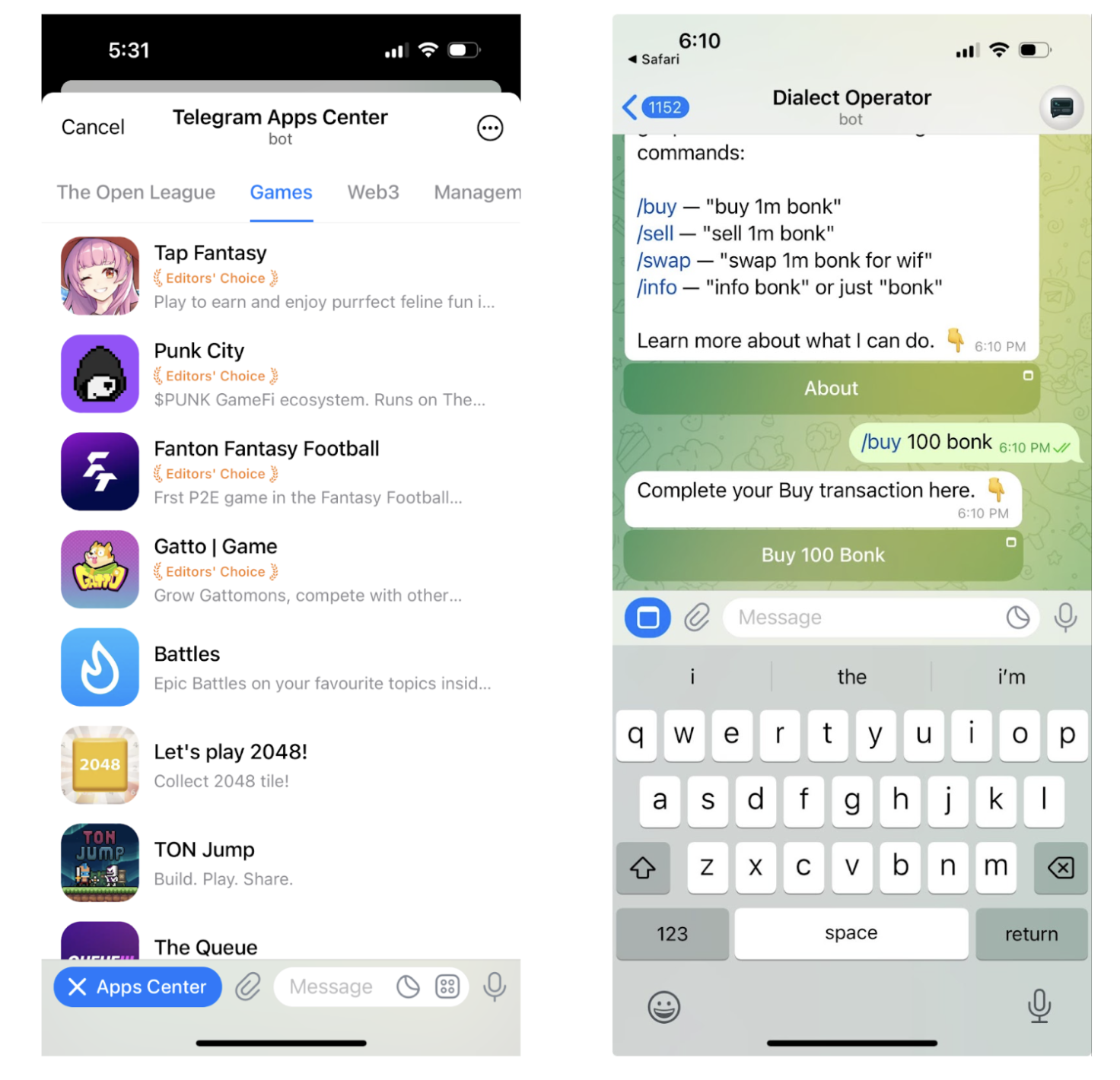
While these Publisher-Exchange bots aim to reduce execution latency for retail traders seeking alpha in closed chat groups, there’s further opportunity to vastly expand the set of issuers and tradable assets. We expect chat groups to become foundational layers for new forms of work (getting paid to complete tasks directly in chat), special projects (crowdfunding new initiatives within large conversations), and gaming (issuing meme coins as easily as sending a GIF)—all embodying the Publisher-Exchange experience.
Content Networks
The largest social media apps (Instagram, TikTok, X, YouTube) are content markets where creators of music, posts, videos, or other user-generated content compete for user attention. Creators then monetize accumulated attention by selling content or branded products.
The guiding principle behind crypto-powered content networks is direct audience support for individual creators or content pieces, and ensuring creators retain most of the value generated from their work. This was the original case for creator tokens, but we’ve learned that creator tokens alone are unlikely to succeed unless tightly integrated with the platforms where their audiences reside.
We’re seeing early experiments today with new types of content networks, each issuing and trading new asset types within their apps. We envision a new class of content markets where users come for entertainment and stay for the market.
Unlonely is a streaming platform that embeds token issuance and prediction games directly into streams and chats. Farcaster Frames enables direct interaction with on-chain states within feeds—another example of issuing and trading assets in familiar environments.

Most content networks today monetize via advertising. Ad-based customer acquisition often leaks down the conversion funnel and is clearly a suboptimal solution for capturing attention—users recognize they’re being sold to, and the experience is frequently interrupted.
Display ads are relics of the pre-crypto era. A more fundamental way for merchants to acquire users is through Direct Value Issuance (DVI)—paying users tokens directly.
Instead of targeting ads based on user behavior or cohort segmentation, advertisers should be able to directly distribute value to users. Content networks need not insert sports betting ads between users scrolling NBA game posts—instead, they could let the sportsbook directly airdrop $50 worth of platform credits to users.
Advertisers no longer act as rent-seeking intermediaries trading with platforms, but deliver their CAC budgets directly to end users. In turn, content markets offer users a better product: shifting from places where users are actively drawn in but see none of the financial upside of their attention (via display ads), to environments where users directly participate in that financialization by earning and spending assets (through DVI), based on their attention patterns.
The backdoor opened by embedded ad networks could be even more compelling. By giving every user an address, apps can zero-cost embed universal financial services, layered atop existing deep contextual states.
Information Markets
Search engines in the 90s sought to organize information on the internet, starting with static web pages and later expanding to new media formats. Access to this information was subsidized via advertising.
Today, information on the internet extends far beyond web pages—it’s scattered across thousands of forum posts, group chats, podcasts, and private databases. Information markets (e.g., prediction markets, sports betting platforms, alternative data providers) are ways for users to extract signals from noise across these sources and distill probabilistic outcomes from vast qualitative data.
While the most successful current instances of information markets don’t rely on crypto rails, we believe they can be strengthened by them. The design space here involves either financializing information itself based on quality, or embedding these markets directly into first-party information-sharing venues.
Prediction markets like Polymarket are effectively binary call options with expiration dates tied to future outcomes like elections or sporting events. Historically, they’ve failed to accumulate sufficient liquidity or attention to become reliable information sources. In contrast, cultural assets (memecoins or NFTs) have proven far more capable of capturing attention and engagement than isolated prediction markets, as they lack fixed expirations and can develop organic momentum. For instance, trading volumes for Trump-related NFTs and tokens consistently exceed those on Polymarket.
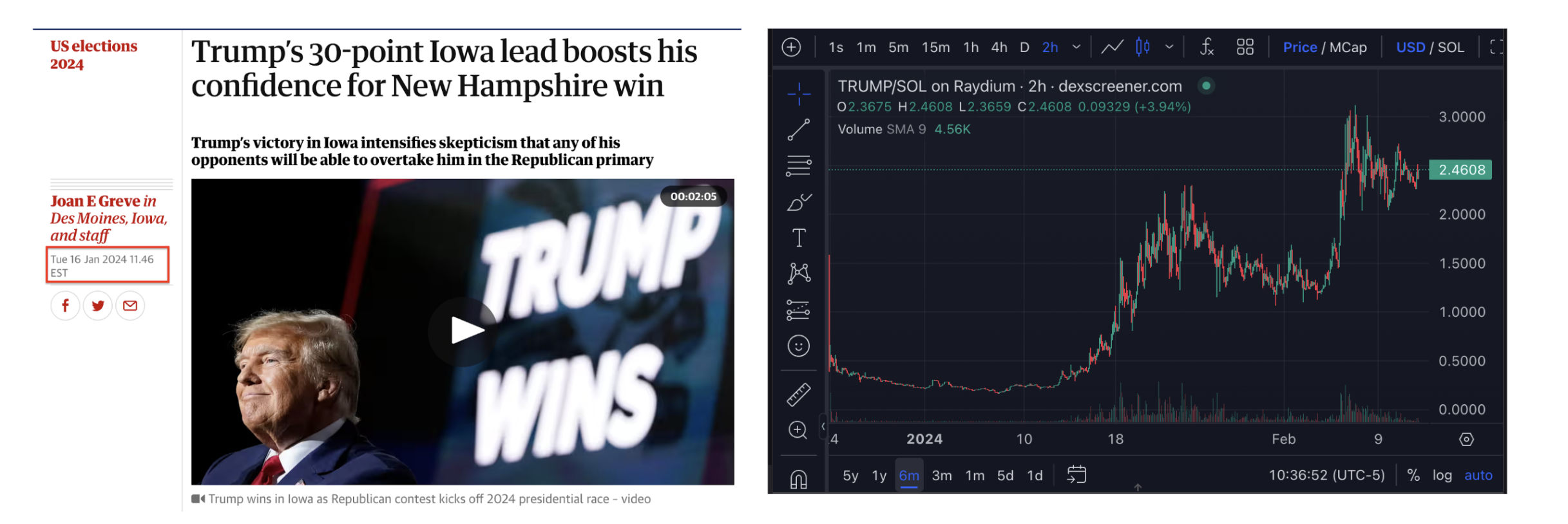
Thus, new spot assets that directly track attention may serve as more interesting proxies for attention or information flow. Embedding such assets into news publishing platforms or editorial publishers might prove more compelling than past binary, fixed-expiry structures. Numerai applies tokenized incentives to machine learning competitions on obfuscated financial data; similarly, we believe general-purpose information markets can be built for new categories of information using the same principles.
Imagine a StackExchange-style forum where voting and reputation carry financial value, or a Pinterest-like curation board where users stake their reputation on emerging trends and behaviors. The internet already hosts vast amounts of high-quality information, much of it user-provided with no economic incentive. What’s missing is a formal mechanism to properly aggregate and monetize it—precisely where crypto proves most valuable.
Special Interest Communities
Tokens enable communities to draw attention to new causes and manage resources. ConstitutionDAO demonstrated that memecoins can rally enough funds to bid on rare artifacts—and that the network continues operating autonomously after the auction.
Here, we conclude that tokens are more likely to coordinate real-world action when attached to specific missions. This precise model of collaborative funding can support novel ventures overlooked by traditional finance and research: capital-intensive projects like VR, niche areas of open-source software, art, or drug development for rare diseases.
Tokens uniquely enable distributed capital formation and grant strong ownership rights to capital contributors. This means global groups can pool capital for large-scale experiments, produce results, and return proceeds to token holders.
HairDAO and VitaDAO are real-world examples today. We’re already seeing new collaborative research platforms funded and sustained by public interest in neglected issues.
Final Thoughts
Consumer crypto applications will represent a generative shift, not an imitative one. The fundamental elements described here reveal a tight feedback loop between attention, capital formation, and coordination—because crypto’s defining feature is that trading can happen anywhere. Crypto is not merely about moving existing economies on-chain, but unlocking new economic expressions to capture attention—where like-minded groups can exchange time for money, and vice versa.
Join TechFlow official community to stay tuned
Telegram:https://t.me/TechFlowDaily
X (Twitter):https://x.com/TechFlowPost
X (Twitter) EN:https://x.com/BlockFlow_News
 Multicoin Capital











