Dymension's "audition season" is here: RollApp airdrop and the birth of a Web3 killer app?
TechFlow Selected TechFlow Selected
Dymension's "audition season" is here: RollApp airdrop and the birth of a Web3 killer app?
How will the AI gaming application chain NIM revolutionize Web3 gaming?
 Navigating Web3 tides with focused insights
Author: Peng SUN, Foresight News
Recently, NIM Network launched its first RollApp on Dymension and submitted a proposal for mainnet deployment within the community. This news immediately reignited long-absent anticipation for potential airdrops. At the same time, Dymension has recently initiated a competition for RollApps, setting the stage for an all-out RollApp War. So what exactly is NIM as a RollApp? What utility does it offer, and how will its tokenomics be structured? Will the modular blockchain sector experience an airdrop frenzy due to the emergence of numerous RollApps? With the “draft season” approaching, which RollApp projects will emerge as front-runners? To answer these questions, let’s begin with NIM Network.
1. What is NIM Network?
NIM is the first RollApp on Dymension, a modular settlement layer in the Cosmos ecosystem, powered by Celestia for data availability (DA) and using the EVM as its execution environment. First, what is a RollApp? A RollApp combines "Rollup" with "App," representing a high-performance, application-specific modular blockchain built on Dymension.
Regarding its relationship with Dymension and Celestia: The RollApp's sequencer handles local transaction validation, ordering, and processing. After block packaging, the data is sent to peer full nodes and published on-chain to the DA network selected by the RollApp. In this case, NIM uses Celestia as its modular DA layer. Once Celestia confirms the data, the sequencer sends the state root to the Dymension Hub for consensus and final settlement.
In other words, NIM offloads consensus and settlement to Dymension and data storage to Celestia, allowing it to share economic security with both networks while focusing solely on application execution. NIM is such a RollApp designed to create the ultimate environment for AI gaming—an application-specific chain dedicated to building game applications.
The identity of NIM’s development team remains unknown, and the number of team members has not been disclosed. However, the proposal reveals that the team has spent the past three years deeply involved in gaming and cryptography, investing in and incubating dozens of projects with a portfolio exceeding $50 million, and has already established an early-stage gaming ecosystem. Perhaps due to sufficient accumulation—or because Web3 games have failed to fully leverage blockchain capabilities—mass adoption has yet to materialize, leaving them far behind Web2 games. Therefore, NIM aims to strengthen synergy between gaming and blockchain, enhance on-chain elements in Web3 games, leverage blockchain’s strengths in ownership and incentives, and improve user experience. Currently, the team has developed its first AI game project, REDACTED, focused on AI agents and crypto infrastructure.
NIM’s future roadmap consists of three phases:
-
Phase One: Establishing an AI Gaming Alliance composed of gaming, application, infrastructure, and tooling projects to unify components across the entire modular stack, deliver better gaming experiences, customize native features, and build initial governance structures.
-
Phase Two: Focus on building unified gaming applications.
-
Phase Three: Construct the NIM flywheel, enabling stakers, governors, and partners to become integral parts of the economic cycle, enhancing the native capabilities of new gaming applications. These apps will generate fees to fund further development and reward community members, creating a compounding effect.
NIM Tokenomics
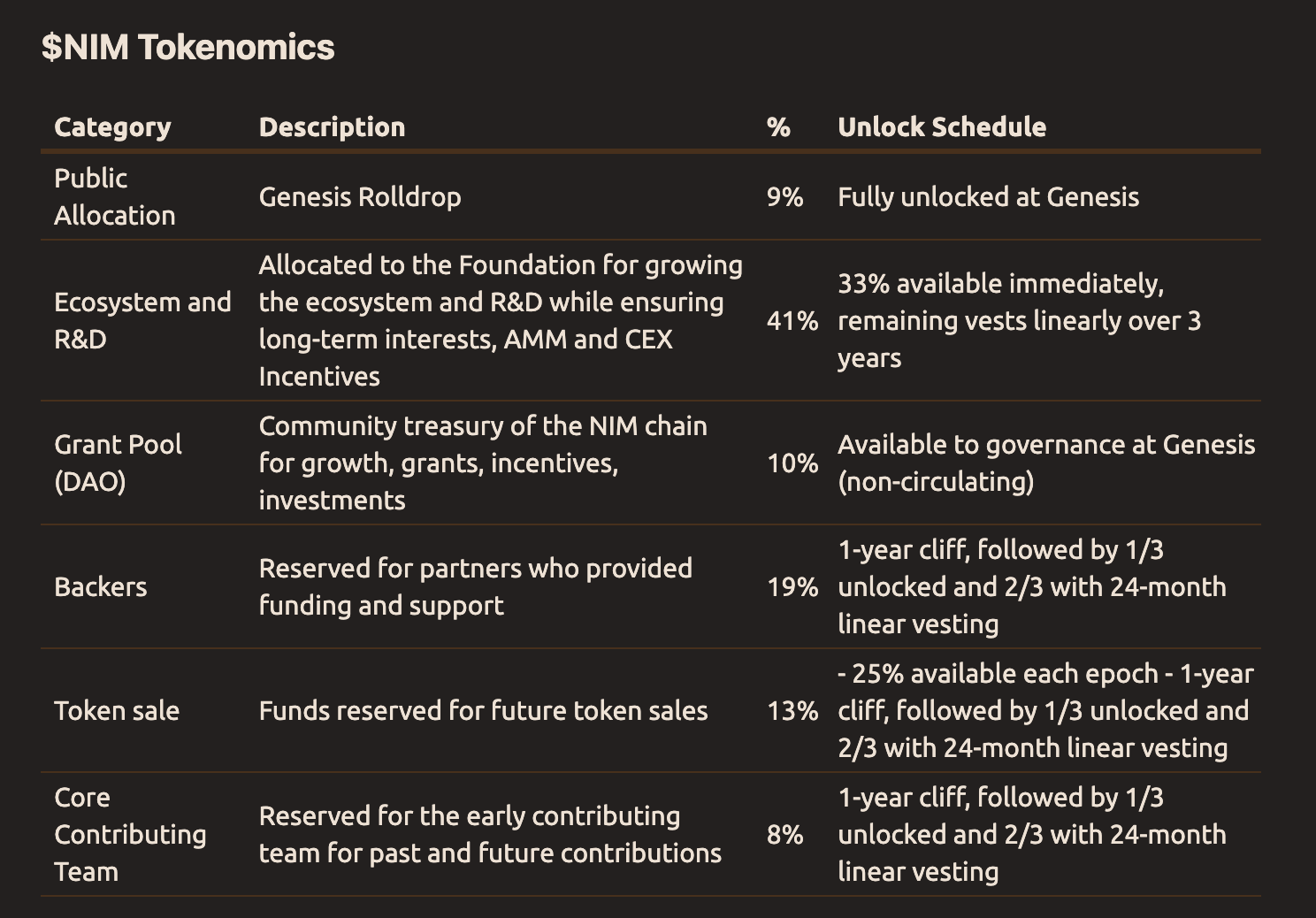
NIM is the native token of the NIM Protocol, used for paying transaction fees and staking alongside DYM, USDT, and USDC within applications. The total supply of NIM has not yet been announced, but we can preview its allocation plan:
-
9% allocated to Genesis Rolldrop (akin to a genesis airdrop);
-
41% reserved for ecosystem development and R&D, ensuring long-term rewards, AMM incentives, and CEX listings;
-
10% allocated to the community treasury to support growth, grants, incentives, and investments;
-
19% allocated to investors;
-
13% designated for token sales;
-
8% allocated to early contributing team members.
As previously mentioned, since NIM uses Celestia for DA and Dymension for settlement, TIA and DYM stakers are highly likely to qualify for the genesis airdrop. Additional token distribution details will be released in the coming weeks.
2. RollApp War: Can a Community-Centric Approach Birth a Killer App?
An interesting aspect of NIM’s mainnet launch is that RollApp teams must first submit a draft on the governance forum, followed by an on-chain proposal seven days later, which then requires community voting approval before deployment during a Dymension network upgrade.
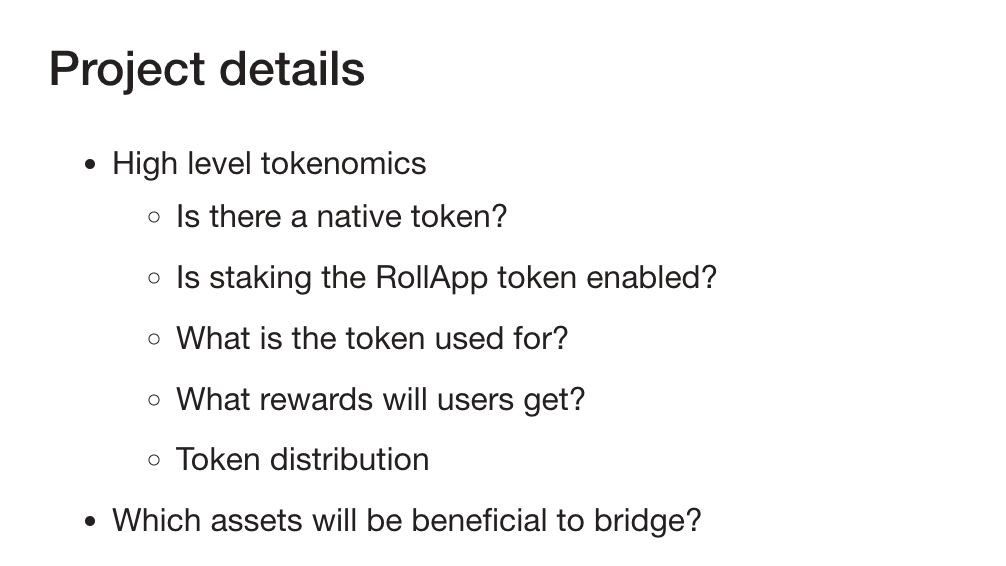
According to Dymension’s suggested RollApp proposal template, submissions should include project descriptions, team introductions, whether the project has a native token, token distribution plans, roadmaps, and social media links. As a result, every Rollup launch will be highly decentralized, with greater transparency and deeper user understanding. Community feedback and voting may also provide additional momentum for application development. Of course, requiring public disclosure of token allocations represents the highest form of respect toward the community.
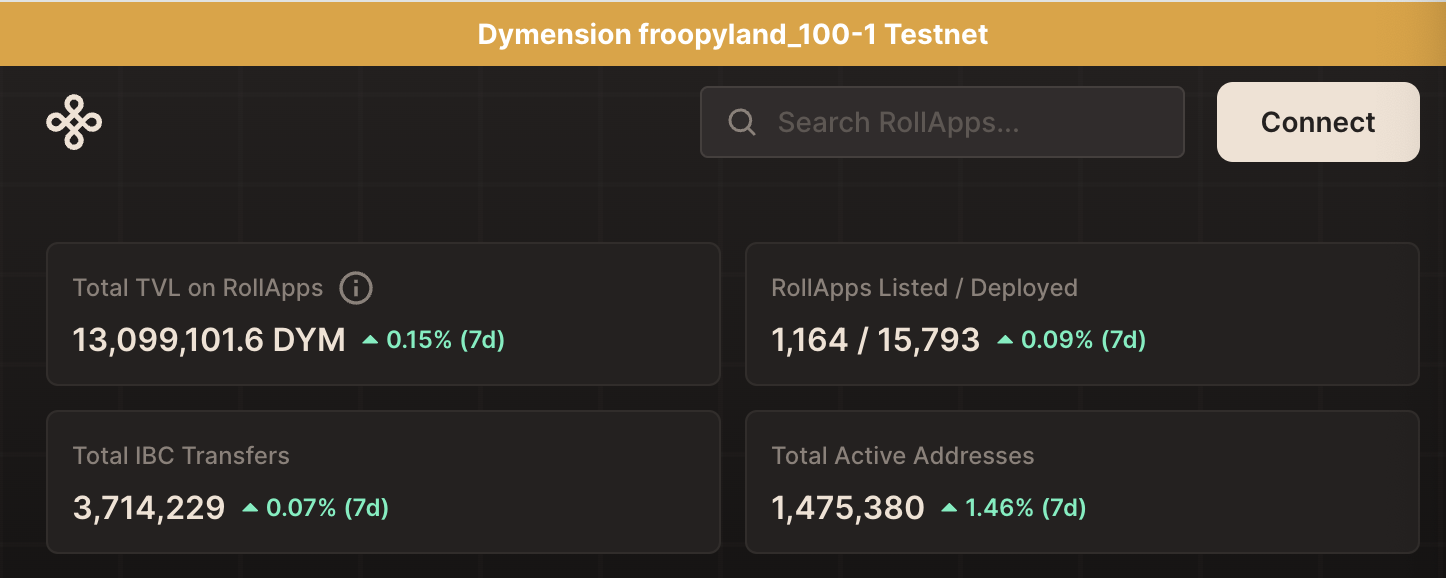
Beyond NIM, Dymension may soon witness a full-blown RollApp War. Consider the testnet data: over 15,793 RollApps have been deployed, with 1,164 already listed.
Currently, Dymension has launched "The RollApp Draft" competition, where RollApp developers can present their projects to the community. Approved RollApps will receive funding, community support, visibility, and liquidity incentives. Multiple incubators and hackathons will participate in The Draft as part of an established guidance framework built atop an open platform. In short, many projects are already testing on the testnet, meaning we’ll see increasing numbers of RollApps emerge on mainnet—and potentially significant airdrop opportunities for DYM stakers.
Dymension was the first major airdrop of 2024, and most users now recognize the potential value of modular settlement layers. As a solution to the blockchain trilemma, modular architectures decouple monolithic blockchains, improving scalability and efficiency without sacrificing security—its future potential is evident. Likewise, when RollApps no longer need to worry about scalability or security and can instead focus purely on product and application design, we gain greater confidence in the emergence of a true killer app. After all, letting specialists handle specialized tasks is always the best approach.
Undercurrents of the RollApp War are stirring, and many teams are likely preparing to compete fiercely for community recognition. In the future, modular-based solutions will inevitably spark intense competition across various sectors, as everyone strives to be the first breakout success and enable Web3 to truly win users through compelling applications. Yet from another perspective, this battle may not be zero-sum but rather positive-sum, because the real competitor for RollApps isn’t other Web3 projects—it’s Web2.
Finally, returning to today’s focus on NIM: What exactly is the AI gaming experience it aims to deliver, and how might it revolutionize Web3 gaming? Can mass adoption finally be achieved? We don’t know yet—but with every new narrative comes renewed hope.
Join TechFlow official community to stay tuned
Telegram:https://t.me/TechFlowDaily
X (Twitter):https://x.com/TechFlowPost
X (Twitter) EN:https://x.com/BlockFlow_News
 Foresight News