Exploring UXLINK: A New Chapter in Web3 Social, The Power and Potential of Familiar Social Connections
TechFlow Selected TechFlow Selected
Exploring UXLINK: A New Chapter in Web3 Social, The Power and Potential of Familiar Social Connections
This article will delve into UXLink's core concepts and technological innovations, while also exploring the project's future prospects.
 Navigating Web3 tides with focused insights
Author: Lin Chuan
Introduction
UXLink, an emerging Web3 social platform, is on the rise—pioneering a unique path through "real-life connections" that differentiates it from previous well-known social projects. It stands as a trailblazer exploring how to build authentic and meaningful social connections in a decentralized world. So what exactly makes UXLink unique? How does it differ from earlier prominent Web3 social initiatives? This article will delve into UXLink’s core philosophy and technological innovations, while also looking ahead at the project’s future potential.
Chapter 1: What is UXLink? How Can Ordinary Users Get Started?
UXLink is a rising Web3 social project launched in 2023. Its product went live at the end of April 2023 and has since entered a phase of rapid growth, with over 3.1 million registered users and more than 200,000 daily active users (DAU).
Mass adoption of Web3 is one of UXLink’s core missions. Onboarding is extremely user-friendly—no funds or blockchain wallet required. All users need is a Telegram account and an invitation from a trusted contact to experience the product within one minute. Simply find the official UXLink Telegram bot @uxlink_bot or click another user's referral link to automatically become a new UXLink user and enter the interactive interface directly within Telegram.
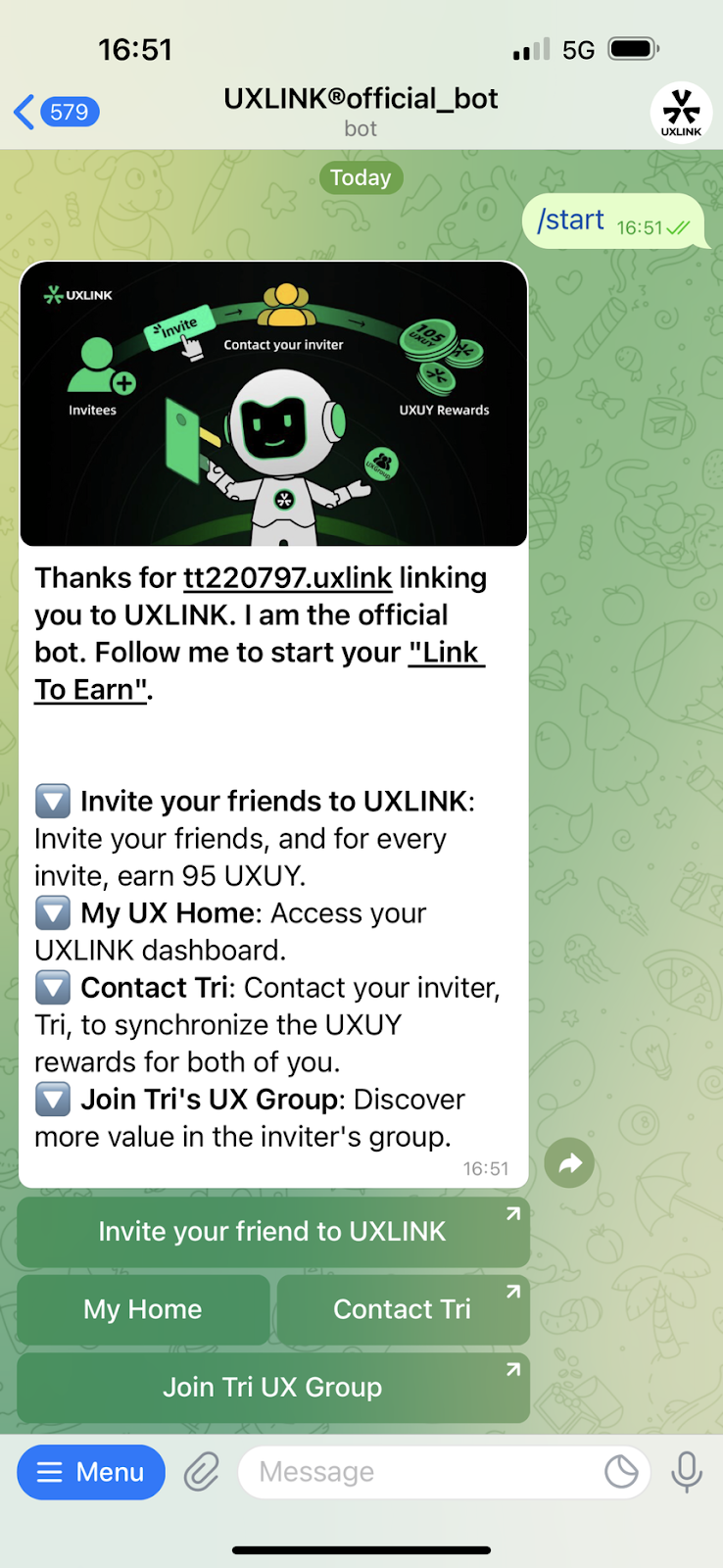
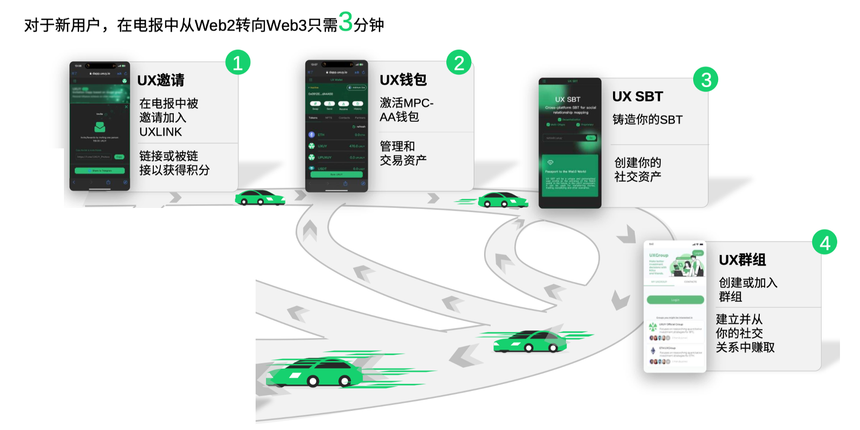
For regular users, a key growth mechanism currently driving UXLink is “Link to Earn.” By inviting friends to join UXLink, users earn UXUY token points, building their own social network and capturing the value of their social relationships. Upon registration, UXLink automatically creates a wallet for each user on the Arbitrum chain using account abstraction via MPC-AA technology. Users can access their dashboard to view their social graph, on-chain balance, mint SBTs, and perform other advanced actions. They can also create UXLink groups, each equipped with its own dedicated wallet address and account system.
The user journey for joining UXLink is illustrated below. Compared to many prior Web3 social products (such as Lens Protocol, FriendTech, etc.), this experience is remarkably smooth and accessible.
Many readers may now be wondering: There have already been numerous social products and protocols—why another one like UXLink? What sets it apart, and why should I spend time learning about and trying it out?
We’ll focus on answering these questions next.
Chapter 2: Real-Life Connections — UXLink’s Differentiated Path in Social Protocols
2.1 How UXLink Differs From Previous Social Protocols
The Web3 social product and protocol space has long remained one of the most discussed sectors in the ecosystem. In 2023 alone, several protocols—including Nostr, Farcaster, Lens Protocol, and CyberConnect—garnered widespread attention and discussion.
While these protocols vary significantly in narrative focus, technical architecture, initial user profiles, operational strategies, and the relationship between protocol and application, they share one common trait: The social relationships they accumulate tend to resemble one-way KOL-follower dynamics like those seen on Twitter or Weibo, rather than two-way real-life connection models akin to WeChat or WhatsApp. This model emphasizes a “follow” mechanism where KOLs generate content and followers consume it passively.
UXLink takes a different approach—focusing on migrating and preserving users’ existing real-life social relationships onto the protocol, while helping them form new ones. Real-life connections refer to ties built on personal acquaintance, intimacy, or shared experiences in real life. At their core lies trust and deep interpersonal bonds—far stronger than simple KOL-follower links. Just like the many small, tight-knit communities commonly found across Web3, these groups thrive because members have established mutual trust. The trust value generated by such relationships exceeds that of typical KOL-follower dynamics.
Consider a common scenario: A new Web3 project launches its token, but there is significant controversy around both its purpose and the token’s market value. For a user relying on KOL-follower relationships, only strong confidence in the KOL’s expertise would prompt them to investigate or act. But within a real-life connection group, users are more likely to proactively ask friends out of curiosity and trust. If doubts arise during research, they can discuss and clarify collectively. From a marketing conversion standpoint, real-life social relationships offer greater transformative power compared to KOL-follower dynamics. Thus, a protocol built on real-life connections—like UXLink—may hold greater commercial potential than those based on influencer-following models.
2.2 The Product Core of UXLink’s Real-Life Social Model: Groups
When discussing UXLink’s real-life social framework, a central concept cannot be overlooked: “Groups.” A group serves not just as a simple chat room but as a dynamic space reflecting the practical application of a user’s social graph—transforming personal networks into real-time, interactive platforms.
To illustrate, imagine a user with a social network of 200 people—family, friends, classmates, and colleagues. While this network appears valuable, the user might struggle with: How can I effectively utilize it?
UXLink offers a solution: consolidating all 200 contacts into a single group. This group becomes more than just a messaging channel—it embodies a living representation of the user’s social graph. Currently, UXLink mainly supports integration with environments like Telegram groups, making such consolidation possible. Within this 200-member Telegram group, members can send/receive payments and distribute earnings, fully showcasing a dynamic social economy.
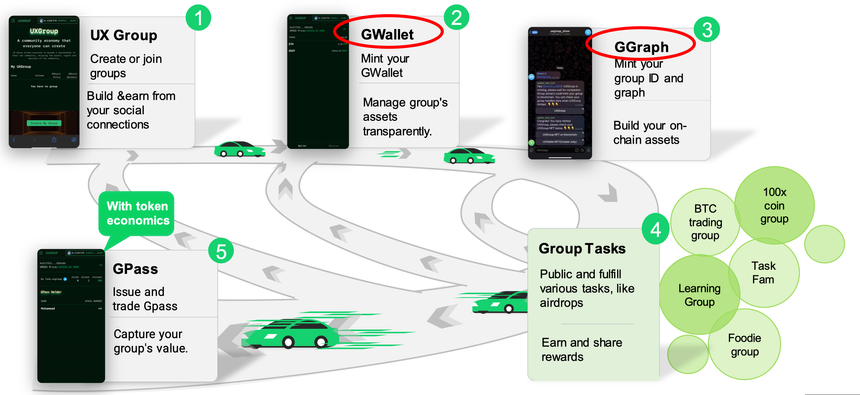
More importantly, groups can interconnect to form expanded social graphs. Rather than being isolated silos, these groups serve as evolving hubs capable of growing and deepening broader networks. In practice, discussions range from everyday topics to professional investment insights, creating rich, diverse interactions.
Within UXLink groups, the group admin acts as a central node for information dissemination. Currently, the platform hosts over 70,000 groups, with some demonstrating high levels of activity and efficiency. This extensive network accelerates information flow and opens new avenues for marketing.
From a marketing perspective, three major user barriers exist: distrust, unconvincedness, and confusion. UXLink groups effectively address all three: Recommendations from trusted peers foster trust more reliably than ads; ongoing discussions help persuade skeptical users; and complex concepts find clarity through real-time Q&A within the group.
In summary, UXLink’s group functionality not only activates social graphs in practice but also provides users with a powerful platform for trust-building, information exchange, and problem-solving. In this new era of real-life social networking, UXLink’s group feature stands as a vital bridge connecting personal networks with tangible applications.
Speaking of groups, some readers may recall FriendTech—the viral Web3 social product that gained popularity in late 2023.
FriendTech’s “Room” concept shares similarities with UXLink’s groups, but its financial incentives are overly dominant. Users buy someone else’s Key primarily betting on price appreciation—not to engage in room discussions or build genuine social ties. This design forces FriendTech to maintain high user growth, relying on constant inflows of new users to sustain Key prices and community confidence.
However, FriendTech presents a relatively high entry barrier for outsiders. Once nearly all interested Web3 users are onboarded, growth stalls. UXLink differs fundamentally—its groups emphasize human interaction and mutual influence, resembling classrooms or small businesses. Value is created through collective building (“BUILD”), not KOL monetization, delivering real utility to users and third parties.
Additionally, FriendTech suffers from several other flawed economic and product design choices, which we won’t elaborate on here. Yet from FriendTech, we clearly see the potential power of the “group” social function.
2.3 The Value of UXLink Protocol for Developers and Third-Party Web3 Projects
UXLink has accumulated a large base of real users and real-life social groups, underpinned by a robust protocol layer.
UXLink’s product architecture consists of three layers:
-
UXLink Application Layer: Provides foundational services including growth mechanics, group management, MPC-TSS-based wallet accounts, and EOA accounts tied to groups, enabling ecosystem apps to scale efficiently.
-
UXLink Protocol Service Layer: Web3 developers can leverage APIs (and ABIs for on-chain/off-chain systems) to efficiently manage users’ social identities and relationship data. The UXLink Protocol features a hybrid, scalable architecture (EVM + IPFS + Cloud), storing identity and relationship data on-chain while processing complex business logic off-chain—supporting mass-adoption use cases for applications built on the protocol.
-
UXLink Infrastructure Layer: A hybrid scalable infrastructure (EVM + IPFS + Clouds), integrating EVM chains (Ethereum Mainnet, Arbitrum L2, BNB Chain, Polygon, Base Chain, etc.), decentralized storage, and centralized data indexing services.
Returning to real-life social relationships: due to their fundamentally different nature, the depth and quality of relational data also differ—similar to comparing WeChat and Weibo. Relationships define trust levels; data defines precision. Consider a recent feature launch:
Since February, UXLink has introduced a multi-wallet feature, encouraging users to link their Web3 wallets under a single account and offering tools to manage them. Throughout February, total linked wallet balances exceeded $1 billion USD. One prominent Web3 wallet was heavily promoted by UXLink, achieving over 200,000 addresses connected to the UXLink network within 14 days—averaging about $70 per wallet. In driving registrations for this wallet, 8,500 Linkers and 4,200 groups contributed over 80% of the results, with a conversion rate exceeding 40%. The high conversion and deposit rates highlight the powerful engagement driven by UXLink’s social dynamics and group interactions. On average, each Linker brought in over 20 new wallets—demonstrating not only strong network effects but also high user activity and quality. Additionally, a 72% deposit rate indicates high commitment and engagement among these new wallet holders.
Geographically, the campaign successfully attracted users from Southeast Asia, Africa/Nigeria, India, Europe, the U.S., and Singapore—achieving broad global reach.
In conclusion, this collaboration between UXLink and a third-party wallet showcases the platform’s immense commercial potential within the Web3 social landscape. For projects seeking effective user acquisition and promotion, partnering with UXLink could prove to be a highly viable strategy.
Chapter 3: UXLink’s Future Outlook and Challenges
Beyond offering Web3 users a novel social experience through its innovative real-life connection model, UXLink is opening new pathways for broader audiences to enter the Web3 world.
Web3 social applications are widely regarded as a cornerstone of mass adoption narratives, primarily because they provide a comfortable on-ramp for non-crypto-native users. Unlike the last bull market, today’s infrastructure—including high-performance public chains and account abstraction wallets—is mature. New users can now adopt next-gen Web3 social platforms like UXLink without needing to understand complex concepts like blockchains, private keys, or wallets—drastically lowering entry barriers. Moreover, the invite-based real-life connection model enables faster viral spread compared to KOL-follower mechanisms.
Bringing more users into the Web3 ecosystem—and helping them grow—enables better service delivery by developers and third-party applications. This kind of sustainable contribution holds far greater long-term value for the industry.
This is precisely what UXLink is striving to achieve. As we move deeper into this bull cycle, let us watch closely as UXLink continues to grow and evolve. Social is the crown jewel of every WEB era—can UXLink seize the gem atop the Web3 crown?
Join TechFlow official community to stay tuned
Telegram:https://t.me/TechFlowDaily
X (Twitter):https://x.com/TechFlowPost
X (Twitter) EN:https://x.com/BlockFlow_News
 @Mtyl_7th