








Why do some major institutions purchase Bitcoin without hesitation?
TechFlow Selected TechFlow Selected
Why do some major institutions purchase Bitcoin without hesitation?
Industry experts believe that Bitcoin's market capitalization could one day surpass that of gold.
 Navigating Web3 tides with focused insights
Source: beincrypto
Compiled by: Blockchain Knight
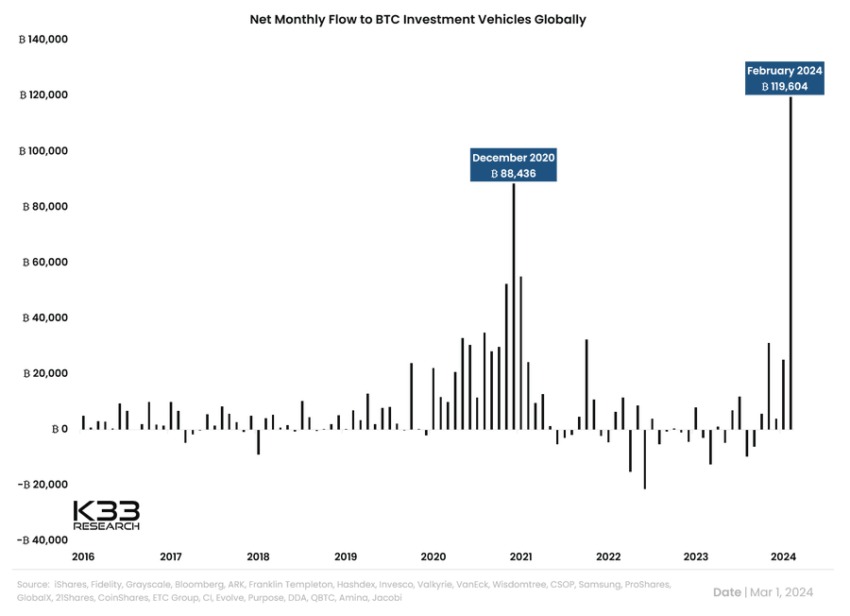
At the beginning of this year, BTC prices surged nearly 50%, largely driven by the launch of BTC ETFs. These ETFs have significantly facilitated retail and institutional investor access to this leading crypto asset.
Recent price movements have also sparked discussions among industry leaders about why institutional investors are increasingly drawn to the crypto asset market.
In a recent interview, Chainlink founder Sergey Nazarov pointed out that the new investors flooding into BTC come from the global financial system and are anticipating the next evolution in the crypto space: "tokenization of real-world assets."
Nazarov emphasized that major financial institutions are preparing for asset tokenization, aiming either to compete with or capitalize on the funds flowing into ETFs.
Nazarov also stated: "The next phase in crypto is asset tokenization. Banks see all this capital flowing into ETFs and will create assets to either compete with ETFs or capture some of that capital."
Tokenization involves converting ownership rights of assets into digital tokens on a blockchain, a process expected to enhance liquidity, transparency, and efficiency for digitized physical assets.
Citing expert predictions, McKinsey estimates that by 2030, trading volume in tokenized digital securities could reach $5 trillion.
Similarly, BlackRock CEO Larry Fink believes that tokenization represents a significant technological breakthrough with the potential to transform asset management.
Fink explained: "We already have tokenization technology today. If you have a tokenized security and identity, then at the moment you buy or sell an instrument on the ledger, everything is created together."
"Moreover, regarding financial crimes, a tokenized system could eliminate all forms of corruption."
U.S. presidential candidate Robert Kennedy Jr. believes another key factor driving institutional interest in BTC is its perceived role as a hedge against inflation.
Kennedy noted that BTC's recent price performance has further strengthened its credibility as a "safe haven" against central banks' tendencies to print money. He also highlighted the significance of BTC for transactional freedom, likening it to freedom of speech.
Kennedy explained: "We need to ensure that people who want to protect themselves from inflation can own BTC. We must also ensure they have transactional freedom—governments shouldn't digitize our currency the way Canada did."
Mike Novogratz, CEO of Galaxy Digital, believes that BTC’s growth potential will continue to attract 'a new army of buyers.'
Novogratz believes that baby boomers—those born during periods of significantly increased birth rates—who control $85 trillion in global wealth, can now enter the BTC market through recently launched BTC ETFs. He suggests that more than half of registered investment advisors (RIAs) are collectively driving this trend.
Novogratz also believes that BTC’s market capitalization may one day surpass that of gold.
His prediction is based on younger generations—particularly Gen Z and millennials—who show a stronger preference for BTC over traditional assets like gold.
Join TechFlow official community to stay tuned
Telegram:https://t.me/TechFlowDaily
X (Twitter):https://x.com/TechFlowPost
X (Twitter) EN:https://x.com/BlockFlow_News
 @beincrypto









