








Understanding KIP Protocol, the Decentralized Web3 Infrastructure Protocol Focused on AI (Part One)
TechFlow Selected TechFlow Selected
Understanding KIP Protocol, the Decentralized Web3 Infrastructure Protocol Focused on AI (Part One)
KIP Protocol is a decentralized Web3 infrastructure protocol focused on AI. Through a series of KIP Explainer articles, we aim to help everyone systematically understand what KIP Protocol is.
 Navigating Web3 tides with focused insights
Author: KIP Protocol
First, KIP is not an AI app, nor a large language model, and certainly not a database or knowledge base.
KIP Protocol is a decentralized infrastructure protocol built for AI app developers, model creators, and data owners to securely transact and monetize within Web3. KIP enables valuable knowledge and data to be protected and monetized as knowledge assets, ensuring interaction with AI without loss of ownership.
For AI app developers, model creators, and data owners, KIP will prove essential for decentralized work and monetization in Web3.
(We refer to these three groups collectively as: AI Value Creators)
Decentralizing AI is an enormous and critically important challenge. Currently, multiple pioneering projects are approaching this problem from different angles.
KIP focuses specifically on solving the fundamental issues AI value creators face when attempting to deploy and monetize their work in Web3.
AI Models Need Apps and Data to Create Economic Value
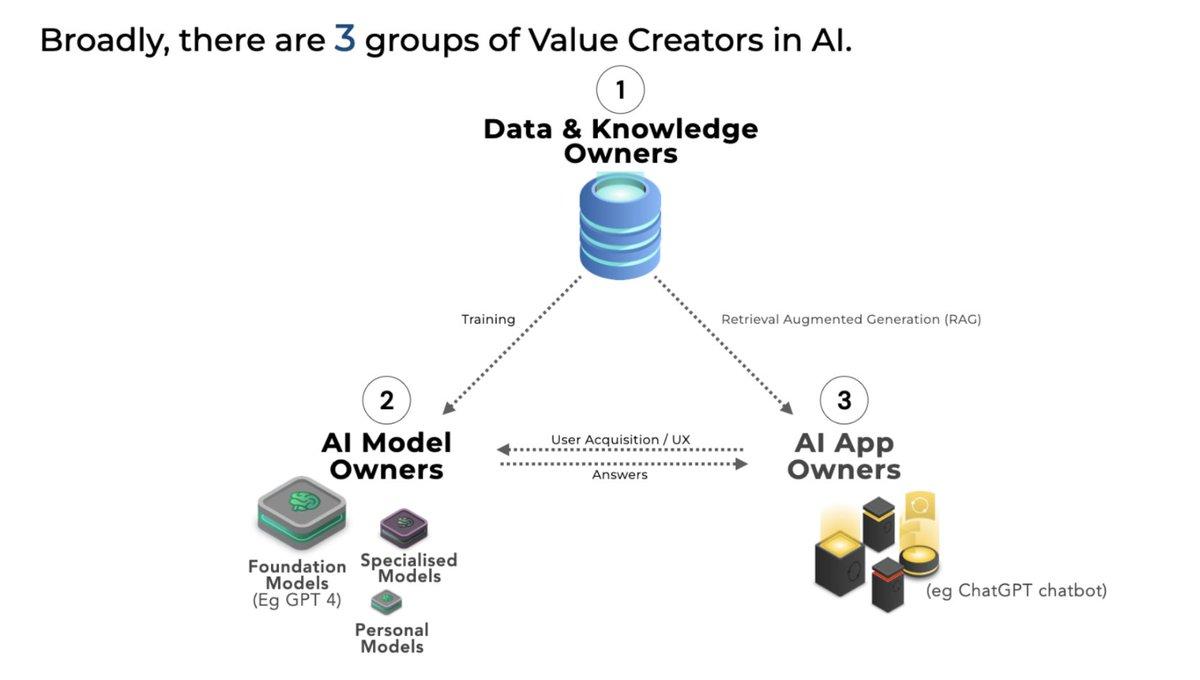
In the AI space, over 20 different categories of companies provide solutions. However, over the past year, most attention in generative AI has focused on AI models (which include diverse approaches ranging from transformers to GANs to diffusion models).
Indeed, these models represent the true breakthrough—the real intelligence—of this new era of computing.
Yet, to build a commercial ecosystem around AI, models depend on at least two other key value creators.
1) AI Apps: 'The Face of AI'
Amid the excitement around models, it's easy to overlook the importance of apps.
AI apps are crucial for guiding users into the AI world. These apps come in many forms—chatbots, image generators, search bots, analytics bots, or even simple prompts.
They accumulate user experience, acquire users, and perhaps most importantly, collect fees from them.
Many forget that ChatGPT is OpenAI’s app, powered by various OpenAI models (GPT-3.5, GPT-4). The groundbreaking human-like responses of the OpenAI chatbot were primarily coded at the app layer, not the model layer. (You can verify this by directly connecting to the model via API and comparing responses.)
In short: Without an app, a model is just a pile of code locked inside a metal box—entirely unusable.
2) Data: 'The Foundation of AI'
Data is critical for:
a) Model training and fine-tuning,
b) Retrieval-Augmented Generation (RAG)
All models are trained and fine-tuned using data. Without fine-tuning, models cannot become stronger or smarter.
However, training or fine-tuning models with data results in that data being essentially "assimilated" or "absorbed" into the model, reflected in adjusted model weights.
Therefore, in cases where direct model training with data is impossible, impractical, or illegal, the innovative technique known as "Retrieval-Augmented Generation" (RAG) comes into play.
RAG combines the ability to retrieve information from external databases with the power of AI models to generate responses. It's like having a super-intelligent assistant who knows how to find answers even if they don’t already know them.
While RAG is still relatively new, we firmly believe that as awareness of data sensitivity and protection grows, RAG could become a leading method, delivering significant commercial value through practical applications and emerging as the dominant framework through which most people access AI in the future.
Regardless of the method used, continuous AI innovation is impossible without data.
A vibrant AI ecosystem requires collaboration among value creators across different domains.
Individuals and companies skilled in training and fine-tuning models may lack expertise in designing or marketing consumer-facing apps.
Likewise, researchers and domain experts with valuable datasets and knowledge bases may lack the skills to train AI models or design apps.
But in a dynamic, diverse ecosystem, they don’t have to go it alone. Companies and individuals from different fields can collaborate to create use cases and economic value for users.
App designers can select the AI models best suited to their product vision and pre-select the most helpful external knowledge bases for users.
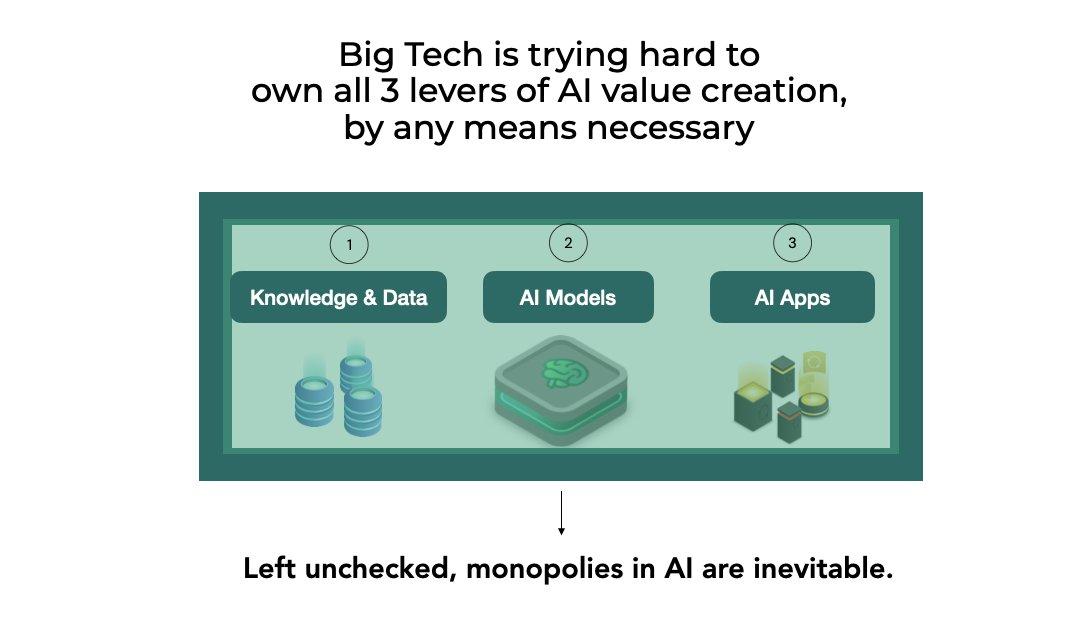
But what happens if all three types of talent are gradually absorbed into a single closed ecosystem?
Because that’s exactly what’s happening now. We’ll discuss this in detail in future articles, but for now: search online for "openai copyright protection" and consider its implications for data ownership in the future of AI.
Why Does KIP Want to Decentralize AI?
Monopolies in AI pose unique dangers. Decentralizing AI is an urgent and necessary response to prevent our collective interests from being subordinated to narrow corporate agendas.
We fully support AI accelerationism (e/acc), and we never deny the significant contributions large tech companies have made to advancing AI innovation.
However, most companies act solely to maximize shareholder value, regardless of cost. This is capitalism’s nature; expecting them to abandon their core incentives is denying reality.
We need a countervailing force in AI—a competitive market with diverse participants—so innovation can thrive. The future of AI must never be subject to the corporate interests of any single giant company.
We believe decentralizing AI is the only way to achieve this ideal.
How Does KIP Enable AI Decentralization?

KIP solves three fundamental problems faced by AI model creators, app developers, and data owners when attempting to decentralize.
-
On-chain/Off-chain Connectivity
-
Monetization and Revenue Extraction
-
Ownership and Security
1) The “On-chain/Off-chain Connectivity” Problem
Hugging Face, the open-source model repository, hosts over 400,000 models—an indicator of just how vibrant the AI industry is, yet still in its early stages.
Current blockchain technology cannot deliver the core inference functionality of models (i.e., fully decentralized models) at a cost or speed acceptable to most regular users. (Though advances in edge computing may soon close this gap.)
As such, even if not all, then certainly most models will remain off-chain—and we should expect continued innovation and expansion in off-chain models.
To unlock all these ideas and innovations in web3, KIP enables seamless on-chain inference.
KIP allows heavy computational tasks related to machine learning inference to be processed outside the blockchain, while still preserving the integrity and principles of decentralized systems.
2) The “Revenue” Problem

No matter how good a technology is, it won’t be adopted if adopters can’t benefit economically. Receiving
The basic revenue model for AI can be described as "pay-per-query," since each user query consumes GPU compute power and therefore someone must pay. Answering a single user query often involves multiple AI value creators.
We do not advocate decentralization for its own sake, but rather as an alternative to monopoly.
Thus, for decentralized AI to succeed, we must ensure that all parties involved in decentralizing AI work can earn revenue.
Easier said than done—it’s far more complex than it sounds in the AI context.
Let’s take an example of running a query via RAG.
-
A user asks a question to an AI chatbot.
-
The AI chatbot forwards the query to its brain—the AI model.
-
The model retrieves only the relevant data chunks from the knowledge base needed to answer the question, formulates a response, and sends it back to the app.
-
The app packages the answer and delivers it to the user.
In this simplified example, you can see how all three roles contribute to answering a user query.
In a centralized ecosystem, one platform owns and controls all three roles (as OpenAI aims to do, shown in the second image above), so you simply pay that central platform—everything else is internal accounting.
But if we want decentralization instead of monopoly, each party must be paid, raising the following challenges:
-
Recording (on-chain) each party’s contribution
-
Distributing revenue collected from users
-
Enabling each party to extract their rightful share
This is the "revenue" problem in decentralized AI that KIP solves.
We achieve this through low-cost, high-efficiency Web3 infrastructure that connects AI value creators, enables charging users, and facilitates revenue extraction. (We'll cover this in detail in our upcoming "Understanding KIP" series.)
Without first solving the revenue problem, decentralizing AI becomes significantly harder and nearly impossible to achieve widespread adoption beyond a few true idealists.
3) The “Ownership” Problem
Without real ownership, monetization is merely a fragile privilege.
We’ve all seen how accounts on centralized platforms can be suspended or banned at any time.
KIP solves this by using blockchain tokens—specifically ERC-3525 tokens (SFTs)—to "represent" the outputs of AI value creators.
-
For data owners: SFTs represent vectorized knowledge bases or encrypted links to raw data files used for model training.
-
For model creators: SFTs can represent an API pointing to an off-chain model or a set of sellable model weights.
-
For app developers: SFTs can represent frontend APIs or the prompts themselves.
These SFTs act as "monetization entities" that can interact on-chain and track how much each SFT earns from specific transactions.
By solving these issues, KIP makes it easy for AI value creators to decentralize their work, creating the initial conditions for a vibrant, larger-scale decentralized AI ecosystem.
KIP is the decentralized Web3 infrastructure protocol essential for AI innovation.
For more information, join our official Chinese community:
Join TechFlow official community to stay tuned
Telegram:https://t.me/TechFlowDaily
X (Twitter):https://x.com/TechFlowPost
X (Twitter) EN:https://x.com/BlockFlow_News
 @KIPprotocol






