Starpower: The Web3 Force in a Trillion-Dollar Market, Powered by Solana and IoTeX
TechFlow Selected TechFlow Selected
Starpower: The Web3 Force in a Trillion-Dollar Market, Powered by Solana and IoTeX
Human-centered virtual power plant.
 Navigating Web3 tides with focused insights
Helium Mobile's "unexpected" rise has revealed a different Web3 world to domestic users. In China, where telecom operators are all state-owned enterprises, signal towers can be built even in the most remote areas, resulting in telecom coverage across most regions except for uninhabited zones. However, in capitalist countries, related companies are privately owned, and signal coverage is maximized based on cost-effectiveness considerations, leading to low signal penetration in many areas—creating significant room for survival for "decentralized mobile networks."
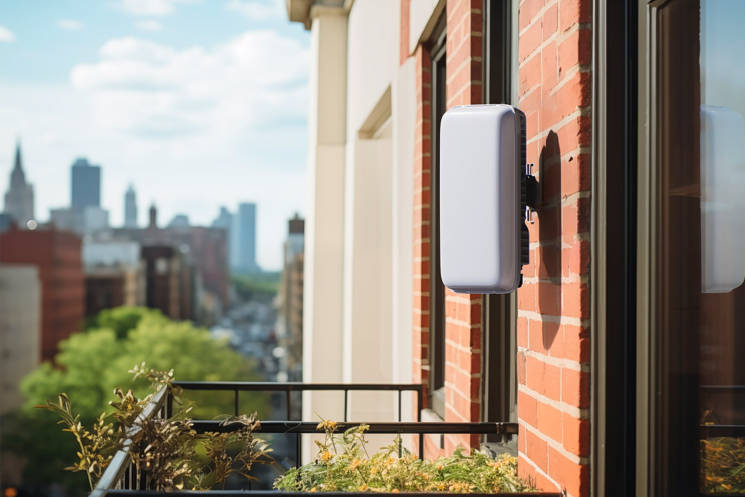
Helium mobile hotspot, image source: Nova Labs
Similar to telecom operators, energy is not purely state-run in many countries either, opening up commercial opportunities throughout the energy lifecycle. One such application is the concept of a "virtual power plant" once proposed by Elon Musk. Starpower has also set its sights on the energy sector, aiming to provide Web3 solutions for this field.
DePIN Infrastructure for a Global Energy Network
A virtual power plant (VPP) uses advanced information and communication technologies and software systems to aggregate and coordinate distributed energy resources such as distributed generation, energy storage systems, controllable loads, microgrids, and electric vehicles. It functions as a special type of power plant participating in electricity markets and grid operations without physical infrastructure—hence the term "virtual power plant (VPP)."
Currently, integration of VPPs into power system planning, operation, and market participation remains limited, hindering their development. In traditional VPP models, incentive mechanisms face several challenges:
- Limited rewards for participants, lacking effective mechanisms to offer sufficiently attractive incentives;
- Complex participation structures with technical barriers and cumbersome administrative procedures making entry difficult;
- Inconsistent compensation models that often do not align with the actual value of energy or resources contributed by participants;
- Compensation models may fail to adapt well to changing market conditions, causing dissatisfaction among participants and reducing their motivation to continue participating.
Against the backdrop of a massive market size and clear structural flaws, Starpower offers a Web3 solution combining physical devices, blockchain, IoT, and AI.
Overall, Starpower revolves around two key themes: VPPs and sustainability. Starpower aims to serve as the "hub" for household energy networks—an area current VPP providers struggle to enter due to cost constraints. On the user side, it leverages smart devices to optimize electricity usage, reducing carbon emissions while collecting data. Once Starpower’s "hub network" matures and integrates with large-scale VPP providers, this data can enable optimal electricity supply efficiency based on consumption patterns.
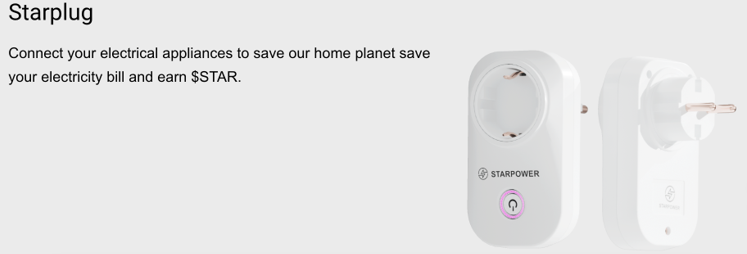
Starpower plans to launch its first product, the smart plug Starplug, within the first quarter of this year. Plug-and-play compatible, Starplug collects home energy consumption data and ensures real-world data authenticity through TEE (Trusted Execution Environment), preserving privacy. As the initial offering, Starplug not only helps users understand and better manage household energy use but also aggregates data from thousands of homes to support future VPP networks in rational power supply and distribution.
Starpower says it is collaborating with Uber’s machine learning algorithm team to apply AI for more efficient energy utilization and scheduling.
With data collection established, Starpower’s next step is launching a home energy storage battery called Starbattery, allowing users to store surplus electricity during periods of stable supply for use during emergencies. Additionally, Starpower plans to roll out EV chargers and other products progressively in the future.

Looking ahead, Starpower hopes to connect household appliances—via hardware or software—to the Starpower network. After initially forming a large-scale network, it will integrate with clean energy power plants and large-scale energy storage facilities to build a true VPP network. As Starpower puts it: “Starpower is the information hub between global distributed energy resources (DERs) and local VPP service providers. Starpower collects DER data from around the world, analyzes it comprehensively, and delivers insights to VPP service providers, enabling efficient power trading and management within local grids, optimizing resource allocation, lowering energy costs, and potentially driving large-scale adoption of renewable energy. Starpower enhances grid intelligence, improves energy efficiency, promotes fine-grained operations in power markets, and achieves a win-win outcome for economic and environmental benefits.”
Team and Tokenomics
Starpower boasts a "star-studded" team. Its two co-founders, Laser Ding and Dr. Darcy Jia, bring strong backgrounds: Laser Ding is a former executive assistant to the chairman at HashKey Group with experience across numerous Web3 projects, while Dr. Darcy Jia holds a PhD in photovoltaics and renewable energy from Professor Martin Green’s lab at the University of New South Wales—the so-called “father of modern photovoltaics.”
Earlier, we mentioned a “Web3 solution integrating physical devices, blockchain, IoT, and AI.” So far, Starpower’s project design has clearly demonstrated the physical device, IoT, and AI components—the missing piece being blockchain. Like most DePIN projects, Starpower will implement on-chain token incentives and use blockchain for real-time settlements across its envisioned VPP network.
Notably, Starpower has secured backing from investors with expertise in both Web3 and new energy sectors. Investors (institutions and individuals) include Escape Velocity, IoTeX, Bas1s, Fenbushi Capital, HashKey, Helium Foundation, Solana Foundation, Arweave, Plug and Play, and REDEX. Supported jointly by Solana—the blockchain infrastructure behind the mature DePIN network Helium—and IoTeX, a public chain dedicated to DePIN development, along with decentralized storage network Arweave, Starpower is poised to become a truly “Web3-native” solution.
In Starpower’s plan, whether it’s the designed Starplug, Starbattery, or future devices that can join the network via smart hardware or software, all will earn token rewards through daily operation. Starpower states that by offering meaningful financial incentives via STAR tokens, participants who contribute energy resources to the network are directly rewarded, increasing participation appeal. Second, tokenization simplifies the process and lowers entry barriers, enabling more users to easily join the virtual power plant network. Finally, STAR token value dynamically adjusts, sensitively reflecting market changes to ensure fair and attractive compensation, thereby encouraging sustained engagement and network growth.

Regarding token distribution, 15% will go to the core team, 15% to investors, 7% to the foundation, 5% will be donated to non-profit organizations focused on climate change, 3% will be allocated for airdrops, and the remaining 55% will be distributed to contributors who help build the Starpower network.
Starpower’s Recent ‘Highlight Moments’
Last night and early this morning Beijing time, Starpower launched the free mint of its “Pioneer Pass” NFT. The website crashed shortly after minting began due to overwhelming traffic. As of 2 PM Beijing time today, the NFT’s floor price had surpassed 2 SOL, with total trading volume exceeding 1800 SOL. Holders of this NFT can participate in a 100-day “soft mining” program to earn Nova points, which can later be redeemed for the project’s $STAR token.

Additionally, at the upcoming ETH Denver event, Starpower will be one of the main guests at the DePIN Meetup, discussing the current state and future vision of DePIN alongside partners like IoTeX. Meanwhile, Starpower will join the first cohort of IoTeX’s incubation program, becoming a globally focused DePIN project prioritized for incubation and collaboration under IoTeX.
A few years ago, the market might not have embraced such a story. But the widespread adoption of Helium and Helium Mobile has turned DePIN from mere narrative into reality. As Web3 solutions in storage, computing, and IoT gradually gain market acceptance, even grand visions now have genuine potential to interact with real-world industries. Starpower, targeting the energy sector, represents a compelling opportunity worth watching and exploring.
Join TechFlow official community to stay tuned
Telegram:https://t.me/TechFlowDaily
X (Twitter):https://x.com/TechFlowPost
X (Twitter) EN:https://x.com/BlockFlow_News
 @starpowerworld