









Should You Sell STRK? Insights from Wintermute's Market-Making Style
TechFlow Selected TechFlow Selected
Should You Sell STRK? Insights from Wintermute's Market-Making Style
This article will examine the patterns by analyzing Wintermute's market-making activities and the performance of OP and ARB tokens, both in the Layer2 sector.
 Navigating Web3 tides with focused insights
Author: Karen, Foresight News
Hard work pays off. The Starknet airdrop has finally concluded.
So, should you sell your STRK after claiming the airdrop? Today, we’ll look to Wintermute—the market maker for STRK—for insights. As an active player in the crypto space, Wintermute provides liquidity and efficient markets across centralized exchanges (CEX), decentralized exchanges (DEX), and over-the-counter (OTC) platforms, serving more than 50 trading venues including Binance, Bybit, Coinbase, Kraken, Bitfinex, Bitstamp, Uniswap, and dYdX.
According to Wintermute’s official website, by the end of 2023, its cumulative trading volume reached nearly $3.7 trillion. Wintermute has served as a market maker for blue-chip tokens across various sectors, including OP, ARB, WLD, BLUR, DYDX, and APE. The community observes that Wintermute’s market-making style typically features high initial pricing, selling pressure, wash trading, accumulation, and subsequent price recovery. Beyond direct secondary market trades, Wintermute often coordinates efforts across multiple fronts such as news flow and market sentiment.
After cross-referencing weekly and monthly charts of OP, ARB, WLD, BLUR, DYDX, APE, and other non-Wintermute-market-made tokens from similar sectors, this author finds that Wintermute’s market-making behavior is influenced by multiple factors and cannot be judged solely based on a few token performances—such as the sector the token operates in, its market cap, the macro bull/bear cycle at launch, Wintermute’s share of market making, and specific trading strategies.
This article examines OP and ARB—both Layer2 tokens with Wintermute involvement—to identify patterns that may help guide user decisions regarding STRK.
OP
Wintermute faced challenges and controversy during its market-making for OP. Days after OP’s launch, Wintermute disclosed a FUD incident: due to an internal team error, it initially provided Optimism with a Gnosis Safe multisig address deployed on Ethereum Mainnet instead of the intended Optimism network address when receiving an initial loan of 20 million OP (OP’s total supply is 2^32, or 4,294,967,296). Subsequently, Wintermute agreed to receive an additional 20 million OP, pledged 50 million USDC as collateral, and worked on a fund recovery plan. Although Wintermute eventually recovered most of the tokens, some observers questioned its true motives behind market-making OP.
Affected by early scientist frontrunning, severe network and RPC delays during airdrop claim periods, and Wintermute’s operational misstep, OP’s price dropped from around $2 at launch to approximately $0.5 within 20 days—a 70% decline. After several rounds of rebound, consolidation, and shakeouts, the current price stands around $3.8. Each consolidation phase lasted between one month, four months, and six months respectively.
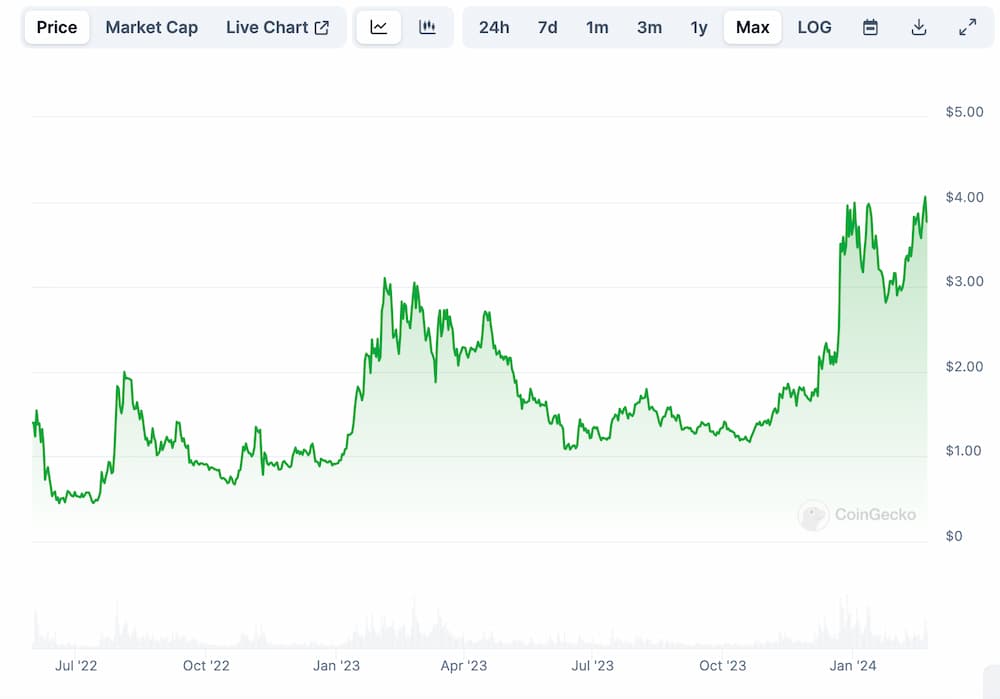
OP price chart, source: CoinGecko
ARB
Prior to the ARB airdrop claim opening, on March 23, 2023, an Arkham-labeled "Wintermute" address starting with 0xcce30 received 40 million ARB (total supply: 1 billion) from the Arbitrum Foundation.
A few days after the airdrop, the Arbitrum Foundation proposed AIP-1, suggesting the establishment of a decentralized autonomous organization, ArbitrumDAO, along with a request for 750 million ARB in funding. However, the Arbitrum Foundation had already transferred 750 million ARB on March 17—before the proposal went live—using the administrative budget wallet later referenced in the late-March AIP-1 proposal.
ARB opened around $1.5, but due to governance confusion, lack of transparency and trust, delayed responses, and FUD triggered by token selling, its price fluctuated near $1.2 over the following two weeks. It later rose alongside the broader market above $1.6 before entering a prolonged downtrend, remaining volatile between $1.3 and $0.75 for seven to eight months. Since December last year, the price has steadily climbed and currently trades around $1.8.
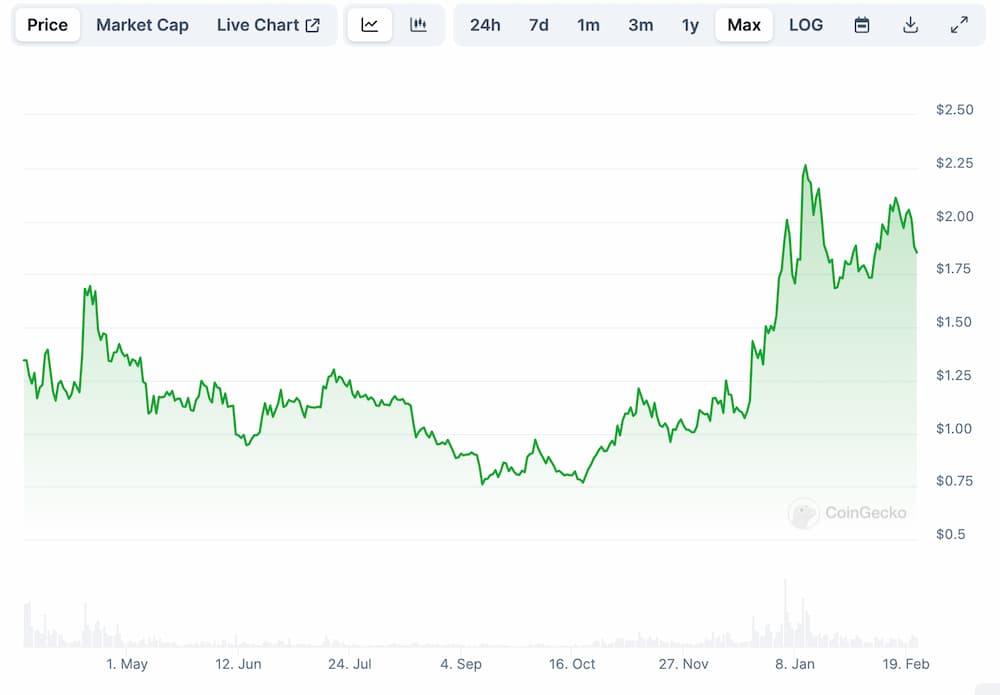
ARB price chart, source: CoinGecko
STRK
Before the STRK airdrop, Wintermute received 2 million STRK (total supply: 10 billion) for market-making purposes. Flow Traders and Amber Group are also STRK market makers. After launch, STRK reached a high of $7.71 on Binance and $3.5 on OKX, then gradually declined, now consolidating between $1.6 and $2.
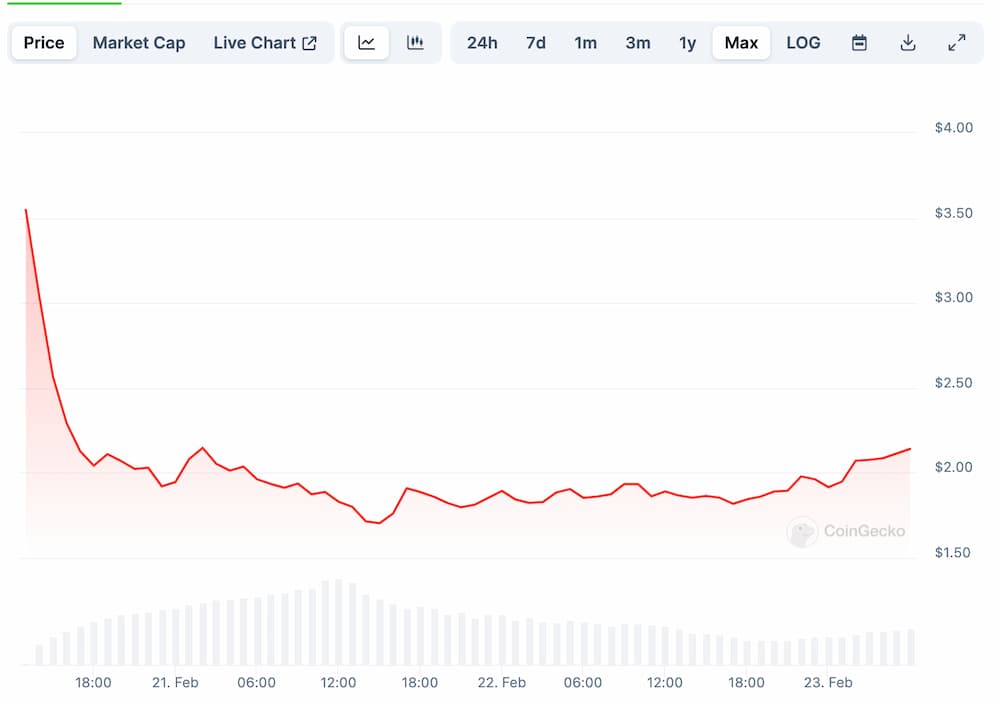
Today, StarkWare announced an updated vesting schedule for early contributors and investors: of the originally scheduled 134 million tokens to unlock on April 15, only 64 million will be released. Thereafter, 64 million tokens will unlock monthly until March 15, 2025. For the next 24 months, 127 million tokens will unlock monthly until March 15, 2027. Of the 580 million tokens held by early contributors and investors, only 580 million will be unlocked by end of 2024—down from the original 2 billion. An additional 1.4 billion tokens will gradually unlock by end of 2025, another 1.5 billion by end of 2026, and 380 million by March 15, 2027. Following this announcement, STRK briefly broke above $2.1.
With nearly 74% of the STRK airdrop already claimed, selling pressure appears to have been significantly alleviated. Additionally, since Wintermute’s allocated STRK for market-making is relatively small compared to its roles in OP and ARB, its potential market impact may be limited.
Notably, the Three Arrows Capital liquidation address “Teneo: 3AC Liquidation” received 134 million STRK this month, making it the 9th largest holder. This development signals possible asset redistribution during the ongoing 3AC liquidation process. Recall that in March and November 2021, Three Arrows Capital participated in StarkWare’s $75 million Series B and $50 million Series C funding rounds. In 2022, Teneo, acting as 3AC’s liquidator, took control of $35.6 million worth of fiat and StarkWare tokens, among other assets.
Overall, in terms of price performance, both OP and ARB experienced declines within 10–20 days post-launch, followed by volatility, multiple minor peaks, and eventual significant rallies. Two additional points are worth noting: both OP and ARB faced FUD crises post-launch, and both launched during a bear-to-bull market transition—a favorable macro condition that likely contributed positively to their long-term price trajectories.
For STRK, drawing parallels with these two Wintermute-market-made Layer2 tokens, there may be short-term opportunities. If you haven’t sold your airdropped tokens yet, now might not be the ideal time to exit.
Of course, investment decisions should also consider broader market trends, current热点 topics, capital flows, and your personal risk tolerance and goals. Given the volatility of cryptocurrency markets, a long-term investment approach is advisable to avoid being swayed by short-term fluctuations.
If you missed the Starknet airdrop or want to explore other opportunities within the Starknet ecosystem, consider the “Starknet DeFi Spring” initiative launched by the Starknet Foundation. This six-to-eight-month program will distribute 40 million STRK to participating DeFi protocols on Starknet. Participants can earn both protocol-specific token airdrops and STRK incentives—an attractive dual reward opportunity. For more details, check out the article “Missed the Starknet Airdrop? Check Out This Transparent 40M STRK Incentive Program” to learn about eligible projects in the Starknet ecosystem.
Join TechFlow official community to stay tuned
Telegram:https://t.me/TechFlowDaily
X (Twitter):https://x.com/TechFlowPost
X (Twitter) EN:https://x.com/BlockFlow_News
 Foresight News











