








Stanford Blockchain Review: How OnChainMonkey Is Reshaping Bitcoin NFTs?
TechFlow Selected TechFlow Selected
Stanford Blockchain Review: How OnChainMonkey Is Reshaping Bitcoin NFTs?
Bitcoin's role in securing digital assets beyond its native token is still in its early stages and holds significant potential.
 Navigating Web3 tides with focused insights
Author: STANFORD BLOCKCHAIN CLUB
Translation: TechFlow
*Note: This article is from the Stanford Blockchain Review. TechFlow is an official partner of the Stanford Blockchain Review and has been exclusively authorized to translate and republish this content.
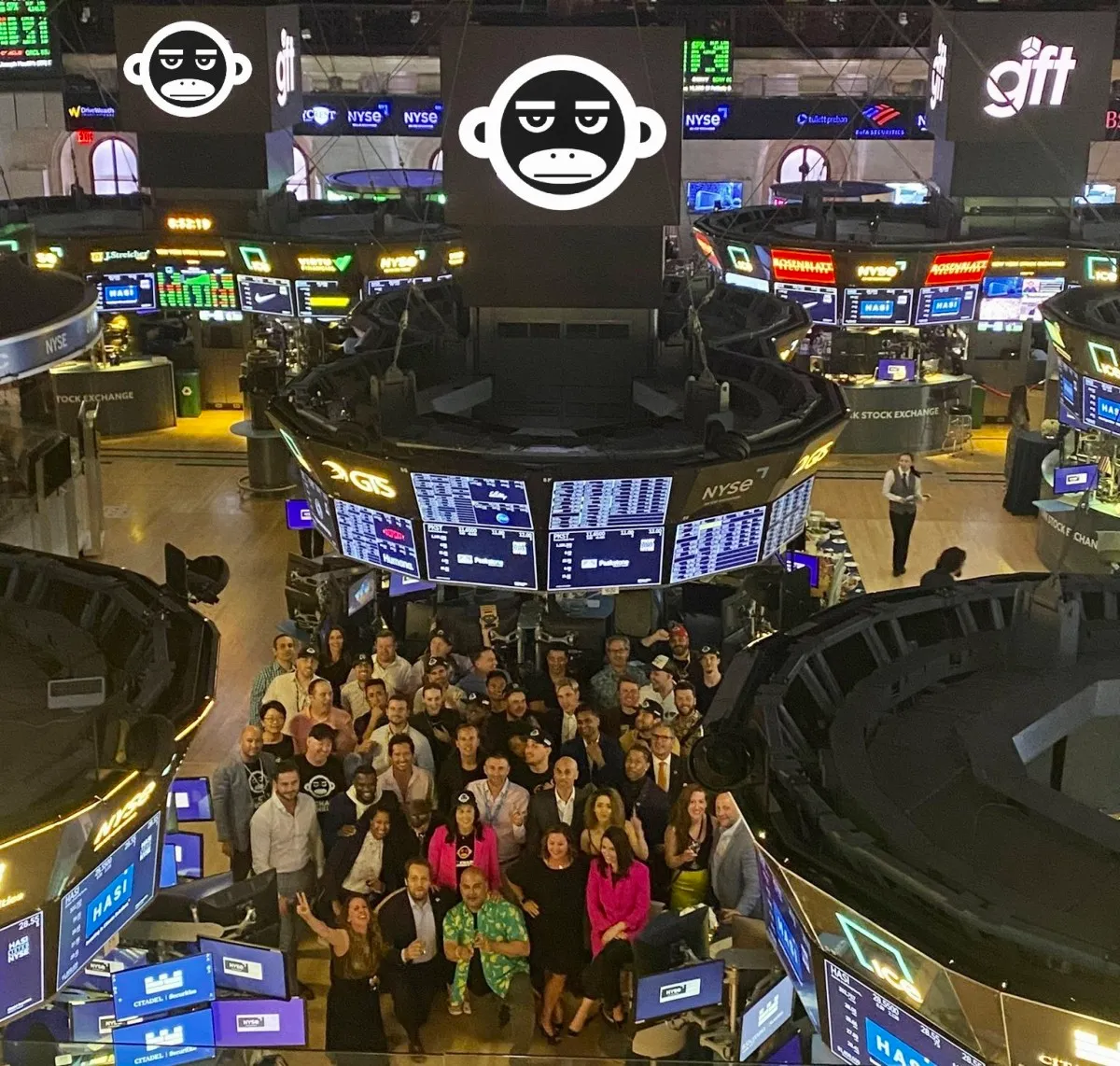
Editor's Note: Ordinals and OnChainMonkey (OCM) have become among the most innovative and significant Bitcoin Ordinals NFTs. In this article, Danny Yang, founder of OnChainMonkey, demonstrates how Ordinals have impacted the Bitcoin NFT ecosystem, explores how OCM leveraged the programmability of Ordinals to redefine digital assets on Bitcoin, and discusses the future direction of the Bitcoin NFT space.
Ordinals: Creating Digital Art with Bitcoin
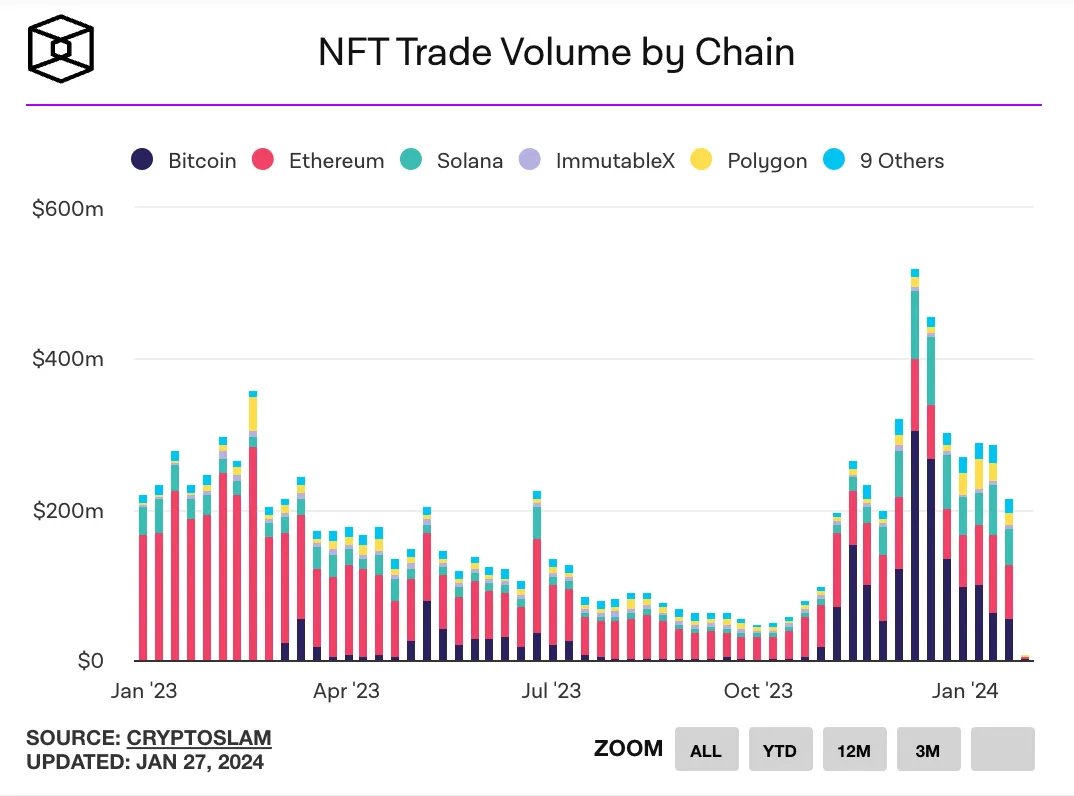
The Ordinals protocol launched in early 2023 at a critical moment for Bitcoin, when transaction fees had remained low due to declining demand. This was a crucial development, as Bitcoin’s renowned security is funded by these fees and block rewards. With the anticipated halving of block rewards in April 2024 significantly impacting miner income, there was an urgent need for a new growth driver. Ordinals effectively fulfilled this role, stimulating a substantial increase in transaction demand. To date, over $200 million in transaction fees have been spent on creating inscriptions—a unique type of transaction specific to Ordinals.

Although NFTs on Bitcoin existed long before ERC-721 (such as Spells of Genesis and Rare Pepes trading cards), the Bitcoin NFT market paled in comparison to those on other blockchains like Ethereum and Solana. However, now, thanks to Ordinals, the Bitcoin NFT market has rapidly caught up to the top NFT markets across all other blockchains. NFTs using Ordinals differ from nearly all other NFTs because the Ordinals protocol treats Bitcoin itself as the medium for NFTs, rather than the typical certificate model used by most NFTs. The launch of Ordinals occurred at a time when the broader NFT market was mature enough to understand this novel form of blockchain-native, on-chain NFTs.
The Ordinals protocol can be distilled into three core concepts: sats, inscriptions, and inscription ownership mapping.
-
Sats: In the Ordinals protocol, the smallest unit of Bitcoin—the sat—is uniquely numbered. This numbering enables tracking each individual sat through Bitcoin transactions. Ownership of sats is determined by the Bitcoin ledger.
-
Inscriptions: The Ordinals protocol allows data to be written on-chain onto the Bitcoin blockchain; these data assets are called inscriptions.
-
Ownership Mapping: The Ordinals protocol links inscription ownership to a unique sat. Therefore, owning the sat is equivalent to owning the inscription.
Through this design, Ordinals NFTs on Bitcoin inherit Bitcoin’s security properties, becoming permanent records on the oldest, most decentralized, most secure, and highest-value blockchain. Like Bitcoin’s founding principles themselves, the Ordinals protocol is permissionless, censorship-resistant, immutable, and complete. Permissionless means we have the right to transfer our NFTs to whomever we choose without needing anyone else’s approval. Censorship-resistant means no third party can censor our NFTs. Immutable means the NFT cannot be altered. Complete means the NFT exists fully on its native medium—Bitcoin (i.e., on-chain). An NFT fulfilling all these properties qualifies as a digital artwork.
The Rise of OnChainMonkey (OCM)
However, Ordinals is more than just a protocol. Like Bitcoin itself, the community that formed around Ordinals has been vital to its rise. Since the 2013 Stanford Bitcoin meetup, I have worked to cultivate this community, culminating in OnChainMonkey (OCM) becoming one of the most prominent Bitcoin Ordinals projects.
OCM was originally launched in 2021 as an art project on Ethereum, representing a fusion of simplicity and innovation. I detailed its creation process in "The Making of OnChainMonkey" (also known as OCM Genesis). OCM stood out due to its unique artistic design and complex on-chain transactions. Notably, all 10,000 unique monkeys were minted within a single Ethereum transaction—an approach that became a defining aspect of OCM’s artistic identity.
Then, in February 2023, the entire set of 10,000 OCM Genesis images and their metadata were inscribed onto the Bitcoin blockchain as inscription #20219. This inscription number is meaningful: as the 20,219th inscription on Bitcoin, it coincidentally reflects the original creation date of the collection on Ethereum—September 2021 (2021.9). This marked the first time such a large volume of images was recorded and preserved on Bitcoin.

One of the most notable aspects of this process was the efficiency of the inscription method. Using a single inscription for the entire collection meant OCM utilized the blockchain medium—a shared resource—with maximum efficiency. Impressively, the transaction recording all 10,000 OCM images consumed less than 20 KB of Bitcoin block space—averaging under 2 bytes per image. This approach ensured the transaction did not impose excessive strain on the Bitcoin network. As Bitcoin usage expands, efficient use of block space—as exemplified by OCM’s methodology—will become increasingly important for all Bitcoin users.
OCM’s core values are embodied in the acronym RISE—Respect, Integrity, Sustainability, and Enrichment. "On-chain" is central to OCM because blockchains provide superior security for digital assets. With the emergence of Ordinals in early 2023, OCM’s strategic shift toward Bitcoin’s new on-chain asset protocol reflected foresight. Despite initial skepticism, our team’s unique experience with Bitcoin since 2013, combined with recent expertise in NFTs and digital art, gave us confidence in this transition. Anticipating rising Bitcoin fees, we committed to growing both the OCM and Ordinals communities, driving the NFT space toward safer, more decentralized, and transparent systems aligned with Bitcoin’s original principles.
Highlighting Ordinals’ Capabilities Through OCM
One of our primary goals has been to clarify the significance of Ordinals and demonstrate optimal use of the Bitcoin medium. This includes showcasing the diverse programmability features of Ordinals, including recursive inscriptions, parent-child provenance, and re-inscriptions.
1. Generative and Recursive Inscriptions on Bitcoin
One powerful feature of Ordinals is the ability to write code directly on Bitcoin. This functionality enables programming directly on the Bitcoin blockchain. It allowed us to efficiently generate all 10,000 on-chain images for OCM. By inscribing a piece of code capable of generating 10,000 SVG image files for the OCM collection, we achieved this feat.
Another advantage of using code is its ability to call other code. OCM was at the forefront of employing a technique called recursive inscriptions, where inscribed code calls other inscribed code. Inscription #20219 was one of the earliest examples of such recursive inscriptions. The code in #20219 can be reused in other inscriptions to access individual OCM images. The concept of recursive inscriptions and the broader application of code will grow increasingly important as Bitcoin evolves. Through recursive inscriptions, all previously inscribed code on Bitcoin becomes a resource for future developers. For example, when developing OCM Dimensions, we were the first to embed JavaScript libraries such as compression, Three.js, and p5.js. Now, creators on Bitcoin are increasingly using these libraries to build innovative new applications. We also provide tutorials and tools for using these popular generative art libraries on Bitcoin.
As Bitcoin fees rise, generative coding methods are crucial to prevent inscription costs from becoming prohibitive. Due to Ordinals’ rapid growth and increased use of Bitcoin block space, Bitcoin fees rose over one hundredfold in 2023. Today, inscribing a single image can cost over $10,000! We adopted the generative approach for OCM Genesis to demonstrate how much can be accomplished on Bitcoin using minimal bytes and fees. Notably, inscribing all 10,000 OCM Genesis images cost only a few dollars.
2. Parent-Child Provenance for Digital Art
A key advantage of NFTs is their ability to establish provenance, and Ordinals introduced a powerful feature called parent-child provenance. This feature traces the origin of a “child” inscription back to its “parent” inscription. For example, when creating an NFT collection on Bitcoin, a parent inscription can be established, from which numerous child inscriptions forming the collection can be derived.
When inscription #20219 was created, it served as the parent inscription for the OCM Genesis collection. At the time, the concepts of parent-child provenance and recursive inscriptions were novel, leading to some misunderstanding about the rationale behind storing an entire collection’s assets within a single inscription. Nevertheless, OCM Genesis emerged as a pioneering collection, demonstrating how parent-child provenance can be used to distribute a 10k collection. Moreover, OCM optimized this distribution through recursive inscriptions, setting a precedent for efficiency.
Parent-child provenance enables tracking ownership transfers—from the collective “parent” (the original inscription of 10,000 OCMs) to individual “children” (each separately owned OCM). Meanwhile, recursive inscriptions help verify that each child inscription is responsible for distributing one of the 10,000 individual elements contained within the parent inscription’s digital artifact.
This process enables the creation of digital artworks on Bitcoin. Take inscription #20219, for instance—it is a digital artwork containing 10,000 unique OCMs (On-Chain Monkeys). This collection meets all the criteria of a digital artwork: complete, ownable, censorship-resistant, permissionless, and immutable.
Initially, the entire set of 10,000 OCMs was owned by a single entity. This is analogous to a car manufacturer like Bugatti producing 10,000 cars and initially owning them all. Once Bugatti sells and delivers a car along with its title and keys to a buyer, that buyer becomes the new owner. Similarly, in the case of inscription #20219, the plan was to transfer the 10,000 OCMs to individual owners. This process was facilitated using parent-child provenance and recursive inscriptions.
3. Cost Savings Through Batch Inscriptions
Creating on-chain records via batch inscriptions is an efficient method that, when combined with parent-child provenance, allows multiple NFTs to be distributed in a single operation. This approach significantly reduces transaction fees and the time (or number of Bitcoin blocks) required to complete the inscription process.
For example, when we applied batch inscription to the OCM Genesis collection, the process of inscribing the full 10,000-piece set was accelerated by 250 times compared to doing so individually. This batching efficiency not only streamlines the inscription process but also optimizes overall resource utilization on the blockchain.
4. Rare and Exotic Sats: The Unique Edge of Ordinals
Ordinal theory precisely tracks every satoshi (sat) in Bitcoin, including those from historic blocks such as Block 9, mined by Satoshi Nakamoto himself. Particularly notable are the sats from Bitcoin’s very first transaction, known as the 450x sats—mined in Block 9 and sent by Satoshi to Hal Finney. These sats, whose numbers begin with 450, are highly prized by sat hunters for their historical and collectible value, making them ideal candidates for engraving digital artworks on Bitcoin.
Within the Ordinals framework, sats are categorized into different rarity tiers—common, uncommon, rare, epic, legendary, and mythic—according to the Rodarmor Rarity Scale designed by Casey Rodarmor, the creator of Ordinals.
The OCM Genesis series leverages these historically significant Block 9: 450x sats. All 10,000 child inscriptions are sequentially inscribed on Block 9 sats, where the last five digits of the sat number correspond to the Genesis number. For example, OCM Genesis #1 resides on sat 45017800001, while OCM Genesis #10,000 is on sat 45017810000. This precise matching of sat numbers not only demonstrates technical mastery in utilizing the Bitcoin medium but also establishes clear provenance and linkage between the sats and the OCM Genesis artwork.
Combining matched sat numbers with generative art opens new creative possibilities. In the case of OCM Genesis, the art is generated by code inscribed on Bitcoin, further embedding the Bitcoin medium into the artistic form through the use of specific sat numbers.
5. Re-inscriptions: Bitcoin Programming’s Unexplored Frontier
One feature of Ordinals is re-inscription, which allows the same sat to be inscribed multiple times. Each re-inscription costs roughly the same as a standard inscription. Importantly, all re-inscriptions occur on the same sat, ensuring they are linked together and transferred collectively. Only the owner of the sat has the authority to inscribe or re-inscribe it. Re-inscriptions are particularly useful for recording state changes, especially with the emergence of Ordinals’ sats endpoint functionality, enabling the development of on-chain programs and applications on Bitcoin.
OCM Genesis leveraged this capability by re-inscribing multiple 10k collections onto the same sats. These re-inscribed collections are essentially “soulbound,” meaning they are permanently linked to the original collection. This connection not only facilitates navigation between collections but also enhances the value of the original set by incorporating additional re-inscribed collections. OCM Genesis pioneered this method by housing four distinct collections within each sat of the original set, showcasing an innovative use of re-inscriptions in digital art and asset management on the Bitcoin blockchain.
Exploring the Future of Digital Assets on Bitcoin
Bitcoin’s role in securing digital assets beyond its native token is still in its infancy. Infrastructure is being developed, but the potential is immense. The success of asset markets on other blockchains—such as Ethereum and Solana—suggests Bitcoin may follow a similar growth trajectory, driven by innovations like Ordinals. Works like OCM Genesis demonstrate the future possibilities of assets within the Bitcoin ecosystem, pointing toward a bright future for digital assets on this platform.
One of the most fascinating aspects of the Ordinals protocol is its reimagining of the popular 10k collection format as an art form on Bitcoin. The 10k collection has become a significant artistic format in the NFT world, with many projects adopting this structure. On Ethereum, creating a set of 10 or 10,000 items is almost equally simple. However, on Bitcoin, creating a 10,000-item collection is far more expensive and complex than smaller sets. This complexity arises because each NFT must be a unique, on-chain digital artwork, making each creation costly and immutable. A single error in any NFT could necessitate abandoning the entire collection. Techniques like parent-child provenance and sequential numbering further complicate the process, increasing the risk of errors in large-scale collections. Therefore, successfully creating a 10k collection on Bitcoin—such as OCM Genesis—is a remarkable achievement that highlights Bitcoin’s potential as a medium for digital art.
Another exciting avenue we’re exploring is the possibility of encoding ownership certificates directly on Bitcoin—a process fundamentally different from Ethereum. Ethereum’s model involves owning a tradable certificate of a digital item, typically stored off-chain. In contrast, digital items on Bitcoin are stored on-chain, allowing them to be directly owned and traded. OCM Genesis explored these concepts by transferring ownership from Ethereum to Bitcoin through a process called teleburn, where Ethereum-based assets are bound to corresponding Bitcoin inscriptions. The Ethereum asset becomes “soulbound” to the Bitcoin inscription, with ownership transferred to whoever holds the Bitcoin inscription. Furthermore, ownership certificates are inscribed on the same sats, serving as proof of ownership for the teleburned Ethereum assets. This concept is part of OCM Genesis’ unique artistic expression and represents a step toward securing real-world assets on Bitcoin, potentially including titles, deeds, and securities.
As we enter 2024 and the second year of the Ordinals protocol, much remains to be explored. We at OCM remain deeply excited about the future of this space and are committed to forging ahead—reimagining the concept of digital assets on Bitcoin and truly exploring Ordinals as a canvas for digital innovation.
Join TechFlow official community to stay tuned
Telegram:https://t.me/TechFlowDaily
X (Twitter):https://x.com/TechFlowPost
X (Twitter) EN:https://x.com/BlockFlow_News
 Stanford Blockchain Club






