









Delphi Researcher: Opening the Box of ERC-404 and Pandora
TechFlow Selected TechFlow Selected
Delphi Researcher: Opening the Box of ERC-404 and Pandora
NFTs can benefit from greater fungibility.
 Navigating Web3 tides with focused insights
Author: Teng Yan, Head of NFT Research at Delphi Digital;
Translation: 0xjs@Jinse Finance
Pandora/ERC404 was born from a rug pull.
It all began with a new token called EMERALD. Conceptualized as a hybrid of ERC-20 (fungible) and ERC-721 (non-fungible) tokens, it was compromised due to inadequate development.
From the ashes emerged a determined trio: 0xacme (a former Coinbase engineer), ctrl, and searnsleele, committed to turning this idea into reality.

My mom told me to be careful when opening boxes
And they did. Since its launch on February 2, Pandora—the first ERC404 token—has experienced explosive growth, skyrocketing from obscurity to a market cap exceeding $100 million.
Its rise has sparked intense excitement around launching new 404 tokens. Within just two weeks, we’ve already seen the emergence of alternative 404 token standards. For example, cygaar, a well-known developer in the space, launched DN404—an enhanced, open-source token standard with characteristics similar to ERC404.
But why all the fuss?
(For simplicity, I’ll refer to ERC404, DN404, and similar token standards collectively as "404.")
NFT Fractionalization Has Failed
NFT fractionalization is nothing new. For years, there's been fascination with splitting NFTs into smaller parts.
The idea is simple: today, a CryptoPunk NFT might be worth $150,000. Very few people can afford an entire Punk.
What if you could own 1/100th of that same Punk for just $1,500? Suddenly, access becomes much more attainable. If the Punk doubles in value during the next NFT bull run, that $1,500 investment could surge to over $4,500.
Yet, previous attempts at fractionalization have consistently struggled to gain traction:
NFTX has tried for years to achieve this through fractional vaults (deposit a Punk NFT and receive fungible PUNK tokens), but even today it hasn’t seen widespread adoption.
Flooring Lab launched a similar concept months ago: deposit an Azuki NFT and receive 1,000,000 uAzuki tokens, which can then be traded like meme coins. It performed decently, largely because it used a new token, FLC, to incentivize liquidity and bootstrap the protocol.
In my humble opinion, despite good intentions, these types of protocols are nearly dead on arrival.
To begin using these fractionalization protocols, users need to approve multiple transactions—each costing gas fees. Both the monetary cost and the mental effort required to understand each step add up quickly. There’s always concern that mistakes could result in losing valuable NFTs. For most people, perpetual NFT derivatives (like nftperp or Tribe3) may be a more efficient way to gain exposure to NFTs.
Here’s the difference: 404 solves the user experience issues associated with fractionalization by defaulting to fragmentation while allowing seamless recombination into whole NFTs.
Yes, it's an old tech adage: fewer steps = higher conversion.
I’ve considered two complementary angles for the potential use cases of 404:
-
Can NFTs benefit from greater fungibility?
-
Can fungible tokens benefit from becoming NFTs?
1. Can NFTs Benefit From Greater Fungibility?
Liquidity reigns supreme in crypto.
Fractionalization can greatly enhance liquidity by enabling investors to buy and sell affordable NFT shares, thereby expanding the market of potential participants.
Additionally, fractionalization enables faster price discovery. In 2023, many NFTs experienced slow downtrends due to inherent illiquidity, prolonging the time needed for fundamentals to align with prices.
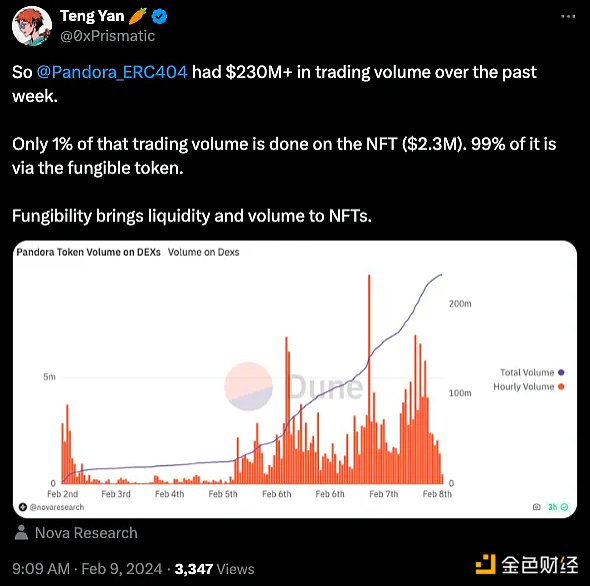
To illustrate how fungibility boosts liquidity, look at what happened with PANDORA: 99% of trading volume occurred via the fungible token rather than the NFT.
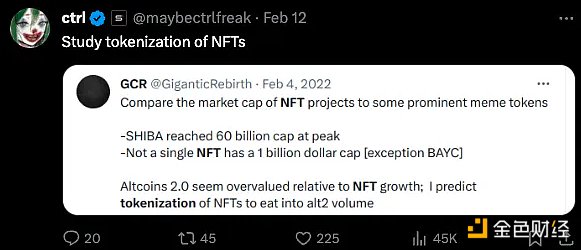
@Ctrl believes that by making NFTs fungible, NFT collections (currently valued at around $1 billion at the top end) could see valuations closer to those of top meme coins ($60 billion), thanks to increased capital velocity.
This opens up some intriguing use cases for 404 tokens:
1. High-value art and collectibles. These are typically extremely scarce and valuable. Tessera, backed by Paradigm, attempted this via its fractionalization platform but had to shut down last year due to limited adoption. A key hurdle was efficiently reassembling split NFTs post-transfer—a process often bogged down in complex DAO governance. 404 tokens alleviate this issue.
2. Real estate: With the RWA trend, real estate is being tokenized on blockchains. Various startups have explored different approaches—from using NFTs to directly represent properties (Roofstock) to leveraging fungible tokens for ICO-like fundraising to acquire properties (CitaDAO). 404 has the potential to merge these models.
Palette is one example: a collection using 404 to introduce native fractionalization into generative art, offering a “re-roll” feature for artworks in its collection. It adds a new interactive layer, making art collecting more engaging.
2. Can Fungible Tokens Benefit From Becoming NFTs?
While 404’s focus has primarily been on increasing NFT fungibility, there’s another side: fungible tokens can also benefit from being transformed into NFTs.
Here’s how various types of fungible tokens could get a major upgrade through 404:
Governance tokens grant holders voting rights within a DAO. By enabling these tokens to also become NFTs with varying reputation statuses (in metadata) based on contributors’ track records, new dimensions of governance emerge. Imagine a governance NFT that grants different levels of access to exclusive features depending on a holder’s historical community participation. This incentivizes active engagement and fosters a more meritocratic governance model.
Utility tokens can incorporate unique traits to deliver personalized experiences. For instance, a gaming platform’s token could be tied to an NFT featuring unique in-game assets or abilities based on traits and rarity. This not only enhances community engagement around the token but also creates new utility layers.
Memecoins (e.g., WIF, DOGE, PEPE)—typically tied to internet culture and viral trends—can leverage NFT mechanics to better engage and grow their communities. By introducing rare traits and loot box mechanisms, they can gamify user interactions. The 2021 NFT bull cycle demonstrated how much we love “shitcoins with pictures.” Merging memes and NFTs amplifies fun and strengthens community belonging.
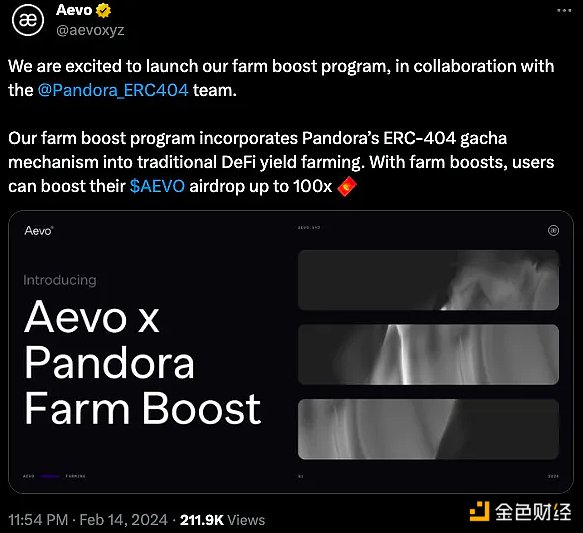
Aevo, an options and perpetual contracts DEX, is a pioneer in integrating 404 tokens. It leverages 404 mechanics on the backend to make DeFi liquidity mining more engaging. When users farm AEVO airdrops by trading on the platform, they stand a chance to earn a 100x farming boost.
What’s Next for 404?
The 404 community will likely work to refine their token standard and address issues such as gas costs. Collaborating with protocols and ensuring exchanges and block explorers support these standards will be critical priorities. Open-sourcing encourages broader participation in 404 development.
However, meaningful use cases will take time to emerge. We've seen this story before with new token standards:
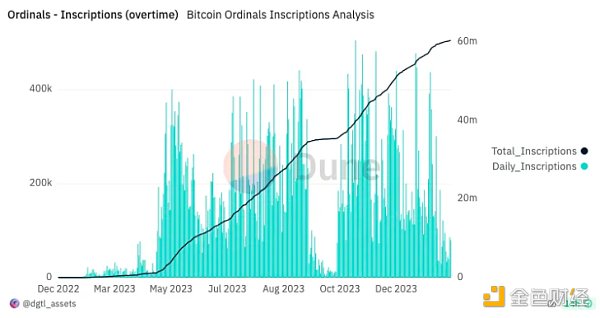
Ordinals (Bitcoin NFTs) launched in December 2022, but inscriptions didn't go parabolic until April 2023—four months later.
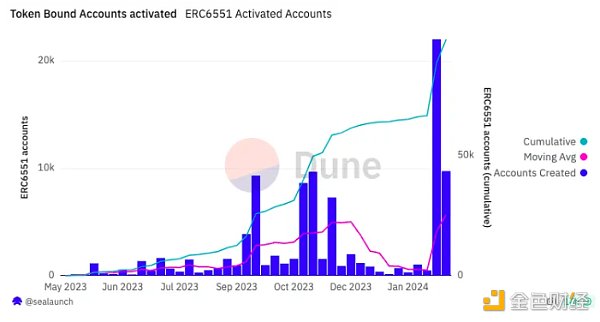
Likewise, ERC-6551—a breakthrough standard enabling NFTs to own wallets—launched in May 2023 and is now gaining momentum after six months.
Building novel use cases and educating users about 404’s potential will undoubtedly take time. Yet, these are essential steps toward realizing 404’s long-term vision.
But What About Pandora?
Despite being the creator of the first 404 token, Pandora lacks any direct value accrual mechanism. Using the 404 standard generates no fees. After all, 404 is designed to be open-source and freely accessible to all.
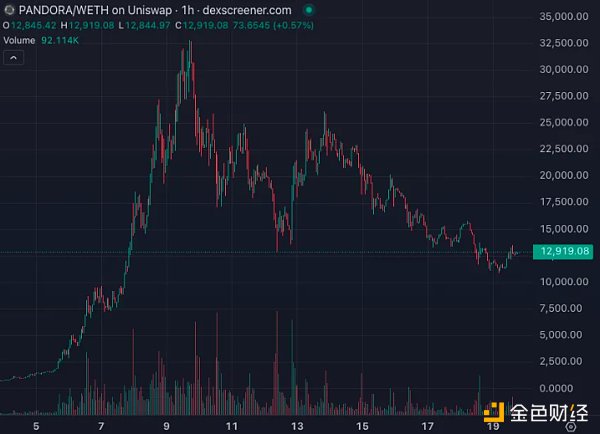
The market is recognizing this: after initially surging to $32,000 amid speculative fervor, PANDORA’s price has since dropped 60% to $12,600.
Nevertheless, two compelling narratives may unfold for Pandora in the coming days:
1. Memecoin: As the first 404 token, if 404 gains broader adoption, Pandora could attract significant attention—similar to ORDI’s astonishing $1.5 billion market cap, driven purely by being the first BRC-20 token.
2. “TIA”: Similar to how TIA saw exponential price growth driven by stakers anticipating a Cosmos protocol airdrop, new 404 projects may distribute airdrops to Pandora holders, who are likely early believers in the 404 ecosystem. For example, Palette plans to airdrop 5% of its tokens to Pandora holders.
Undeniably, tokens supporting new functionalities are exciting. Innovations like these are exactly what fuels progress in crypto.
Join TechFlow official community to stay tuned
Telegram:https://t.me/TechFlowDaily
X (Twitter):https://x.com/TechFlowPost
X (Twitter) EN:https://x.com/BlockFlow_News
 Delphi Digital











