









Is it legal to run mining operations in blockchain games?
TechFlow Selected TechFlow Selected
Is it legal to run mining operations in blockchain games?
In blockchain gaming "mining," there is no policy risk related to virtual currency mining; instead, entrepreneurs of blockchain gaming platforms need to pay more attention to legal risks concerning illegal fundraising.
 Navigating Web3 tides with focused insights
By Shao Shiwei
In September 2021, the National Development and Reform Commission (NDRC) and other government departments jointly issued a notice titled "On Rectifying Virtual Currency 'Mining' Activities" (hereinafter referred to as the "Notice"), effectively banning cryptocurrency mining in China. Around that time, blockchain games began gaining popularity. Is there any connection between these two developments? Some people argue that while traditional crypto mining relies on machines, blockchain gaming is essentially "human mining," with little fundamental difference. Given China's ban on mining, what legal risks might developers face when launching blockchain gaming platforms domestically?
Is Playing Blockchain Games Equivalent to Mining?
To answer this question, we need to understand two key concepts: virtual currency mining and liquidity mining.
1. What is Virtual Currency Mining?
In blockchain terminology, "mining" refers to a reward mechanism for miners who maintain the network. To incentivize data validation and maintenance, blockchains implement a rule where individuals who process transactions fastest and most accurately—and gain system approval—receive newly minted virtual currency (such as Bitcoin) as a reward. This method of acquiring cryptocurrency through computational work is known as "mining," and participants are called "miners," responsible for transaction confirmation and block creation.
2. What is Liquidity Mining (Yield Farming)?
Liquidity mining is an application within DeFi (decentralized finance), referring to mechanisms where users provide token assets to support a project’s liquidity pool in exchange for rewards. For example, by depositing or borrowing tokens on the Compound lending platform, users enhance the liquidity of its funds and earn COMP governance tokens as compensation. At its core, liquidity mining serves as a token distribution strategy designed to improve usability and encourage user participation in DeFi protocols.
Simply put, depositing tokens generates returns—referred to metaphorically as "mining," borrowing from the original concept of cryptocurrency mining. The returns from liquidity mining typically include governance tokens and trading fees.
For instance, imagine a new bank offering interest (fees) to depositors. To boost liquidity further, it also distributes shares of its own stock. As the bank grows, those shares increase in value; if the bank fails, the shares become worthless. Simply having money in your account supports the bank’s deposit and withdrawal operations. In the crypto world, this same principle is termed "liquidity mining."
3. How Are Blockchain Games Related to Mining?
Now that we’ve clarified the above concepts, how exactly are blockchain games related to mining?
Most existing blockchain game projects require players to invest money ("pay-to-play") to participate. This involves certain prerequisites: first, creating a cryptocurrency wallet (e.g., MetaMask); then purchasing stablecoins like USDT from a cryptocurrency exchange; followed by using these coins to acquire the game platform’s native tokens. Once inside the game, depending on the game type, players can earn more in-game tokens or items through activities such as leveling up, battling monsters, or breeding digital pets. These earned tokens or items can then be traded on cryptocurrency exchanges for other digital currencies. Subjectively, players engage in this cycle hoping to "play-to-earn." Objectively, their trading activity provides liquidity across different cryptocurrencies on exchanges.
Take Mobox, founded in 2020, as an example—a blockchain gaming platform built around DeFi-based liquidity mining. One of Mobox’s core features leverages liquidity mining: users provide liquidity for the MBOX/BNB trading pair on PancakeSwap (a decentralized cryptocurrency exchange), then stake the received LP (liquidity provider) tokens on Mobox to earn additional MBOX token airdrops.
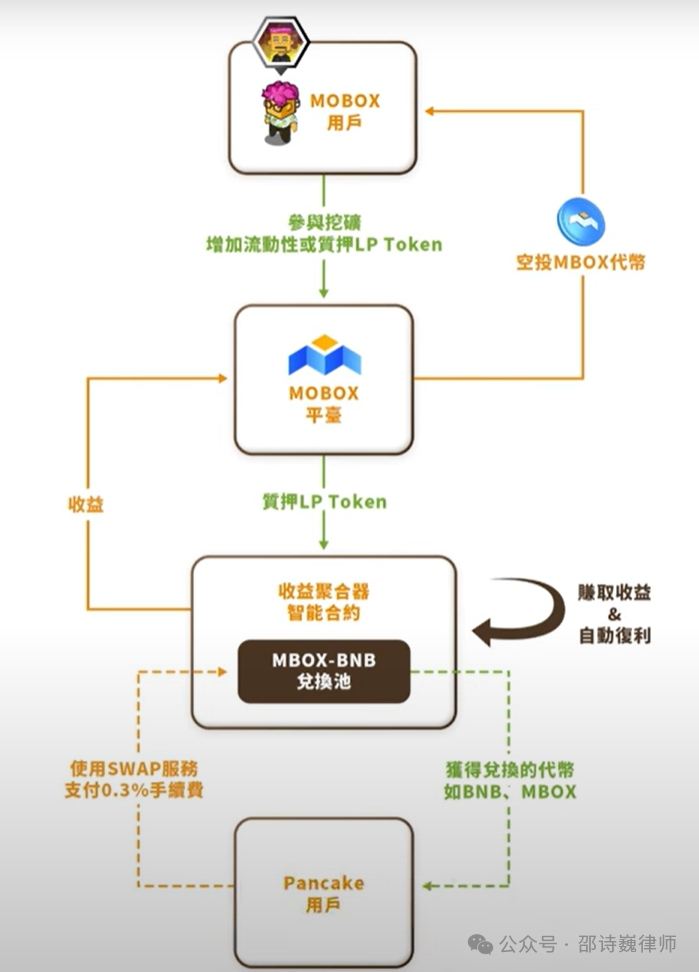
Image source: YouTube
What Legal Risks Exist for Developing Blockchain Gaming Platforms in China?
The common characteristics among virtual currency mining, liquidity mining, and play-to-earn blockchain games lie in investing human and material resources to complete tasks and receive rewards. Does the 2021 Notice mentioned earlier restrict blockchain game "mining"? The answer is no.
This is because the Notice specifically targets virtual currency "mining" activities—which involve large-scale purchases of mining hardware and graphics cards, consuming vast amounts of electricity. In practice, cases like Bitcoin mining often lead to criminal charges such as theft (of electricity). While liquidity mining and blockchain gaming may share conceptual similarities with traditional mining, they do not involve excessive power consumption or waste national energy resources.
But does the absence of policy restrictions under the Notice mean there are no legal risks at all? For blockchain game developers, two high-frequency legal risks must be carefully considered: operating a gambling business and illegal fundraising offenses.
For analysis regarding gambling-related risks, readers may refer to attorney Shao’s previous article, “How Can Play-to-Earn Blockchain Games Avoid Becoming Gambling?” Here, we focus on illegal fundraising crimes.
"Illegal fundraising" is not a standalone criminal charge under Chinese law but primarily encompasses two specific crimes: Illegal Absorption of Public Deposits and Fundraising Fraud.
First, the crime of Illegal Absorption of Public Deposits. According to the Supreme People's Court's judicial interpretation on handling illegal fundraising cases, this offense can be summarized by four key characteristics: illegality, publicity, inducement, and non-specificity.
Publicity and non-specificity are inherent traits of nearly all blockchain game projects—meaning they publicly promote themselves and solicit funds from an undefined group of users. Even if some projects use invitation codes or other access barriers, courts generally still recognize them as meeting the criteria of publicity and non-specificity.
Therefore, to minimize the risk of being accused of illegal absorption, blockchain game platforms should eliminate both "illegality" and "inducement" in their design and marketing. Specifically, "illegality" refers to violating the 2017 "Announcement on Preventing Risks of Token Issuance and Financing," which prohibits domestic platforms from facilitating direct exchanges between fiat currency and tokens/virtual currencies, or acting as central counterparties in buying/selling such tokens. "Inducement" means promising principal protection, guaranteed returns, or fixed income during promotional activities.
Second, Fundraising Fraud. This refers to raising funds with the intent to illegally possess them—such as squandering raised funds, using them for illegal purposes, hiding assets, or evading repayment obligations. Although blockchain games leverage decentralized, tamper-proof features of blockchain technology, it's undeniable that in China, fully decentralized operation is practically unfeasible. Among public chains, private chains, and consortium chains, only public chains offer high levels of decentralization. Private chains operate within limited nodes, theoretically allowing collusion between operators and malicious players to harm others.
Conclusion
Based on the analysis above, we conclude that "mining" in blockchain games does not fall under the policy prohibitions targeting virtual currency mining. Instead, entrepreneurs developing blockchain gaming platforms should primarily focus on mitigating legal risks associated with illegal fundraising. Platforms should avoid features involving "illegality" and "inducement" through compliant marketing practices and thoughtful game design. Additionally, partners should sign internal agreements to protect against situations where one shareholder damages the platform or player interests, potentially harming other shareholders as well.
Join TechFlow official community to stay tuned
Telegram:https://t.me/TechFlowDaily
X (Twitter):https://x.com/TechFlowPost
X (Twitter) EN:https://x.com/BlockFlow_News












