








Interview with Keone, Monad Co-Founder: The Innovative Path to Optimizing EVM
TechFlow Selected TechFlow Selected
Interview with Keone, Monad Co-Founder: The Innovative Path to Optimizing EVM
A key advantage lies in Monad's potential to enable broad composability that surpasses Ethereum's existing limitations and even outperforms higher-performance systems like Solana.
 Navigating Web3 tides with focused insights
Authors: Snownad & Danny
Translation: TechFlow
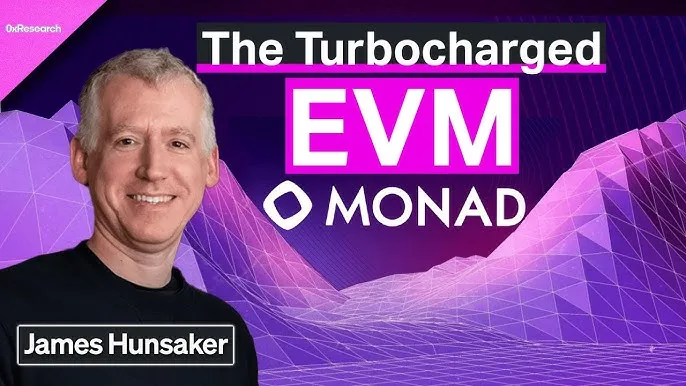
Keone Hon, CEO and co-founder of Monad Labs, and Kevin G, Developer Relations Engineer, joined the third episode of The Pipeline podcast to discuss the work the Monad Labs team has been doing over the past two years.
Guests:
Keone is CEO and co-founder of Monad Labs. Prior to that, he worked as a quantitative analyst at Jump Trading, focusing on high-frequency trading (HFT);
James Hunsaker is co-founder and CTO of Monad;
Kevin G is a core developer at Solana Labs, previously working at Apple on local systems engineering for AirPods.
Why choose Monad? In an environment where L2s and other scaling solutions are so popular, why rebuild the EVM?
Keone:
When we first started a few years ago, many people asked us, "Why not just build an L2?" Our answer then—and now—is that we believe someone needs to focus on improving the performance of the EVM execution stack. By introducing optimizations such as parallel execution, a custom state database, pipelined execution, and support for asynchronous I/O, Monad can better leverage hardware to achieve a more efficient and decentralized system.
Over time, it's become increasingly clear that many bottlenecks in the Ethereum Virtual Machine can be addressed and optimized by the right engineering team. Back in 2020, when Monad was first conceptualized, there weren’t many teams focused on these kinds of optimizations—especially compared to the effort going into other infrastructure like rollups, zero-knowledge proofs, or data availability.
As the dominant standard for smart contracts, EVM chains have the largest TVL, the biggest developer and research network, and an incredible community that has stood the test of time (and multiple bear markets). When we want to expand adoption and support more complex applications, this makes optimization even more important.
"Dramatically improving EVM performance is indeed an interesting and challenging problem. I'm glad our team started working on this early. It excites me, and I look forward to showing it to the world in the coming months."

EVM performance meets scalability on Monad
Kevin G:
Much of what Monad is doing involves applying best practices from computer science to blockchain networks. This is possible because the team has such deep expertise in this domain.
Not every development team can tackle fundamental protocol issues and deliver high-performance solutions. These optimizations are not only exciting—they’re ambitious.
How did you assemble a team capable of tackling this challenge?
Keone:
I feel incredibly lucky to have such an outstanding group of people at Monad Labs—talented individuals across engineering, growth, marketing, community building, and business development. We're around 25 people, trying to keep the team super lean so we can stay focused on the problems we need to solve.
Over time, we'll continue to grow the team to support the scale and adoption we aim to achieve. That will certainly require broader skill sets and additional manpower.
Most of our engineering team has extensive experience building high-performance, low-latency systems. A common pattern in developing truly high-performance foundational systems is that you need a deep understanding of overall system performance. Sometimes you have to go down to the kernel level to get the optimizations you need. At the end of the day, a blockchain is essentially a database.

Some beloved Monad characters have cemented their place in community lore
Why should builders take a look at Monad?
Keone:
A key advantage lies in Monad’s potential to enable broad composability beyond the current limitations of Ethereum—even surpassing higher-performance systems like Solana.
Because Monad is compatible with EVM bytecode and RPCs, the learning curve for engineers is much lower than in many other environments. We’re excited to leverage the vast amount of research and tools that have fueled the EVM ecosystem, enabling developers to build high-performance, scalable applications within an environment they already know and trust.
What is Monad’s strategic positioning within the broader Layer 1 landscape?
Keone:
The ultimate goal is to create a more scalable and cost-effective platform for building diverse applications, removing the constraints that currently hinder composability in existing blockchain ecosystems.
In the context of Ethereum’s original design: the intent was to empower builders to create anything within its ecosystem. Monad represents an acceleration of that vision, breaking free from limitations that have persisted for over a decade. We can draw a parallel to the shift from internal combustion engines to electric vehicles—an analogy for the paradigm shift enabled by new technology.
Considering real-world challenges faced by Ethereum developers, such as gas limits: without these constraints, there would be far more applications and features on Ethereum, but they’ve been disabled due to prohibitively high costs. One of Monad’s primary goals is to liberate existing EVM applications from today’s gas limitations.
Monad also leverages the rich ecosystem of existing code and products within the EVM space, providing an ambitious builder with a platform to create dApps that simply aren't possible elsewhere.
Overall, Monad emphasizes the collective nature of the crypto community. Right now, we're in an experimental phase where crypto enthusiasts are building applications for decentralized personal finance. Monad aims to make these applications more cost-effective, unlocking their true potential and expanding them to a broader user base.

What types of applications are you most excited to see built on Monad?
Keone:
For me, there are two areas I’m most excited about—DeFi and consumer-facing applications.
DeFi
Any application that allows ordinary people to manage their personal finances in a decentralized way. Of course, things like money markets, decentralized exchanges, derivatives, high-precision and high-scale oracles. This is a vertical I’m extremely excited about.
Before Monad, I was part of Jump Crypto. Jump is deeply interested in and excited about the Solana ecosystem because it makes sense. If fees are just a fraction of a cent and you can scale to millions of users, you can essentially replace what the current incumbents do. Centralized exchanges charge very high fees for data.
One reason we love Solana is that it's fantastic technology. Although it lacks EVM compatibility, which can make the development experience a bit tricky, Solana has come a long way since James and I started working on it back in 2021.
Consumer Applications
I'm also very excited about consumer-facing applications on Monad—things like sports betting, casinos, social apps, basically anything that makes sense as a mobile app on your phone.
If I know all my data lives securely in my wallet, I’d be much more willing to interact with apps, services, and content—because wallets are cryptographically secure.
What aspects of the EVM excite you most about Monad’s direction?
Keone:
For me, it's about building something that ultimately helps the greatest number of developers scale their applications. At its core, Monad is a developer platform. Going where developers already are and solving their real, pressing problems is crucial. I believe pure EVM compatibility is part of solving those problems, but there will be future challenges too—essentially making support for more cryptographic capabilities easier and cheaper.
Ultimately, it's about solving the barriers that prevent developers from building apps that rank #1 in the iOS App Store. For me, I believe the EVM is the best place to achieve that.
It's surprising that no one has really focused on the execution stack. Given our team’s background and how critical we believe solving this problem is, this was a very natural area to work on.
Monad offers a real path to product-scale realization of the ideals of the EVM and Ethereum communities.
"At the end of the day, Monad is a really cool combination—we can have a Solana-like user experience on top of EVM. Then developers can choose where to build based on their system needs."
Collaboration is really important. Our team recognizes we don’t have all the answers. We’re experts in building high-performance parallel systems, Byzantine fault-tolerant consensus, and other very specific problems. But there are many others who’ve invested heavily in Ethereum research, focusing on MEV minimization, governance, cryptography, and more. So I think it's important to follow standards and ensure our work composes well with others’.
Kevin G:
The EVM is central to so much applied cryptography research, application building, and improved security practices. Being positioned at the standard and helping push the entire field forward is great.
This allows us to focus deeply on scaling the base layer (our strength) while leveraging the expertise of the research community in this space. Plus, we don’t have to rebuild all the developer tools already developed for EVM.
What’s the biggest challenge for builders in the EVM environment?
Keone:
I think there are several. Right now, raising capital is quite challenging for builders—the investor community is heavily biased toward the U.S. For international builders, securing funding is genuinely difficult.
Additionally, from a security standpoint, building dApps is challenging. There are countless black-hat hackers constantly probing for vulnerabilities and attack opportunities. This makes the environment highly adversarial. We need better security practices, including gas optimization.
By drastically reducing gas costs, Monad removes a major trade-off developers face: whether to include additional defensive assertions—which consume more gas.

A Monad community member showcasing his new mural in Turkey
What’s an overlooked advantage in building crypto products?
Keone:
The strength of the crypto community is astonishing. If you're building a traditional tech startup and your Twitter has no followers, you can post updates, but nobody cares. No one rushes to try your product. You have to jump through hoops just to get people to try it for free.
In crypto, we have such a powerful community (which is actually core to the product)—this is a massive advantage over other tech sectors and one reason why crypto will ultimately succeed. It's about leveraging strengths and minimizing weaknesses, allowing our industry to scale.

In November 2023, the community created an early ecosystem map for Monad
As an industry, blockchain is just beginning to mature. Over time, blockchains will become higher-performing (by then, I don’t want Monad to stand out just because of performance).
Other systems will make further improvements, and there will be cross-pollination of ideas and technologies. This will ultimately push the space forward, enabling the creation of higher-performance applications. We’ll continue pushing the boundaries of what’s possible in blockchain and introducing new infrastructure to support novel implementations.
There’s a lot of discussion on Crypto Twitter about TPS as a general transaction and voting metric. When is TPS a valuable metric?
Keone:
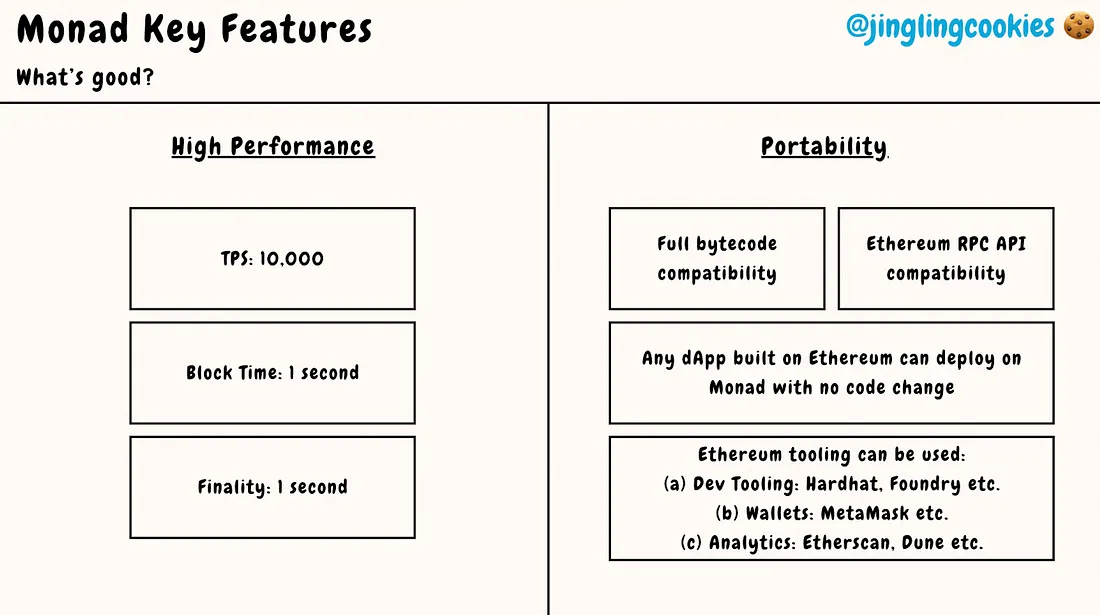
Regarding general TPS measurement, we believe it should only count real transactions—smart contract interactions and transfers occurring on-chain—not just voting transactions. For Monad, we won’t include votes in any TPS figures we present.
Generally, there's a lot of confusion about what qualifies as a real transaction. Many teams use different metrics to count transactions. The field is very inconsistent in how performance is marketed. For example, some count one transaction as one instruction. So if a single smart contract call executes several sub-instructions, others might count it as roughly 10 transactions, which is actually incorrect.
The only thing you can truly measure is the number of transactions passing through the system. If the system isn’t fully loaded at any given moment, the observable TPS will be much lower. So there’s a lot of confusion here too.
I believe the real solution is having reproducible benchmarking in a GitHub repository. Every team should contribute to this repository and release a complete script defining the process of deploying many different servers around the world. The script should then send a large volume of transactions to various nodes in the system and actually reproduce full transaction throughput testing.
This is something our team plans to introduce—at least for Monad, but hopefully for competitive benchmarking in general. It’s similar to the normal scientific process: you don’t just publish your results—you publish the process used to generate them. That way, third parties can rerun the experiment and reproduce the benchmarks. This is very important to us, and it’s what we intend to do.
Join TechFlow official community to stay tuned
Telegram:https://t.me/TechFlowDaily
X (Twitter):https://x.com/TechFlowPost
X (Twitter) EN:https://x.com/BlockFlow_News
 @pipeline_xyz






