Crypto + AI Ecosystem Applications: Potential Opportunities and Most Comprehensive Overview
TechFlow Selected TechFlow Selected
Crypto + AI Ecosystem Applications: Potential Opportunities and Most Comprehensive Overview
The convergence of crypto and AI is becoming the next mainstream crypto narrative.
 Navigating Web3 tides with focused insights
Author: Accelxr, 1kx
Translation: DAOSquare
Artificial intelligence is an accelerating technology that will profoundly shift societal trends, reshape economies, transform industries, and introduce new forms of online interaction.
While many consider crypto's intrusion into the AI world unnecessary, we believe it represents a crucial synergy. As restrictions tighten around the production and distribution of AI models, a fast-moving, anti-authoritarian open-source community is rapidly emerging to challenge well-funded centralized solutions and governments. Crypto remains the best tool yet for fundraising and managing open-source tools—standing in stark contrast to external pressures. This alone makes for an ideal match, not even accounting for AI’s impact on authenticity, provenance, identity, and other areas where crypto can naturally provide remedies or improvements.
There are countless rabbit holes to explore here, and this article attempts to cover as many as possible, serving as a broad overview of the emerging landscape at the intersection of Crypto x AI—so far and into the foreseeable future.
Creativity
The first wave of interest in AI recently centered on creative generation tools. Generative AI reduces users’ dependence on technical skills such as programming or advanced software proficiency, enabling anyone with basic digital experience to create complex works and produce professional-grade outputs at minimal cost.
This could have massive implications for the creative industries, including:
Anyone can now become a creator. As human-AI co-creation becomes more common and sophisticated, collaborative creation modes—akin to multiplayer experiences—will flourish like never before.
Niche communities can now produce high-quality work that was previously limited by audience size and commercial viability.
Generative content will flood the internet at speeds far exceeding human output, potentially leading to a revaluation of human-created online content.
Below are discussions on some innovative media deeply interacting with AI.
Art
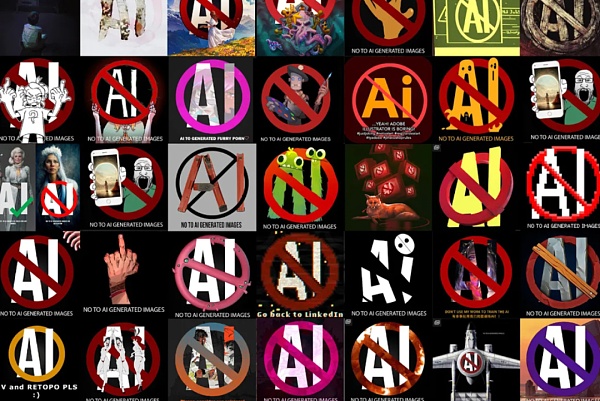
“AI art isn’t real art” is a common refrain among those resisting the rise of AI tools. The release of generative models sparked strong backlash and protests, such as those seen on ArtStation. Yet, they’ve ignited excitement within some of web3’s most interesting creative verticals.
AI art comes in many forms, most famously through popular generative models like DALL-E, Stable Diffusion, and Midjourney. Web3 competitors like ImgnAI aim to enhance the social experience around generative image creation, driven by tokenomics—an essential ingredient for building community moats around these models.
However, acclaimed AI artists often engineer and fine-tune their models in unique ways to produce distinct results, going beyond simple prompting. This may involve training new embeddings, using LoRAs to refine styles, or even building entirely custom models.
Popular artists who use more complex, personalized models to release AI art as NFTs include Claire Silver, Ivona Tau, Roope Rainisto, Pindar van Arman, Refik Anadol, and Gene Kogan. These artists have experimented with various distribution channels, most notably AI-specific marketplaces like Braindrops, Mirage Gallery, and FellowshipAI, as well as event platforms like Bright Moments tailored to artistic formats.

Vertical subfields of AI art have also emerged, such as post-photography and data art. Post-photography, championed by the Fellowship.ai team in collaboration with Roope Rainisto, has brought more artists exploring this medium into the spotlight. Much of the post-photography aesthetic embraces visual artifacts commonly found in early generative tools. Roope Rainisto’s “Life in West America” series, published on Braindrops, has gained increasing attention on social media.
In data art, Refik Anadol stands out as a leading artist known for creating immersive installations using data, algorithms, and AI. Notable examples include “Unsupervised,” which transforms MoMA’s metadata into a real-time generative artwork, and “Sense of Place,” which uses live environmental data—wind, temperature, humidity, and signals from Bluetooth, Wi-Fi, and LTE—as input sources.

Another fascinating vertical is a new content medium enabled by crypto: on-chain autonomous artists.
The most famous example is Botto, a community-governed generative artist that creates 350 artworks weekly in cycles called “rounds,” each composed of multiple individual “fragments.” Every week, the BottoDAO community votes on these fragments, using their aesthetic preferences to guide Botto’s future algorithmic development, ensuring the art evolves under community influence over time. The winning fragment each week is minted and auctioned on SuperRare, with proceeds returned to the community. After completing its “Fragmentation” and “Paradox Periods,” Botto is currently in its “Rebellion Period,” integrating newer technologies like Stable Diffusion 2.1 and Kandinsky 2.1, and exploring collaborative and curated collections within its weekly rounds. Botto ranks among SuperRare’s top-earning artists and has even attracted its own collector DAO, CyborgDAO. Projects like v0 are also exploring the integration of tokenomics with AI art models, aiming to provide a platform where multiple artists can build their own on-chain art engines governed by holder communities.
A common critique from the crypto space when discussing any form of AI art collection is that the artist curation reduces blockchain interaction, unlike more classic generative art (e.g., Art Blocks). These outputs aren't generated from chain-specific randomness but are hand-selected by the artist and embedded into the collection after numerous permutations. Although digitally native, the process requires manual on-chain publishing.
Fully on-chain AI art is challenging due to execution environment constraints and the computational complexity of image generation models. Lightweight examples like Pindar van Arman’s byteGANs have been stored on-chain, but for more complex models, the nearest viable solution in the short term is likely off-chain verification. For instance, Modulus Labs recently partnered with Polychain Monsters to build a GAN model verified via zkML to generate collectible pixel monsters. Using zk proofs, each generated NFT can be cryptographically verified as originating from the actual Polychain Monsters art model—a significant leap forward for AI art.
Music
Beyond image-based art, music is brewing a major movement. The success of ghostwriter’s AI-generated Drake song is now widely known—it amassed over 20 million streams in two days before being swiftly taken down by UMG. This brief phenomenon highlighted a fundamental shift in the relationship between artists and their creations.
Within a few years, generative music will undoubtedly surpass human-created music. Boomy, a generative music startup founded in late 2018, has already seen its users create nearly 14% of all recorded music globally (around 14 million songs). This is just one platform’s data, predating the recent surge in public interest.
Given that generative content will exceed human creations and voice models will further complicate attribution—determining whether a piece was genuinely created by an artist—authenticity verification will become essential. Naturally, the best way to publish and verify authenticity of artistic media is through cryptographic primitives.
That said, this isn’t necessarily bad news for artists, especially those embracing this inevitable trend. Holly Herndon, an innovator in open voice models, licenses her community (Holly+) to create and distribute works using her voice. Her initial statement upon launch was straightforward:
“While the difference between pirated and official voice models might seem small today, as voice generation becomes more nuanced and realistic, demand for higher-fidelity training data and source identification will grow. For these reasons, I believe official, high-fidelity voice models from public figures will become essential—why not try it?”
A DAO oversees the Holly+ voice model, voting on new creations and approvals. Token holders are incentivized to approve only high-quality works to prevent devaluation from low-quality or negative content. The voice model will be used for a limited number of official artworks, with DAO token holders earning ongoing royalties from resales.

More recently, Grimes launched elf.tech, a platform allowing artists to use her “GrimesAI vocal print” in original songs, sharing 50% of royalties with Grimes upon approval. Elf.Tech is powered by CreateSafe’s AI and enables professional distribution through a partnership with TuneCore, ensuring proper royalty management. If the final music form is an on-chain NFT, profit distribution is handled either via fiat or automatic on-chain royalty splits. Hume, a web3 music studio focused on virtual artists, was among the first to use the Grimes model, releasing a collaboration between Grimes AI and its virtual artist angelbaby.
Fashion & Physical Goods
I previously explored the concept of generative manufacturing for physical consumer goods and fashion using creative programming and AI in this article: https://mirror.xyz/1kx.eth/oBuaEp5jgGbe2gCsa6Z-_mLAeMRUhsIdZsaScHQNXS0.
In short, generative AI and creative programming set the stage for hyper-personalized futures in products and user experiences, enabling uniquely designed patterns and art based on personal preferences. This tech applies across domains—from fashion to home decor—and gains further advantage by letting users fine-tune outputs. New manufacturing tools now allow direct code-to-machine integration, automating production and solving key bottlenecks in personalized manufacturing.
Current web3 projects exploring this space include Deep Objects, RSTLSS, and Little Swag World. It’s worth noting that most digital fashion projects may incorporate generative creative tools and media, as detailed by Draup, Tribute Brand, and others.
An intriguing idea akin to Botto’s community-driven model is what Deep Objects is exploring. They use a community curation engine to narrow down 1 million GAN-generated designs into a single community-chosen piece. This final design will now be 3D printed as a showcase of generative product creation. DeepObjects could easily extend such curated designs to other physical goods.
RSTLSS collaborated with AI artist Claire Silver on a project called Pixelgeist, where each mint includes not only the artwork but also a digital garment featuring the art, a game avatar with the outfit, and the right to purchase the physical version. This unique fusion of digital-physical fashion and AI output is an exciting experiment merging gaming, fashion, and AI. Claire Silver also addressed fashion photography in her recent series, realized on Braindrops. For more on digital fashion, see my article.

Little Swag World is an excellent case study in using GAN models throughout the creative workflow (from design to physical product). The artist behind the project, Bosch, initially created the designs himself, then ran them through Stable Diffusion / Controlnet to generate unique surrealistic pieces. This technique achieves high aesthetic consistency. The next step involves combining these generative models with ceramics to create AI-enhanced NFT physical goods.
Overall, we expect many exciting Crypto x AI projects—from decentralized brands curating generative products to fractional NFTs of AI agent designers.
Entertainment
After the initial hype around Nothing Forever, generative entertainment has matured significantly. Nothing Forever is a generative, interactive animated sitcom based on Seinfeld, running 24/7 on Twitch. Interestingly, it demonstrates media’s power—the show’s narrative changes based on Twitch chat responses and allows donors to import their portraits as characters.
Fable’s Simulation expands this research with SHOW-1, a model for prompt-based TV show generation, where writing, animation, direction, voice acting, and editing are all prompt-driven. They initially demonstrated this with a South Park episode, but it can easily scale to any IP. I’m excited to see more permissionless IP formats in web3 deeply experimenting with such content creation tools.
Upstreet has also begun experimenting with generative TV shows, leveraging the AI agent models developed for its virtual world platform, allowing creators to add their VRM avatars and craft unique interactions and short skits via prompts.
Another area to watch is intellectual property. Projects like Story Protocol are researching decentralized IP registries to facilitate IP creation, distribution, and monetization. This offers smoother workflows for creators compared to traditional IP licensing—especially valuable in the generative AI era. NFT IPs, memes, and other entertainment projects can be licensed, with royalties paid for derivative works, greatly amplifying creators’ value capture.
Are You a Robot?
We may soon face a critical issue: deepfakes. Examples include chatbots trained on influencers to interact with fans, or generative spam flooding social media. Soon, verifying real humans will be essential.
Web3 has invested heavily in Sybil resistance (though not fully solved). Reputation systems, proof-of-personhood mechanisms, user passports, soulbound NFTs, and entire token economies are all working toward solutions.
Authenticated Hardware, zkML & Proof of Personhood
I previously discussed the practical implications and potential use cases of zkML in detail here: https://mirror.xyz/1kx.eth/q0s9RCH43JCDq8Z2w2Zo6S5SYcFt9ZQaRITzR4G7a_k.
Multiple teams—Modulus Labs, EZKL, Giza—are focusing on using zk proofs to verify model inference. These efforts to validate model outputs via zk have wide-ranging applications, enabling new experiments in DeFi, identity, art, and gaming that leverage these models in trust-minimized ways.
While countless projects focus on proof of personhood, one of the most interesting is Worldcoin. Worldcoin uses an AI model to convert iris scans into short hashes, making cross-checking for similarity or conflict easy during potential Sybil attacks. Since every iris is unique, the model can confirm users are real and distinct. It relies on trusted hardware (the iconic orb) to ensure the model accepts only inputs from its camera that are cryptographically signed.
Similarly, the zk microphone team demonstrated how authenticated microphones can create and digitally sign audio content to verify authenticity. Keys are stored in the microphone’s secure enclave, guaranteeing the recording’s origin via signatures. Since most recordings are processed or edited, SNARK-powered audio editing software can transform audio while still proving provenance. Daniel Kang, alongside Anna Rose and Kobi Gurkan, also conducted a proof-of-concept for authenticated recordings.
Perpetual Influencers
The flip side of verifying human-created content is embracing the possibility of deepfakes. Similar to voice cloning models above, some influencers choose to create chatbots to engage their audience. A notable example is Caryn Marjorie, who launched an AI girlfriend product using her voice, trained on thousands of hours of YouTube videos to perfectly capture her personality, mannerisms, and tone. Users can chat with her avatar in a private Telegram channel at $1 per minute, sending and receiving voice messages with her likeness. In its first week, Caryn Marjorie earned $72,000, and with growing subscriptions, her monthly income is projected to exceed $5 million.
CarynAI is just one example of AI companion products (more below). Imagine playing games with your favorite streamer’s AI model, having real-time conversations that simulate authentic experiences—or influencers licensing anthropomorphized AI+avatars for fashion shows or publications.
˚✧₊⁎( ˘ω˘ )⁎⁺˳✧༚ Uwu-ral Networks are so kawaii (ノ◕ヮ◕)ノ:・゚✧*
A stark reality: 79% of adults aged 18–24 report feeling lonely; 42% of people aged 18–34 say they “always” feel “forgotten”; 63% of men under 30 consider themselves single, versus 34% of women in the same age group; only 21% of men say they received emotional support from friends in the past week.
People are lonely. In an era of rising loneliness—especially among youth—the emergence of AI companions offers a unique, albeit slightly dystopian, solution. AI companions are always available, non-judgmental, and highly personalized. They can act as therapists or outlets for desire. They can be creative collaborators or lifestyle coaches. They’re always ready to talk about whatever you want.
The infrastructure for this is straightforward: fine-tune a model with personality prompts outlining behavior, appearance, traits, communication style, etc. Run the output through voice models like elevenlabs. Use image generators with defined appearance prompts to create selfies on demand. Generate appropriate VRM avatars and place them in interactive environments. There—you now have a hypermedia companion perfectly suited to you. Add crypto, and you can make them ownable, tradable, rentable, and more.
Companions
The above setup can be DIY’d, but there are also dedicated apps for this purpose. Replika is the most famous, enabling real-time interaction with virtual companions without technical skills. These apps typically operate on subscription models, charging users to interact with their companions. Such products aren’t just profitable—they reveal profound psychological impacts: Reddit posts show individuals chatting with their companions for 2,000 consecutive days, proposals, AR selfie creation, and more. An interesting anecdote: when NSFW features were removed from the platform, subreddit moderators pinned suicide hotlines at the top to calm distressed community members.
Character-based platforms are also emerging, offering users multi-character experiences (usually subscription-based). While platforms like Character.ai and Chub.ai offer many pre-built characters, the real novelty lies in crafting entirely personalized characters or scenarios via personality prompts and feedback training.
Many web3 projects have experimented with providing these companion experiences, such as Belong Hearts, MoeMate, and Imgnai.
Belong Hearts introduced a novel NFT minting mechanic: users chat with provided characters until they obtain the character’s phone number, qualifying them for the NFT whitelist. Once minted, the NFT unlocks chat experiences with the character, including erotic roleplay and generated selfies. While the product’s future direction is unclear, there’s active discussion around using tokenomics—letting players gift items or tokens to the chatbot to influence her mood and relationship level.

MoeMate, built by the team behind Webaverse, offers both desktop and browser apps where users can easily import VRM models, assign personalities, and interact. The desktop version evokes nostalgia for old-school paperclip assistants.
Then there’s Imgnai, which—not only a high-quality image generator mentioned earlier—also tackles Nai character anthropomorphism through a fully integrated chatbot experience.
Ultimately, the potential for tokenomics in the companion space is vast: tokenized APIs, tradable personality prompts (see below), on-chain gaming currencies, agent payments, tradable accessories, role-playing mechanics, and token-gated access are just a glimpse of future possibilities.
Personality Markets
Interestingly, the rise of companion apps has also spurred standardization of personality prompts and platforms for exchanging personality primitives. This space could evolve toward financializing high-quality prompts and scenarios. For example, if an uncensored open-source LLM can read metadata from an NFT containing a standardized personality, the personality NFT could earn royalties from generated content, benefiting its creator.
But this raises another unresolved issue: since many top models restrict NSFW content, viable open-source alternatives must be created—precisely where token-based crowdfunding and governance present a perfect opportunity.
You can read my article for deeper exploration of ideas mentioned in this section.
Augmented Governance
The history of DAO governance is essentially an evolution of human collaboration. Ultimately, organizing resources effectively, minimizing governance bloat, eliminating freeloading, and identifying inefficiencies in soft power remain extremely difficult.
Experiments using AI as an augmented layer for DAOs have just begun, but their potential impact is profound. The most common form involves using trained LLMs to help direct labor capital within DAOs toward more effective tasks, identify issues in proposals, and broaden participation in contributions and voting. Simpler tools like AwesomeQA boost DAO efficiency through search and automated replies. Ultimately, we expect “autonomous” functions within DAOs to grow increasingly important over time.
Autonomous councils and voting delegates
Upstreet has applied multi-agent systems (like AutoGPT) to its governance process as an early experiment. Each agent is defined by a DAO subgroup—artists, developers, BD strategists, PR, community managers, etc. These agents analyze contributor proposals, debate pros and cons, score them based on impact within their domain, and aggregate scores. Human contributors can evaluate these discussions and scores before voting—essentially providing a diversified parallel review service.
This is particularly interesting because it surfaces aspects of proposals humans might miss, or enables humans to debate AI agents about downstream implications.
Advanced Coordination Systems
MakerDAO has also discussed similar concepts, aiming for autonomous governance decisions with minimal human input. They outlined Atlas, a real-time data center encompassing all Maker-related governance information. These data units are organized in a document tree to provide context and prevent misinterpretation. Atlas will use JSON format and standardization to make it easily usable by AI and programming tools.
Atlas can be leveraged by various Governance AI Tools (GAIT), which participate in governance by automating interactions and prioritizing participant tasks. Example use cases include:
Project bidding: GAIT can streamline ecosystem participants’ project proposal processes by handling paperwork and ensuring alignment with strategic goals.
Monitoring rule violations: GAIT can help monitor deliverables and compliance, flagging potential issues for human review.
Integrating expert advice: GAIT can translate expert input into structured proposals, bridging governance and specialized knowledge.
Data integration: GAIT can seamlessly integrate new data and experiences, helping DAOs learn and adapt without repeating mistakes.
Language inclusivity: GAIT can serve as translators, enabling multilingual governance and fostering diversity and inclusion.
SubDAOs: Atlas and GAIT can be applied to SubDAOs, enabling experimentation, rapid development, and learning from failures.
One area of Crypto x AI I’m especially excited about is gaming. This space offers many novel gameplay types to explore—procedural content games, generative virtual worlds, LLM-driven narratives, cooperative games with AI agents working together, and more.
While web2 offers many great examples of new games, we’ll focus on web3 here. Notably, the academic paper “Generative Agents: Interactive Simulacra of Human Behavior” inspired widespread exploration of multi-agent AI game environments. Researchers from Stanford and Google demonstrated this potential by applying LLMs to sandbox game settings. LLM-powered agents exhibited impressive behaviors—spreading party invitations, forming friendships, going on dates, and coordinating attendance—all stemming from a single user-specified prompt. Their architecture extended LLMs to store and synthesize higher-level memories, enabling dynamic behavioral planning.
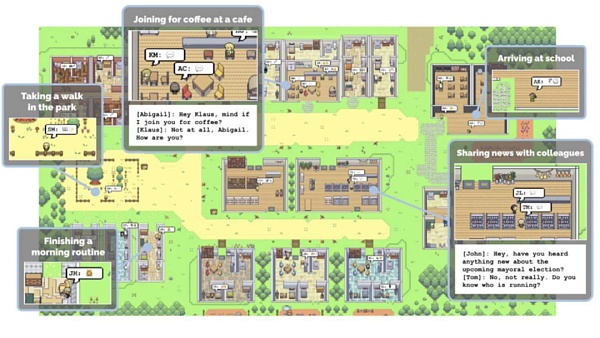
This research forms the foundation for the most explored (though still experimental) games in web3. The core idea is how we can use highly autonomous or characterful AI agents in simulated environments to build fun, engaging games around them.
Parallel TCG’s Parallel Colony explores this by having AI agents gather resources and tokens for players in-game. Using the ERC-6551 standard, AI agents are NFT wallets representing users and capable of in-game trading. These agents can create, mint, and store new in-game items and possess personalities defined by fine-tuned LLMs crafted by the team, giving them non-standardized behaviors and traits influencing their in-game actions.
Conceptually, the most compelling AI-agent-based game is Upstreet. Upstreet is a virtual world project packed with wild innovations: an AI agent SDK, procedural quests, browser + VR support, drag-and-drop interoperability, and social features within an environment called “The Street,” where players build and interact with their own experiences. Beyond human players, AI agents—deployed by developers (or players)—can introduce personalities and objectives shaping the game world. Most intriguing is their development of the AI Director, an agent that sets goals like “parachute from the tallest building” or “start a new religion,” with users and agents participating as challengers. At the end of each round, the Director determines winners, rewarding them with prizes, tokens, and NFTs. This could lead to incredibly complex player-agent interactions. We’re excited to see its evolution—especially its potential to generate high-value 3D environment research and data, feeding future advanced models. OpenAI seems interested in acquiring open-source Minecraft-style games too.
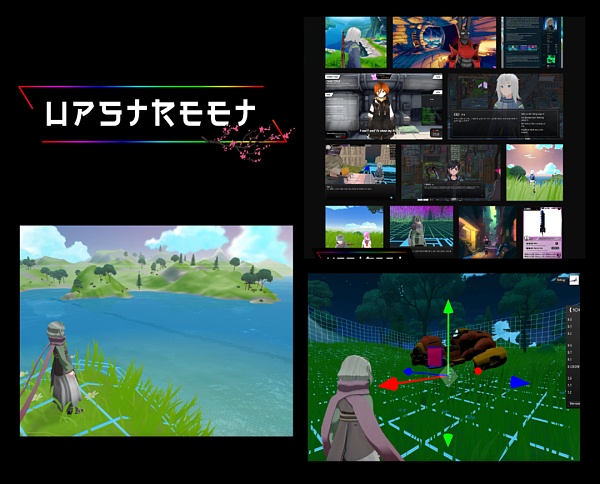
Generative tools for creating virtual worlds represent another area enhancing gaming. For example, Today lets players design their own virtual islands and care for AI NPC companions. Uniquely, it leverages generative creative tools to facilitate in-game UGC development. Since the game primarily revolves around user-created islands, providing seamless asset creation for players without 3D development or art skills is crucial. Arguably, metaverse-style gameplay has stagnated largely due to content scarcity—something generative tools can directly address in the short term.
Training AI agents can itself become an engaging game. AI Arena offers a novel approach: players train AI agents by playing a Super Smash Bros-style game, gradually teaching them through imitation. Since AI agents don’t need rest, they can compete 24/7 in tournaments against a constantly active pool of opponents, while players asynchronously fine-tune their playstyles. This turns training into a game, amplified by tokenomics.
Mass-scale cooperative gameplay between humans and powerful AI players was possible before, but tokenomics elevates it. Leela vs. the World by Modulus Labs is an experiment in this format. Here, Modulus used the Leela chess engine, verifying its output via zk circuits. Players bet funds on human vs. AI matches, forming an intriguing prediction market. While verification times may be long given current zk limitations, it undeniably opens doors to large-scale collaborative esports prediction markets and verifiable, complex AI player governance challenges.
Finally, pure on-chain games or autonomous worlds will also be enhanced by AI. One of the most compelling ideas here is Large Lore Models (LLMs), using LLM protocol layers to create persistent knowledge that’s interoperable across modifiable, interconnected game environments. Player actions in autonomous worlds affect multiple game contexts simultaneously, requiring higher-dimensional knowledge to drive narratives. This aligns well with abstract LLM layers built atop multi-chain gaming environments.
Infrastructure
AI x Crypto infrastructure deserves its own full article, but here’s a brief overview of emerging ideas.
Distributed Computing
To understand crypto-economic systems' demand for computing, grasp the core problem: GPU capacity faces massive bottlenecks, with top hardware like H100s facing year-long wait times. Meanwhile, startups raise huge sums to buy hardware, governments scramble to procure for defense, and even well-funded teams like OpenAI pause feature rollouts due to compute limits.
Many teams in decentralized computing and DePIN see an opportunity: bootstrap permissionless clusters to meet demand, offering crypto incentives and minimal margins, making networks highly competitive with web2 peers on pricing while delivering better returns to hardware providers.
Machine learning generally involves four main computational workloads:
- Data preprocessing: preparing raw data into usable formats.
- Training: running ML models on large datasets to learn patterns and relationships.
- Fine-tuning: optimizing trained models on smaller datasets for specific tasks.
- Inference: running trained/fine-tuned models to make predictions.
We’re seeing general-purpose compute networks like Render and Akash pivot toward more specialized AI/ML services. For example, Render leverages providers built on its network—like io.net—to directly serve AI customers, while Akash suppliers onboard hardware owners with demand, showcasing network strength by training their own models—one being a Stable Diffusion fork trained exclusively on copyright-free material. Livepeer is also focusing on AI video compute, leveraging its existing large network serving video transcoding.
Additionally, networks specifically designed for AI computation are emerging, recognizing that core challenges around coordination and verification can be better addressed by building chains or models around AI. Gensyn stands out, building a substrate-based L1 designed for parallelization and verification. The protocol uses parallelization to split large compute jobs into async tasks distributed across the network. To solve verification, Gensyn employs probabilistic proof-of-learning, graph-based pinpoint protocols, and staking/slashing incentives. Though not yet live, the team estimates equivalent V100 GPU costs at ~$0.40/hour on their network.
Beyond storage, alternative training models like federated learning are gaining traction, revived in web3 after realizing blockchains can better incentivize them. Federated learning trains models across multiple independent parties, periodically batching updates to a global model. Real-world examples include Google’s keyboard prediction. In web3, FedML and FLock are experimenting with combining federated learning and token incentives.
Also noteworthy: decentralized data storage like Filecoin and Arweave, and databases like Space and Time, can play vital roles in data preprocessing.
Consensus-Based ML
Another novel infrastructure approach is consensus-based machine learning (ML). Bittensor is the prime example: a Substrate-based L1 blockchain designed to improve ML efficiency and collaboration via application-specific subnets. Each subnet has its own incentive system serving various use cases—from LLMs to prediction models to generative innovation. Bittensor’s uniqueness lies in how miners coordinate high-quality outputs: they earn TAO (its native token) by submitting intelligent outputs from their ML models, rated by validators. Since miners are rewarded for top outputs, they continuously improve models to stay competitive, enabling faster learning coordinated by tokenomics.
Recent exciting developments in the TAO ecosystem include the Dynamic TAO proposal, transitioning Bittensor to a more automated, market-driven mechanism for token emissions, and the launch of the Nous subnet to incentivize model fine-tuning for competition with companies like OpenAI.
We may see more attempts at such systems—where mining or consensus regulates model outputs in quality-advancing ways.
Intent Is All You Need
In DeFi, the latest MEV discourse centers on user intent and economically-aligned solvers executing those intents. Intent discussions vary widely, but one thing is clear: user intents require higher-order semantic context to be parsed into executable code. LLMs may provide this semantic layer.
Propellerheads offers the clearest vision so far for using LLMs in intent spaces: https://www.propellerheads.xyz/blog/blockchain-and-llms.
In short, LLMs can semantically understand and convert near-matching intents into exact matches, helping uncover coincidences of wants (CoWs). This can happen via inward intent rebidding (“Can I buy LUSD instead of USDC? I found a matching limit order—you’ll save 0.3% in fees with this CoW”) or outward rebidding (“I want to buy your BAYC—would you sell it for X ETH?”).
Other structures are possible, becoming especially interesting in post-account-abstraction contexts involving wallets and multisigs. Projects like DAIN and Autonolas already experiment with agents as wallet signers—soon, talking to your wallet and having it execute transactions on your behalf for security and intent-based purposes will be reality.
Also worth watching: large-scale DeFi use cases like agent-based prediction markets, AI-managed economic models, and ML-parameterized DeFi apps—explored in greater depth in my zkML article.
Agent Economies
One of my favorite infrastructure areas so far is AI agent economies. It stems from my vision of a world where everyone has personal agents, hiring high-quality, well-trained agents to serve us or deploying autonomous agents to achieve our goals in complex economic behaviors. To do this, agents need a way to pay for and receive payment for services. Traditional payment modes could open up for these agents, but more likely—given ease of use, settlement speed, and permissionless nature—agents will transact in cryptocurrency.
Autonolas and DAIN are prime examples. In Autonolas, agents are nodes in the network pursuing specific goals, maintained by service operators—similar to Keeper networks. These agents can serve various functions: oracles, prediction markets, messaging, etc. DAIN takes a similar approach, enabling agents to “discover, interact, transact, and collaborate with other agents in the network.”
Other Innovations
Beyond the above, we’re seeing:
- Decentralized vector databases for model fine-tuning (e.g., BagelDB)
- Wallets for API keys and SIWE for AI apps (e.g., Window.ai)
- Data provisioning services
- Indexing and search tools (e.g., Kaito)
- Block explorers and dashboards (e.g., Modulus Labs’ AI Verification Dashboard, now validating a series of Upshot model inferences)
- Developer assistants (e.g., Dune’s on-chain SQL query model)
- Simulation environments for agent testing
- Bandwidth for data scraping (e.g., Grass Network)
- Synthetic data and human RLHF platforms
- DeSci applications (e.g., LabDAO’s distributed
Join TechFlow official community to stay tuned
Telegram:https://t.me/TechFlowDaily
X (Twitter):https://x.com/TechFlowPost
X (Twitter) EN:https://x.com/BlockFlow_News
 1kx
1kx