Editor's Pick: The Most Watched Crypto New Projects in 2024 (Part I)
TechFlow Selected TechFlow Selected
Editor's Pick: The Most Watched Crypto New Projects in 2024 (Part I)
In our view, the narrative space for infrastructure is larger and more difficult to falsify.
 Navigating Web3 tides with focused insights
By TechFlow
In the LOL community, there's a famous saying: one patch, one god—crypto markets are no different.
Every cycle has its heroes.
Driven by the "new over old" and "love new, discard old" mentality—a hallmark of short-term opportunism—we focus on new projects launching in 2024, or so-called "major projects." The selection criteria are highly subjective, centered around emerging narratives such as AI, parallel EVM, DePIN, Bitcoin ecosystem, and modular blockchains. Most remain infrastructure plays, which we believe offer broader narrative potential and are harder to falsify.
Note: This article is divided into two parts. Selection criteria are highly subjective and primarily focus on entirely new projects that have not yet issued tokens.
Monad: Leading the Parallel EVM Narrative
When discussing the parallel EVM narrative, Monad is unavoidable.
Monad is an innovative project focused on enhancing EVM performance through parallel processing technology, aiming to solve the performance bottlenecks of existing blockchain networks.
Parallel EVM represents an innovative optimization over the traditional EVM. In conventional EVMs, smart contracts and transactions are processed sequentially, leading to inefficiencies and network congestion under high loads. The core idea of parallel EVM is to shift from this serial processing model to enable simultaneous execution of multiple transactions.
By enabling parallel execution, Monad aims to significantly boost transaction throughput and resolve congestion issues on existing EVM chains under heavy load, with a long-term goal of achieving 400,000 TPS—approaching physical bandwidth limits.
At the implementation level, Monad’s parallel execution strategy hinges on its ability to identify and execute transactions without shared dependencies in parallel. While both Monad and Ethereum organize blocks as linear, ordered transaction sets, Monad optimizes execution logic to allow transactions to proceed in parallel without affecting final outcomes. Key features include:
-
Optimistic Execution: Start executing subsequent transactions before the prior one completes. This may lead to dependency conflicts, but the system re-executes transactions upon detecting data inconsistencies, ensuring correct results.
-
Scheduling and Dependencies: To minimize redundant executions, Monad uses static code analysis to predict transaction dependencies and intelligently schedules their execution for optimal parallel efficiency.
-
State Merging: Despite parallel execution, each transaction’s state updates are merged sequentially at the end to ensure overall block-level state consistency.
In 2024, Monad will be a major player in the L1 arena.
On February 14, 2023, Monad raised $19 million in a seed round led by Dragonfly Capital.
Website: https://www.monad.xyz/
Twitter: https://twitter.com/monad_xyz
For more details, see our previous research and founder interview:
"Getting Ahead of the Next Narrative: The Rise of Parallel EVM and Key Projects to Watch"
Eclipse: Solana Virtual Machine (SVM) L2 on Ethereum
Eclipse is an Ethereum Layer 2 that leverages the Solana Virtual Machine (SVM) to accelerate transaction processing.
The project aims to provide a massively parallel execution environment, allowing multiple operations to run simultaneously, thereby increasing network throughput and efficiency while reducing congestion and transaction fees. This architecture enhances dApp scalability and user experience.
Simply put, Eclipse’s design logic executes transactions via Solana’s SVM while settling them on Ethereum. Like Zhang Wuji from martial arts novels, it synthesizes strengths from different schools—combining Ethereum’s security with Solana’s speed.
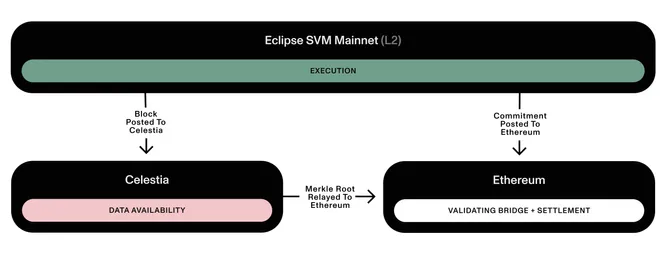
Settlement Layer – Ethereum: Eclipse uses Ethereum as its settlement layer and ETH as gas.
Execution Layer – Solana Virtual Machine (SVM): For application logic and smart contracts, Eclipse adopts Solana’s SVM. This allows Eclipse to benefit from Solana’s high throughput and low latency, enabling fast transaction processing. By maintaining compatibility with both Ethereum and SVM, Eclipse offers developers and users a flexible and efficient environment.
Data Availability – Celestia: To ensure data availability and verifiability, Eclipse uses Celestia for DA.
Fraud Proofs – RISC Zero: For verification and zero-knowledge proofs, Eclipse uses RISC Zero, eliminating the need for intermediate state serialization, making the system more efficient and secure.
On September 27, 2022, Eclipse raised $9 million in a seed round co-led by Tribe Capital and Tabiya.
Website: https://www.eclipse.builders/
Twitter: https://twitter.com/EclipseFND
EigenLayer: Reshaping Ethereum
EigenLayer is an innovative protocol built on Ethereum that introduces the concept of “restaking,” allowing users to earn additional rewards and contribute to security using their staked ETH or liquid staking tokens.
This is the common understanding of EigenLayer. However, in our view, EigenLayer represents a direct expansion attempt at Ethereum’s base layer—and possibly the most important protocol since Ethereum’s inception—tasked with reshaping Ethereum itself, even if Vitalik may not agree.
On one hand, EigenLayer unlocks capital efficiency for staked ETH. By inheriting Ethereum’s security, innovation across Ethereum-based applications accelerates dramatically, validation costs drop rapidly, and ETH becomes a productive asset capable of generating high yields.
On the other hand, EigenLayer goes beyond restaking—it reconstructs much of Ethereum’s foundational infrastructure.
For example, one of EigenLayer’s flagship offerings is its Data Availability module—EigenDA (Eigen Data Availability). Compared to Celestia, EigenDA has a clear advantage: it can leverage existing ETH validators and staking to bootstrap a large validator network more easily, at lower cost and with higher throughput.
Mantle Network is the first L2 to adopt EigenDA.
Additionally, decentralized Rollup sequencers can be operated on EigenLayer, changing the current reality where most L2s rely on centralized sequencing. Furthermore, EigenLayer enables truly decentralized RPC nodes.
Recently, EigenLayer extended its reach into the Cosmos ecosystem, publicly announcing its ability to provide Ethereum-grade security guarantees for Cosmos subnets.
According to the latest data from its official site, EigenLayer currently supports over 65 ecosystem projects.
For instance, AltLayer, recently listed on Binance, is part of the EigenLayer ecosystem. Initially promoting the RaaS ("Rollup-as-a-Service") concept—enabling one-click rollup deployment—it later pivoted to focus on Restaked Rollups developed in collaboration with EigenLayer. This concept is somewhat abstract, so let’s simplify it:
For most teams building an appchain, the ideal scenario would be:
I don’t want to worry about how to build a Rollup from scratch, nor do I want to stress over securing it afterward.
AltLayer’s Restaked Rollups improve Rollup security via EigenLayer’s restaking mechanism.
We know that restaking essentially involves reusing staked assets to enhance the security of infrastructure beyond Ethereum’s mainnet. So for a Rollup, what aspects raise the most security concerns post-launch?
Namely: whether transactions confirm quickly, whether the sequencer is centralized, and whether transactions are genuinely validated by multiple parties.
Therefore, you can think of a Restaked Rollup as a “lazy security package” that actively proves these aspects are secure.
This is achieved through a suite of vertically integrated Active Validation Services (AVS), where staked ETH’s liquid staking tokens (LSTs) are restaked into these AVS to ensure their operation—thereby adding an extra layer of trusted security to self-hosted Rollups.
In 2023, EigenLayer announced a $50 million funding round led by Blockchain Capital, with participation from Coinbase Ventures, Polychain Capital, Bixin Ventures, Hack VC, and other prominent industry VCs.
Website: https://www.eigenlayer.xyz/
Twitter: https://twitter.com/eigenlayer
io.net: Solana-Based DePIN & AI Infrastructure
io.net is a decentralized computing network supporting the development, execution, and scaling of ML (machine learning) applications on the Solana blockchain. It leverages the world’s largest GPU clusters to allow machine learning engineers to access distributed cloud computing power at lower costs.
What sets io.net apart is its ability to rapidly cluster GPUs from diverse locations, aggregating 50,000 to 70,000 GPUs into a single cluster with highly efficient inter-GPU communication. With sufficient resources, users could potentially train large language models directly on the platform.
Reportedly, the product has already been demonstrated to well-known companies including OpenAI, Instacart, and Uber.
io.net engages users and compute providers through three core products to enhance user experience:
-
IO Cloud: Interface for deploying and managing decentralized GPU clusters;
-
IO Worker: Provides real-time insights into user computations, offering operational visibility and control over connected devices, enabling monitoring, deletion, renaming, and other quick actions;
-
IO Explorer: Offers transparency into network operations, including network activity, key statistics, data points, and full visibility into reward transactions.
IO is the native and protocol token of the io.net network. Its primary utilities are twofold:
-
IO serves as the main payment method within the io.net ecosystem—for instance, paying GPU deployment fees. Every model deployed on io.net must perform a small IO transaction for inference.
-
IO tokens are used to reward GPU contributors.
According to TechFlow, io.net has attracted significant interest from top-tier VCs in the primary market.
Website: https://io.net/
Twitter: https://twitter.com/ionet_official
Berachain: A Meme-Powered, EVM-Compatible Chain in the Cosmos Ecosystem
Berachain is an EVM-compatible Layer 1 built on the Cosmos SDK, notable for its use of Proof-of-Liquidity as its consensus mechanism.
Through Proof-of-Liquidity, users can stake blue-chip assets like BTC, ETH, and stablecoins, delegating them to validators. These staked assets are then used to provide liquidity to the chain’s native virtualized AMM, increasing capital efficiency and reducing user churn.
Berachain’s tokenomics feature a three-token system: $BERA (gas token), $HONEY (stablecoin), and $BGT (governance token). Notably, $BGT cannot be purchased on secondary markets; it is a non-transferable NFT whose holders receive a portion of fees generated on Berachain.
The project was launched by four anonymous co-founders who created the NFT collection Bong Bears in 2021, inspired by Olympus DAO. It has since evolved into a strong community-driven project with deep meme culture roots.
On April 20, 2023, Berachain announced a $42 million Series A round led by Polychain Capital.
Website: https://www.berachain.com/
Twitter: https://twitter.com/berachain
Blast: The Yield-Bearing L2 and Marketing Mastermind
Whether it’s Blur or Blast, both act like sharp swords, disrupting established orders and dethroning former kings.
What truly matters for an L2? User count or TVL? Blast makes it clear: TVL reigns supreme.
While other L2s focus on technical narratives and vague promises of future airdrops, Blast takes a simple, direct approach: transparent airdrop mechanics; ETH deposits earn yield automatically.
Blast is the first L2 blockchain to offer passive yield on funds held within Layer 2 accounts.
Specifically, when users deposit funds into Blast, the platform stakes ETH natively (primarily via Lido) and automatically returns the staking yield to users on Blast.
Beyond ETH, Blast also supports yield-bearing stablecoins. When users bridge stablecoins (e.g., USDC, USDT, DAI) to Blast, the corresponding stablecoins locked on Layer 1 are deposited into DeFi protocols like MakerDAO, and the yield is returned to users on Blast in the form of USDB—the native stablecoin of Blast.
As of January 28, Blast’s TVL reached $1.3 billion.
Beyond yield, the transparent airdrop expectations further drive adoption: early users accessing the Blast network not only enjoy 4% APY on ETH or 5% on stablecoins but also accumulate Blast Points rewards.
On January 17, Blast officially launched its testnet and a month-long "Big Bang" incentive program, encouraging developers to build on its ecosystem. Winning projects will receive token airdrops.
The airdrop is split equally between users and developers. With users, liquidity (TVL), and airdrop incentives in place, there’s no reason for developers not to participate. In effect, Blast has completed years’ worth of ecosystem development during its testnet phase alone.
We look forward to seeing what other exciting innovations Blast will introduce in the future.
In November 2023, the L2 network Blast raised $20 million in funding, with participation from Paradigm and Standard Crypto.
Website: https://blast.io/zh-CN
Twitter: https://twitter.com/Blast_L2
dYmension: Modular Settlement Layer in the Cosmos Ecosystem
dYmension is a modular settlement layer built on Cosmos.
The term "modular settlement layer" may sound abstract. First, understand the three-layer blockchain architecture:
-
Execution: Transaction processing and state computation.
-
Settlement & Consensus: Enforcing protocol rules, ensuring all participants agree on blockchain order and state.
-
Data Availability: Ensuring all published data remains accessible.
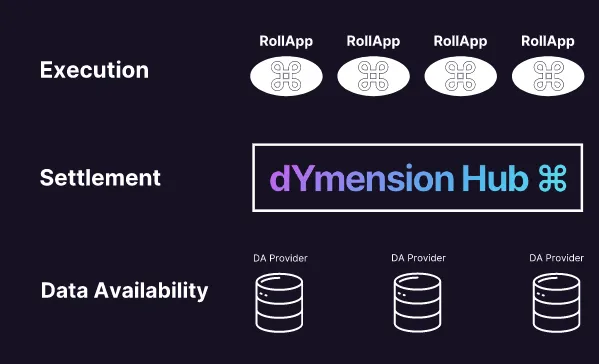
Dymension splits blockchain functionality into distinct layers, enabling modular composition. Its architecture includes execution, settlement, consensus, and data layers.
Execution Layer – RollApps: Responsible for transaction processing and state computation. RollApp is a new crypto term—developers can use dYmension’s RollApp Development Kit (RDK) to build RollApps.
Unlike dApps built on general-purpose rollups, RollApp-based apps have autonomy—meaning they gain control over the blockchain’s execution layer while still adhering to base-layer protocol rules.
Settlement & Consensus Layer – Dymension Hub: A proof-of-stake chain built on Cosmos SDK, leveraging Tendermint Core’s state replication model for networking and consensus. The Dymension Hub provides security, interoperability, and liquidity to serve RollApps.
Data Layer: Dymension supports various data availability providers. Developers can choose based on needs, though most will likely opt for Celestia.
Dymension and Celestia are the twin pillars of modularity in this cycle—TIA as gold, DYM as silver—with potential price and market correlations across multiple dimensions.
On February 9, 2023, Dymension raised $6.7 million in a seed round led by Big Brain Holdings and Stratos.
Website: https://dymension.xyz/
Twitter: https://twitter.com/dymension
Note: This article was written in January 2024, prior to DYM’s mainnet launch.
Join TechFlow official community to stay tuned
Telegram:https://t.me/TechFlowDaily
X (Twitter):https://x.com/TechFlowPost
X (Twitter) EN:https://x.com/BlockFlow_News
 深潮TechFlow