Exclusive Interview with Merlin Chain Founder: The Story Behind the "Blue Box" Surge and the Future of Bitcoin
TechFlow Selected TechFlow Selected
Exclusive Interview with Merlin Chain Founder: The Story Behind the "Blue Box" Surge and the Future of Bitcoin
As explorers of the Bitcoin metaverse, why are they building a new Bitcoin Layer2?
 Navigating Web3 tides with focused insights
By: BlockBeats
With the approval of BTC ETFs, the Bitcoin ecosystem is entering a golden era. Many believe this bull market will primarily unfold within the Bitcoin space. We are honored to have invited Jeff, founder of Merlin Chain and a pioneering figure deeply rooted in the Bitcoin ecosystem. Merlin Chain is a BTC Layer2 dedicated to serving native Bitcoin users, assets, and protocols, sharing Bitcoin's Layer1 security through ZK technology, making it an indispensable force in today’s Bitcoin ecosystem.
The Original Intent Behind Bitmap and BRC-420
BlockBeats: Both Bitmap.Game and BRC-420 have received strong market responses. Could you share your original intentions behind launching these two projects?
Jeff: Bitmap represents a fully decentralized and trustless asset we observed in the market. Each inscription on it captures specific data from a particular block—such as all transaction information, fees, and mined bitcoins.
This asset itself is entirely decentralized; anyone can inscribe onto it, resulting in a large community. However, right after its initial inscription, the market cap was only $2 million. Seeing this vast community, we wanted to build applications that offer utility, so we launched Bitmap.Game—an on-chain metaverse built on Bitcoin.
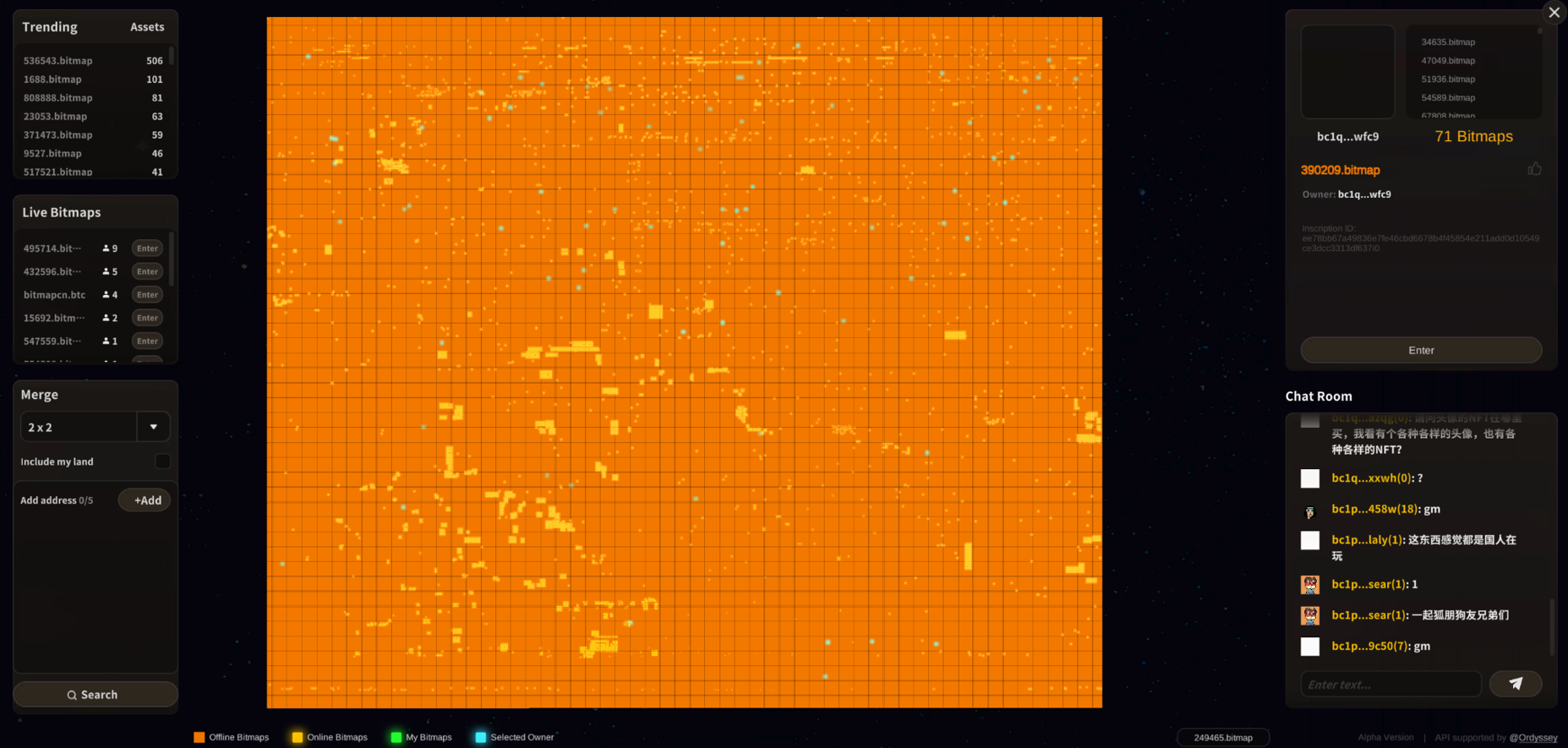
The yellow dots on the map represent currently online users. Zooming in reveals individual plots:
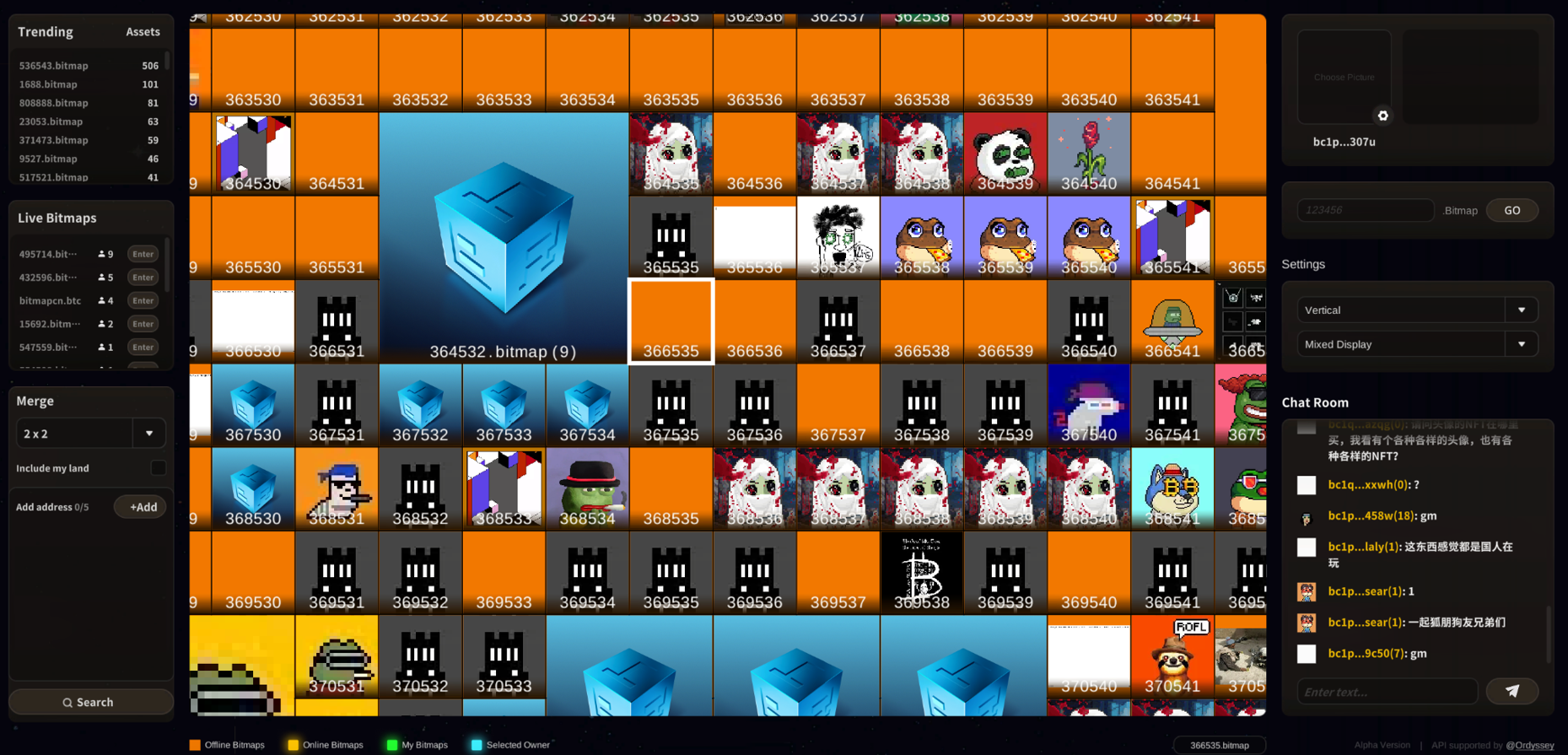
All visible content—images, text, everything users see in our product—is on-chain data. Each user owns different wallet assets, which they can choose to display as their plot’s cover image. Entering a specific plot allows you to view avatars, gameplay mechanics, scenes—all represented as on-chain assets.
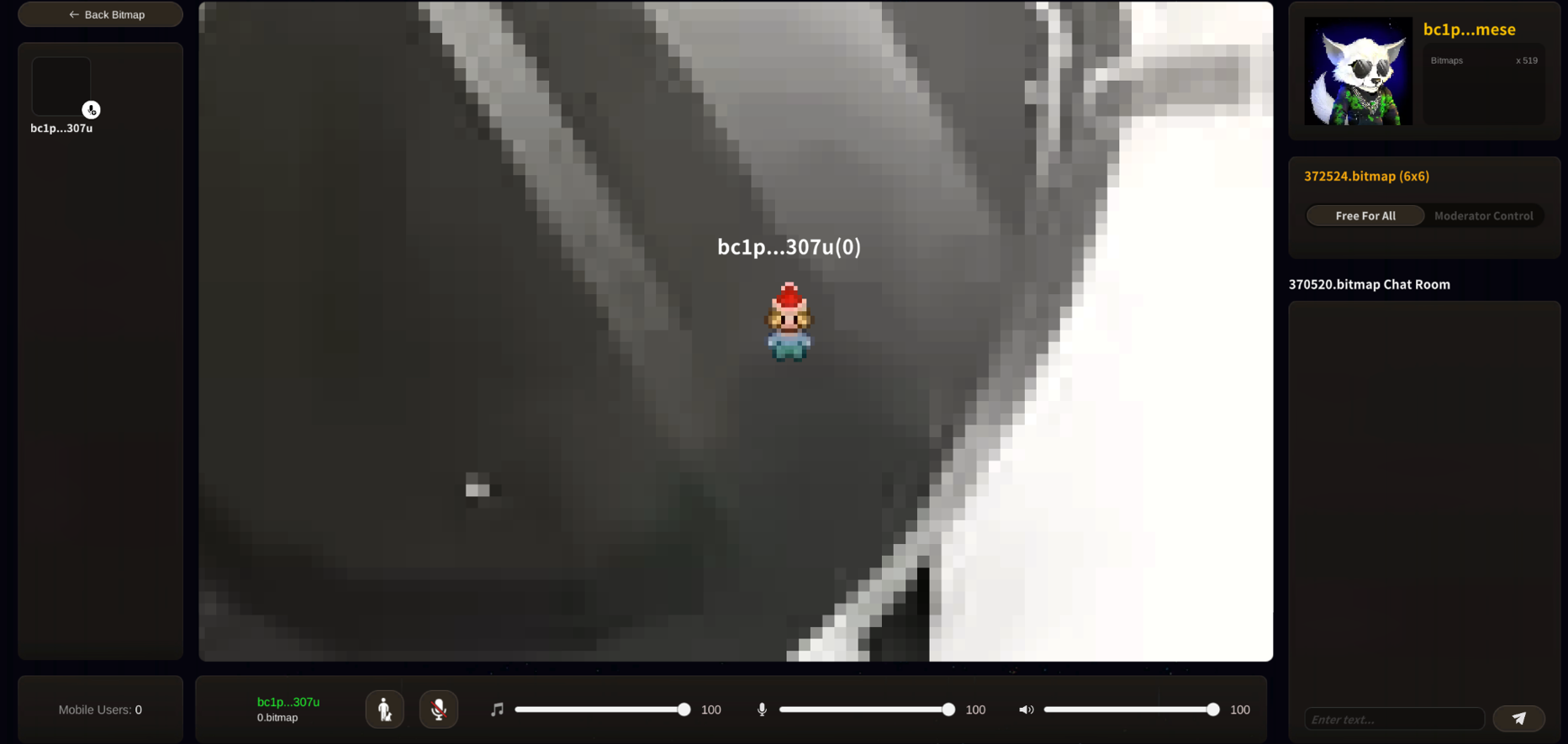
Our original goal with Bitmap.Game was to create a client-agnostic, server-independent, decentralized, permissionless product. Since all data resides on-chain rather than under our control, even if we cease operations, others could fork the client and continue development. Anyone could compete by building similar products. We believe this kind of architecture represents the future direction—even if it seems unique or unconventional, it remains our core vision.
As for BRC-420, we refer to it as a protocol for modularizing data and tokenizing those modules into assets. Essentially, any piece of data can be packaged into a module and turned into a tradable tokenized asset. For example, there's a DLC called Bitmap.town containing over 600 metaverse game assets—animations, scripts, avatars, music—that are bundled together and tokenized. Once released, all contents go fully on-chain, allowing users to access them directly, build upon them independently, and hold ownership via tokens—without relying on the original development team.
So far, BRC-420 assets have seen significant trading volume, strong price appreciation, growing holder counts, and increasing market caps. While initially labeled a "metaverse protocol," BRC-420 isn't inherently tied to the metaverse. Our hope is that more innovative use cases will emerge around decentralized product architectures and fully on-chain composable asset protocols.
BlockBeats: It sounds like turning inscriptions into game cartridges and transforming Bitcoin into a gaming console where players can download games. How do you think these features might impact the broader development of the Bitcoin ecosystem?
Jeff: Among teams in the Bitcoin ecosystem, we’re probably the most distinctive because we focus exclusively on things never seen before in other ecosystems. Early on, we experimented heavily with recursion—recursive graffiti, recursive on-chain forums—then developed Bitmap, a fully decentralized data package, followed by BRC-420.
Firstly, I believe every new ecosystem needs its own narrative. Simply recreating Ethereum-style applications on Bitcoin—or vice versa—lacks innovation. After the Blue Box craze, every chain ended up copying some version of a “420” protocol with differently colored boxes. To grow the Bitcoin ecosystem, we must pioneer novel concepts instead of repeating existing ones. For instance, much of Ethereum’s content stays off-chain—we want to compose everything directly on-chain.
Secondly, new narratives enable new product models—something already visible in many BRC-420-based projects. Take Mineral, for example, which combines DeFi with mining power. Or games built on Bitmap such as Bitmap Valley and Bitmap War, both issuing assets via BRC-420. These follow an on-chain content-driven operational model: first issue BRC-420 assets, then conduct NFT-to-token conversions or token airdrops, and finally build Layer2 applications atop these assets. I believe this kind of product innovation will keep emerging alongside macro trends.
Finally, composability—this is what I consider blockchain’s greatest productivity breakthrough, yet rarely discussed in ecosystems like Ethereum. You’ve likely heard of “DeFi Lego,” where the essence lies in combining different components. From Uniswap to liquidity mining, Compound to Curve—the explosion of innovation in DeFi stems directly from composability enabled by smart contracts. What Bitcoin enables is *content* composability. If someone builds a game with 20 modules, I should be able to reuse 15 of them to quickly launch my own game without rebuilding from scratch. This, I believe, is the truly unique innovation within the Bitcoin ecosystem—not just replaying Ethereum’s playbook.
Jeff’s Entrepreneurial Journey in the Bitcoin Ecosystem
BlockBeats: Your insights reflect deep understanding of Bitcoin and the broader crypto industry. Before this surge in Bitcoin-native activity, did you ever consider launching ventures in other ecosystems?
Jeff: Founding Bitmap Tech was actually my first Web3 startup. Prior to this, I had been focused on Web2 entrepreneurship. I’ve always believed in the spirit of blockchain, but until recently hadn’t found a compelling entry point where real productivity gains could be achieved.
As digital natives, we’ve all experienced how the internet dramatically increased productivity—video conferencing, instant access to global knowledge, democratizing visibility into previously exclusive domains. Thus, I see productivity innovation as the key driver.
Whether during the 2017 ICO boom or the 2020 DeFi summer, I didn’t find a meaningful angle to engage, so I stayed focused on Web2. My previous company operated in the metaverse space and reached around 40–45 million users globally.
My move into Bitcoin entrepreneurship was quite serendipitous. When we decided to reevaluate Web3 opportunities, Ordinals happened to be rising. I felt incredibly fortunate to catch that wave.
Additionally, the cultural tide has shifted back toward Bitcoin’s original cypherpunk ethos, reigniting my passion for Web3 innovation. To me, Ethereum has become too institutionalized—with rigid rules, predefined playbooks, and high centralization. Success often depends on following V God or the Ethereum Foundation’s lead, then securing VC and exchange support. That model feels disconnected from crypto’s original ideals.
Ordinals’ philosophy of full on-chain presence aligns perfectly with my belief in permissionless composability and decentralization. That’s why I chose to launch my venture within the Bitcoin ecosystem this time.
BlockBeats: Clearly, you're a staunch Bitcoin believer. Can you share how you first encountered Bitcoin? And why are you so confident about its future today?
Jeff: I got involved with Bitcoin very early. Back in 2012, I raised funding from a VC firm to start my first company in China—one that also invested in Coinbase and Ripple. At the time, I was studying computer science, but later transitioned to political science and sociology during high school and undergrad in the U.S. This interdisciplinary background helped shape my deep conviction when I first encountered Bitcoin.
Back then, many programmers dismissed Bitcoin as technically outdated, while humanities people found it too obscure to care about. But when I read the whitepaper, I immediately became devoted. I’ve remained close friends with China’s earliest Bitcoin adopters—we discussed purchase methods together, traded together. My belief in Bitcoin isn’t based on logic—it’s pure faith.
I see Bitcoin and Ordinals as similar—antifragile systems with no single point of failure. Even if prices crash or public sentiment turns negative, they persist. They cannot be erased by a single file or shutdown. That resilience resonated deeply with me. The world is fragile—countries face endless crises—and we need antifragile solutions. For over a decade, I've held unwavering faith in Bitcoin, and last year, I began believing strongly in the Ordinals ecosystem too.
BlockBeats: You seem quite punk in spirit. Has this deep faith in the Bitcoin ecosystem influenced your project’s positioning and strategic direction?
Jeff: First, we aim to uncover the most unique innovations within the Bitcoin ecosystem—never retracing Ethereum’s steps. As entrepreneurs, we thrive on uncertainty; it fuels innovation. Following well-trodden paths lacks excitement.
Second, our faith in the ecosystem is ultimately faith in people. When we started building Ordinals products around May-June last year, nearly all Ordinals assets had crashed to zero. The entire Bitcoin and Ordinals ecosystem faced ridicule and skepticism. Most people around me didn’t even know what I was working on—mentioning “Ordinals” would invite dismissal as either a scam or child’s play.
Yet during those nights, we noticed 5–10 Twitter Spaces running daily—both English and Chinese—where developers gathered to support each other, brainstorm ideas. Learning pressure was intense: every day brought new protocols, standards, and innovations. I could feel the ecosystem’s vitality, the depth of commitment and belief among builders. It reminded me of the pure, grassroots energy at the dawn of any transformative industry.
Therefore, whether building Layer2 or launching new products, we’ll always center around these users and assets. We genuinely want to contribute long-term to this ecosystem—not just as builders, but as participants and members of the local community and its native assets. Rather than rushing to import Ethereum’s assets and mechanisms, we prefer organic growth rooted in existing Bitcoin-native communities.
Current State of BTC L2 and Merlin Chain’s Path of Innovation
BlockBeats: Could you explain why you decided to launch Merlin Chain?
Jeff: Three to four months ago, I often said publicly that it’s extremely hard to build meaningful experiences on Bitcoin Layer1. Users are constantly chasing new mints—once one asset finishes launching, everyone rushes to the next. There’s constant motion, but little substance.
Most fast-growing, high-market-cap assets today were created three months ago. It’s now difficult to generate new valuable assets—partly due to stale narratives, limited use cases, and weak financial liquidity and leverage. To revitalize the ecosystem, virtual machine environments capable of supporting complex functionalities have become essential.
Thus, demand for Bitcoin Layer2 isn’t theoretical—it’s real and urgent. Additionally, capital seeks investment opportunities. On Layer1, everything is fair launch with no room for investor participation, so investors naturally turn to Layer2.
We’re building Layer2 not for abstract reasons, but for our community, our users, and the products we ourselves want to build. Over the past six months, many asked why we don’t build games on Bitmap or implement P2E models. The answer is simple: doing so requires a virtual machine, which doesn’t exist on Bitcoin Layer1. Demand from users and the ecosystem is clear—so three months ago, we committed to building a truly Bitcoin-native scaling solution.
BlockBeats: What distinguishes Merlin Chain from other L2s? What are your advantages?
Jeff: Our biggest distinction is our focus: serving Bitcoin’s native users with native innovations using native assets. If a chain fails to serve its core base—if it starts by attracting Ethereum users, ends up dominated by ETH and USDT—then regardless of branding, it cannot truly be considered a Bitcoin Layer2. Yet many chains today still claim that title despite lacking Bitcoin-native substance.
To address this, three months ago we partnered with Particle to develop a Bitcoin-native wallet solution. Whether users rely on Unisat, OKX, or any Bitcoin wallet, they can seamlessly switch between Layer1 and Layer2. This integration added significant engineering effort and cost—but we believe it’s necessary to properly serve Bitcoin users.
Second, we prioritize Bitcoin-native assets—ORDI, SATS, RATS, etc. Most so-called Bitcoin Layer2s today host Ethereum assets, or even BNB Chain tokens. We believe innovation must begin with empowering Bitcoin’s own assets and communities. Only then can we explore meaningful innovations with ARC-20 and BRC-420. Innovating with ETH and USDT isn’t innovation at all—it’s imitation.
Third, embracing Bitcoin-native innovation follows naturally. True innovation emerges only when real Bitcoin users, protocols, builders, projects, and native assets coexist within a shared virtual machine environment. If everything comes from Ethereum, Bitcoin-native breakthroughs won’t happen.
Currently, Bitcoin-related assets collectively amount to roughly $4 billion in market cap—still tiny compared to Bitcoin’s overall value. We have a long journey ahead. Our mission is to embrace these assets and users, exploring innovative models together.
Our first launchpad will be Particle’s People's Launchpad, leveraging the BRC-20 standard to introduce novel approaches to native asset issuance on Bitcoin.
Technically speaking, EVM compatibility alone isn’t innovation—everyone does that. Our technical edge includes a custom cross-chain bridge enabling transfer of niche assets like Bitmap, BRC-420, and ARC-420—none of which are supported on other chains today. We’re also building a ZK Rollup with optimized proof compression to create a DA layer inheriting Bitcoin’s security—all documented in our GitBook. That said, many teams are exploring similar directions; calling it exclusive innovation would be premature.
On the ecosystem side, we’re supporting projects like People's Launchpad, Mineral, Bitmap War, and MOBOX games. We aim to empower existing Bitcoin-native products since their communities are active, easier to bootstrap, and quicker to generate traffic and revenue.
Jeff on Merlin Chain and the Future of the Bitcoin Ecosystem
BlockBeats: How will Merlin Chain’s token launch differ from other projects?
Jeff: A key challenge with Bitcoin Layer1 assets is the “impossible trinity”: the more holders an inscription has, the higher the number of inscriptions required, driving up costs and raising breakeven expectations—making price appreciation increasingly difficult. This dynamic contributes to stagnation in today’s Bitcoin asset market.
People's Launchpad retains a similar distribution mechanism but reduces costs, increases holder count, and makes the minting process more engaging. All tokens launched through it will have a valuation cap of $100,000. Some may expect Merlin Chain to launch at hundreds of millions or even billions in valuation—but we will still allocate a portion of our token supply for fair launch via People's Launchpad at just $100,000 valuation.
I believe this approach emphasizes community, fairness, fun, and low-cost access—an inclusive way for users to acquire assets.
BlockBeats: Will there be any upcoming announcements from Merlin Chain? What’s the roadmap looking like?
Jeff: In early February, we’ll announce a staking rewards program allowing early users to provide liquidity at zero cost while earning token incentives. Around the same time, our mainnet testnet will go live, featuring People's Launchpad, iZUMi Finance’s MerlinSwap, and Bitmap War.
In the first half of the year, we’ll host developer ecosystem events to attract more builders. We don’t want to simply port Ethereum DApps using the same models. Instead, we’re investing in and incubating native projects that build DApps the Bitcoin way. One such tool allows users to receive any token on Layer2 to mint assets on Layer1—essentially cross-chain delegated minting, deeply aligned with Bitcoin’s ethos.
This year, we plan two rounds of developer incentive programs, encouraging more people to build natively on Bitcoin, driving greater user adoption, improved liquidity, and more innovative products.
BlockBeats: Many say this bull market will be led by Bitcoin. What’s your take? Could you share your outlook on the evolution of the Bitcoin ecosystem?
Jeff: I completely agree. Ethereum already offers numerous yield-generating avenues—DeFi, lending, PoS staking yields—but Ethereum’s market cap remains less than one-third of Bitcoin’s.
Bitcoin accounts for over 50% of the total crypto market cap. If Bitcoin-native assets gain yield-bearing capabilities, the resulting financial derivatives and liquidity effects would dwarf anything achievable in other ecosystems, regardless of innovation pace. Simply meeting Bitcoin’s inherent demand for yield generation could fuel an entire bull cycle.
The potential for new Bitcoin-native assets is enormous. During past bull markets, the total market cap of ERC-20 tokens approached that of ETH itself. Today, Bitcoin-native assets represent just 0.5% of Bitcoin’s market cap. The journey from 0.5% toward 100%—a 200x increase across all Bitcoin assets—could define this bull run. That 200x gap presents an unprecedented opportunity absent elsewhere in crypto.
BlockBeats: What role do you envision Merlin Chain playing in the development of the Bitcoin ecosystem? How will it empower Bitcoin projects and assets?
Jeff: Merlin Chain will help BRC-20, BRC-420, Bitmap, and other native assets circulate, launch, and gain leverage more effectively on Layer2. We aim to walk alongside these native assets, exploring opportunities and pioneering new methods—together, grow their market cap from 0.5% to 100% of Bitcoin’s value.
Once sufficient liquidity exists, and trading volume, users, and DeFi infrastructure mature, even large Bitcoin holders and whales will gain opportunities to earn yield using Bitcoin-only assets—amplifying overall liquidity. By serving native assets and users, boosting trading volume, and creating compelling financial products, we aim to attract seasoned Bitcoin OGs to deposit funds for yield generation—creating a virtuous cycle. That’s exactly what Merlin Chain aims to achieve.
Join TechFlow official community to stay tuned
Telegram:https://t.me/TechFlowDaily
X (Twitter):https://x.com/TechFlowPost
X (Twitter) EN:https://x.com/BlockFlow_News
 BlockBeats