








TVL Grows 3x in One Month: In-Depth Analysis of Manta Pacific, the Third-Largest L2 Ecosystem
TechFlow Selected TechFlow Selected
TVL Grows 3x in One Month: In-Depth Analysis of Manta Pacific, the Third-Largest L2 Ecosystem
Can Manta Pacific rise to the top amid intensifying competition in the L2 sector?
 Navigating Web3 tides with focused insights
Written by: Michael Nadeau & Token Terminal, Token Terminal
Translated by: Felix, PANews
Key Takeaways:
-
Manta focuses on building modular, scalable, zero-knowledge infrastructure for Web3 applications.
-
Manta is the first Ethereum-based rollup leveraging Celestia for data availability, having already saved users $750,000.
-
The team appears highly motivated. Manta has raised significantly less funding than competitors ($60 million vs. zkSync’s $450 million). In some ways, this is beneficial—it forces the team to think creatively, evident in Manta Pacific’s marketing and incentive programs that tripled TVL last month.
-
The team is not resistant to change, as demonstrated by its decision to transition from the OP Stack to Polygon zkEVM.
-
Kenny Li, co-founder and spokesperson of Manta Network, appears to have a clear vision for how the Web3 tech stack will scale and positions Manta as a leader in this evolution.
Manta Pacific is an Ethereum-based L2 rollup built on the OP Stack, using Celestia for data availability and Ethereum for settlement. Its mainnet launched just three months ago. Manta currently has over 60 developers.
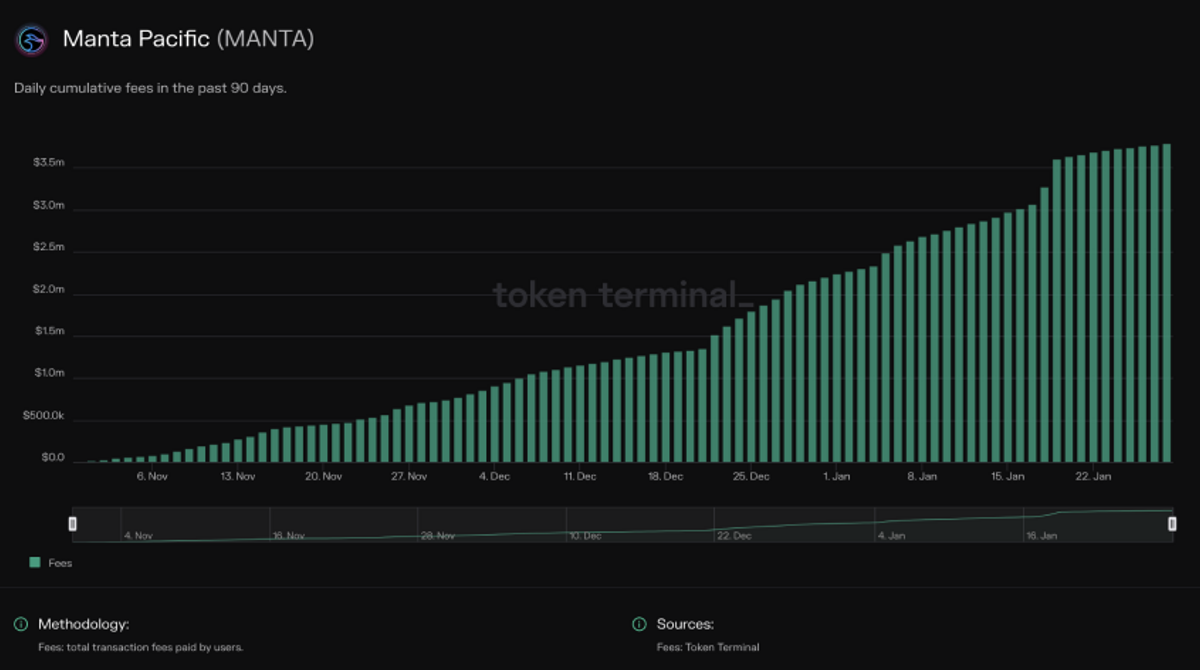
The project has performed strongly recently, with TVL surpassing $1.7 billion—reaching $1.76 billion—and tripling in January, making it currently the third-largest L2 ecosystem. In addition to TVL growth, the network generated $3.7 million in fee revenue over the past 90 days.
Product Differentiation
Kenny Li is one of the co-founders of p0x Labs, the development team behind Manta. In a recent interview, Kenny noted that developers are uninterested in figuring out which L2 to deploy on—they don’t know or care about the differences between various L2s. Clearly, developers do not want to deploy across multiple ecosystems and maintain code across multiple networks. Manta is building for a future where infrastructure is commoditized. This is why developers are creating tools in a modular format to enable “plug-and-play” experiences for Web3 application developers.
Beyond strong support for modularity, from a product perspective, Token Terminal identifies five key areas to watch:
-
Manta focuses exclusively on ZK technology because it believes ZK offers superior user experience for application developers and end users: privacy + scalability.
-
Manta provides developers with "universal circuits," meaning they don’t need to maintain code or handle cryptography. Instead, developers simply leverage existing SDK solutions to deploy ZK functionality with minimal code.
-
Manta is the first L2 deployed on Celestia, significantly reducing gas costs for application developers. These savings (exceeding $750,000) can improve profitability on the L2 while enhancing user experience.
-
As an Ethereum-based L2, any Ethereum-based application deployed on other EVM-compatible chains can be redeployed on Manta and benefit from lower gas fees enabled by Celestia's data availability.
-
Manta is highly bullish on Polygon zkEVM. This is likely a major reason why Manta decided to move away from the OP Stack.
User Acquisition

Below are Manta Pacific’s metrics since launching its mainnet three months ago:
-
In September, Manta added 54,000 new users. As of December, 54% of these user wallets were still interacting with Manta’s smart contracts.
-
In October, Manta added 123,000 new users. As of December, 39% were still interacting with the blockchain.
-
In November, 88,000 new users joined, with 66% still active in December.
-
In December, 216,000 new users were added—note that the first token airdrop occurred on January 18.
Business Model
Manta Pacific benefits by charging fees from users interacting with applications built on its L2 infrastructure. A portion of these fees is then paid to Ethereum for settlement and data availability.
However, by leveraging Celestia for data availability, Manta can significantly reduce costs paid to Ethereum (by approximately 95%). These savings are passed back to users, and Manta aims to maintain or slightly increase its profit margins to build highly scalable infrastructure.
According to Kenny Li, the team plans to reinvest profits into marketing, ecosystem projects, and an ecosystem growth fund.

Market Comparison
Based on Manta’s early performance compared to more mature protocols, several conclusions can be drawn:
-
Manta is the first L2 project to use Celestia to reduce data availability costs. The team claims to have already saved users $750,000. However, this has not yet been fully reflected when reviewing average cost per transaction over the past three months. Note that Manta’s profitability is still being determined, as they only pay Ethereum for settlement fees.
-
The Manta team is highly driven. Despite having far fewer developers than established projects, the team continues to push forward aggressively.
-
Attracting nearly $500 million in TVL during its initial months is impressive.
-
Manta currently leads its peers in 4-month user retention rates.
In conclusion, Manta’s long-term success will ultimately depend on sustained execution by the core team and community over an extended period.
Join TechFlow official community to stay tuned
Telegram:https://t.me/TechFlowDaily
X (Twitter):https://x.com/TechFlowPost
X (Twitter) EN:https://x.com/BlockFlow_News
 Token Terminal


