








Crypto Morning Brief: edgeX to launch TGE on March 31; SK Hynix plans to issue new shares for U.S. ADR listing
TechFlow Selected TechFlow Selected
Crypto Morning Brief: edgeX to launch TGE on March 31; SK Hynix plans to issue new shares for U.S. ADR listing
Strategy increased its Bitcoin holdings by 1,031 BTC last week, bringing its total to 762,099 BTC.
 Navigating Web3 tides with focused insights
Author: TechFlow
Yesterday’s Market Updates
Israeli media reports U.S. sets April 9 as target date to end war; Iran denies negotiations amid ongoing strikes
According to Israeli media outlet Ynetglobal, following a statement by President Trump, an Israeli official said Washington has set April 9 as the target date to end the war. The official added that talks between Iran and the U.S. are expected to take place later this week in Pakistan and noted that Washington has not yet briefed Israel on any contact with Iranian Parliament Speaker Mohammad Bagher Ghalibaf. The official stated that ending the war by the target date would allow President Trump to visit Israel on Independence Day and receive the “Israel Prize.” He also noted that Iran has at times launched 12–15 missiles per day, while on other days the number drops to around seven. However, he emphasized that Iran has struggled to conduct large-scale salvo launches, partly due to damage sustained by its command-and-control systems. Although the U.S. has set April 9 as the target date to end the conflict with Iran, Tehran has denied engaging in negotiations as strikes intensify.
Clarity Act draft update: Bans yield solely for stablecoin holdings; permits only activity-based rewards
According to CoinDesk, provisions on stablecoin yield in the latest draft of the U.S. Senate’s Digital Asset Market Clarity Act have drawn criticism from the crypto industry. Sources familiar with the matter say the language is overly narrow and ambiguous.
Per the latest revisions released last Friday by Senators Angela Alsobrooks and Thom Tillis, the draft explicitly prohibits users from earning yield solely for holding stablecoin balances and restricts any yield schemes structured similarly to interest-bearing bank deposits. It permits only activity-based reward programs—but offers no clear criteria for determining what qualifies.
Crypto industry representatives attended a closed-door review session on Capitol Hill this Monday—their first exposure to this revised draft. Earlier, banks had insisted that stablecoin yield must not compete with interest-bearing bank deposits, arguing such products could weaken banks’ lending capacity. This compromise emerged against that backdrop.
edgeX to conduct TGE on March 31
The decentralized derivatives exchange edgeX announced on X that it will conduct the EDGE token TGE and listing on March 31.
Aave V4 Ethereum mainnet activation proposal (ARFC) passes Snapshot vote
According to the Aave Governance Forum, Aave Labs’ proposal to activate Aave V4 on Ethereum mainnet has passed the Snapshot vote. V4 adopts a modular Hub-and-Spoke architecture: the Liquidity Hub manages shared liquidity, while Spokes define independent lending environments—enabling more granular risk pricing and credit expansion. Initial deployment will feature three core liquidity hubs—Core Hub, Prime Hub, and Plus Hub—covering major assets including wETH, wBTC, USDC, USDT, and GHO.
Deployment will begin with conservative parameters prioritizing security, followed by gradual DAO-led adjustments to limits, asset expansions, and new Spoke configurations. Security reviews spanned approximately 345 days and included audits by Trail of Bits, Blackthorn, and ChainSecurity, plus a public security competition, with a total security budget of $1.5 million. Post-launch, V4 will be accessible via the dedicated interface pro.aave.com; next steps include submitting a full AIP containing comprehensive risk parameters for formal activation.
Balancer co-founder announces shutdown of Balancer Labs and transition to DAO governance
Fernando Martinelli, co-founder of the Balancer protocol, announced the formal shutdown of Balancer Labs (BLabs). He stated that BLabs, as a corporate entity, has become a burden on protocol development and remains exposed to ongoing legal risks stemming from the v2 vulnerability incident on November 3, 2025, compounded by a lack of sustainable revenue streams—making closure inevitable.
Core BLabs team members will be integrated into Balancer OpCo via governance vote; related proposals will be submitted by Marcus and Danko.
Fernando emphasized that the protocol retains real operational value and will not cease operations entirely. He explicitly supports the current tokenomics restructuring proposal, whose core elements include: reducing BAL emissions to zero; disabling the veBAL mechanism; directing 100% of protocol fees to the DAO treasury; lowering the v3 protocol fee share to 25% to attract organic liquidity; and establishing a buyback-and-exit channel for BAL holders.
SK Hynix plans new share issuance and U.S. ADR listing, targeting $7.2–$10.8 billion in proceeds
According to Maeil Business Newspaper, SK Hynix plans to issue new shares and list American Depositary Receipts (ADRs) in the U.S., representing approximately 2.4% of its total share capital. Proceeds will primarily fund expansion of high-bandwidth memory (HBM) production capacity and advancement of the Yuseong Semiconductor Cluster, reinforcing its leadership position in the global AI semiconductor market. SK Group Chairman Chey Tae-won previously confirmed the ADR listing plan publicly at NVIDIA’s GTC 2026 Developer Conference.
Strategy announces two concurrent $21 billion ATM equity offering programs
Per Strategy’s official announcement, the company has launched two large-scale financing initiatives: a new $21 billion STRC ATM equity offering program and a $21 billion MSTR ATM equity offering program—totaling $42 billion in potential funding.
Strategy adds 1,031 BTC; total holdings now stand at 762,099 BTC
According to Strategy’s official announcement, the company recently acquired an additional 1,031 bitcoins for approximately $76.6 million, at an average price of ~$74,326 per BTC. As of March 22, 2026, Strategy holds 762,099 BTC, with a cumulative acquisition cost of ~$57.69 billion and an average purchase price of ~$75,694 per BTC.
Bitmine acquires 65,341 ETH; total ETH holdings rise to ~4.66 million
Per a PRNewswire report, Ethereum treasury firm Bitmine Immersion Technologies disclosed acquiring 65,341 ETH last week. Its current crypto holdings include 4,660,903 ETH, 196 BTC, $95 million in Eightco Holdings equity, and $200 million in Beast Industries shares. Additionally, the firm has staked 3,142,643 ETH (valued at $6.5 billion at $2,072 per ETH).
Early Kalshi employees launch prediction market VC fund backed by Kalshi and Polymarket CEOs
According to Fortune, Adhi Rajaprabhakaran and Noah Zingler-Sternig—two early Kalshi employees—are raising up to $35 million for their newly formed venture capital fund, 5c(c) Capital, focused exclusively on early-stage prediction market startups. Kalshi CEO Tarek Mansour and Polymarket CEO Shayne Coplan have both committed capital. Other early supporters include a16z co-founder Marc Andreessen, Ribbit Capital founder Micky Malka, and former Multicoin Capital managing partner Kyle Samani. The fund aims to invest in roughly 20 companies over the next two years, with its first close scheduled within one month.
Digital asset management firm ParaFi closes $125 million new fund
According to Bloomberg, New York–based digital asset management firm ParaFi completed fundraising for a new venture capital fund totaling $125 million this month. Henry Kravis, co-founder of KKR & Co., is among its investors.
ParaFi also disclosed that, since early 2025, it has raised an additional $325 million for its existing digital asset investment strategies. Combined with the new fund, ParaFi’s total assets under management now stand at approximately $2 billion.
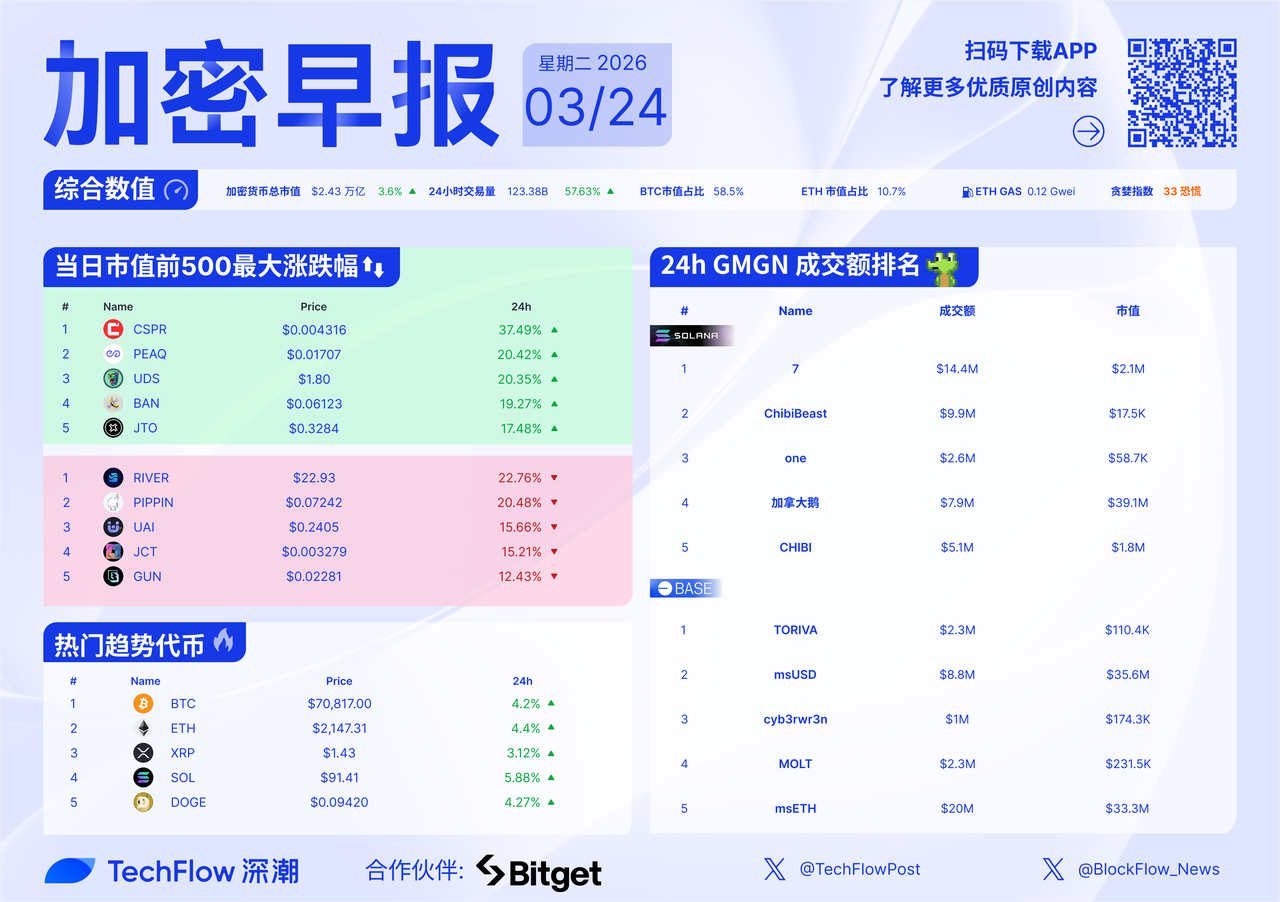
Market Data
Recommended Reading
Tokens Don’t Need Chinese Names—but the Businesses Behind Them Do
This article examines how tokens have increasingly become billing units for cloud services, revenue drivers for large language models, and key metrics used by national governments to gauge AI industry scale—sparking widespread attention to their Chinese translation. The naming of “token” in Chinese has ignited a naming contest, with stakeholders proposing terms like “Zhiyuan” (Wisdom Unit), “Moyuan” (Model Unit), and “Fuyuan” (Symbol Unit)—each reflecting distinct industry narratives and economic interests. Naming is not merely a linguistic question but a matter of economic allocation: different names may shape industry话语权 (influence), future business models, and value distribution.
This article analyzes gold’s sharp price decline against the backdrop of the Middle East war and explores why gold—traditionally viewed as a safe-haven asset—has failed in that role. It argues gold is increasingly behaving as a risk asset, subject to dual pressures from liquidity crises and high-leverage liquidations, leading to sustained price declines. War developments, inflation dynamics, and expectations of Fed rate hikes further compound gold market instability.
Why Are Gold and Oil Prices Diverging?
This article discusses the divergence between gold and oil prices since the outbreak of the Middle East war—gold declining modestly while oil surges sharply—attributing it to differences in their safe-haven attributes and market expectations. Gold initially rose on geopolitical risk concerns but later plunged as capital rotated from gold into oil and amid fears of tighter Fed monetary policy. Future trajectories for both metals will hinge on developments in the U.S.–Iran conflict—especially whether the Strait of Hormuz can be reopened.
This article analyzes the Iran war’s impact on global markets using a four-stage framework, detailing how the conflict drives energy price increases, inflationary pressures, and possible shifts in Fed policy. It also explores accelerated enterprise adoption of AI and its implications for the economy and labor markets.
Is Your AI Agent Outputting Garbage? The Problem Is You’re Reluctant to Burn Tokens
This article explores the relationship between AI Agent output quality and the number of tokens invested, outlining two simple methods to improve agent performance. It analyzes how token count affects resolution of complex problems—and highlights the fundamental limitation that tokens cannot solve “novelty” challenges.
Join TechFlow official community to stay tuned
Telegram:https://t.me/TechFlowDaily
X (Twitter):https://x.com/TechFlowPost
X (Twitter) EN:https://x.com/BlockFlow_News
 深潮TechFlow









