Deep Dive into MyShell's Badge System: A Leading Practice in AI and Web3 Creator Economy
TechFlow Selected TechFlow Selected
Deep Dive into MyShell's Badge System: A Leading Practice in AI and Web3 Creator Economy
This article focuses on the economic system of Myshell's Alpha stage testing.
 Navigating Web3 tides with focused insights
Author: @0xAikoDai, Folius Ventures
On January 26, MyShell launched its badge points system, turning every AI agent, chatbot, and app on the platform into open, investable assets. Currently, the team is busy iterating on product and economic systems, so let me take the liberty of explaining how it works.
For readers unfamiliar with MyShell, I encourage you to visit the official website and experience the product firsthand. In short, it's a powerful AI agent/app creation platform that integrates mainstream closed-source large models with a wide range of open-source models. At present, it stands as the most user-friendly and highly integrated solution in both Web2 and Web3.
Let me reiterate: MyShell is first and foremost an extremely practical AI creation platform, secondly one with an open creator economy. While this article focuses on the alpha-stage tested economic system, I still recommend every interested user to try the product, create their own Agent/App/Bot, and feel how a well-designed Web3 economic system can empower excellent AI products.

In this article, I will mainly cover:
1) The points system of MyShell’s Alpha version badges;
2) Analysis of how this model supports the creator economy and the team’s long-term design intentions;
3) Vision for future expansion of this economic model and ecosystem.
1. Understanding the Badge Points System
Agents/Apps are core income-generating assets. On MyShell, each interaction with an Agent/App consumes “power” (a form of paid credits). Each Agent/App charges different amounts of power based on which language, voice, or image models they use. For example, a simple chatbot using only GPT-3.5 and a fine-tuned model by the creator may consume just 1 power per interaction; whereas an image-generation bot that uses additional open-source language models and the official TTS (OpenVoice) model might cost 13 power per use. Thus, MyShell has established pricing for all interactions across Agents/Apps. Every time a publicly released Agent/App is used effectively 10 times, 100 Shell points are distributed proportionally among the agent creator, model creators, and investors.
For creators:
1) Creators of Agents and Apps not only get access to multiple models to build highly usable tools but also receive an initial share (worth 10 Shell points) upon release, plus ongoing revenue from future interactions.
2) Open-source model developers can earn Shell points rewards simply by being referenced—even without building anything directly on MyShell—while gaining real usage from tens or even hundreds of thousands of users.
3) Rewards earned through these mechanisms can be reinvested: creators can buy pass cards to publish more public Agents/Apps, creating new investable assets for the platform, or invest in other Agents/Apps themselves as stakeholders.
Investment process details:
1) Buy-in: Each Agent/App starts at 10 Shell points. With every additional purchase, the price increases by 10 Shell points. To prevent wash trading and price manipulation, users can only buy one Agent/App per hour, and no single user can purchase the same asset more than three times.
2) Earnings: While holding an Agent/App, all investors split 40% of the revenue generated from others’ interactions. The longer you hold, the more cumulative earnings you accumulate. However, payback periods vary significantly—for instance, someone buying at 50 points breaks even much faster than someone entering at 500 points.
3) Selling: When deciding to exit, users can redeem 90% of their original investment cost plus all accumulated dividends. Additionally, the early investor slot becomes vacant, often available at half the current market price or lower—creating opportunities for other investors to jump in at a discount.
Thus, the entire investment cycle can be summarized as follows: buy a promising Agent/App, actively promote it to increase interactions, wait until passive dividends exceed your initial cost by 10%, then start earning net profits. When you feel returns are diminishing or want to shift capital to newer opportunities, you can sell—recovering 90% of your principal plus all dividends. Other investors spotting your discounted entry point may step in, reigniting promotion and driving renewed interest and value discovery.
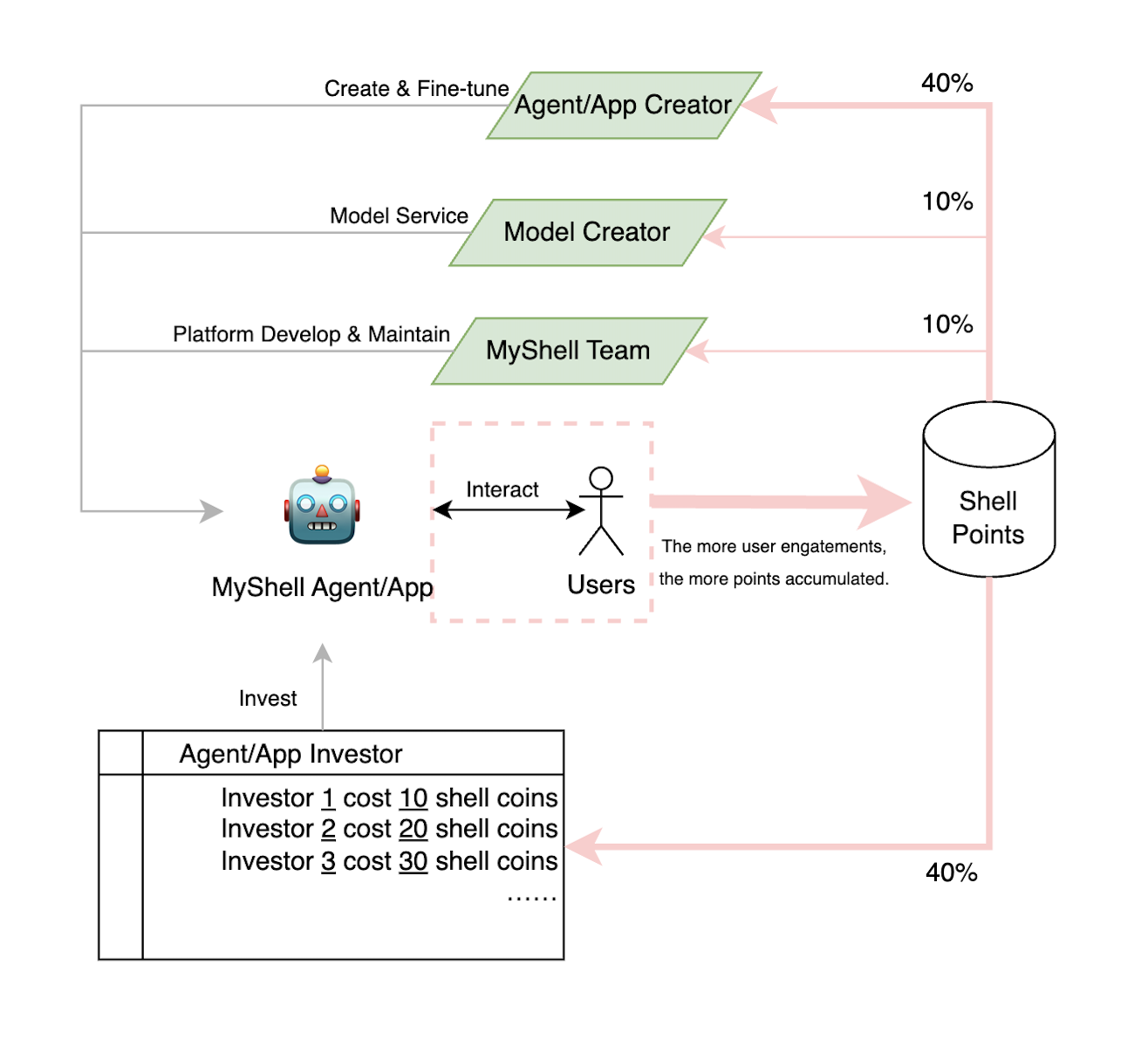
Next, I’ll explain how this economic model incentivizes participants across the ecosystem.
2. Unique Features and Advantages of the Economic Model
The entire economic design of MyShell stems directly from its core purpose. Rules alone cannot reflect the health and long-term sustainability embedded in this model. Drawing from personal observations and conversations with the team, here are key insights into the underlying design philosophy—deeply aligned with MyShell’s long-term vision. I hope readers can sense the team’s commitment to values and mission.
1) A gentler bonding curve variant – Encouraging rational decisions and long-term holding
With nearly 500 public Agents/Apps on MyShell, each featuring unique personalities, fine-tunings, base models, and functions, investors face abundant choices. They can make rational, long-term investment decisions based on popularity and usage frequency, actively promoting their chosen assets rather than blindly chasing rapidly rising prices driven by speculative curves.
2) Earning via dividends, not spreads – Promoting long-term engagement and product empowerment
While Agent/App prices rise with increased purchases, investors only profit if actual user interactions generate dividend payouts. If an early investor regrets their decision and exits early, they won’t gain any price appreciation—and must forfeit 10% of their principal as a fee. This structure ensures early adopters must work alongside later entrants to grow overall value instead of exiting prematurely to exploit newcomers. The correct mindset: since 90% of capital is recoverable, risk is low, while upside potential is massive once traction builds. Therefore, smart strategy involves selecting undervalued yet high-potential Agents, buying in, promoting them, and earning passive income from usage. In many ways, this resembles staking—if you believe strong Agents/AI tools have lasting market demand, you can confidently hold and avoid frequent trading.
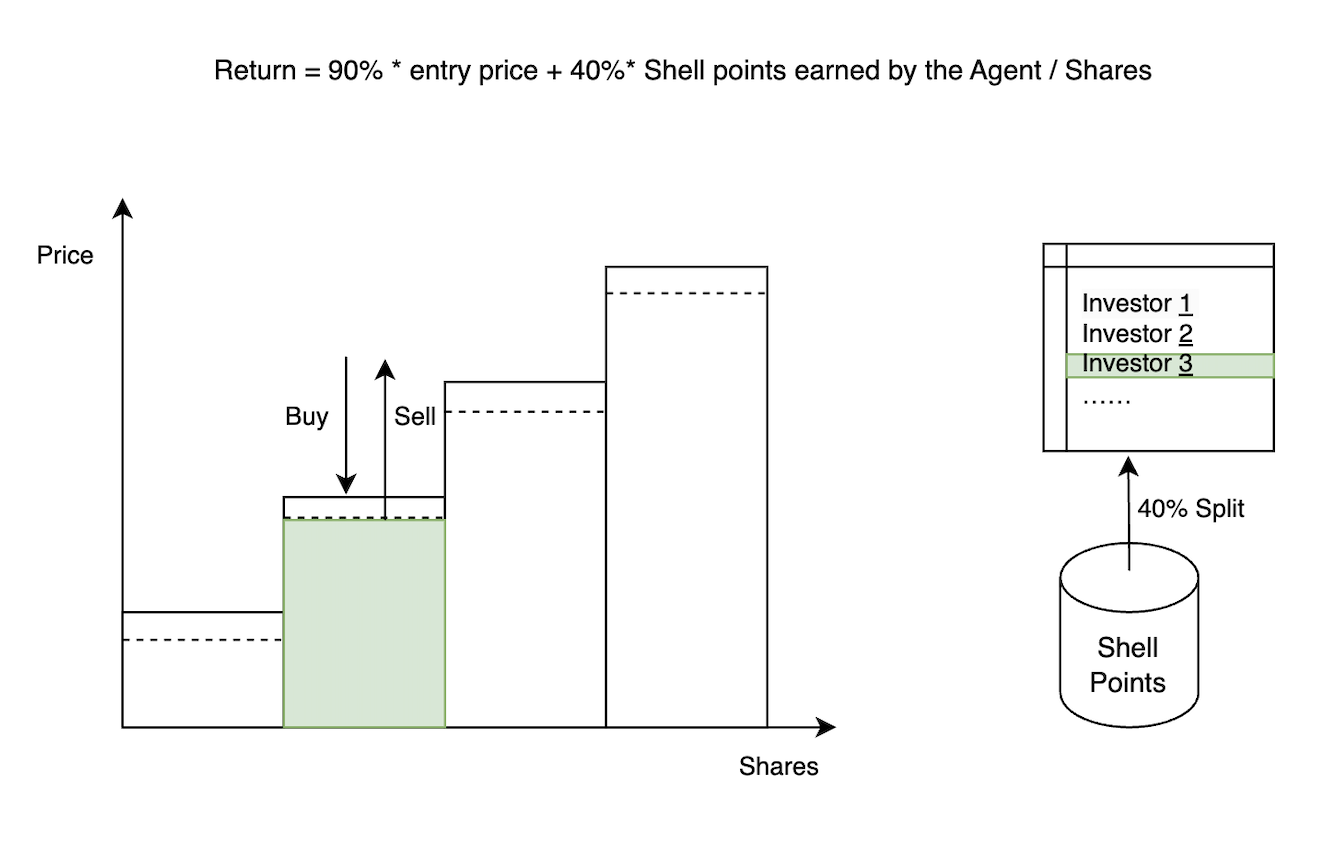
Profits depend solely on usage frequency—not the number of buyers—giving older or previously overlooked assets renewed chances for revival. People begin to trust that even if an Agent faded after initial hype, it still serves a niche need and could resurface when discovered by another group with similar interests. MyShell’s Rick Bot (from Rick and Morty) exemplifies this perfectly: initially popular upon launch, it has now regained attention due to the new investment mechanics, proving quality Agents can capture fresh waves of attention from different user groups over time.
3) Diverse strategic dynamics foster value discovery and emergence of high-potential new assets
Participants engage in nuanced strategic thinking: because dividend sharing is equal regardless of entry price, higher-priced Agents require far more usage to break even. For example, someone who bought at 50 points needs only 10 points in earnings to turn a profit, while someone entering at 500 points must first recoup 500 points before profiting. This creates natural investor博弈 (strategic tension):
-
Choose classic Agents known for consistent daily usage—even if priced high (e.g., 500 points)—because they generate substantial daily returns.
-
Opt for emerging Agents with low prices (e.g., 50 points), then actively promote them to drive interactions.
This trade-off encourages more people to hunt for hidden gems. Market demand for new assets rises, drawing investor attention and speculation toward newly launched Agents. High-quality creations gain recognition—and may even surpass older classics—while flawed ones reveal weaknesses after a brief surge, prompting feedback and improvement from engaged investors.
Additionally, the “grab-the-discount” mechanism upon early investor exit adds another fascinating layer. When early holders leave, new investors can enter at half the current price or less. This stimulates quick adoption by new players, helping maintain total asset valuation and preventing the price collapse and death spirals common in pure bonding curves. More importantly, renewed investment brings fresh promotional energy, enabling cyclical patterns of value discovery → promotion → hype → quiet period → rediscovery.

Finally, and most importantly, to protect the team’s and creators’ efforts and ensure healthy ecosystem operations, MyShell will safeguard contributors’ interests and crack down on malicious multi-accounting and fake interaction farming. MyShell will implement strict risk controls and anti-cheat mechanisms. We welcome users who genuinely wish to invest in the creator economy and grow with MyShell long-term. Inorganic or abnormal interactions carry a higher risk of account suspension.
3. Long-Term Expansion of the Economic Model – Building an Ecosystem, Not Just a Platform
1) Agent/AI-native APPs as investable assets
Why does the logic of investing in Agents and earning dividends succeed on MyShell? How does MyShell optimize and scale token-based betting-like mechanics?
Return to MyShell’s essence: a creator tool platform where Agents/AI-native apps become investable assets—built upon four pillars: irreplaceable infrastructure, high-quality native content supply, asynchronous AI agent interaction, and accessible, long-term investment.
Investors active in various Web3 points systems are often accustomed to short-lived fads fueled by FOMO and wealth effects. After friend.tech, numerous point-based projects emerged—ranging from companion chats to live streaming and mini-games. Though such systems help bootstrap growth, most suffer from four fundamental flaws:
-
Lack of irreplaceability (can be replaced by traditional social media or apps like X, Telegram, Twitch);
-
Non-native content (key information spreads elsewhere, e.g., alpha groups, not within the new app);
-
Lack of asynchronous interaction (host must be online to respond);
-
Poor investment accessibility and longevity (requires constant trading and operational effort, demanding high financial literacy).

In short, MyShell has built formidable moats through integration and tool refinement: creators must come here to build, users must use the products here, investors must participate here. And crucially, participation is accessible to a broad audience. This cannot be replicated by low-cost, short-cycle products or mass-market social platforms. As the Web3 open economy accelerates, this advantage evolves into an increasingly insurmountable barrier.
2) Empowering small AI startups with funding and product launches—using Web3’s economic flywheel to solve persistent challenges in AI commercialization, fundraising, and exit strategies.
“A small AI startup launching a product shares many similarities with a Web3 project launching via IDO or DEX.” – Ethan (Co-founder of MyShell)
Ethan and I once had an interesting brainstorm: small AI products = $MEME, because they share these traits:
-
Small capital requirements (low cost thanks to open-source models);
-
Fast development cycles (short delivery time, often within a week—no time for fundraising, lawyers, or legal terms);
-
Short lifespans;
-
Need to go viral quickly and earn enough during a brief two-week window (to cover costs and fund next project);
Familiar examples include “Miao Ya Camera” or “Catgirl Girlfriend Simulator,” which monetize immediately via subscriptions, one-time purchases, or ads during their peak—but lack sustainable cash flow. Behind these few survivors lie countless small AI teams and startups:
In Q1 2023, small AI product launches increased by 300% compared to Q4 2022, with around 100 AI products published monthly on Product Hunt. Yet, the number of AI startups incorporating dropped 70%, and 83% of those companies have fewer than ten employees. (source: Sortlist)
These figures highlight a trend: in AI and post-AI application domains, small teams (even solo founders) are thriving, while large corporate ventures are declining.
With the explosion of small-team innovations, new paradigms for liquidity and commercialization are needed. Most VC funds flow to giants, leaving smaller AI companies reliant on self-funding or seed rounds—but struggling with PMF and monetization. Many remain stuck in search of product-market fit; only a few briefly gain visibility via short videos, missing the chance to capitalize before momentum fades.
Hence, innovation in AI entrepreneurship demands matching support in liquidity and monetization—specifically, Launchpad and IDO models.
Imagine a platform that provides access to most open-source and major closed-source models, enabling rapid development and deployment; natively supports a token economy with a large base of individual investors ready to back early-stage projects; and offers probabilistic access to 24/7 financial market liquidity and speculative boosts when a product goes viral—that is precisely the role MyShell aims to fulfill.
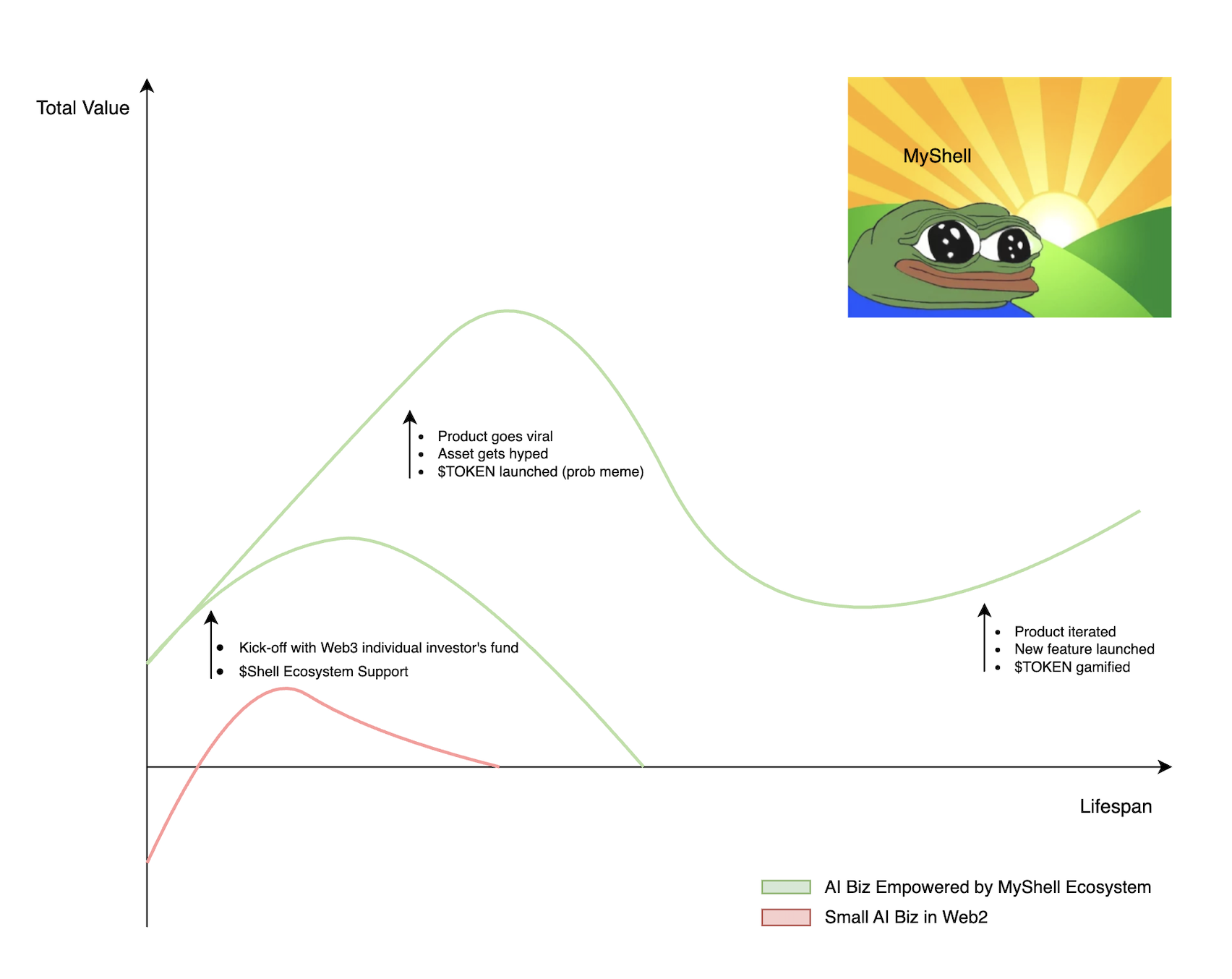
Eventually, MyShell’s value will equal the sum of all AI products built on it—like Valve for indie games, Kickstarter for consumer goods, Product Hunt for mobile apps, but going further by combining Apple Store-level traffic with Launchpad/DEX-level capital and liquidity.
3) More to come: Exploring and experimenting with AI agent markets and other valuable agent-related themes. Due to space constraints, product stage limitations, confidentiality, and a desire not to distract from the alpha-phase economic model, many exciting possibilities (already in development) cannot be detailed here. These will appear in future research pieces, including:
-
Fully on-chain agent markets
-
Trading agents with diverse strategies and personalities
-
Gaming agents (optimizing gameplay, auto-farming, even bribing other agents)
-
Inter-agent calling and interaction
-
…
All these advanced capabilities will eventually integrate into a vast user ecosystem and economy. For a team with strong research and technical execution, fostering an inclusive, experimental, and stable environment, launching an alpha economic system isn’t the end—it’s just the beginning. ;D
Postscript
Over the past year, many AI and IP teams have reached out to me, curious about integrating Web3’s creator economy into their communities and products (e.g., the largest GPT prompt community in Web2, or知名 anime IPs). Yet, they’re unsure how to incorporate Web3 funding and investment features in a comfortable, secure way. I’m glad to see MyShell taking the lead in embedding such mechanisms into its ecosystem. As the platform evolves, this challenge will be addressed, positioning MyShell as a pioneer in the future of creator economies. You never know until you try.
In our previous discussions, we’ve repeatedly explored the intersection of Web3’s speculative nature with Web2 creators, and the myriad possibilities arising from this fusion.
We know that due to the intense incentives of Web3 economics, many teams become short-sighted and overly profit-driven. But only those truly committed to creator ecosystems and product excellence will patiently build economic systems that satisfy complex, overlapping needs—ensuring all participants contribute meaningfully and receive fair rewards.
On this front, MyShell’s response has always been consistent: they firmly believe gradual growth and shared rewards create more sustainable, long-term momentum. From day one, their goal has been to build a truly powerful AI tool rivaling Web2 giants, while fairly sharing value with creators and the broader open-source community. I’m happy to see them delivering on that promise through countless iterations and explorations.
Join TechFlow official community to stay tuned
Telegram:https://t.me/TechFlowDaily
X (Twitter):https://x.com/TechFlowPost
X (Twitter) EN:https://x.com/BlockFlow_News
 @0xAikoDai