








In-depth Analysis of the Telegram Bot Sector (Part 1): How On-chain Brokers Drive Mass Web3 Adoption?
TechFlow Selected TechFlow Selected
In-depth Analysis of the Telegram Bot Sector (Part 1): How On-chain Brokers Drive Mass Web3 Adoption?
Projects must differentiate themselves through personalized services, technological innovation, or superior user experiences to attract and retain users.
 Navigating Web3 tides with focused insights
Author: @ChingChaLong02
Advisors: @Zou_Block, @Erjiueth
Since the emergence of Telegram trading bots, the barrier to entry for trading has significantly decreased, enabling seamless on-chain transactions directly from mobile devices. Functioning much like on-chain brokers, these Telegram trading bots have driven sharp price increases for multiple projects, sparking a wave of enthusiasm around Telegram bots.
This article series offers an in-depth analysis of the Telegram bot sector, divided into two parts: the first provides a comprehensive overview of the sector, while the second focuses on key project evaluations.
1. Sector Overview
Since the rise of Telegram trading bots, we have witnessed significant price surges across multiple projects. Unibot, in particular, began rapidly gaining momentum starting July 2023. According to CoinGecko data, Unibot’s token price surged from a low of $3.13 in May to a peak of $200.45 in August—an almost 100-fold increase—leading a new wave of interest in Telegram trading bots.
However, as Unibot's popularity gradually waned, Banana Gun emerged as a strong contender. After announcing its airdrop in September, its token price climbed from around $9 to a high of $18. While its upward momentum didn't match that of Unibot, Banana Gun still helped sustain market activity within the Telegram trading bot ecosystem.
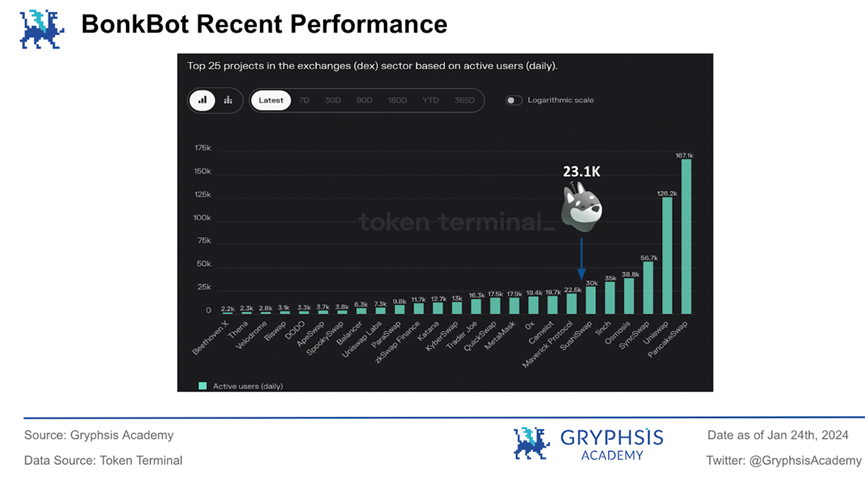
An emerging standout is BonkBot, built on the Solana blockchain, which once achieved a daily active user count of approximately 35,700—surpassing established projects such as Banana Gun and Maestro, and performing exceptionally well compared to players in the decentralized exchange (DEX) space.
In the DEX arena, BonkBot ranked just behind SushiSwap in terms of 7-day average daily users, outperforming veteran protocols such as Maverick Protocol and Trader Joe. This surge was undoubtedly fueled by the rising popularity of the Solana ecosystem and heightened user engagement in trading Solana-based meme coins, further boosting BonkBot’s transaction volume.
Meanwhile, BTCBot.pro, a Telegram bot tailored for the Bitcoin ecosystem, has been live for nearly a month. Due to Bitcoin's unique technical characteristics, BTCBot.pro offers functionalities distinct from those of ETH- or Solana-based Telegram bots, making it a noteworthy case for study.
Overall, the Telegram trading bot landscape is clearly not a fleeting trend. However, this space continues to evolve rapidly. This article aims to map the current macro landscape of Telegram trading bots and highlight several projects worth watching.
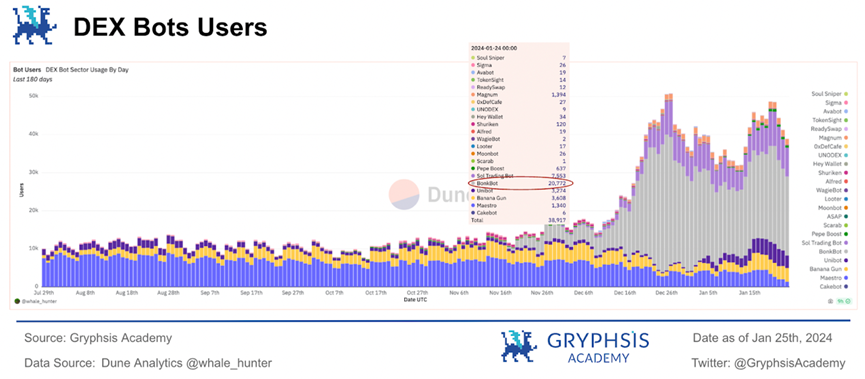
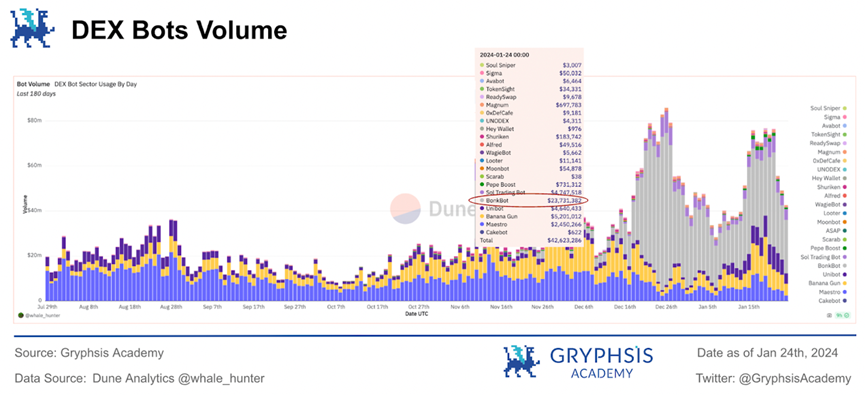
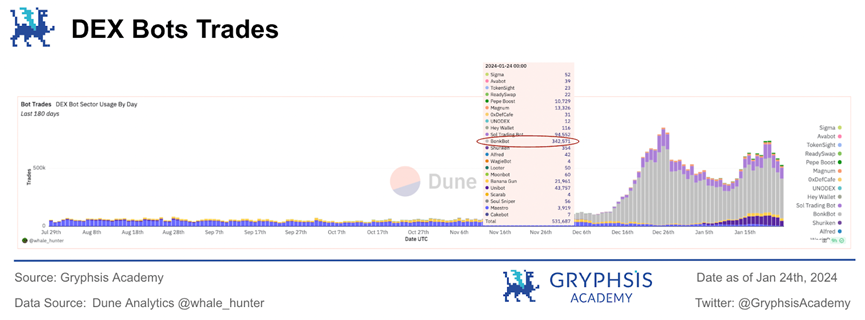
Data analysis shows that since its launch, BonkBot has taken the lead over other trading bots in both transaction frequency and user numbers. In transaction frequency specifically, BonkBot significantly outperforms Banana Gun and Maestro Bot, achieving roughly ten times their rate.
This remarkable performance stems from BonkBot’s efficient design on Solana—a chain renowned for its high TPS (transactions per second), capable of supporting frequent transaction processing. Combined with the recent surge in meme coin activity on Solana, BonkBot has solidified its dominant position in the Telegram trading bot market.
Inspired by BonkBot’s success, similar clones such as Sol Trading Bot have launched on Solana, quickly catching up to projects like Banana Gun and Maestro Bot in trading volume, and even surpassing them in transaction frequency and daily active users.
As for Unibot, current data indicates its market advantage has diminished. Nevertheless, it’s notable that the project has started deploying on Solana, which has slightly boosted its trading volume. Clearly, leveraging Solana as infrastructure may be key to driving the next wave of growth in Telegram trading bots.
While Solana-based bots are currently excelling, it's important not to overlook Banana Gun’s strong prior performance before the Solana boom. It remains close behind BonkBot across several key metrics.
2. Historical Evolution
With the rapid development of the cryptocurrency industry, Telegram bots have become increasingly popular as intelligent trading tools within crypto communities. As early as 2017, Telegram bots already had the capability to automatically respond to messages and execute user commands.
As the crypto industry expanded, Telegram became the most widely used instant messaging platform among crypto enthusiasts. Against this backdrop, Telegram-based trading bots began to emerge, enabling automated operations such as token swaps, copy trading, data analytics, automated airdrop participation, and cross-chain asset management.

3. Market Landscape
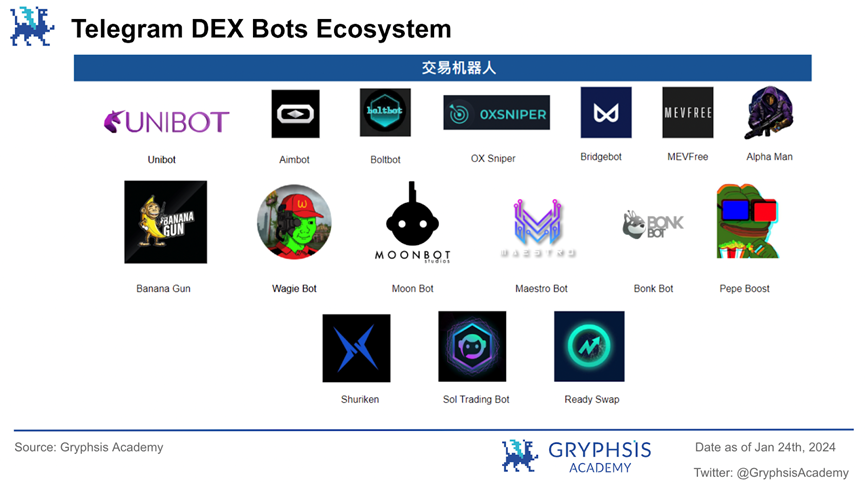
Telegram trading bots are automated systems within Telegram that assist users in executing trades on decentralized exchanges. Users interact with these bots through the messaging interface of the app.
While different Telegram trading bots offer unique features, most include common trading functions such as stop-loss and take-profit orders, copy trading, and multi-wallet support.
These bots replace the user interface (UI) and user experience (UX) of Web3 wallets and DEXs, simplifying what were previously complex decentralized trading processes.
Leveraging advanced algorithms and infrastructure, these bots enable ultra-fast transactions, often referred to as "Uniswap snipers." They meet user demands for efficiency and convenience. Although speed is a shared trait, they differ in specialized features. For example, UniBot offers limit orders and mirror sniping, SwipeBot emphasizes ease of use, while OxSniper includes anti-MEV protection. The main uses of trading bots include:
-
Buying and selling tokens: Integrated with Telegram, these bots allow users to easily acquire tokens by copying and pasting contract addresses into the chat. Some bots provide real-time profit and loss updates and accelerate token selling via pre-approved transactions.
-
Setting stop-loss and take-profit orders: Users can set stop-loss and take-profit orders via these bots, enabling automatic execution based on predefined parameters. This feature is particularly useful for trading new tokens not yet listed on centralized exchanges (CEXs), though such trades carry higher risk.
-
Rug pull and貔貅 scam detection: Some bots include rug-pull prevention and anti-MEV features. If a token developer plans to rug pull, the bot detects pending mempool transactions and quickly sells to avoid losses. Anti-MEV functionality routes purchases through private relays, preventing public broadcast in the mempool and thereby avoiding sandwich attacks.
Additionally, trading bots can detect potentially malicious developer transactions. If such transactions render a token unsellable, it is flagged as a貔貅 (a token that can only be bought, not sold). The bot will then immediately exit the position to avoid entrapment.
-
Copy trading: Users can automatically replicate trades from specific wallet addresses using certain Telegram bots. These bots act as bridges between user accounts and selected traders, executing trades based on signal inputs. However, copy trading carries liquidity risks—insufficient market liquidity may hinder trade execution and increase costs.
-
Sniping: Some bots support liquidity sniping, method ID sniping, and multi-wallet sniping. Liquidity sniping automatically buys when increased liquidity is detected. Method ID sniping executes buys based on the “method ID” of pending developer transactions. Users can also deploy multiple wallets via Telegram bots for coordinated sniping.
Traders can use bots to automate tasks for airdrop farming. Airdrop-focused bots typically operate across multiple chains, identifying promising airdrop opportunities. However, caution is advised when participating in unverified airdrops to avoid scams and fraud.
4. Technical Implementation
Telegram bot functionality has existed for years, but recently there has been growing interest in integrating Telegram bots with Web3 technologies such as blockchains and smart contracts. Unibot is one of the leading platforms for Web3 Telegram bot development, offering tools and services that help developers create, manage, and organize bots capable of interacting with decentralized applications and blockchain networks.
With the rise of decentralized finance (DeFi) and non-fungible tokens (NFTs), the Web3 Telegram bot ecosystem has gained significant traction. These bots serve various purposes, including automated trading, asset tracking and management, and social features. By combining the Telegram Bot API with Web3 technologies, these bots integrate seamlessly with blockchain networks and other Web3 apps, delivering more flexible and powerful functionalities to users.
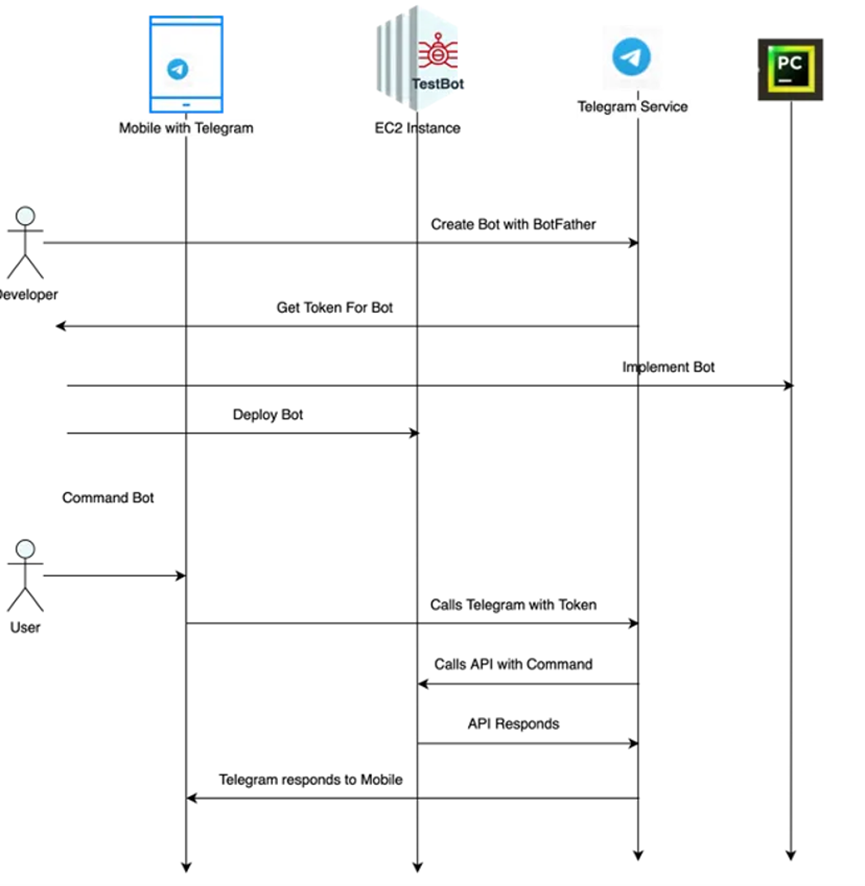
The Telegram bot ecosystem is primarily built on the Telegram Bot API—a set of HTTP-based API endpoints that allow developers to programmatically interact with the Telegram system.
The Telegram Bot API is language-agnostic, meaning it can be used with any programming language capable of making HTTP requests. Common languages for building Telegram bots include Python, JavaScript (Node.js), and PHP.
Source: Medium @Srikari Rallabandi
At their core, Telegram bots are programs that interact with the Telegram system via the Telegram Bot API. They can be programmed to respond to messages, commands, and inline queries. To create a bot, you must register it within Telegram, which provides a unique authentication token. This token verifies the bot’s identity and enables communication with the bot API.
From an infrastructure standpoint, bots run on servers rather than user devices, ensuring they remain online and can respond to user messages instantly. Servers can be cloud-based or local, depending on developer preference.
5. Growth Drivers
5.1 Democratization of Crypto Trading
Crypto trading is often seen as having a high knowledge barrier, making widespread adoption difficult. Compared to stock trading, crypto requires additional setup steps such as creating wallets and completing KYC procedures, which pose obstacles for mainstream investors. Moreover, even centralized exchanges often feature complex user interfaces that appear less intuitive compared to the simplicity of Telegram bots.
Since the emergence of Unibot, the goal has been to streamline trading by minimizing operational complexity. All interactions occur through simple conversations with the bot, complemented by fast Uniswap sniper capabilities for quick and precise trades. The convenience of Unibot allows users to trade anytime, anywhere via Telegram, without relying on external platforms—greatly benefiting the long-term democratization of crypto trading.
Recently, the surge in Telegram bot trading volume confirms strong market demand for this model. Especially for tokens with low liquidity or no CEX listings, Telegram bots greatly enhance visibility. At the same time, they expand investment options for traders, creating a win-win scenario.
5.2 Telegram as a Platform
As one of the world’s most popular social apps, Telegram boasts over 55 million daily active users, providing fertile ground for the growth of Telegram bots. Thanks to its wide recognition and massive user base, Telegram is evolving toward becoming a super app akin to WeChat, supporting a variety of mini-programs within its platform. This expansion enhances functional diversity and opens new pathways for decentralized payments.
To realize this vision, Telegram is collaborating with leading tech and crypto organizations such as the TON Foundation and Tencent Cloud, aiming to expand its global reach and accelerate decentralization. These strategic moves underscore Telegram’s potential as a key super app in the future of Web3.
Telegram bots, built atop this robust platform, stand to benefit immensely—potentially converting Telegram’s vast user base into loyal bot users and further strengthening their influence in digital transactions and crypto integration.
6. Risks
6.1 Asset Security Risks
Using Telegram bots for crypto trading exposes users to asset security risks. These bots typically require either creating a dedicated wallet or connecting an existing one. In both cases, bots may gain access to private keys, creating potential vulnerabilities.
Private Key Access Risk: Bots accessing private keys raise serious security concerns. Private keys act as master keys to users’ digital wealth; exposure could lead to theft or unauthorized transactions. Bot access to these keys significantly increases the risk of security breaches.
Challenges to Self-Custody: Delegating wallet creation and private key management to bots undermines the fundamental principle of self-custody in crypto. Shifting control from individuals to automated systems may foster a false sense of security, leaving users vulnerable to mismanagement or even malicious behavior.
Risks of Mismanagement and Unauthorized Access: Telegram bots are often designed to manage assets without direct user oversight, opening doors to potential mismanagement. Additionally, inadequate security protocols may allow unauthorized access—either due to flaws in the bot itself or external threats.
To mitigate these risks, users should exercise caution when using Telegram bots for crypto trading. This includes thoroughly researching a bot’s security features, avoiding storing large amounts of assets in connected wallets, and regularly monitoring transaction activity for signs of unauthorized actions.
While Telegram bots offer convenience and efficiency, they also introduce substantial asset security risks. Users must remain vigilant and proactively protect their digital assets in this evolving landscape.
6.2 Risk of Lack of Code Audits
For Telegram bots, the absence of comprehensive and regular code audits increases the risk of exploitable vulnerabilities. This lack of auditing leads to reduced transparency and oversight, putting user assets at risk. Take Unibot and Banana Gun as examples: according to Certik data, neither project has undergone a Certik code audit, meaning users must bear the risks associated with unverified smart contracts.
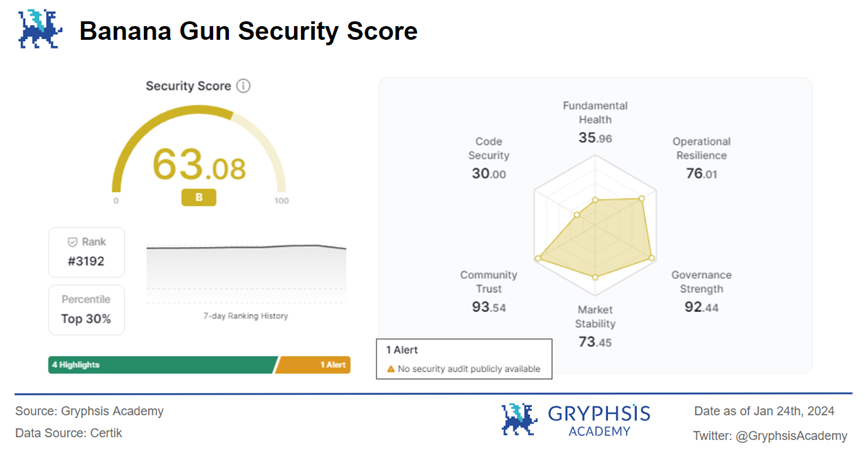
Due to the absence of Certik code audits and KYC verification, both projects score lower in “code security” and “fundamental health.”
Banana Gun has precedent: within three hours of its initial launch, its price experienced extreme volatility, plummeting from a peak of $8.7 to just $0.02—nearly zero.
In response to this anomaly, the Banana Gun team stated in an official announcement that a critical bug existed in the token contract that the team failed to fix. They added that despite two prior audits, the flaw went undetected. This incident highlights the risks posed by the absence of proper code audits.
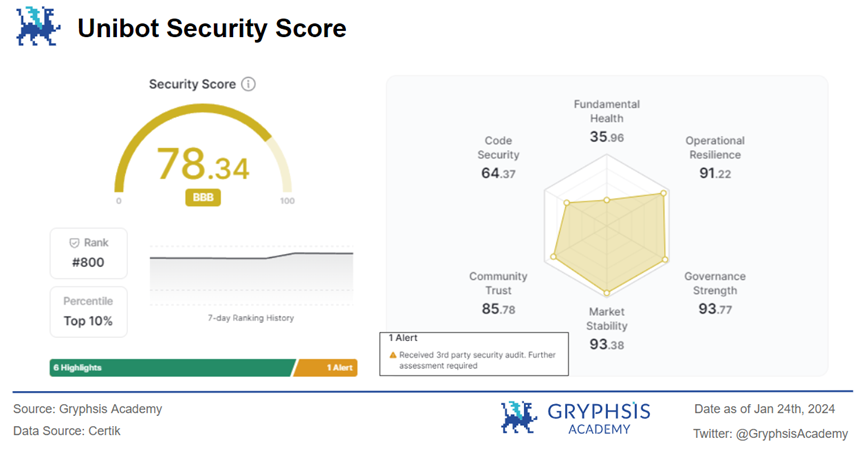
Unibot opted for a third-party auditor with relatively low recognition and did not undergo KYC verification. This may impact the project’s credibility and security, as lesser-known auditors may not deliver the same quality of review as more reputable firms. Additionally, the lack of KYC increases the risk of dealing with anonymous or opaque entities.
6.3 Intense Competition
In the highly competitive Telegram bot ecosystem, low barriers to entry make imitation and replication easy, resulting in severe homogenization among projects. Under such conditions, individual bots may face user attrition, making the construction of strong competitive moats crucial. Projects must develop unique advantages to defend against market encroachment by rivals.
Take BonkBot as an example: its dominance in the Solana meme coin space largely stems from its status as a first mover. However, user loyalty in this space is generally low, with users tending to choose services based on performance and potential returns rather than brand loyalty. This means users will quickly switch platforms if better trading conditions or more attractive opportunities arise—precisely why platforms like Unibot or Maestro Bot failed to maintain leadership.
In summary, although the Telegram bot sector shows promising growth potential overall, not every project will succeed in this fierce competition. Investors entering this space must recognize the inherent risks of each project and remain aware of the market’s unpredictability.
7. Conclusion and Outlook
7.1 Intensifying Competition Among Solana-Based Telegram Bots
Market Saturation and Emergence of Leaders: As competition intensifies among Solana-based Telegram bots—with major players like Unibot and Banana Gun entering—the market becomes increasingly saturated. In this environment, only a few projects will survive, requiring each to develop a unique roadmap and value proposition.
Personalization and Innovation: Projects must differentiate themselves through personalized services, technological innovation, or superior user experience to attract and retain users.
7.2 Crypto Market Entering a Bull Run
Impact of Policy and Market Sentiment: Fueled by positive regulatory developments and improving market sentiment, the cryptocurrency market is gradually entering a bull phase. This will draw more retail investors into the market, benefiting the adoption of tools like Telegram bots.
Market Positioning and Accessibility: Given that Telegram bots aim to simplify crypto trading, their appeal to mainstream Web2 users will grow as retail participation increases.
7.3 Growth of Ordinals Inscriptions and Bitcoin-Based Telegram Bots
Favorable Trends in Bitcoin Markets: The Ordinals inscription market benefits from positive momentum and news flow in the Bitcoin ecosystem and is expected to continue growing.
Early-Stage Market and Opportunities: Since the Bitcoin Telegram bot market is still in its infancy, there is reason for optimism about its future. This presents a significant opportunity, especially for projects that can quickly adapt to market needs and innovate their offerings.
Overall, while competition is fierce, it also signifies abundant opportunities. For Telegram bot projects, the key lies in identifying and leveraging these trends while continuously innovating and improving to maintain competitiveness and appeal in the market.
Join TechFlow official community to stay tuned
Telegram:https://t.me/TechFlowDaily
X (Twitter):https://x.com/TechFlowPost
X (Twitter) EN:https://x.com/BlockFlow_News
 @gryphsisacademy






