









Bitcoin falls to lowest level since spot ETF approval, could GBTC be the "culprit"?
TechFlow Selected TechFlow Selected
Bitcoin falls to lowest level since spot ETF approval, could GBTC be the "culprit"?
It's not just institutional investors moving money—retail investors also appear to be shifting from exchanges to cheaper spot Bitcoin ETFs.
 Navigating Web3 tides with focused insights
By Mary Liu, Bitpush News
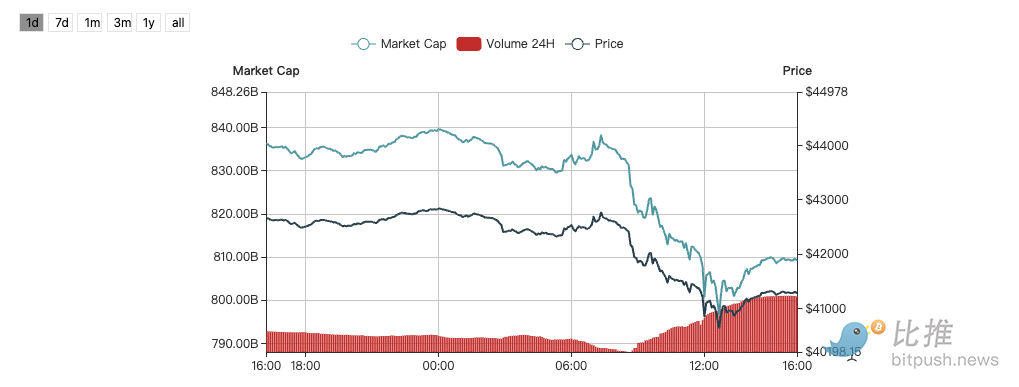
Bitpush terminal data shows that Bitcoin prices fell another 4.5% on Thursday, briefly dropping to a one-month low of $40,800. Since the U.S. SEC's newly approved spot Bitcoin ETFs began trading on January 11, Bitcoin has experienced only a brief rally and is now down approximately 13%.
Crypto-related stocks were also dragged lower. Coinbase, the largest cryptocurrency exchange in the United States, dropped around 6.7%, and is down 17% since the approval of the spot ETF. Bitcoin miner Marathon Digital fell 6.9%, while dedicated Bitcoin holder MicroStrategy declined by 3%.
GBTC Could See Outflows Up to $10 Billion, Selling Pressure Looms
Traders are closely watching ETF fund flows. Many industry insiders believe that selling pressure from Grayscale’s GBTC could be the main culprit behind this downturn.
On Thursday, JPMorgan analysts led by Nikolaos Panigirtzoglou stated that if investors in Grayscale’s spot Bitcoin ETF (converted from its flagship GBTC) continue to take profits, Bitcoin could face additional downward pressure in the coming weeks.
Established in 2013, GBTC managed over $28 billion in assets when it converted to an ETF. According to The Block, GBTC saw outflows of $451 million on January 17. Since converting to a spot ETF, the fund has experienced approximately $1.6 billion in total outflows.
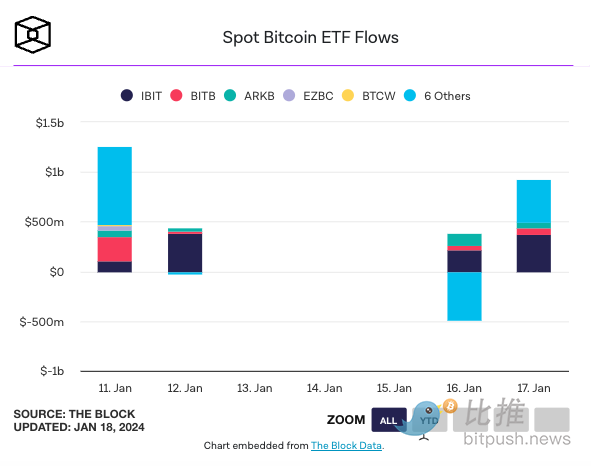
Some capital has been absorbed by other spot ETF products. Michael Safai, founding partner at quantitative trading firm Dexterity Capital, said: "Many investors wanted to wait until Grayscale’s negative premium narrowed significantly before exiting their positions. Now that the discount has nearly disappeared, some traders may have sold and are waiting to re-enter ETFs as soon as possible."
BlackRock’s spot Bitcoin ETF (IBIT) has attracted over $1 billion in inflows, becoming the first of its kind to reach this milestone.
Fidelity Investments followed closely behind, with its FBTC product seeing $358 million in inflows yesterday—the highest single-day inflow since the fund launched a week ago—bringing its total inflows to approximately $880 million. BlackRock and Fidelity together captured 68% of the total inflows across nine new ETFs, amounting to nearly $2 billion.
Among the 11 spot Bitcoin ETFs, Grayscale charges the highest management fee in the industry at 1.5%. Franklin Templeton offers the lowest at 0.19%, though its recent share of total inflows remains below 2%. Ark Invest has waived fees for the first year, charging 0.21% thereafter. BlackRock, the world’s largest asset manager, charges 0.12% in the first year and 0.25% afterward.
JPMorgan analysts noted in a report that GBTC’s situation could worsen, estimating the fund could lose up to $10 billion in assets.
"Liquidity and market depth matter," JPMorgan said, "but GBTC will also be at risk in this regard if other spot Bitcoin ETFs achieve critical scale in size and liquidity."
Liquidity typically refers to the ability to sell an asset for cash. Reduced liquidity poses risks to investors who may find it difficult to exit positions. The report added: "If GBTC loses its liquidity advantage, more capital could exit—perhaps an additional $5 billion to $10 billion."

It’s not just institutional investors moving funds—retail investors also appear to be shifting from exchanges to cheaper spot Bitcoin ETFs. JPMorgan noted: "Bitcoin wallets held by retail investors have shrunk in recent days."
Other ETF Products Also Seeing Outflows
Vetle Lunde, analyst at K33 Research, pointed out that long before U.S. regulators approved spot Bitcoin ETFs, there were already numerous such products trading globally. He noted that global exchange-traded products (ETPs) currently hold over 864,000 bitcoins, meaning that, relatively speaking, the incremental impact of U.S.-listed products so far has been modest.
Lunde also highlighted that apart from GBTC withdrawals, European and Canadian ETPs have seen significant outflows over the past week as investors take profits and/or shift capital into cheaper U.S. ETFs.
There is also the ProShares Bitcoin Strategy ETF (BITO), which recently managed over $2 billion in assets. Lunde noted that although this futures-based ETF does not hold Bitcoin directly, it accounts for 36% of open interest in Bitcoin contracts on the CME exchange. He added that futures-based Bitcoin ETFs collectively represent 48% of CME’s Bitcoin open interest.
Lunde believes that as BITO and other futures-based funds experience outflows, they will need to close (sell) their long positions in the futures market, potentially adding further downward pressure on Bitcoin prices.
Bartosz Lipiński, CEO of trading platform Cube.Exchange, suggested: "The hype around ETFs may have already faded, and traders’ attention could shift elsewhere. Current options positioning suggests support around $40,000, a key psychological level."
Independent market analyst Michael van de Poppe advised investors on X: "Don’t be bearish on BTC or hold a negative outlook—remember, buy the dip and hold."
Join TechFlow official community to stay tuned
Telegram:https://t.me/TechFlowDaily
X (Twitter):https://x.com/TechFlowPost
X (Twitter) EN:https://x.com/BlockFlow_News
 比推 BitpushNews











