








OKLink Research Institute 2024 Outlook: Web3 and AI Resonance Ignite a Trusted Digital Society
TechFlow Selected TechFlow Selected
OKLink Research Institute 2024 Outlook: Web3 and AI Resonance Ignite a Trusted Digital Society
If combined, could they produce a synergistic effect greater than the sum of their parts?
 Navigating Web3 tides with focused insights
Author: Bi Lianghuan, Chief Researcher at OKG Research
“AI is about to completely transform the way you use computers and disrupt the software industry.” This headline from an article by Bill Gates last November sparked widespread attention.
This immediately reminded me of several years ago, when blockchain technology first entered broad public discussion and people frequently used the word "disruption" to describe its potential. Looking back over the past few years, blockchain has evolved from early native innovations like ERC20, zero-knowledge proofs, and BRC20 into more integrated applications such as DeFi and DePIN.
Could combining these two technologies create a synergistic effect greater than the sum of their parts?
At the beginning of last year, we proposed that super apps would be key to mass adoption. This year, OKG Research turns its focus toward the technological convergence of AI and Web3—with support from compliant environments, this integration has the potential to reshape current Web3 user behaviors, accelerate mass adoption, and jointly build a trustworthy digital society.
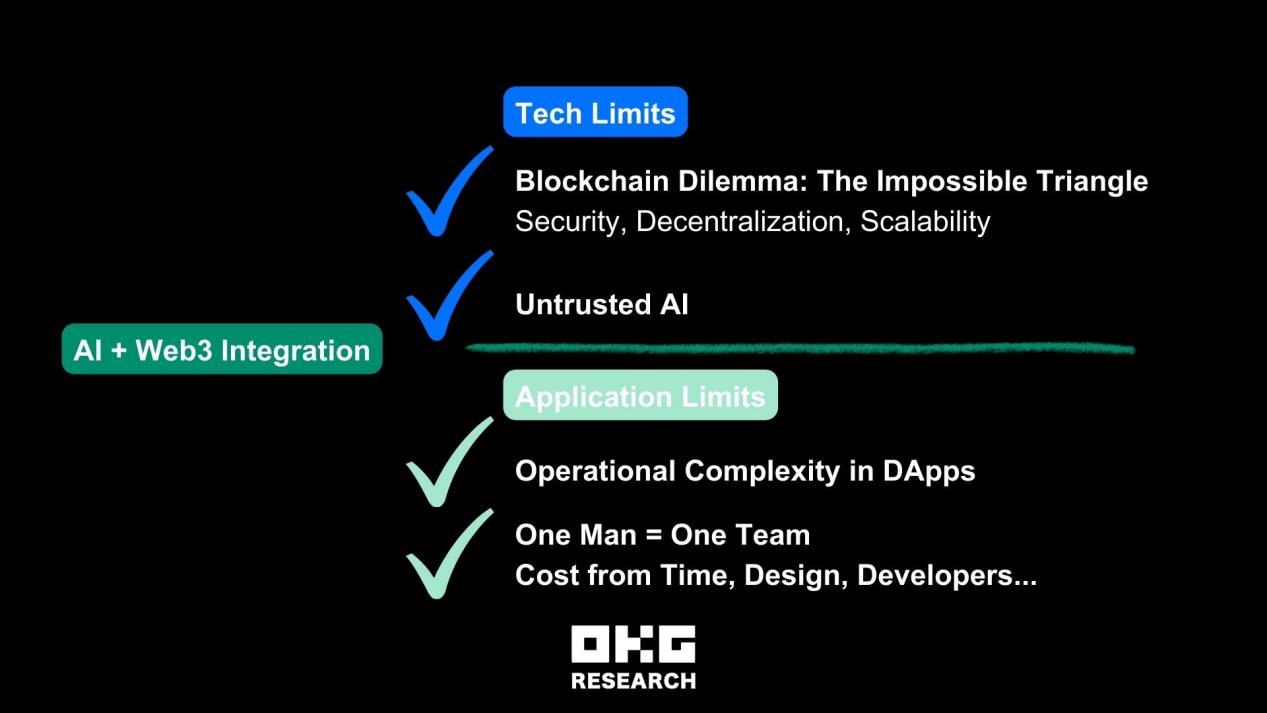
Figure: The fusion of AI and Web3 technologies can help resolve technical and application-level challenges
Scaling Trust: The Foundation of a Trusted Digital Society
In today’s networked society filled with misinformation, Web3 has long been expected to evolve into a new value-based platform ecosystem—replacing Web2’s information-centric model. Imagine a platform where information flows are no longer threatened by manipulation or distortion. Economic activities on this value network become fairer and more transparent, with on-chain data clearly revealing the value chain behind every transaction, eliminating black-box value transfers.
However, this evolution is constrained by the so-called “impossible triangle” of decentralization, security, and scalability. Without scalability, building this new value platform remains out of reach. Yet the integration of AI offers promising solutions to break through this impossible triangle and advance Web3 toward a scalable, trusted digital society.
From a scalability perspective, today’s Web3 ecosystem includes hundreds of blockchains, Layer-2 networks, and application-specific chains. However, due to blockchains’ lack of native communication capabilities with external systems, many “information silos” have formed. Technologies such as cross-chain bridges, atomic swaps, relay chains, and sidechains have been proposed as solutions. Yet these remain difficult for most users to access. By introducing intelligent agents (AI Agents) capable of autonomous decision-making and execution—simulating human roles—these agents can select optimal cross-chain solutions based on user needs, breaking down information silos between different blockchains and delivering superior cross-chain experiences.
From a security standpoint, AI can enhance the safety of Web3 systems. Through real-time monitoring and analysis, AI can detect and respond to potential threats promptly, effectively safeguarding users’ assets and privacy. Beyond using AI as an efficiency tool—for example, accelerating code audits or enhancing security reviews during development—a new direction gaining academic attention is the Blockchain Large Language Model (LLM) proposed by Berkeley RDI. It aims to provide an infinite search space unrestricted by predefined rules or patterns, enabling direct detection of a broader range of anomalies.
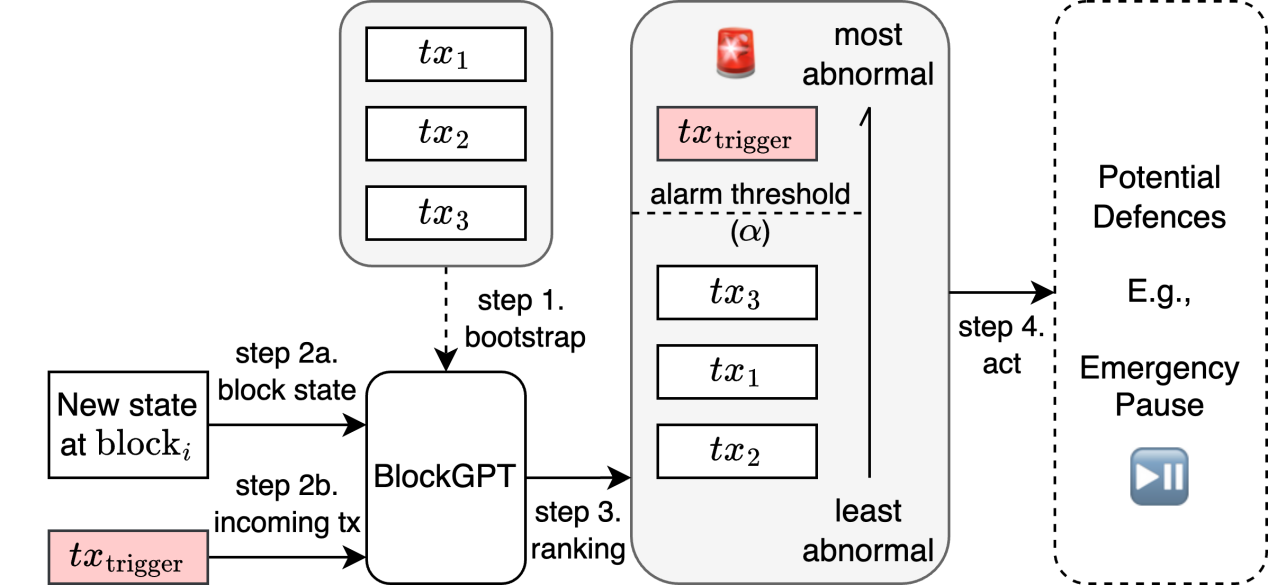
Figure: Simplified product design diagram of a blockchain large language model
Source: Berkeley RDI
Technological Convergence Empowers Trust in AI
To build a trustworthy digital society, having a scalable and secure Web3 isn’t enough—what if AI itself acts maliciously? A survey conducted by EY found that 90% of enterprises surveyed remain in the early stages of AI maturity, with only 4% reaching the most advanced level. Low trust and concerns about potential risks of artificial intelligence have become major barriers to accelerating AI adoption.
Low trust stems from two main sources: one is incorrect training data fed into AI; the other is centralized, manipulatable data sources. However, Web3 technology offers significant benefits in improving trust in AI:
Web3 leverages blockchain’s notarization function to combat AI-generated misinformation. For instance, content creators can apply hashing (Note 1) to articles or videos—similar to creating a digital fingerprint—ensuring each piece of content is unique. These digital fingerprints are then recorded on the blockchain and signed with a public key, guaranteeing authenticity and integrity.
The convergence of AI and Web3 opens new pathways to improve privacy and data ownership, offering decentralized data storage and management via blockchain, giving users control and visibility over their data. This provides an alternative to large-scale cloud development, reducing monopolies held by centralized cloud providers. In the future, some centralized cloud service providers may choose to collaborate with Web3 ecosystems to integrate new technologies and services.
Once fundamental technical limitations are addressed through the fusion of Web3 and AI, the foundation for a trusted digital society will be laid. Scalable Web3 will empower individuals more significantly. Centered around individual economies, the application layer of Web3 and AI will unlock infinite potential. In this new ecosystem, individuals can directly participate in economic activities and gain greater control over their data and assets. Everyone can engage in innovative business models through AI-assisted smart contracts, digital identities, and other technologies, contributing to a fairer and more transparent economic system. This emerging economic model will drive creativity and personalization, bringing more opportunities and fairness to society.
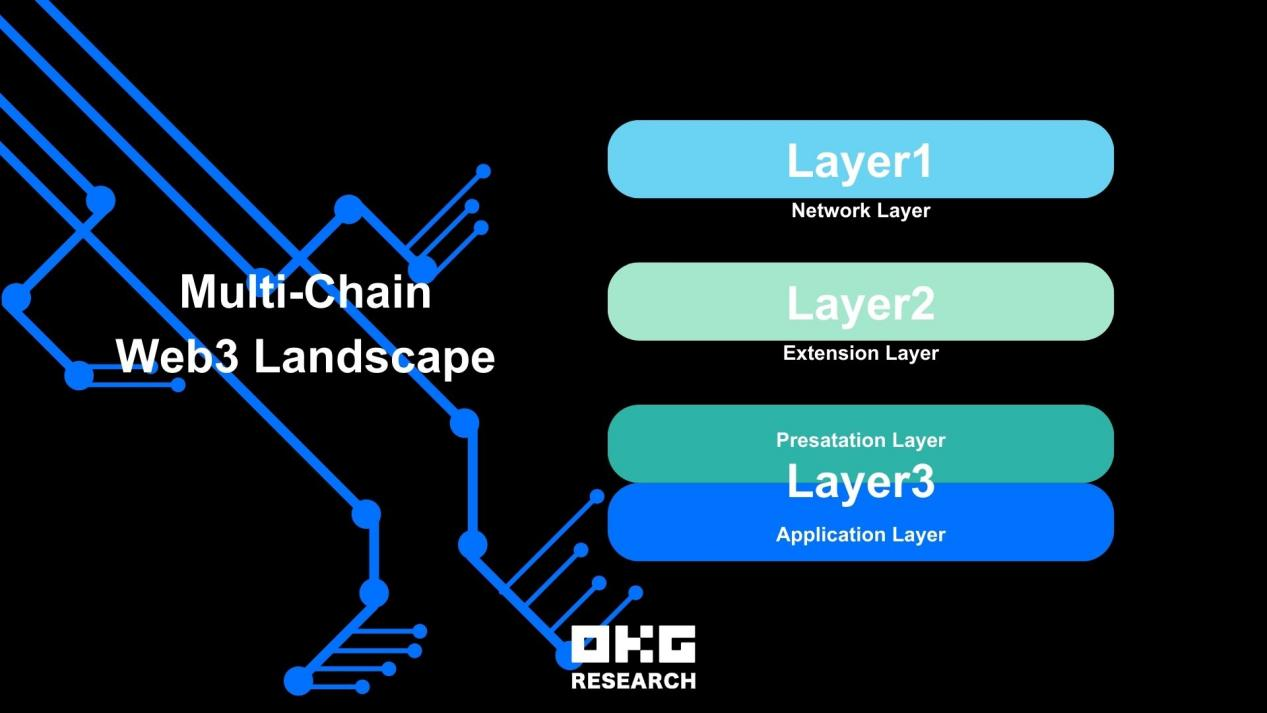
Figure: Multi-layer structure of multi-chain Web3
Bringing Web3 Back to “Human-Centric” Design
The user experience of Web3 differs fundamentally from that of AI. Generative AI-powered large language models have exploded into public view—ChatGPT, for example, attracted its first million users within just five days. Yet despite a wide array of professional and leading products and platforms in the Web3 space, overall adoption remains relatively low. Although regulatory progress in 2023 increased institutional acceptance, it hasn’t triggered the same kind of rapid consumer explosion seen with ChatGPT.
User experience is one of the primary reasons for the difference in adoption rates between Web3 and AI on the consumer side. Compared to the simplicity of “just typing a message to interact,” understanding Web3 wallets, learning addresses and private keys that differ from traditional bank account numbers presents ongoing challenges in terms of interaction, speed, and usability. However, AI can effectively improve this user experience, complementing Web3’s weaknesses—and may even become one of Web3’s main users.
By introducing AI Agents at the application layer, complex processes can be handled behind the scenes while interactions are presented to users in familiar front-end formats. For example, time-consuming steps differing from traditional finance or Web2 can be simplified: cryptographic proofs via digital signatures, generated using a creator’s known private key and verified using a public key.
By integrating AI Agents, the barrier to entry for Web3 is lowered, returning it to a “human-centric” paradigm and extending the usability experience of Web2—or even, as Bill Gates suggested, disrupting the software industry and transforming how humans use technology and live.
In the future, using a DApp might require nothing more than asking a precise question or issuing a clear instruction.
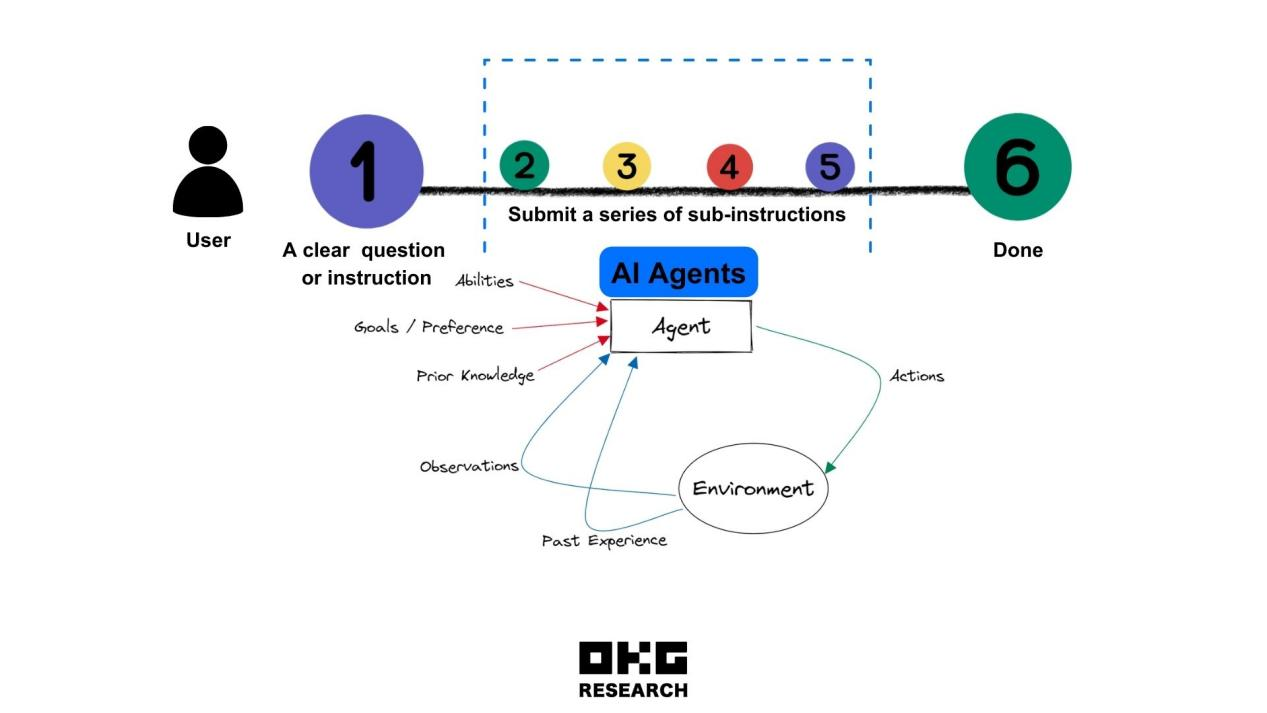
Figure: Flowchart of an AI Agent
One Person, One Team: AI and Web3 Unlock Human Creativity Together
Beyond improving DApp usability and lowering barriers for everyday users, generative AI (GenAI) serves as another catalyst for mass adoption of Web3. From early text-to-image tools like Midjourney to today’s video generation platforms such as Runway and Pika, GenAI enables fast, low-cost realization of imagination. In earlier Metaverse and GameFi projects, the biggest challenge during development was rarely coding—but rather areas like art design, game mechanics, and character creation.
The integration of GenAI and Web3 will dramatically accelerate the development of the Metaverse. Web3 introduces novel reward mechanisms—especially for social relationships within games—linking virtual economies with the outside world, improving operational efficiency and forming self-sustaining economic systems. Meanwhile, AI brings speed and diversity to virtual creation and content generation. Beyond images, videos, and audio, users can employ GenAI to create intelligent NPCs and virtual characters, making interactions within the Metaverse more immersive and lifelike. For GameFi, both content generation and game design can leverage GenAI, allowing developers to rapidly produce game items, scenes, and characters, delivering personalized gaming experiences. These applications make the Metaverse and GameFi more creative and engaging.
All of this enables one person to function as an entire team. The fusion of these two technologies frees human effort from the question of “how to do it,” unleashing creativity. In the future, deep integration between Web3 and AI will give rise to smarter, more innovative digital societies. Individuals will become creators, artists—empowered by Web3, they’ll no longer need large teams. Ideas will flow freely, ushering in a golden age of global creativity. Everyone will be able to shape their own Metaverse. This future is not just about technology—it marks a milestone in redefining how humans create, share, and connect.
The future we envision is one where trust issues are gradually resolved, user experiences become friendlier, and individuals are equipped with greater power and efficiency tools. Imagine a digital world like this—it would redefine our way of life. In 2024, the convergence of AI and Web3 will undoubtedly become the dual engine of a trusted digital era, unlocking everyone’s infinite potential.
Note 1: Hashing is an algorithm that converts data of arbitrary length into a fixed-length string. A hash function maps input data to a fixed-length hash value, which is typically unique—different inputs produce different outputs. This process is one-way, meaning the original data cannot be reconstructed from the hash value.
Join TechFlow official community to stay tuned
Telegram:https://t.me/TechFlowDaily
X (Twitter):https://x.com/TechFlowPost
X (Twitter) EN:https://x.com/BlockFlow_News
 @OKGResearch











